21 Card Game Rules: Complete Guide to Playing Twenty-One (2026)
Master Twenty-One with our complete guide covering rules, basic strategy, odds, and expert tips to reduce the house edge to just 0.5%.
Twenty-One is one of the oldest and most beloved card games in the world. Known by many names—21, Blackjack, Vingt-et-Un, Pontoon—this classic game has been played in homes, saloons, and casinos for over 300 years. What sets it apart from other casino games is simple: your decisions actually matter. With perfect basic strategy, you can reduce the house edge to just 0.5%—making it the best odds you’ll find at any casino table.
KEY FACTS AT A GLANCE
- House Edge: 0.5% with perfect basic strategy (lowest of any casino game)
- Natural Blackjack Odds: 4.8% (roughly 1 in 21 hands)
- Standard Payout: 3:2 for blackjack, 1:1 for regular wins
- Decks Used: 1-8 decks (single deck offers lowest house edge)
- Player Win Rate: ~42% of hands won outright
Whether you’re hosting a game night with friends or preparing for your first casino visit, this complete guide covers every rule, variation, and strategy you need to master the game of 21.
What Is the 21 Card Game?
Twenty-One is a comparing card game where players compete to build a hand totaling as close to 21 as possible without exceeding it (going “bust”). In casino versions, you play against the dealer. In home games, players may take turns being the banker, or everyone can play against a designated dealer.
The game’s appeal lies in its perfect balance of simplicity and depth. The basic rules take minutes to learn, but the strategic decisions—when to hit, stand, double, or split—create genuine skill opportunities. Unlike pure chance games, your choices directly impact your odds of winning. For those playing online, using a Blackjack Strategy tool can help you make the optimal move every time.
Card Values in 21
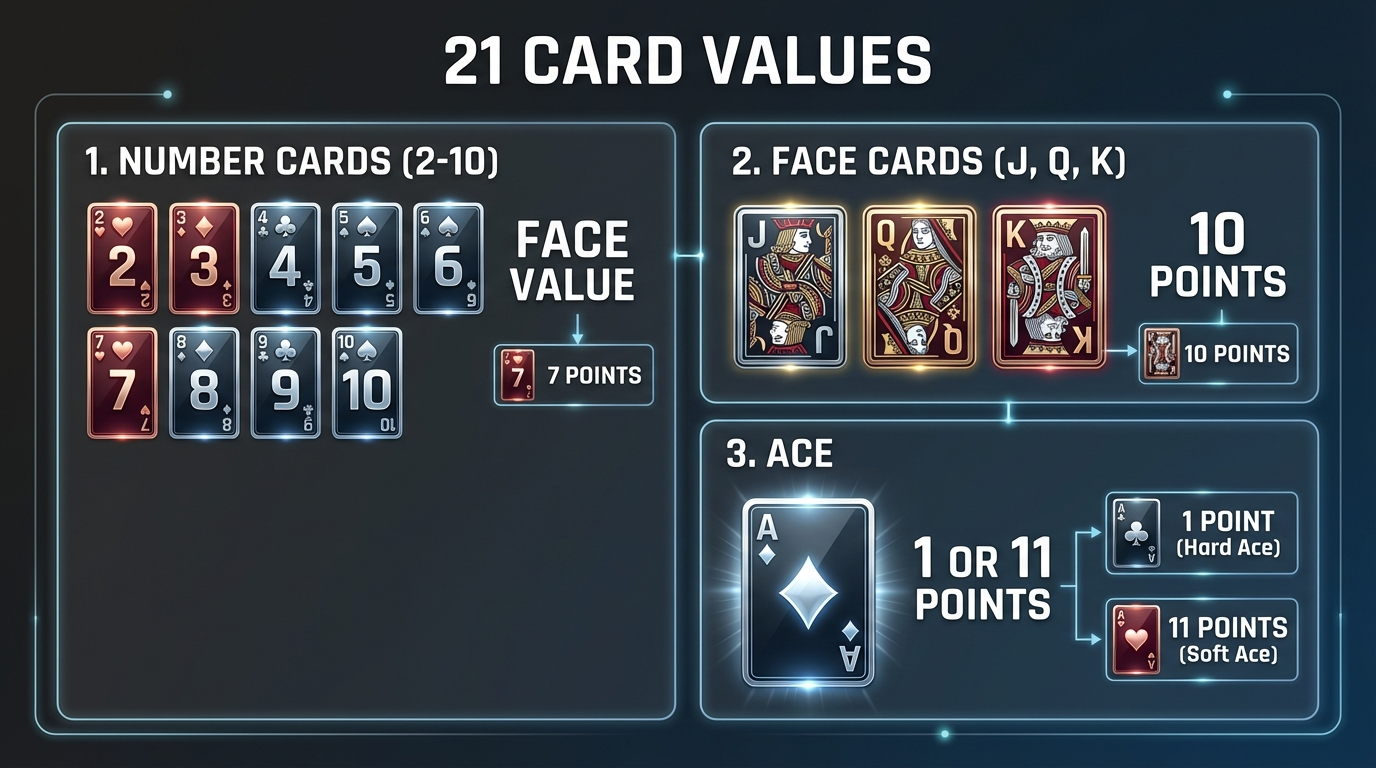
Understanding card values is fundamental to playing 21. Here’s how every card counts:
| Card | Value | Example |
|---|---|---|
| 2 through 10 | Face value | A 7 counts as 7 points |
| Jack, Queen, King | 10 points each | K + 5 = 15 |
| Ace | 1 or 11 (player’s choice) | A + 6 = 7 or 17 |
The Ace’s flexibility is what makes it the most valuable card in the deck. It can count as 11 when beneficial or drop to 1 to avoid busting—this flexibility is central to understanding soft vs. hard hands (explained below). To better understand how these values affect your long-term success, check our RTP and house edge guide.
Soft Hands vs. Hard Hands
Understanding the difference between soft and hard hands is crucial for making correct strategic decisions.
SOFT HANDS VS. HARD HANDS EXPLAINED
Soft Hand
- Contains an Ace counted as 11
- Cannot bust with a single hit
- Example: A + 6 = Soft 17
- If you hit and get 8, Ace becomes 1 = 15
- Play more aggressively
Hard Hand
- No Ace, or Ace must count as 1
- Risk of busting on any hit
- Example: 10 + 7 = Hard 17
- Example: A + 6 + 10 = Hard 17
- Play more cautiously
This distinction matters because strategy changes dramatically based on hand type. With a soft 17, basic strategy says to hit (you can’t bust and might improve). With a hard 17, you should always stand—any card 5 or higher busts you.
Step-by-Step: How to Play the 21 Card Game
STEP 1: PLACE YOUR BET
Lay your chips in the betting circle before the dealer starts. Bets cannot be changed once cards are dealt.
STEP 2: RECEIVE YOUR CARDS
The dealer gives two cards to each player (face-up) and two to themselves (one face-up, one face-down).
STEP 3: CHECK FOR BLACKJACK
A “Natural 21” (Ace + 10-value card) wins immediately at 3:2 payout, unless the dealer also has blackjack (push).
STEP 4: MAKE YOUR MOVE
Choose: Hit (take card), Stand (keep total), Double Down (double bet, one card), Split (separate pairs), or Surrender.
STEP 5: DEALER PLAYS
Dealer reveals hidden card and must hit until reaching 17+. Most casinos require dealer to stand on all 17s.
STEP 6: COMPARE & PAYOUT
Closest to 21 wins. Beat dealer = 1:1 payout. Tie = push (bet returned). Bust = lose regardless of dealer’s hand.
Player Actions Explained
Understanding all available actions is essential for optimal play. Here’s what each option means and when to use it:
| Action | What It Does | When to Use |
|---|---|---|
| Hit | Take another card | When your total is low and dealer shows strong card |
| Stand | Keep your current total | When you have 17+ or dealer likely to bust |
| Double Down | Double bet, receive exactly one card | Strong hand (10, 11) vs. weak dealer card |
| Split | Separate pair into two hands (requires matching bet) | Always split Aces and 8s; never split 10s or 5s |
| Surrender | Forfeit hand, get half bet back | Hard 16 vs. dealer 9, 10, or Ace |
| Insurance | Side bet (half original) if dealer shows Ace | Almost never—house edge is too high |
Insurance: Why You Should (Almost) Never Take It
When the dealer shows an Ace, you’re offered “insurance”—a side bet of up to half your original wager that pays 2:1 if the dealer has blackjack. While it sounds protective, the math doesn’t support it.
WHY INSURANCE IS A BAD BET
In a standard deck, only 4 out of 13 cards (30.8%) are 10-value cards. Insurance pays 2:1, but true odds are closer to 2.25:1. The house edge on insurance is approximately 7.5%—far worse than the base game’s 0.5%. Basic strategy is clear: decline insurance every time unless you’re counting cards.
Surrender: A Strategic Retreat
Not all casinos offer surrender, but when available, it’s a valuable option. “Late surrender” lets you forfeit your hand after the dealer checks for blackjack, returning half your bet. It’s optimal in specific situations:
- Hard 16 vs. dealer 9, 10, or Ace — Always surrender
- Hard 15 vs. dealer 10 — Surrender in multi-deck games
- Never surrender 8-8 — Always split instead
Hard 16 is widely regarded as the worst hand in blackjack. Surrendering loses 50% of your bet immediately, but playing it out loses more than 50% on average.
21 Basic Strategy: The Optimal Way to Play
Related tools: Blackjack Strategy Calculator · Bankroll Calculator · Risk of Ruin Calculator
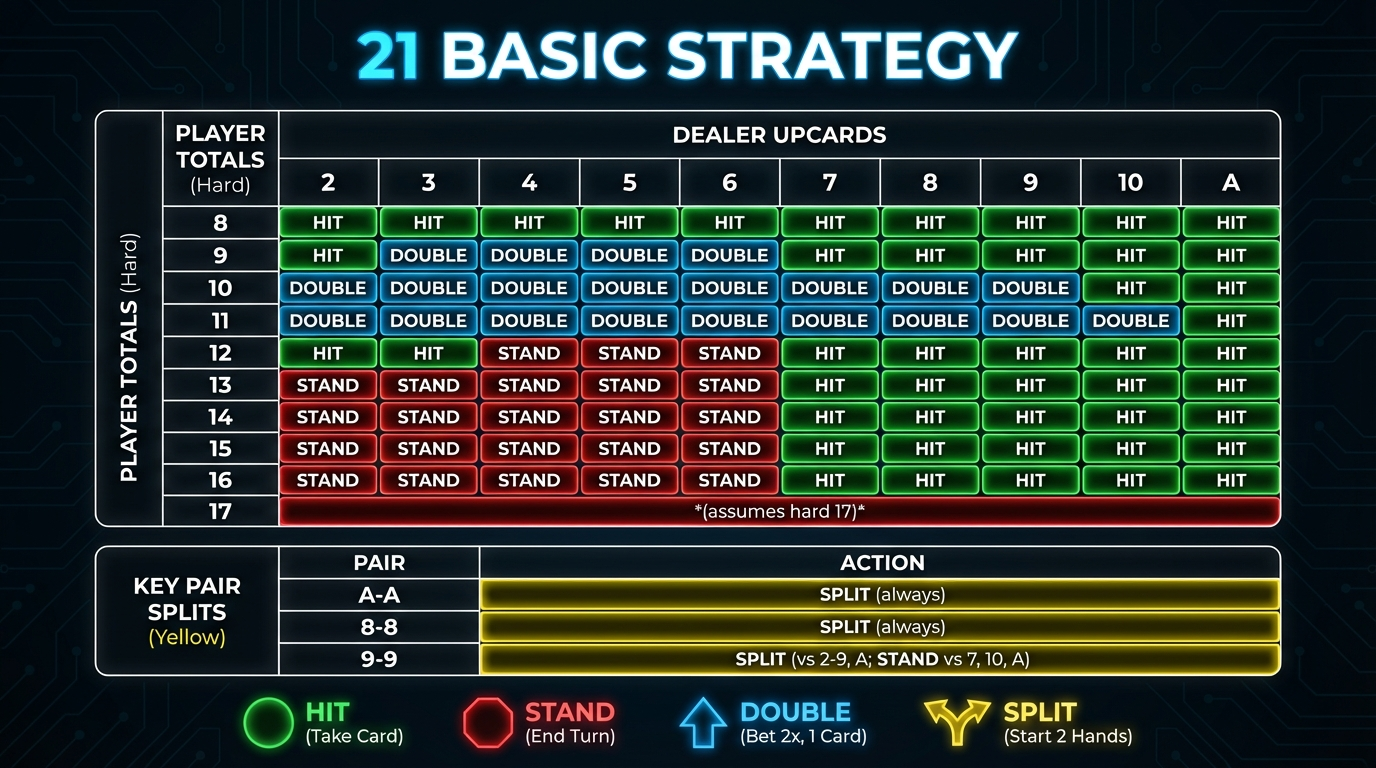
Basic strategy is a mathematically derived set of rules that tells you the optimal play for every possible hand combination. It was developed through computer simulations of hundreds of millions of hands, determining which decision produces the best expected outcome in each scenario.
Following basic strategy perfectly reduces the house edge to approximately 0.5%—the lowest of any casino table game. That means for every $100 wagered, you can expect to lose only about 50 cents in the long run.
Essential Basic Strategy Rules
HARD HANDS
- 8 or less: Always hit
- 9: Double vs. dealer 3-6, otherwise hit
- 10: Double vs. dealer 2-9, otherwise hit
- 11: Double vs. dealer 2-10, hit vs. Ace
- 12: Stand vs. 4-6, otherwise hit
- 13-16: Stand vs. 2-6, otherwise hit
- 17+: Always stand
SOFT HANDS
- Soft 13-14: Double vs. 5-6, otherwise hit
- Soft 15-16: Double vs. 4-6, otherwise hit
- Soft 17: Double vs. 3-6, otherwise hit
- Soft 18: Stand vs. 2, 7, 8; double vs. 3-6; hit vs. 9, 10, A
- Soft 19-20: Always stand
PAIRS
- Aces: Always split
- 8s: Always split
- 10s: Never split (20 is too strong)
- 5s: Never split (double instead)
- 4s: Split only vs. 5-6 if double after split allowed
To find your exact mathematical edge in different scenarios, use our EV Calculator. For managing your sessions, our Bankroll Calculator helps determine appropriate bet sizes based on your total bankroll.
House Edge and Odds
Understanding the mathematics behind 21 helps you appreciate why certain strategies work and which rules to seek out.
| Statistic | Value |
|---|---|
| House edge (basic strategy) | 0.5% |
| House edge (average player) | 2-4% |
| Natural blackjack odds | 4.8% (~1 in 21 hands) |
| Player wins | 42% of hands |
| Dealer wins | 49% of hands |
| Push (tie) | 9% of hands |
| Dealer bust with 6 showing | 42% |
Rule Variations That Affect House Edge
| Rule | Effect on House Edge |
|---|---|
| Blackjack pays 6:5 (not 3:2) | +1.39% (avoid these tables) |
| Dealer hits soft 17 | +0.20% |
| 8 decks vs. single deck | +0.15% |
| No double after split | +0.14% |
| Late surrender allowed | -0.08% |
| Re-split Aces allowed | -0.06% |
AVOID 6:5 BLACKJACK TABLES
The single biggest factor affecting your odds is the blackjack payout. Traditional 3:2 pays $15 on a $10 bet. The increasingly common 6:5 pays only $12—a 20% reduction that adds 1.39% to the house edge. Always check the table placard before sitting down.
Common Mistakes to Avoid
Even experienced players make these costly errors. Avoiding them can significantly improve your results:
MISTAKES THAT COST YOU MONEY
Playing Hunches
- Standing on 12 vs. dealer 2 or 3
- Hitting 12 vs. dealer 4, 5, or 6
- Not doubling soft 17 vs. dealer 3-6
- Standing on soft 18 vs. dealer 9, 10, A
Bad Splitting Decisions
- Splitting 10s (20 is nearly unbeatable)
- Splitting 5s (double instead)
- Not splitting 8s vs. 10 or Ace
- Never splitting Aces
Bankroll Errors
- Taking insurance (7.5% house edge)
- Playing side bets (3-25% house edge)
- Betting too large for your bankroll
- Chasing losses with bigger bets
Popular 21 Variations
While the standard game is most common, several variations offer unique twists. Understanding the differences helps you adjust your strategy appropriately.
| Variation | Key Differences | House Edge |
|---|---|---|
| Classic Blackjack | Standard rules, 6-8 decks, dealer stands on 17 | 0.5% |
| Pontoon (British) | Both dealer cards face-down; 5-card trick wins; must hit on 14 or less | 0.38% |
| Spanish 21 | No 10s in deck; bonus payouts for 21 combos; player 21 always wins | 0.4% |
| Blackjack Switch | Play two hands; can swap second cards between hands | 0.58% |
| Double Exposure | Both dealer cards face-up; blackjack pays even money | 0.69% |
| Vegas Strip | 4 decks, dealer stands all 17s, double after split, resplit to 4 hands | 0.35% |
For more casino game guides, check out our baccarat guide, roulette guide, or craps guide.
A Note on Card Counting
Card counting is a legitimate advantage play technique that can flip the edge in the player’s favor—but it’s not as simple as Hollywood portrays.
- Is it legal? Yes, card counting using only your brain is perfectly legal
- Will casinos let you? No—casinos are private businesses and will ban suspected counters
- Is it easy? No—modern countermeasures (continuous shufflers, frequent shuffles, multiple decks) make it extremely difficult
- Is it worth it? For most players, perfecting basic strategy offers better returns with far less effort
If you’re interested in advantage play concepts, understanding variance and survival is essential.
Frequently Asked Questions
Is 21 the same as Blackjack?
Essentially yes. ’21’ and ‘Blackjack’ refer to the same game. The name ‘Blackjack’ originated from a bonus payout (no longer common) for an Ace of Spades plus a black Jack. Some home game variations use slightly different rules, but the core gameplay is identical.
What happens if I get exactly 21?
If your first two cards total 21 (Ace + 10-value card), you have a ‘Natural Blackjack’ which typically pays 3:2 (avoid 6:5 tables). If you reach 21 with 3+ cards, you have a strong hand but receive standard 1:1 payout. Either way, you only lose if the dealer also has 21 (push) or blackjack.
Does the dealer have to hit on 16?
Yes. In standard rules, the dealer must hit on any total of 16 or below and stand on 17 or above. Some casinos require dealers to hit on ‘soft 17’ (Ace + 6), which slightly increases the house edge by about 0.2%.
Why shouldn’t I split 10s?
A total of 20 is the second-best hand possible and wins approximately 85% of the time. Splitting trades one highly likely win for two uncertain hands. Mathematically, you’ll win less money on average by splitting. The only exception is for card counters in very specific high-count situations.
Can I count cards in 21?
Yes, card counting is legal since you’re only using your brain—no devices allowed. However, casinos are private property and can ban you if suspected. Modern countermeasures (8-deck shoes, continuous shufflers, frequent shuffles) have made counting much less profitable than in the past.
Should I take insurance?
Almost never. Insurance has a house edge of approximately 7.5%—far worse than the base game. Basic strategy recommends declining insurance every time. The only exception is for card counters who know the remaining deck is rich in 10-value cards.
What’s the best blackjack strategy for beginners?
Learn basic strategy. It’s a set of rules for every hand combination that minimizes the house edge to about 0.5%. Start with the essentials: always split Aces and 8s, never split 10s or 5s, stand on hard 17+, and never take insurance. Use a strategy chart until the decisions become automatic.
Final Thoughts
Twenty-One has endured for centuries because it strikes the perfect balance between simplicity and depth. It’s one of the only casino games where your decisions genuinely matter—and where perfect play can reduce the house edge to a fraction of what you’d face at most other tables.
Whether you’re playing for matchsticks at the kitchen table or real money at a casino, the fundamentals remain the same: learn basic strategy, manage your bankroll, avoid insurance and side bets, and always check the blackjack payout before sitting down. With these principles, you’ll be playing at near-optimal levels within a few sessions.
KEY TAKEAWAYS
- House edge of 0.5% — With perfect basic strategy, blackjack offers the best odds of any casino table game
- Learn soft vs. hard hands — This distinction changes optimal strategy significantly
- Always split Aces and 8s — Never split 10s or 5s
- Never take insurance — The 7.5% house edge makes it a losing proposition
- Avoid 6:5 tables — Always play at tables paying 3:2 for blackjack
- Surrender strategically — Hard 16 vs. dealer 9, 10, or Ace is a smart fold
- Use strategy tools — A blackjack calculator helps until decisions become automatic
If you or someone you know has a gambling problem, call the National Council on Problem Gambling helpline at 1-800-522-4700.

Aevan Lark
Aevan Lark is a gambling industry veteran with over 7 years of experience working behind the scenes at leading crypto casinos — from VIP management to risk analysis and customer operations. His insider perspective spans online gambling, sports betting, provably fair gaming, and prediction markets. On Dyutam, Aevan creates in-depth guides, builds verification tools, and delivers honest, data-driven reviews to help players understand the odds, verify fairness, and gamble responsibly.
Related coverage

Indian State Tamil Nadu’s 2023 Gambling Bill: Passed Twice, Governor Dispute Details
Why the Indian state of Tamil Nadu passed its gambling bill twice in 2023, and how the Governor dispute unfolded.

Crypto Casino Bonuses vs Traditional: The 25x Rule
Crypto vs traditional casino bonuses: the 25x break-even rule, rakeback's $10,000 gate, and the volatility that moves a bonus's value.

Kelly Criterion Betting: Optimal Staking Without Ruin
How the Kelly Criterion sizes bets from your edge: the formula, devigging, worked examples, and why fractional Kelly wins.