Walk into any casino—physical or digital—and you’ll find two roulette wheels that look almost identical but play very differently. That extra green pocket on the American wheel isn’t just decoration; it’s the difference between losing $27 per $1,000 wagered versus losing $52.60. Your choice of wheel is quite literally the most important decision you’ll make before placing a single chip.
Key Highlights
- European roulette has 37 pockets (single zero), while American roulette has 38 pockets (single zero plus double zero)
- House edge difference is significant: European at 2.70% vs American at 5.26%—nearly double the disadvantage
- RTP (Return to Player): European offers 97.30% RTP compared to American’s 94.74%
- The five-number bet (0, 00, 1, 2, 3) is exclusive to American roulette—and it’s the worst bet in the game at 7.89% house edge
- French roulette uses the European wheel but adds La Partage/En Prison rules, dropping the house edge to 1.35% on even-money bets
- Winning probability: Even-money bets win 48.6% of the time in European vs 47.4% in American
The Wheel: One Extra Pocket, Double the Damage
The most obvious difference between American and European roulette is the wheel itself. European roulette wheels contain 37 pockets: numbers 1-36 (alternating red and black) plus a single green zero (0). American roulette wheels have 38 pockets: the same 1-36 plus two green pockets—a single zero (0) and a double zero (00).
That extra green pocket seems innocent enough. But here’s what it actually means: when you bet on red, you’re not competing against just 18 black numbers and one green zero—you’re competing against 18 black numbers and two green zeros. Your winning probability drops from 18/37 (48.6%) to 18/38 (47.4%). Over hundreds of spins, that 1.2% difference compounds into real money.
House Edge: The Numbers That Define Your Long-Term Results
The house edge represents the casino’s mathematical advantage over time. Think of it as a tax on every bet you place—invisible in the short term but inexorable over the long run.
| Metric | European Roulette | American Roulette |
|---|---|---|
| Number of Pockets | 37 | 38 |
| Green Zeros | Single (0) | Double (0, 00) |
| House Edge | 2.70% | 5.26% |
| RTP (Return to Player) | 97.30% | 94.74% |
| Expected Loss per $1,000 | $27.00 | $52.60 |
| Even-Money Win Probability | 48.6% | 47.4% |
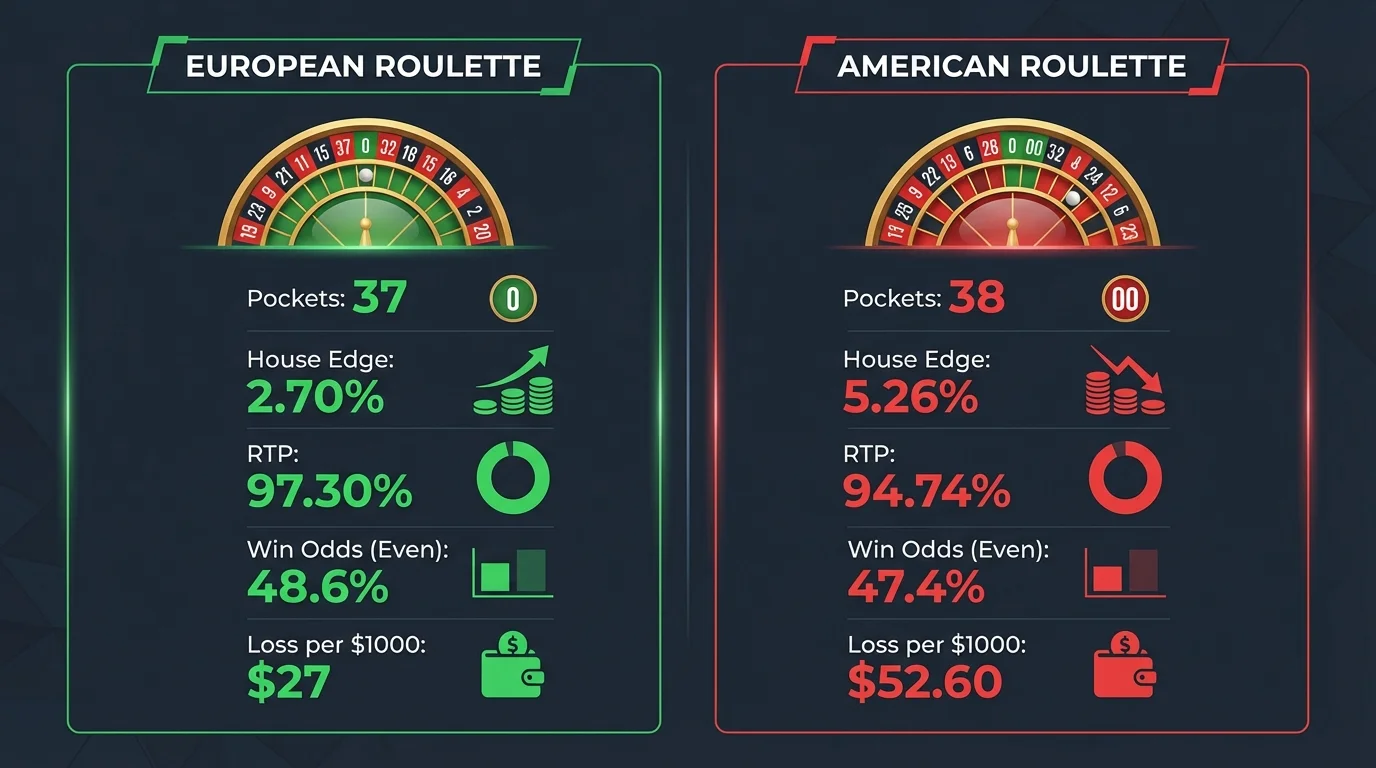
In practical terms: if you wager $1,000 total at an American roulette table, you can expect to lose about $52.60 over time. At a European table with identical bets, you’d expect to lose only $27.00. That’s nearly double the cost for the same entertainment.
The Complete Betting Options
Both versions share the same core betting options, with one notable exception. Here’s the full breakdown:
Inside Bets (Higher Risk, Higher Reward)
| Bet Type | Description | Payout | European Odds | American Odds |
|---|---|---|---|---|
| Straight Up | Single number | 35:1 | 2.70% | 2.63% |
| Split | Two adjacent numbers | 17:1 | 5.41% | 5.26% |
| Street | Three numbers in a row | 11:1 | 8.11% | 7.89% |
| Corner | Four numbers forming a square | 8:1 | 10.81% | 10.53% |
| Six Line | Two adjacent rows (6 numbers) | 5:1 | 16.22% | 15.79% |
| Five Number (Basket)* | 0, 00, 1, 2, 3 | 6:1 | N/A | 13.16% |
*The Five Number Bet (Basket Bet) deserves special attention. This bet is only available in American roulette—you can’t even make it on a European wheel. It covers 0, 00, 1, 2, and 3, pays 6:1, and carries a house edge of 7.89%. That’s the worst odds of any roulette bet in either version. Experienced players avoid it entirely.
Outside Bets (Lower Risk, Lower Reward)
| Bet Type | Coverage | Payout | European Win % | American Win % |
|---|---|---|---|---|
| Red/Black | 18 numbers | 1:1 | 48.6% | 47.4% |
| Odd/Even | 18 numbers | 1:1 | 48.6% | 47.4% |
| High/Low (1-18 / 19-36) | 18 numbers | 1:1 | 48.6% | 47.4% |
| Dozens | 12 numbers (1-12, 13-24, 25-36) | 2:1 | 32.4% | 31.6% |
| Columns | 12 numbers (vertical column) | 2:1 | 32.4% | 31.6% |
French Roulette: The Best of Both Worlds
French roulette uses the identical 37-pocket European wheel but adds two player-friendly rules that can cut the house edge nearly in half on even-money bets.
La Partage (“The Sharing”)
If you place an even-money bet (red/black, odd/even, high/low) and the ball lands on zero, you lose only half your stake instead of the full amount. Bet $100 on black, the ball lands on zero—you get $50 back instead of losing everything.
En Prison (“In Prison”)
Instead of losing half your bet when zero hits, your wager stays “imprisoned” on the table for the next spin. If your bet wins on that spin, you get your full stake back (no winnings, just the original bet). If it loses, you forfeit everything. It’s a second chance rather than an immediate partial refund.
Both rules reduce the house edge on even-money bets from 2.70% to just 1.35%—making French roulette the best mathematical option for players who stick to outside bets.
Pro Tip: French roulette is less common in American casinos but widely available online and at European venues. If you find a table with La Partage or En Prison rules, the effective house edge on even-money bets drops to levels competitive with blackjack basic strategy.
Call Bets: Advanced Options in European/French Roulette
European and French roulette tables often feature a “racetrack” betting area that allows for announced bets (sometimes called call bets). These cover specific sections of the wheel rather than the layout:
- Voisins du Zéro (Neighbors of Zero): Covers 17 numbers surrounding zero on the wheel, including 22-25, 0, 2-3, 4-7, 12-15, 18-21, 19-22, 25-29, 32-35
- Tiers du Cylindre (Thirds of the Wheel): Covers 12 numbers on the opposite side of the wheel from zero
- Orphelins (Orphans): The 8 numbers not covered by Voisins or Tiers
- Jeu Zéro (Zero Game): A smaller version of Voisins covering numbers closest to zero
These bets aren’t available on American roulette tables. They don’t change the underlying house edge, but they allow experienced players to bet on wheel sectors rather than just the felt layout—useful if you believe in dealer signatures or simply want more betting variety.
Table Layout Differences
Beyond the wheel, the betting layouts differ subtly:
- American layout: The 0 and 00 sit at the top of the grid, with outside bets arranged down one side
- European layout: Single 0 at the top, similar outside bet arrangement
- French layout: Same wheel as European, but outside bets are split on both sides of the number grid, and all labels are in French (Rouge/Noir instead of Red/Black, Pair/Impair instead of Even/Odd)
The French layout can be intimidating for first-timers, but once you know that Manque means 1-18 and Passe means 19-36, it plays identically to European roulette with those valuable extra rules.
Why Does American Roulette Still Exist?
Here’s the question every rational player asks: if European roulette offers better odds, why would anyone play American?
The answer is largely historical and geographical. When European roulette crossed the Atlantic in the 19th century, American casino operators wanted to increase their edge. They reintroduced the double zero (early European wheels had both 0 and 00 before François and Louis Blanc removed the double zero at the German spa town of Bad Homburg to attract more players).
American roulette became the standard in U.S. casinos simply because casinos had no competitive pressure to offer better odds—players had limited options. Today, with online casinos offering both versions side by side, informed players increasingly choose European.
If you’re playing in a Las Vegas casino, American roulette often dominates the floor. But many casinos now offer at least one European wheel, often at higher minimums. Online, you have complete freedom to choose—and there’s rarely a good reason to pick American.
European vs American Roulette: Pros and Cons
✅ European Roulette
- Lower house edge (2.70% vs 5.26%)
- Higher RTP returns 97.30% over time
- Better winning probability on all bets
- French version can drop edge to 1.35%
- Call bets add strategic variety
- Widely available online
❌ American Roulette
- Nearly double the house edge at 5.26%
- Worst bet in roulette (five-number at 7.89%)
- No La Partage or En Prison rules
- No call bets or racetrack options
- Lower RTP of 94.74%
Which Roulette Should You Play?
For the mathematically minded, the answer is unambiguous: always choose European or French roulette when available. The house edge difference between American (5.26%) and European (2.70%) means you’re essentially paying twice as much for the same experience.
If you primarily bet on even-money options (red/black, odd/even, high/low), seek out French roulette tables with La Partage or En Prison rules. That 1.35% house edge puts roulette in the same league as some of the best-odds games in the casino. For a deeper dive into the complete rules and strategies of roulette, our full guide covers everything from bet placement to bankroll management.
The only scenario where American roulette makes sense is when it’s literally your only option. If you’re at a casino with exclusively American wheels, you can still enjoy the game—just know what you’re paying for it. And never, ever touch the five-number bet.
FAQs
The main difference is the number of green zero pockets. European roulette has one zero (37 total pockets), while American roulette has both 0 and 00 (38 total pockets). This extra pocket nearly doubles the house edge from 2.70% to 5.26%.
Yes, from a mathematical standpoint. European roulette has a house edge of 2.70% compared to American roulette’s 5.26%. This means you’ll lose less money over time playing European roulette with identical betting patterns.
American roulette has a 5.26% house edge on all bets except the five-number bet (7.89%). European roulette has a 2.70% house edge on all bets. French roulette with La Partage or En Prison rules drops to 1.35% on even-money bets.
La Partage is a French roulette rule that returns half your even-money bet (red/black, odd/even, high/low) when the ball lands on zero. Instead of losing your entire stake, you get 50% back. This reduces the house edge from 2.70% to 1.35% on these bets.
En Prison is a French roulette rule where your even-money bet stays on the table for another spin when zero hits. If your bet wins on that second spin, you get your original stake back (but no winnings). If it loses, you forfeit the bet. The expected value equals La Partage.
The five-number bet (also called basket bet) covers 0, 00, 1, 2, and 3 and pays 6:1. It’s only available in American roulette and carries a 7.89% house edge—the worst odds of any roulette bet. Experienced players avoid it entirely.
Call bets (or announced bets) allow you to bet on sections of the wheel using the racetrack betting area. Common examples include Voisins du Zéro (neighbors of zero), Tiers du Cylindre (thirds of the wheel), and Orphelins. They’re available in European and French roulette but not American.
In European roulette, red or black wins 48.6% of the time (18 winning numbers out of 37). In American roulette, the odds drop to 47.4% (18 out of 38) due to the extra double zero pocket. Both pay 1:1.
