Blackjack is the world’s most popular casino card game—and for good reason. With a house edge as low as 0.5% when played correctly, it offers some of the best odds and house edge you’ll find on any casino floor. Whether you’re stepping up to a table for the first time or want to sharpen your skills before your next casino visit, this complete guide covers everything you need to know about playing blackjack like a pro.
What Is Blackjack?
Blackjack, also known as “21,” is a comparing card game where you compete against the dealer—not other players. The premise is beautifully simple: get a hand value closer to 21 than the dealer without going over (busting). That’s it. This simplicity, combined with the element of skill involved in decision-making, is what makes blackjack so appealing to millions of players worldwide.
Unlike pure games of chance like slots or roulette, blackjack rewards knowledge and strategy. The decisions you make—whether to hit, stand, double down, or split—directly impact your expected return. Master the fundamentals, and you’ll transform from a casual gambler into an informed player who understands exactly what they’re doing at the table.
Blackjack Card Values: The Foundation
Before you can play, you need to understand how cards are valued in blackjack. This is straightforward:
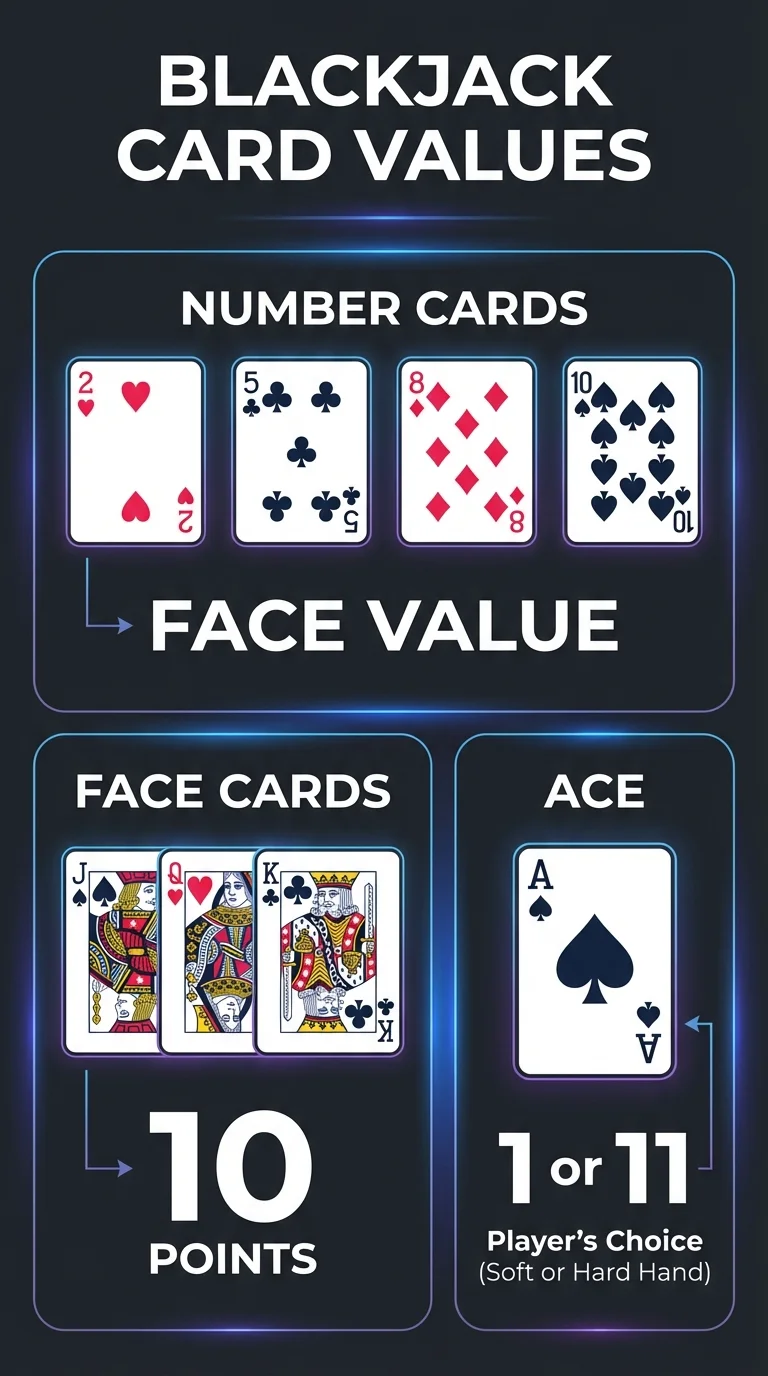
| Card | Value |
|---|---|
| Number Cards (2-10) | Face value (a 7 is worth 7 points) |
| Face Cards (Jack, Queen, King) | 10 points each |
| Ace | 1 or 11 points (your choice) |
The Ace is the most powerful card in blackjack because of its flexibility. When an Ace counts as 11, you have a “soft” hand (because you can’t bust by taking another card—the Ace can always revert to 1). When it counts as 1, you have a “hard” hand.
Example: An Ace + 6 = “Soft 17” (could be 7 or 17). If you hit and receive a 9, your hand becomes 16 (the Ace now counts as 1 to avoid busting).
The Blackjack Table Layout
A standard blackjack table is semicircular and can accommodate 5-7 players. Here’s what you’ll find:
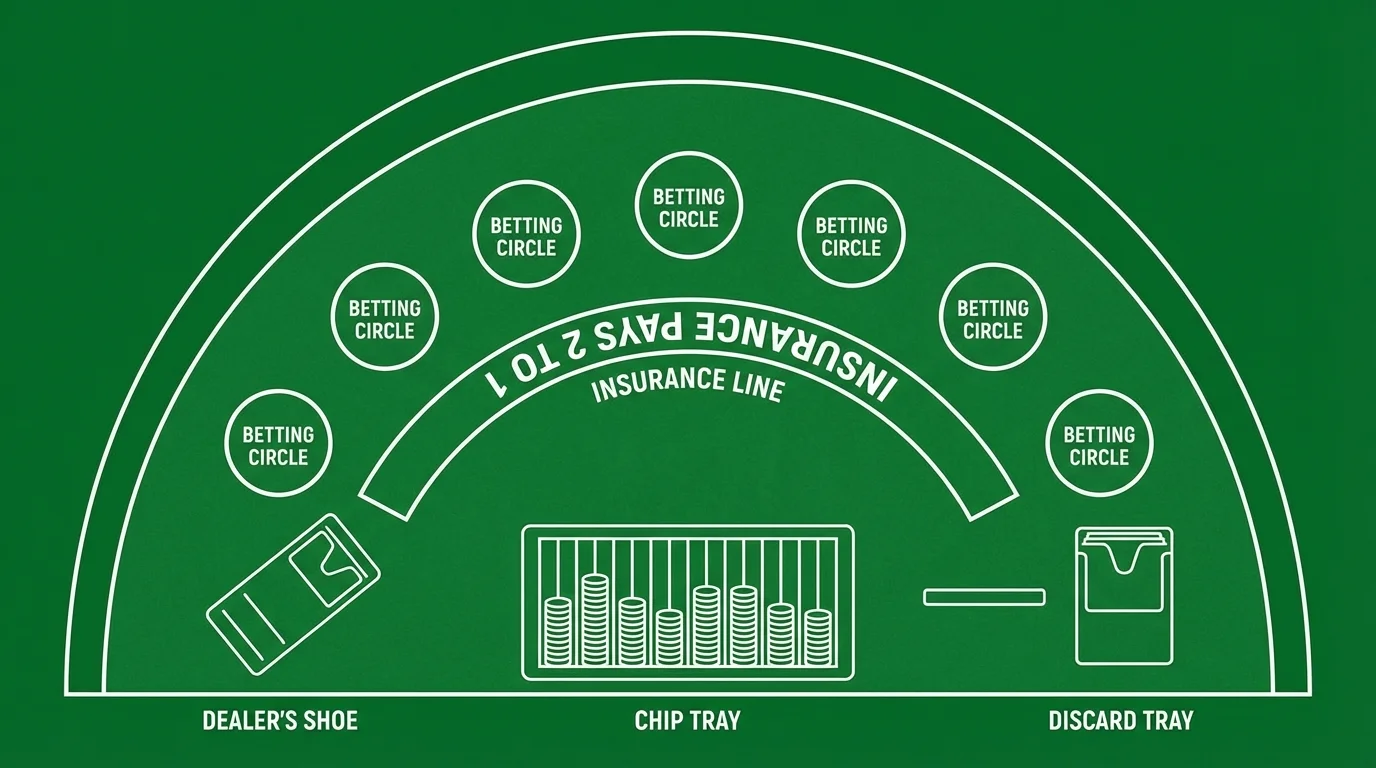
- Betting Circles/Squares: Where you place your chips before each hand
- Chip Tray: Where the dealer keeps the house chips
- Shoe: A device holding multiple decks (usually 6-8 decks)
- Discard Tray: Where used cards are placed
- Insurance Line: A semicircular line where insurance bets are placed
- Table Minimums/Maximums: Posted signs showing betting limits
The felt surface typically displays important rules like “Blackjack Pays 3 to 2” and “Dealer Must Stand on All 17s” (or “Dealer Hits Soft 17”).
How a Blackjack Round Works: Step by Step
Understanding the flow of a blackjack hand is essential. Here’s exactly what happens from start to finish:
Step 1: Place Your Bet
Before any cards are dealt, place your chips in the betting circle in front of you. Once the dealer waves their hand over the table (signaling “no more bets”), your wager is locked in.
Step 2: Initial Deal
The dealer distributes two cards to each player, moving left to right. They also deal themselves two cards—one face-up (the “upcard”) and one face-down (the “hole card”). In some variants, the dealer takes only one card initially.
Step 3: Check for Naturals
A “natural” or “blackjack” is an Ace plus any 10-value card (10, J, Q, K) dealt as your first two cards. This is the best possible hand and typically pays 3:2 (you win $15 on a $10 bet).
- If you have blackjack and the dealer doesn’t, you win immediately
- If the dealer has blackjack and you don’t, you lose immediately
- If both you and the dealer have blackjack, it’s a “push” (tie)—your bet is returned
Step 4: Player Decisions
If there’s no blackjack, starting from the dealer’s left, each player makes decisions about their hand. (We’ll cover all your options in detail in the next section.)
Step 5: Dealer’s Turn
After all players have acted, the dealer reveals their hole card and plays according to fixed rules—no decisions involved:
- Dealer must hit on 16 or below
- Dealer must stand on 17 or above (in some games, dealers hit on “soft 17”)
Step 6: Determine Winners
Once the dealer completes their hand:
- Dealer busts (over 21): All remaining players win
- Your hand beats dealer’s hand: You win even money (1:1)
- Dealer’s hand beats yours: You lose your bet
- Tie (push): Your bet is returned
Your Playing Options: Every Move Explained
This is where skill enters the game. Understanding when to use each option is what separates winning players from losing ones.
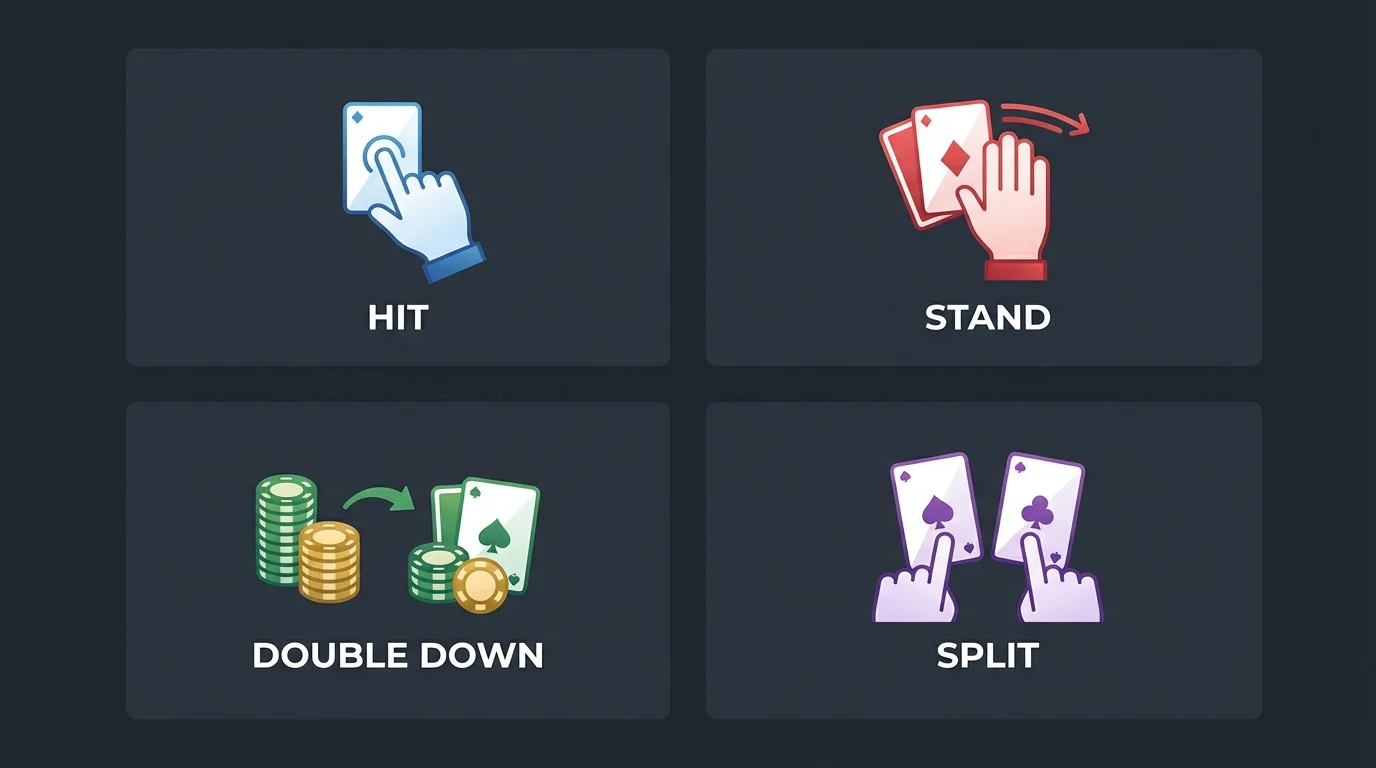
Hit
What it means: Request another card from the dealer.
How to signal: Tap the table with your finger, or say “hit.”
When to use: When your hand total is low and unlikely to beat the dealer. You can hit as many times as you want until you stand or bust.
Stand
What it means: Keep your current hand; take no more cards.
How to signal: Wave your hand horizontally over your cards, or say “stand.”
When to use: When you’re satisfied with your hand or when hitting would risk busting.
Double Down
What it means: Double your original bet and receive exactly one more card.
How to signal: Place an additional bet equal to your original wager next to (not on top of) your existing chips. Some casinos allow doubling for less than the original bet.
When to use: When you have a strong advantage—typically with a total of 10 or 11, especially when the dealer shows a weak upcard (2-6). This is one of the most profitable moves in blackjack when used correctly.
Split
What it means: When dealt two cards of the same value, separate them into two independent hands, each with its own bet.
How to signal: Place a second bet equal to your original next to your first bet and point with two fingers in a “V” shape (or say “split”).
Key rules to know:
- Each hand is played independently
- When splitting Aces, most casinos give only one card per Ace
- Some casinos allow re-splitting (splitting again if you receive another matching card)
- A 21 after splitting is NOT a blackjack—it pays 1:1, not 3:2
When to use: Always split Aces and 8s. Never split 10s or 5s. For other pairs, the decision depends on the dealer’s upcard.
Surrender
What it means: Forfeit half your bet and end your hand immediately.
How to signal: Draw a horizontal line behind your bet with your finger, or verbally say “surrender.”
When to use: When you have a very poor hand against a strong dealer upcard (like 16 vs. dealer 10). Surrender saves you money in mathematically hopeless situations. Not all casinos offer this option.
Types of surrender:
- Late surrender: Available after the dealer checks for blackjack (most common)
- Early surrender: Available before the dealer checks for blackjack (rare, very player-favorable)
Insurance
What it means: A side bet offered when the dealer shows an Ace, betting that the dealer has blackjack.
How it works: You can bet up to half your original wager. If the dealer has blackjack, insurance pays 2:1. If not, you lose the insurance bet.
Should you take it? Almost never. Insurance has a house edge of about 7.4%—much higher than the base game. It’s a sucker bet in disguise. Even when you have blackjack yourself, taking “even money” (insurance’s equivalent) is mathematically unfavorable.
Basic Strategy: The Mathematically Optimal Way to Play
Basic strategy is a set of rules that tells you the statistically best decision for every possible hand combination. It was developed through computer simulations of millions of hands and reduces the house edge to its minimum—around 0.5%.
Here are the fundamental principles:
Hard Hands (No Ace, or Ace Counts as 1)
- 8 or less: Always hit
- 9: Double if dealer shows 3-6; otherwise hit
- 10: Double if dealer shows 2-9; otherwise hit
- 11: Double if dealer shows 2-10; hit against Ace
- 12: Stand if dealer shows 4-6; otherwise hit
- 13-16: Stand if dealer shows 2-6; otherwise hit
- 17+: Always stand
Soft Hands (Ace Counts as 11)
- Soft 13-14 (A-2, A-3): Double if dealer shows 5-6; otherwise hit
- Soft 15-16 (A-4, A-5): Double if dealer shows 4-6; otherwise hit
- Soft 17 (A-6): Double if dealer shows 3-6; otherwise hit
- Soft 18 (A-7): Stand if dealer shows 2, 7, or 8; double against 3-6; hit against 9, 10, or Ace
- Soft 19+ (A-8, A-9): Always stand
Pairs
- A-A: Always split
- 8-8: Always split
- 10-10: Never split (you already have 20!)
- 5-5: Never split; treat as hard 10
- 4-4: Split only if dealer shows 5-6 (and doubling after split is allowed); otherwise hit
- 2-2, 3-3: Split if dealer shows 2-7; otherwise hit
- 6-6: Split if dealer shows 2-6; otherwise hit
- 7-7: Split if dealer shows 2-7; otherwise hit
- 9-9: Split if dealer shows 2-6 or 8-9; stand against 7, 10, or Ace
Understanding the House Edge
The house edge in blackjack depends entirely on the rules and how you play. Here’s what affects it:
| Rule/Factor | Impact on House Edge |
|---|---|
| Perfect basic strategy | Reduces edge to ~0.5% |
| Blackjack pays 6:5 instead of 3:2 | Adds ~1.4% to house edge |
| Dealer hits soft 17 | Adds ~0.2% to house edge |
| More decks (8 vs. single) | Adds ~0.5% to house edge |
| No doubling after split | Adds ~0.14% to house edge |
| No surrender | Adds ~0.08% to house edge |
Warning: Avoid 6:5 blackjack games at all costs. The reduced payout increases the house edge dramatically, making it one of the worst blackjack variations you can play.
Blackjack Etiquette: What to Know at the Table
Following proper etiquette makes the game enjoyable for everyone and helps the dealer do their job efficiently:
- Use hand signals: Verbal commands alone aren’t enough—cameras need to see your decisions
- Don’t touch your cards: In shoe games, cards are dealt face-up and should not be touched
- Don’t touch your bet: Once the cards are dealt, hands off your chips
- Stack your chips properly: Largest denomination on the bottom
- Wait for payouts: Don’t grab your winnings until the dealer pushes them to you
- Tip the dealer: Optional but appreciated—you can place a bet for them or tip after a winning hand
- Don’t blame others: Another player’s “bad” decision doesn’t mathematically affect your odds in the long run
Common Beginner Mistakes to Avoid
Even with the best intentions, new players often fall into these traps:
1. Taking Insurance
It sounds logical—protect your hand when the dealer might have blackjack. But the math doesn’t support it. The 2:1 payout isn’t enough to overcome the probability that the dealer doesn’t have blackjack.
2. Standing on Soft 17
With Ace-6, you can’t bust by taking another card. Hitting or doubling (depending on the dealer’s card) is always better than standing on soft 17.
3. Never Splitting 8s Against a 10
It feels counterintuitive to split into two hands against the dealer’s strongest card, but 16 is the worst hand in blackjack. Two chances with 8 are mathematically better than one chance with 16.
4. Playing 6:5 Games
Many casinos now offer 6:5 payouts instead of 3:2. On a $10 bet, that’s $12 vs. $15 for a blackjack. This adds 1.4% to the house edge—a massive difference.
5. Chasing Losses
Increasing bets after losses (known as the Martingale system) doesn’t change the house edge. Each hand is independent. Bet sizing should be consistent and based on your bankroll, not recent results.
6. Ignoring the Dealer’s Upcard
Your decisions should always consider what the dealer is showing. A dealer showing 6 (likely to bust) requires a completely different strategy than a dealer showing 10 (likely to make a strong hand).
Blackjack Variations You’ll Encounter
While classic blackjack is the standard, you’ll find several popular variations:
European Blackjack
The dealer receives only one card initially (no hole card). This slightly changes strategy because you won’t know if the dealer has blackjack when making split/double decisions.
Spanish 21
Played without 10s (only face cards), but offers bonus payouts for specific hands and allows late surrender after doubling.
Blackjack Switch
You play two hands and can swap the second cards between them. Blackjack pays even money, and dealer 22 is a push.
Pontoon
British version with different terminology: “twist” (hit), “stick” (stand), “buy” (double). Both dealer cards are face-down, and five-card hands under 21 automatically win.
Double Exposure
Both dealer cards are dealt face-up. To compensate, blackjack pays even money and ties go to the dealer.
Online vs. Live Blackjack
Both formats follow the same rules, but the experience differs:
| Aspect | Live Casino | Online |
|---|---|---|
| Pace | Slower (60-80 hands/hour) | Faster (200+ hands/hour possible) |
| Minimum bets | Usually $5-$25 | As low as $0.10 |
| Social interaction | Yes | Limited (live dealer options available) |
| Distractions | Noise, drinks, crowds | You control environment |
| Rule transparency | Must read felt/ask dealer | Clearly displayed in rules section |
Important: Online blackjack uses Random Number Generators (RNGs) for virtual games. Reputable sites are audited for fairness using provably fair technology. Live dealer games stream real cards dealt by human dealers for an authentic experience.
Bankroll Management for Blackjack
Smart money management is crucial for any casino game:
- Session bankroll: Bring 20-30 times your average bet for a session (e.g., $500 for a $20 table)
- Bet sizing: Keep each bet at 1-2% of your total gambling bankroll
- Win/loss limits: Decide in advance when you’ll walk away—both for wins and losses
- Never chase losses: If you lose your session bankroll, stop. Don’t hit the ATM.
- Play within your means: Only gamble with money you can afford to lose
Even with perfect basic strategy, variance exists. You can lose 10 hands in a row through pure bad luck. Proper bankroll management ensures these swings don’t end your session prematurely.
Blackjack Glossary: Essential Terms
Master these terms to communicate confidently at any blackjack table:
- Blackjack/Natural: Ace + 10-value card as your first two cards
- Bust: Going over 21
- Hole Card: Dealer’s face-down card
- Upcard: Dealer’s face-up card
- Push: Tie between player and dealer
- Shoe: Device holding multiple decks
- Soft Hand: Hand with an Ace counted as 11
- Hard Hand: Hand without an Ace, or where Ace counts as 1
- Pat Hand: A hand worth 17-21 that doesn’t need improvement
- Stiff Hand: A hard 12-16 that could bust with one card
- Burn Card: Card discarded before dealing begins
- Cut Card: Plastic card used to cut the deck and signal reshuffling
- Penetration: How deep into the shoe the dealer deals before reshuffling
- Third Base: The seat to the dealer’s far right (last to act)
- First Base: The seat to the dealer’s far left (first to act)
Tips for Your First Blackjack Session
Ready to put your knowledge into practice? Keep these tips in mind:
- Start at low-limit tables: Find a $5 or $10 minimum table to learn without significant risk
- Bring a strategy card: Most casinos allow pocket-sized basic strategy charts—use one until you’ve memorized the plays
- Watch before playing: Spend a few minutes observing a table to understand the flow
- Sit at third base (far left): You’ll have more time to decide while watching others play
- Avoid peak hours: Tables are less crowded on weekday mornings
- Check the rules: Confirm 3:2 payouts, dealer stand rules, and available options before sitting down
- Stay sober: Free drinks are great, but alcohol impairs decision-making
- Don’t fear asking questions: Dealers are usually happy to help beginners
- Set a budget: Decide how much you’re willing to lose before you start playing
- Have fun: Blackjack should be entertainment, not a source of stress
Frequently Asked Questions
What are the odds of getting blackjack?
In a standard 6-deck game, the probability of being dealt a natural blackjack is approximately 4.75%, or about 1 in 21 hands.
Should I always hit on 16?
Not always. Basic strategy says to stand on hard 16 against dealer 2-6 (the dealer is likely to bust). Hit against 7-Ace. With a pair of 8s, always split.
Is card counting illegal?
No, card counting is not illegal—it’s just using your brain. However, casinos are private property and can ban you for counting. They also use countermeasures like frequent shuffling, multiple decks, and cutting off a large portion of the shoe.
Why do people say “never split 10s”?
A 20 is the second-best hand in blackjack. While splitting 10s can sometimes have a higher expected value (against weak dealer upcards), keeping the 20 provides a very consistent win. Most basic strategy charts say never split 10s for simplicity and consistency.
What’s the worst hand in blackjack?
Hard 16 against a dealer 10 is statistically the worst situation. You’ll lose money on average whether you hit or stand—hitting just loses slightly less. This is one situation where surrender (if available) is the best option.
Does it matter where I sit at the table?
Mathematically, no. Over the long run, your seat position doesn’t affect your odds. However, sitting at third base gives you more time to make decisions, which some beginners find helpful.
How many decks are used in blackjack?
Casinos typically use 1, 2, 4, 6, or 8 decks. Fewer decks are slightly better for the player, but single and double-deck games often have other rule changes that offset this advantage.
Final Thoughts
Blackjack stands apart from most casino games because your decisions genuinely matter. By learning basic strategy, finding games with favorable rules (3:2 payouts, dealer stands on soft 17), and practicing proper bankroll management, you’re giving yourself the best possible chance at the tables.
Remember: the goal isn’t to win every hand—it’s to make the mathematically correct decision every time. Do that consistently, and you’ll minimize losses while maximizing your entertainment value. The house still has an edge, but at 0.5%, it’s one of the smallest you’ll find anywhere in the casino.
Now you know everything you need to sit down at a blackjack table with confidence. Good luck—and may the cards fall in your favor.
Looking to master other casino favorites? Check out our guides on Poker, Craps, Sic Bo, and the popular Aviator game.
