Cash out lets you settle a bet before the event finishes. Your team is up 2-0 at halftime, and the sportsbook offers you $85 on a $50 bet that would pay $100 if your team wins. Take the $85 now, or risk it all on the second half?
That’s cash out in a nutshell—guaranteed money now versus potential full payout later. It sounds like a safety net, but the math often tells a different story than your gut.
KEY FACTS AT A GLANCE
- What It Does: Settles your bet early for a guaranteed payout based on current probability
- Hidden Cost: Cash out offers include 5-15% bookmaker margin—you’re rarely getting fair value
- Types Available: Full cash out (universal), partial cash out, and auto cash out (varies by sportsbook)
- Best Use Case: Hedging futures bets or protecting against significant in-game events
- Mathematical Reality: Letting bets ride is usually +EV; cashing out often benefits the house
What Is Cash Out?
Cash out is an early settlement feature that lets you close a bet before the event ends. The sportsbook calculates what your bet is currently worth based on live odds and offers you that amount.
Accept, and you get paid immediately. Decline, and your bet continues as normal.
The offer changes constantly during live events. When your bet looks strong, the cash out offer increases. When your bet looks weak, the offer decreases—sometimes to pennies on the dollar.
It’s essentially the sportsbook saying: “Based on what’s happening right now, here’s what we’ll pay you to end this bet.”
Where Is Cash Out Available?
Every major sportsbook offers cash out on most bets, though availability varies. Some bets—particularly exotic props or lower-tier leagues—may not have cash out available. Cash out can also be suspended during fast-moving live action or at the sportsbook’s discretion.
How Cash Out Is Calculated
Sportsbooks calculate cash out offers using the current implied probability of your bet winning, minus their margin. Use an odds converter to translate between odds formats and see the implied probability of any line.
Here’s a simple example: You bet $100 at +200 odds and the live odds have moved to +100 (50% implied probability). Your fair cash out would be around $50. But the actual offer might be $45-47 because the book takes a cut.
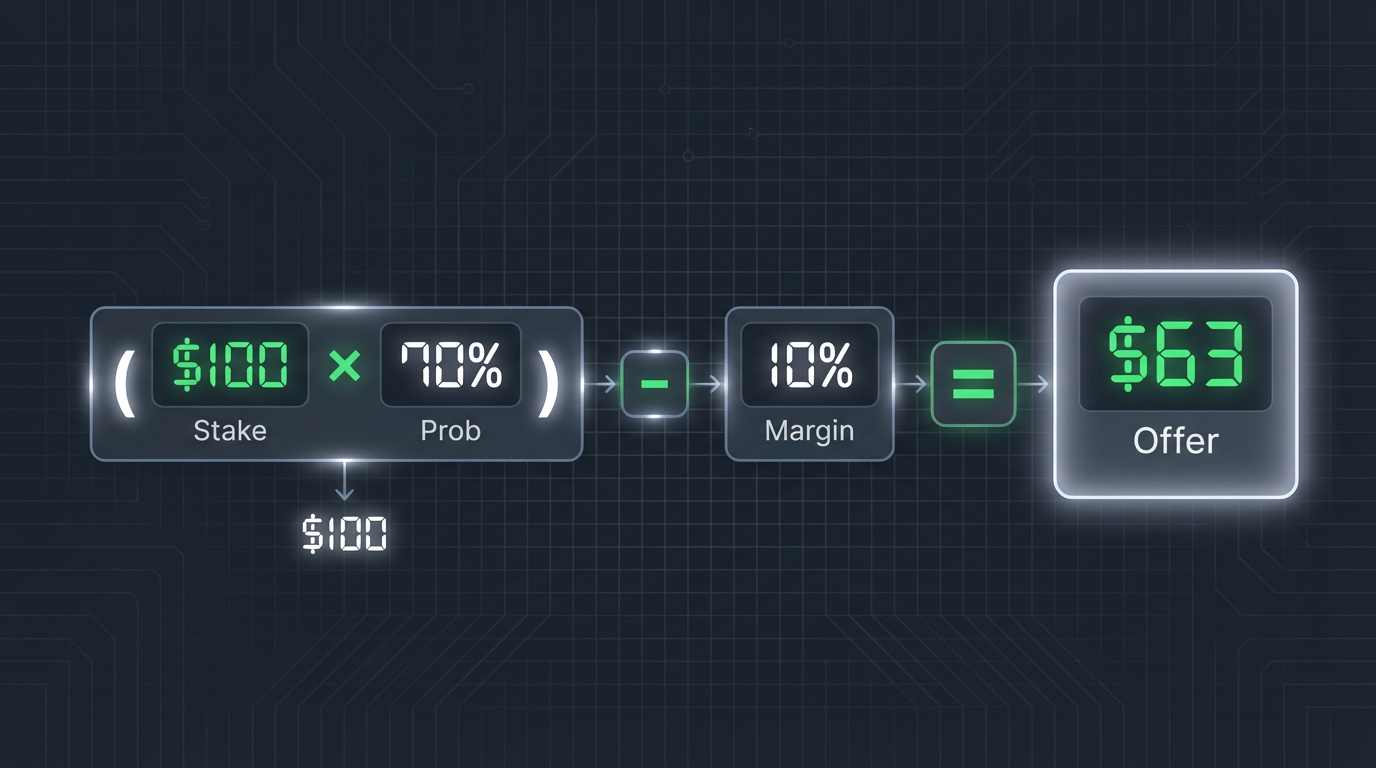
The formula roughly works like this:
Cash Out Offer = (Original Stake × Current Implied Probability) × (1 – Bookmaker Margin)
That margin—typically 5-15%—is the hidden cost of cash out (you can calculate how much margin any sportsbook charges with a vig calculator). You’re paying for the convenience of guaranteed money. The sportsbook profits whether you cash out or not, but they profit more when you cash out because they’ve priced in their edge.
| Scenario | Fair Value | Typical Offer | You Lose |
|---|---|---|---|
| $100 bet, 70% win probability | $70 | $63-66 | $4-7 |
| $100 bet, 50% win probability | $50 | $44-47 | $3-6 |
| $100 bet, 30% win probability | $30 | $25-28 | $2-5 |
Types of Cash Out
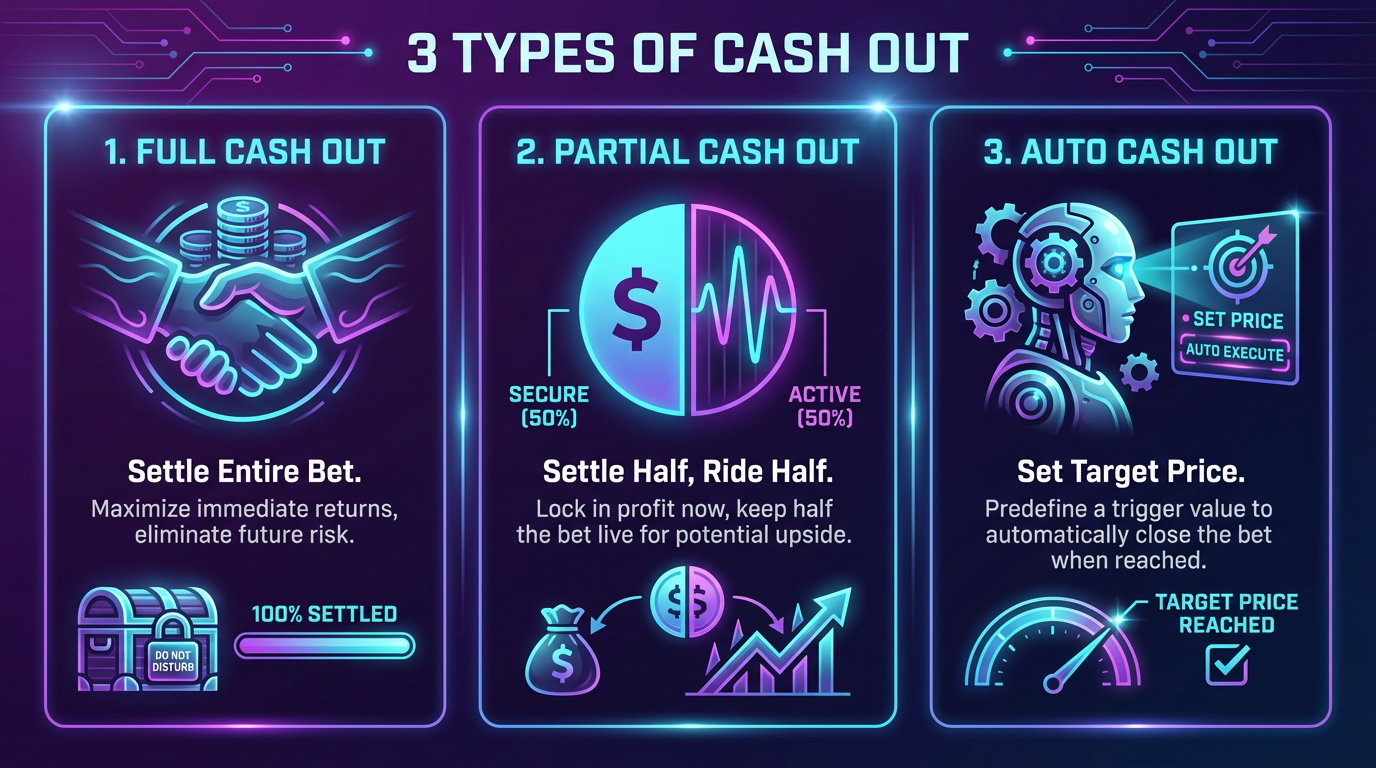
There are three main types of cash out, but here’s an important caveat: not every sportsbook offers all three. Full cash out is nearly universal, but partial and auto cash out features vary significantly between platforms.
Full Cash Out
The standard option—settle your entire bet for the offered amount. Your bet closes completely, and you receive the cash out value regardless of what happens afterward.
If you bet $50 and the cash out offer is $80, you take $80 and walk away. Even if your team goes on to win and the full payout would have been $150, you’re done at $80.
Availability: Offered by virtually all major sportsbooks.
Partial Cash Out
Partial cash out lets you settle a portion of your bet while keeping the rest active. If your $100 bet has an $80 cash out offer, you might cash out 50% ($40) and let the other half ride.
This gives you guaranteed profit while maintaining upside potential. The math scales proportionally—cash out half, and you get half the offer. The remaining half continues at half the original stake with the same potential payout ratio.
PARTIAL CASH OUT EXAMPLE
Original Bet
- Stake: $100
- Potential payout: $250
- Current cash out: $180
After 50% Partial Cash Out
- Cash received: $90 (locked in)
- Remaining stake: $50
- Remaining potential: $125
IMPORTANT: NOT ALL SPORTSBOOKS OFFER PARTIAL CASH OUT
Partial cash out is a premium feature that many sportsbooks don’t provide. Before counting on this option, check whether your sportsbook actually offers it. If partial cash out is important to your betting strategy, verify availability before opening an account.
Auto Cash Out
Auto cash out lets you set a threshold that triggers automatic settlement. Set it at $150 on a bet with $200 potential, and if the cash out offer ever hits $150, the system automatically settles your bet.
You don’t need to monitor the game constantly. This works well for bettors who know their target profit and don’t want emotions influencing decisions during live action. Set it and forget it—though make sure your threshold is realistic given the bet’s trajectory.
IMPORTANT: AUTO CASH OUT AVAILABILITY VARIES
Auto cash out is even less common than partial cash out. Many sportsbooks don’t offer this feature at all. If you want to lock in profits automatically without watching the game, confirm your sportsbook supports auto cash out before relying on it.
Cash Out Feature Availability by Sportsbook
Before planning your cash out strategy, know what your sportsbook actually offers:
| Feature | Availability | What to Know |
|---|---|---|
| Full Cash Out | Nearly Universal | Available at most major sportsbooks on most bet types |
| Partial Cash Out | Limited | Some major books offer it; many don’t. Check before assuming |
| Auto Cash Out | Rare | Fewer sportsbooks offer this; often only on select markets |
Bottom line: Don’t assume you’ll have access to partial or auto cash out. If these features are central to your betting strategy, choose a sportsbook that explicitly offers them.
When to Consider Cash Out
Cash out isn’t always the wrong move. Here are the situations where it makes the most sense:
Hedging Futures Bets
Futures are the best cash out candidates. If you bet $100 on a team at +2000 to win the championship and they reach the finals, your cash out offer might be $800-1000.
That’s significant value locked in, with the alternative being all-or-nothing on the final series. The longer the bet runs successfully, the more sense cashing out makes—you’ve already captured most of the value.
Major In-Game Events
Red cards, injuries to key players, weather changes—significant events can dramatically shift probabilities. If you bet on a team and their star player limps off injured, cashing out before the odds adjust might preserve value you’d otherwise lose.
The key is acting quickly. Cash out offers update rapidly after major events. By the time you’ve processed what happened, the offer may already reflect the new reality.
Parlay Protection
Parlays with one or two legs remaining are prime cash out opportunities. You’ve already hit 4 of 5 legs, and the cash out offer represents significant profit. (Use a parlay calculator to see what your full payout would be if all legs hit.)
The final leg could lose, killing the entire parlay. Taking guaranteed money often makes sense here, especially if the final leg is a coin flip.
Bankroll Considerations
If the cash out represents a meaningful portion of your bankroll and losing would hurt, securing profit isn’t wrong. Professional bettors might let it ride because they have volume to absorb variance. Recreational bettors with smaller bankrolls might reasonably prioritize certainty. A bankroll calculator can help you determine proper bet sizing so no single wager feels make-or-break.
When NOT to Cash Out
THE MATHEMATICAL REALITY
Cash out is designed to benefit the sportsbook. The margin they build into offers means you’re statistically better off letting bets ride in most situations. Every cash out decision should acknowledge you’re likely giving up expected value for certainty. Sometimes that tradeoff is worth it—often it isn’t.
When You’re Ahead Early
Your team scores in the first minute. The cash out offer jumps. But the game is 89 minutes from over—anything can happen.
Early cash out offers are often the worst value because so much game remains. The margin compounds over the remaining time, eating into your potential profit. Unless something fundamental changed (injury, red card), early cash outs trade too much upside for minimal certainty.
Small Amounts
Cashing out $12 on a $10 bet that could pay $25 rarely makes sense. The $2 profit you’re locking in doesn’t justify giving up $13 in potential value.
Small-stake bets should generally ride to completion—the variance is acceptable when the amounts don’t materially affect your bankroll.
Emotional Decisions
The opponent scores and suddenly you’re nervous. The cash out offer drops to $30 on a bet that could still pay $100. Panic-cashing because of momentary anxiety usually means selling low.
If your pre-game analysis was sound, short-term variance shouldn’t change your decision. Ask yourself: “Would I make this bet at current odds?” If yes, don’t cash out. You’re essentially re-betting by staying in.
When the Offer Is Clearly Bad
Sometimes sportsbooks offer laughably low cash outs hoping emotional bettors will bite. Your team is winning, but the cash out offer is barely above your original stake.
That’s the book betting you’ll panic. Don’t take the bait. Either the offer reflects fair probability (meaning you should hold) or it’s exploitative (meaning you definitely should hold).
Cash Out Strategy: Best Practices
Set Thresholds Before the Event
Decide your cash out criteria before the game starts. “I’ll cash out if the offer reaches 80% of full payout” or “I’ll cash out if they’re still winning in the 80th minute.”
Pre-committing removes emotion from the equation.
Use Partial Cash Out Strategically
Partial cash out is underutilized (when available). Instead of agonizing over full cash out versus letting it ride, take 30-50% off the table and let the rest run.
You lock in meaningful profit while maintaining upside. It’s a compromise that often beats both extremes.
Remember: Check that your sportsbook offers partial cash out before planning to use it.
Consider Alternative Hedges
Sometimes placing a new opposing bet offers better value than cashing out. If your team is winning and you want to lock in profit, compare the cash out offer to the cost of betting the opponent. Our hedging calculator can show you exactly how much to bet on the other side to guarantee profit.
The new bet might give you better terms than the book’s cash out margin allows.
HEDGING VS. CASH OUT EXAMPLE
Scenario: Your bet could pay $100. Cash out offers $80.
Alternative: Bet $30 on the opponent at +200.
Outcome: If opponent wins, your hedge pays $90 (net $60 profit). If your original wins, you get $100 minus $30 hedge = $70 profit. Either way, you’re guaranteed profit—and potentially more than the $80 cash out.
Know When You’ve Won Enough
This sounds obvious but matters psychologically. If you bet $20 on a longshot and the cash out is $300, take it.
Yes, full payout might be $500, but you’ve already 15x’d your money. The marginal utility of $200 more versus locking in a great win tilts toward certainty. Don’t get greedy when you’ve already won big.
Cash Out on Different Bet Types
| Bet Type | Cash Out Behavior | Recommendation |
|---|---|---|
| Singles | Straightforward; offer reflects current probability minus margin | Usually let ride unless major event occurs |
| Parlays | Value builds as legs hit; final legs are high-variance | Strong cash out candidate with 1-2 legs remaining |
| Futures | Develops over weeks/months; significant value accumulates | Best cash out candidates—lock in profits near conclusion |
| Live Bets | Offer fluctuates rapidly; timing matters significantly | Act quickly after major events or let ride |
| Teasers | Often unavailable or heavily margined | Check availability; often better to ride or hedge manually |
The Psychology Behind Cash Out
Sportsbooks didn’t add cash out to help you. They added it because it’s profitable for them. The feature exploits several cognitive biases:
Loss Aversion: Losing $100 hurts more than winning $100 feels good. Cash out offers certainty that appeals to this bias, even when the math favors staying in.
Present Bias: Money now feels more real than money later. A $70 cash out feels tangible; a $100 potential payout feels abstract.
Regret Minimization: We fear regretting not cashing out more than we appreciate maximizing expected value. Books know this and price accordingly.
Understanding these biases doesn’t make you immune, but it helps you recognize when you’re making emotional rather than rational decisions.
Conclusion
Cash out is a tool—neither inherently good nor bad. Used strategically on futures bets, parlays with few remaining legs, or after significant in-game events, it can protect real value. Used emotionally on standard bets mid-game, it typically costs you money over time.
The sportsbook’s margin ensures that most cash outs favor them, not you.
The best approach treats cash out as the exception rather than the rule. Set pre-game thresholds, use partial cash out to hedge without fully surrendering upside (if your sportsbook offers it), and always compare the offer to alternative hedging strategies.
When the cash out amount represents life-changing money or critical bankroll protection, take it. For routine bets? Let them ride. The math almost always supports seeing things through.
KEY TAKEAWAYS
- Definition: Cash out settles bets early for a guaranteed payout based on current probability
- Hidden Cost: Offers include 5-15% bookmaker margin—you’re rarely getting fair value
- Feature Availability: Full cash out is universal; partial and auto cash out vary by sportsbook
- Best Use Cases: Futures near conclusion, parlays with 1-2 legs left, major in-game events
- Avoid When: Early in games, small amounts, or when driven by short-term emotion
- Partial Cash Out: Great option when available—but check your sportsbook offers it first
- Alternative: Manual hedging often offers better value than built-in cash out
- Reality: Mathematically, letting bets ride usually maximizes expected value
FAQs
Cash out is a feature that lets you settle a bet before the event ends. The sportsbook offers you an amount based on the current probability of your bet winning. If you accept, you receive that amount immediately and your bet closes. If you decline, your bet continues normally until the event concludes.
It depends on the situation. Cash out offers include a 5-15% bookmaker margin, so you’re typically giving up expected value. However, cashing out makes sense for futures bets near conclusion, parlays with few legs remaining, or after major in-game events like injuries. For standard mid-game bets, letting them ride is usually the better mathematical choice.
Sportsbooks calculate cash out using the current implied probability of your bet winning, minus their margin. If your bet has a 70% chance of winning based on current odds, fair value might be $70 on a $100 bet. The actual offer would be $63-66 after the bookmaker takes their cut. Offers update in real-time as game events change probabilities.
Partial cash out lets you settle a portion of your bet while keeping the rest active. If your $100 bet has an $80 cash out offer, you might cash out 50% to receive $40 immediately while the remaining $50 stake continues with half the original potential payout. Note: Not all sportsbooks offer partial cash out—check your platform’s features before assuming this option is available.
Auto cash out lets you set a threshold that triggers automatic settlement when reached. If you set auto cash out at $150 on a bet with $200 potential payout, the system automatically settles your bet if the offer ever reaches $150. Important: Auto cash out is not available at all sportsbooks—many platforms don’t offer this feature, so verify availability before relying on it.
Sportsbooks offer cash out because it’s profitable for them. The 5-15% margin built into cash out offers generates additional revenue. Cash out also exploits psychological biases like loss aversion—bettors often accept suboptimal offers because certainty feels safer than probability, even when the math favors letting bets ride.
Not all bets have cash out available. Most major sportsbooks offer full cash out on popular markets like moneylines, spreads, and totals for major leagues. However, exotic props, lower-tier leagues, and certain bet types may not have cash out. Partial and auto cash out have even more limited availability—many sportsbooks don’t offer these features at all.
Sometimes. Placing a new bet on the opposing outcome can offer better value than the built-in cash out margin. Compare the cash out offer to the cost of hedging manually—if betting the other side gives you better terms, hedge instead of cashing out. This requires having accounts at multiple sportsbooks and doing quick math, but it can save you money.
No. Full cash out is nearly universal among major sportsbooks, but partial cash out and auto cash out are not standard features. Many sportsbooks don’t offer these options at all. If partial or auto cash out is important to your betting strategy, check that your chosen sportsbook explicitly provides these features before opening an account.
