Roulette is the iconic casino game that needs no introduction. The spinning wheel, the bouncing ball, the collective held breath as fate decides—it’s pure gambling theater. Whether you’re drawn to the elegance of European tables or the fast action of American roulette, this complete guide will teach you everything you need to know to play confidently and make smart bets.
What Is Roulette?
Roulette (French for “little wheel”) is a casino game where players bet on where a small ball will land on a spinning numbered wheel. It’s one of the oldest and most recognizable gambling games in the world, dating back to 18th-century France.
The game is elegantly simple: place your chips on the betting layout to predict the outcome, watch the wheel spin, and collect your winnings if you’re right. Unlike blackjack or poker, roulette requires no skill or strategy to play—every spin is independent, and the odds are fixed. What you can control is which bets you make, and that’s where understanding the game becomes valuable. If you’re playing online at sites like BC.Game or Stake, you can use our Roulette Verifier to check game results.
Understanding the Roulette Table Layout
Before placing your first bet, you need to understand the betting layout. The roulette table is divided into two main areas: the Inside Bets area (the numbered grid) and the Outside Bets area (the surrounding boxes for group bets).
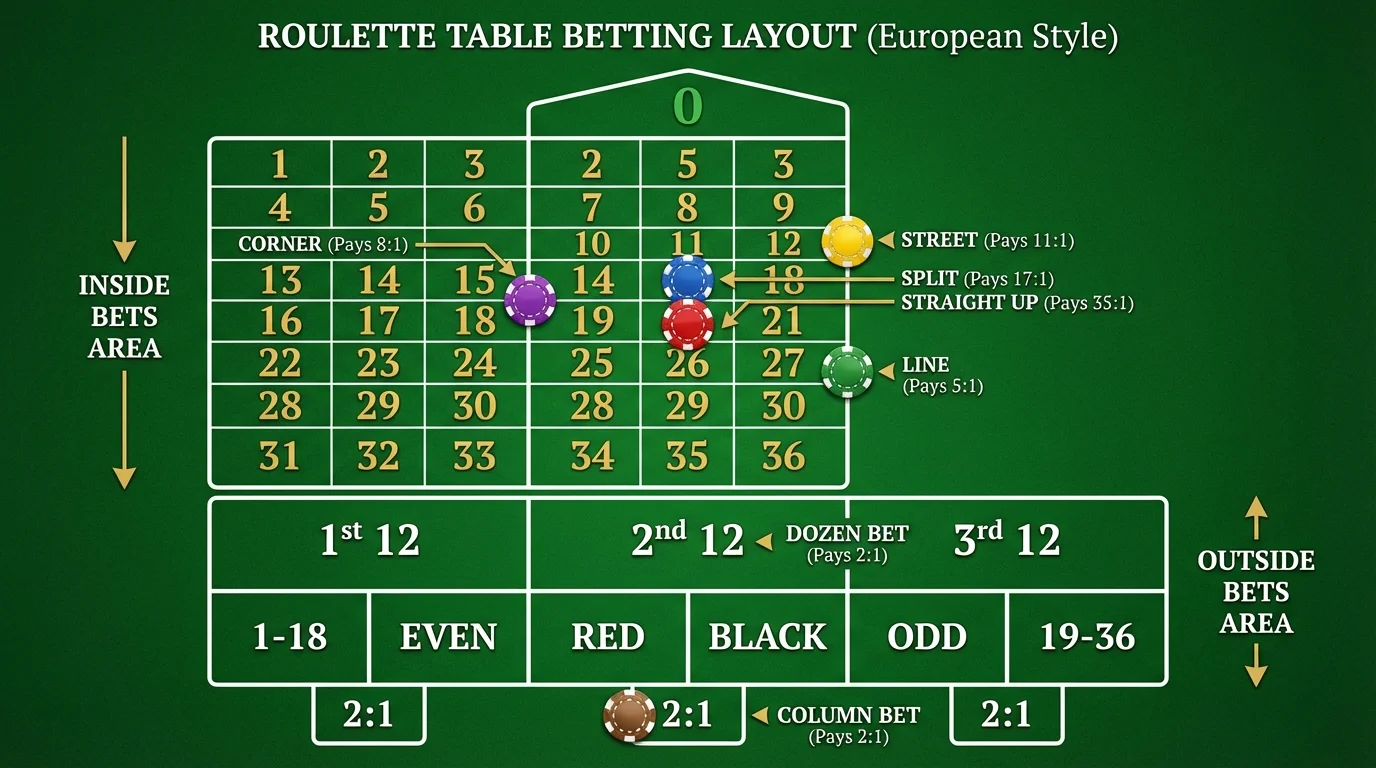
The diagram above shows exactly where to place your chips for each bet type. Notice how chip positioning determines your bet: placing a chip on a line between numbers creates a split bet, while placing it at an intersection creates a corner bet.
The Roulette Wheel: Variants Compared
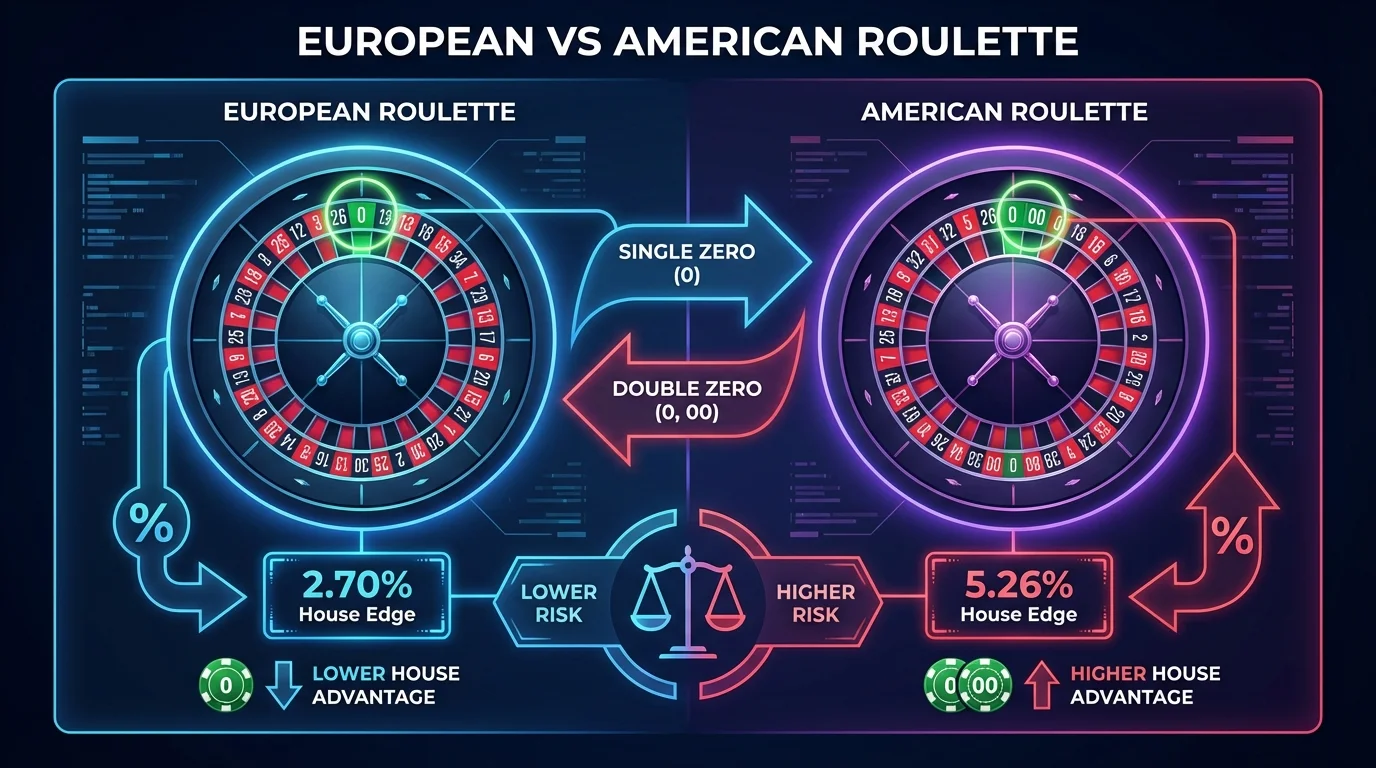
There are three main variants of roulette, and choosing the right one significantly impacts your odds:
European Roulette (Single Zero)
The European wheel has 37 pockets: numbers 1-36 plus a single green zero (0). This is the original version of the game and offers a house edge of 2.70%.
American Roulette (Double Zero)
The American wheel has 38 pockets: numbers 1-36 plus both a single zero (0) and a double zero (00). That extra pocket nearly doubles the house advantage to 5.26%.
French Roulette: The Best-Kept Secret
French roulette uses the same 37-pocket European wheel, but includes two special rules that make it the best value for players:
- La Partage (“The Sharing”): If you place an even-money bet (Red/Black, Odd/Even, High/Low) and the ball lands on zero, you get half your bet back instead of losing it all.
- En Prison (“In Prison”): Instead of losing half, your bet is “imprisoned” for the next spin. If your bet wins on the next spin, you get your original stake back (but no winnings).
Both rules reduce the house edge on even-money bets to just 1.35%—making French roulette the single best value in the game. Always seek out French tables when available.
Side-by-Side Odds Comparison
| Feature | European | American | French (La Partage) |
|---|---|---|---|
| Pockets on Wheel | 37 | 38 | 37 |
| Zero Pockets | Single (0) | Double (0, 00) | Single (0) |
| House Edge (All Bets) | 2.70% | 5.26% | 2.70% |
| House Edge (Even-Money) | 2.70% | 5.26% | 1.35% |
| Your Verdict | Good choice | Avoid if possible | Best choice |
The numbers speak for themselves: American roulette costs you almost double in house edge compared to European. French roulette with La Partage cuts that edge in half again for even-money bets.
Inside vs. Outside Bets Explained
Understanding the difference between Inside and Outside bets is fundamental to playing roulette intelligently:
Inside Bets (High Risk, High Reward)
Inside bets are placed directly on the numbered grid. They offer bigger payouts but lower odds of winning. These are for players seeking big wins and willing to accept longer losing streaks.
| Bet Type | Description | Chip Placement | Payout | European Odds |
|---|---|---|---|---|
| Straight Up | Single number | Directly on one number | 35:1 | 2.70% |
| Split | Two adjacent numbers | On the line between two numbers | 17:1 | 5.41% |
| Street | Three numbers in a row | On the outer edge of a row | 11:1 | 8.11% |
| Corner (Square) | Four numbers in a square | On the intersection of four numbers | 8:1 | 10.81% |
| Line (Six Line) | Six numbers (two rows) | On the outer corner of two rows | 5:1 | 16.22% |
Outside Bets (Lower Risk, Longer Play)
Outside bets are placed in the boxes surrounding the number grid. They cover larger groups of numbers, offering better odds but smaller payouts. These are recommended for beginners because your bankroll lasts longer and you experience more frequent wins.
| Bet Type | Description | Payout | European Odds |
|---|---|---|---|
| Red/Black | Bet on all red or all black numbers | 1:1 | 48.65% |
| Odd/Even | Bet on all odd or all even numbers | 1:1 | 48.65% |
| High/Low (1-18/19-36) | Bet on low half or high half | 1:1 | 48.65% |
| Dozen | 1st 12, 2nd 12, or 3rd 12 | 2:1 | 32.43% |
| Column | Vertical column of 12 numbers | 2:1 | 32.43% |
Beginner tip: Start with even-money Outside bets (Red/Black, Odd/Even, High/Low). You’ll win almost half the time, giving you more spins to learn the game rhythm without depleting your bankroll quickly. To visualize how these odds play out over time, you can use our Streak Calculator to see the likelihood of long losing or winning runs.
How to Play Roulette: Step-by-Step
Step 1: The Buy-In
Approach the table and place your cash flat on the felt—never hand money directly to the dealer. Say “change, please” or simply place it down. The dealer will count it and slide you a stack of colored chips.
Important: At a roulette table, each player receives their own unique color of chips. This prevents confusion when multiple players bet on the same numbers. These are “roulette chips” and have no value outside the table. Before leaving, you must exchange them for regular cash chips.
Step 2: Place Your Bets
Position your chips on the layout according to your chosen bets. You can place multiple bets simultaneously. The dealer will spin the wheel and release the ball in the opposite direction.
Step 3: Listen for “No More Bets”
You can continue placing bets while the ball is spinning—but watch for the dealer’s announcement. When the ball begins to slow and drop toward the wheel, the dealer will wave a hand over the table and call “No more bets.” After this moment, touching the layout is not allowed. New players often try to place last-second bets after this call—don’t be that person.
Step 4: The Result and Payout
The ball settles into a numbered pocket. The dealer places a marker (called a “dolly”) on the winning number on the layout. This is your signal:
- Do NOT touch your chips while the dolly is on the table
- Do NOT place new bets until the dealer removes it
- The dealer will first sweep losing bets, then pay winners
- Once the dolly is removed, you may collect winnings and place new bets
Touching the layout before the dolly is removed is a serious breach of table etiquette and may get you removed from the game.
Roulette Strategies: What Actually Works
Important truth: No betting system can overcome the mathematical house edge. The wheel has no memory—it doesn’t know or care about previous results. Strategies exist for bankroll management, not for “beating” the game. With that caveat, here are the popular systems and when they make sense:
Martingale System
Logic: Double your bet after every loss to recover all previous losses plus one unit profit when you eventually win.
Warning: This system is dangerous. A losing streak of just 7 spins turns a $10 bet into $1,280 required for the next bet—and most tables have maximum bet limits that will stop you before you can recover. Use our Martingale Calculator to see exactly how quickly bets escalate.
Fibonacci System
Logic: A more gradual progression where each bet equals the sum of the two previous bets (1, 1, 2, 3, 5, 8, 13…). After a win, move back two numbers in the sequence.
This is gentler than Martingale but still requires careful bankroll limits. Try our Fibonacci Calculator to plan your session.
Labouchère System
Logic: Write a sequence of numbers representing your target profit. Each bet equals the sum of the first and last numbers. Remove those numbers after a win; add the loss amount to the end after a loss.
More flexible than fixed progressions but requires concentration. Use our Labouchère Calculator to track your sequence.
For professional bankroll management across any strategy, we recommend the Bankroll Manager.
Roulette Myths Debunked
Misinformation costs players money. Here are the facts:
The Gambler’s Fallacy
The myth: “Black has hit 8 times in a row—Red is due!”
The reality: Every spin is 100% independent. The wheel has no memory. The ball doesn’t know what happened on previous spins. The odds of Red on the next spin are exactly 48.65% (on a European wheel), regardless of what happened before. Past results never influence future outcomes.
Dealer Control
The myth: “Dealers can control where the ball lands” or “Watch for patterns in dealer spins.”
The reality: Dealers cannot aim the ball. The physics of a spinning wheel with a bouncing ball makes targeting a specific number virtually impossible. Casinos also require dealers to vary their spin speed. Don’t waste time looking for dealer patterns—they don’t exist.
“Winning Systems”
The myth: “This system guarantees long-term profits!”
The reality: No betting system can overcome the house edge mathematically. Over infinite trials, you will lose exactly 2.70% (European) or 5.26% (American) of all money wagered. Systems like Martingale simply trade many small wins for occasional catastrophic losses. Use systems for bankroll management and entertainment structure—never believe they “beat” the house.
FAQs
Even-money bets (Red/Black, Odd/Even, High/Low) on a French wheel with La Partage rules offer the lowest house edge at just 1.35%. On standard European wheels, these same bets have a 2.70% edge—still the best odds available.
The Martingale can produce short-term wins, but it is mathematically flawed. A losing streak of 7+ spins (which will happen eventually) requires exponentially larger bets that hit table limits. It does not beat the house edge—it simply rearranges wins and losses.
American roulette has 38 pockets (0 and 00) with a 5.26% house edge. European roulette has 37 pockets (single 0) with a 2.70% house edge. Always choose European or French roulette when available.
Licensed online casinos use Random Number Generators (RNG) that are regularly audited by third parties. These games are provably fair. Some sites like BC.Game offer verifiable results that you can check independently.
La Partage (French for ‘the sharing’) is a rule in French roulette where if you place an even-money bet and the ball lands on zero, you get half your bet back instead of losing it all. This reduces the house edge to 1.35%.
No. The physics of a spinning wheel with a bouncing ball makes targeted spins virtually impossible. Casinos also require dealers to vary their spin speed. Looking for dealer patterns is a waste of time.
Final Thoughts
Roulette remains one of the most exciting casino games due to its simplicity and potential for big wins. Now you know the optimal choices: play European or French roulette (never American if you can avoid it), start with even-money Outside bets as a beginner, understand that no system beats the math, and respect the table etiquette. With this knowledge, you can enjoy the thrill of the spin while making informed decisions. Good luck at the tables!
