The difference between winning and losing at blackjack often comes down to a single decision: hit or stand. While luck plays a role in any card game, players who master basic strategy can reduce the house edge to under 0.5%—making blackjack one of the most favorable casino games for skilled players.
KEY FACTS AT A GLANCE
- House Edge with Basic Strategy: 0.5% or less (vs 2-5% without)
- Most Critical Decision: What to do with 12-16 vs dealer’s upcard
- Golden Rule: Always stand on 17+ and always hit on 8 or less
- Dealer Weakness: Dealer showing 4, 5, or 6 has highest bust probability
- Biggest Mistake: Standing on 12-16 against dealer’s 7 or higher
Why the Hit or Stand Decision Matters
Every hand in blackjack presents a mathematical puzzle. Your goal is to get closer to 21 than the dealer without going over. The hit or stand decision is the foundation of this puzzle—get it wrong consistently, and you’re giving the casino an unnecessary advantage.
Consider this: a player using perfect basic strategy faces a house edge of roughly 0.5%. A player making decisions based on gut instinct or superstition might face a house edge of 2-5%. Over hundreds of hands, that difference translates to significant money lost.
Related tools: Blackjack Strategy Calculator · Bankroll Calculator
The Basic Strategy Explained
Basic strategy is a mathematically-derived set of decisions that tells you the optimal play for every possible hand combination. It was developed through computer simulations of millions of blackjack hands and represents the statistically best decision in each scenario.
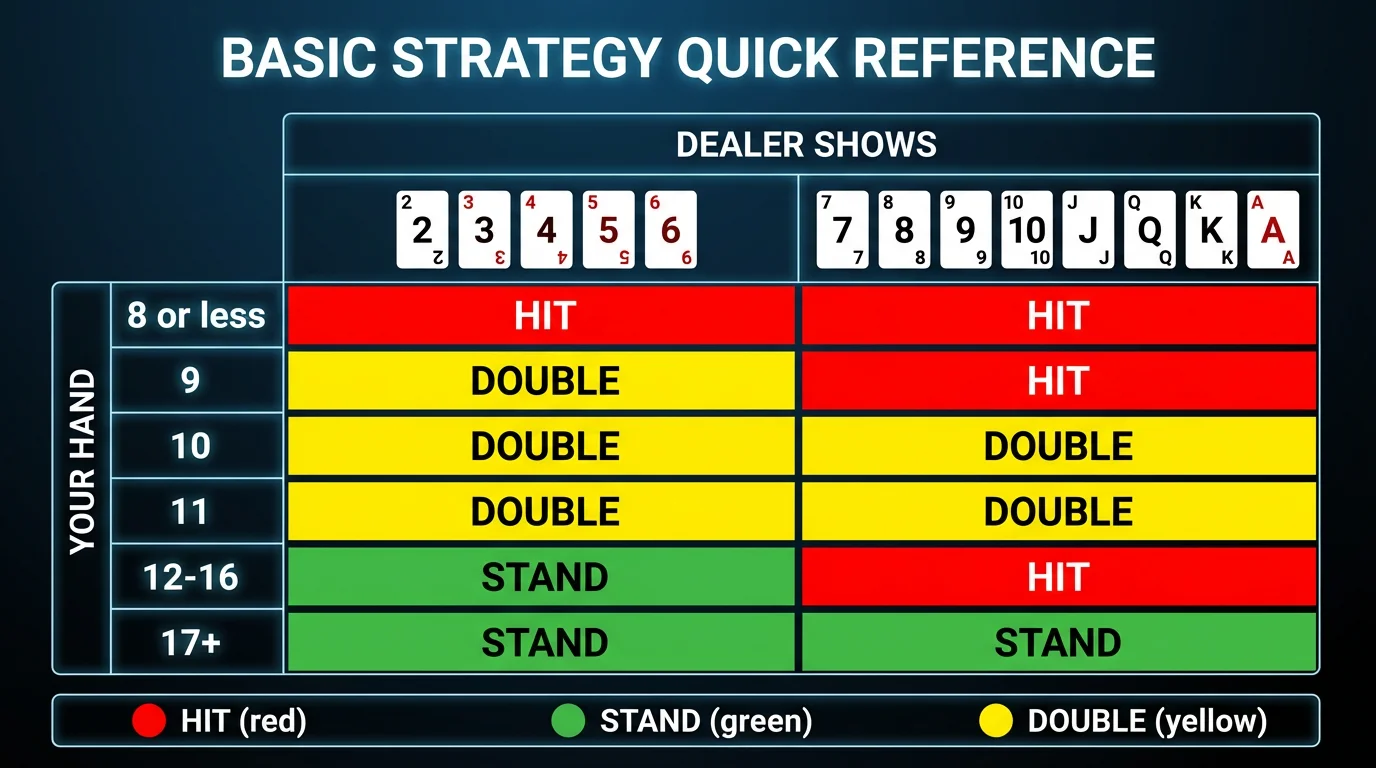
The strategy depends on two factors: your hand total and the dealer’s visible upcard. Let’s break down each scenario.
Hard Hands: When to Hit or Stand
A “hard hand” is any hand without an Ace, or where the Ace must count as 1 to avoid busting. These are the most common scenarios you’ll face.
| Your Hand | Dealer Shows 2-6 | Dealer Shows 7-A |
|---|---|---|
| 8 or less | Always HIT | Always HIT |
| 9 | DOUBLE (or hit) | HIT |
| 10 | DOUBLE (or hit) | DOUBLE vs 2-9, HIT vs 10-A |
| 11 | Always DOUBLE | DOUBLE (hit vs A) |
| 12 | STAND vs 4-6, HIT vs 2-3 | HIT |
| 13-16 | STAND | HIT |
| 17+ | Always STAND | Always STAND |
THE 12-16 ZONE: WHERE GAMES ARE WON OR LOST
Hands totaling 12-16 are called “stiff hands” because any 10-value card will bust you. The key insight: when the dealer shows 2-6, they’re more likely to bust, so you stand and let them take the risk. When they show 7 or higher, they’re likely to make a strong hand, so you must hit and try to improve.
Soft Hands: When to Hit or Stand
A “soft hand” contains an Ace counted as 11. These hands are more flexible because you can’t bust with a single hit—the Ace simply converts to 1 if needed.
| Your Hand | Dealer Shows 2-6 | Dealer Shows 7-A |
|---|---|---|
| Soft 13-14 (A-2, A-3) | DOUBLE vs 5-6, else HIT | HIT |
| Soft 15-16 (A-4, A-5) | DOUBLE vs 4-6, else HIT | HIT |
| Soft 17 (A-6) | DOUBLE vs 3-6, else HIT | HIT |
| Soft 18 (A-7) | DOUBLE vs 3-6, STAND vs 2, 7, 8 | HIT vs 9, 10, A |
| Soft 19-20 | Always STAND | Always STAND |
The key principle with soft hands: be more aggressive. You have a safety net that hard hands don’t have, so take advantage of doubling opportunities when the dealer shows weakness.
Understanding the Dealer’s Upcard
The dealer’s upcard is your most important piece of information. It divides neatly into two categories that should change your entire approach.
DEALER UPCARD CATEGORIES
Weak Cards (2-6): STAND More
- Dealer must hit until 17+
- High chance of busting (35-42%)
- Let the dealer take the risk
- Stand on stiff hands (12-16)
Strong Cards (7-A): HIT More
- Dealer likely to make 17-21
- Low bust probability (17-26%)
- You must improve your hand
- Hit on stiff hands (12-16)
Dealer Bust Probabilities
Understanding how often dealers bust based on their upcard helps explain why basic strategy works. Use our blackjack strategy calculator to see these probabilities in action.
| Dealer Upcard | Bust Probability | Your Strategy |
|---|---|---|
| 2 | 35% | Stand on 13+ |
| 3 | 37% | Stand on 13+ |
| 4 | 40% | Stand on 12+ |
| 5 | 42% | Stand on 12+ |
| 6 | 42% | Stand on 12+ |
| 7 | 26% | Hit on 16 or less |
| 8 | 24% | Hit on 16 or less |
| 9 | 23% | Hit on 16 or less |
| 10/J/Q/K | 21% | Hit on 16 or less |
| Ace | 17% | Hit on 16 or less |
When to Split Pairs
Pair splitting adds another dimension to your decisions. Here’s a quick reference for the most common situations:
ALWAYS SPLIT
Aces and 8s—no exceptions. Two aces give you two chances at 21. Two 8s (16) is the worst hand; splitting gives you two chances at 18.
NEVER SPLIT
Tens and 5s. A pair of tens is 20—nearly unbeatable. A pair of 5s is 10, perfect for doubling down instead.
SPLIT VS WEAK DEALER
2s, 3s, 6s, 7s—split against dealer 2-7. 4s—split only vs 5 or 6. 9s—split vs 2-9 except 7.
Common Mistakes to Avoid
Even players who know basic strategy often make these errors under pressure:
COSTLY MISTAKES
- Standing on 12-16 vs dealer 7+ — You will lose more often by standing than by hitting and risking a bust
- Always standing on soft 18 — Against dealer 9, 10, or A, you should hit (you can’t bust)
- Never doubling down — Missing double opportunities costs you significant expected value
- Splitting 10s against a weak dealer — A 20 is almost always better than two unknown hands
- Taking insurance — Insurance is a sucker bet with a house edge of around 7%
- Playing hunches over strategy — The math doesn’t change based on “hot” or “cold” streaks
Managing Your Bankroll
Even perfect strategy won’t help if you don’t manage your money properly. Use our bankroll calculator to determine appropriate bet sizes, and consider the risk of ruin calculator to understand your chances of going broke at different bet levels.
“The goal of basic strategy isn’t to win every hand—it’s to minimize the house edge over thousands of hands. Short-term variance is unavoidable, but long-term results favor the prepared player.”
— Blackjack Mathematics
Practice Makes Perfect
Memorizing basic strategy takes time. Start by learning the hard totals, then soft hands, then pair splits. Practice with free online games before risking real money. Our interactive blackjack strategy tool can help you drill these decisions until they become automatic.
Remember: casinos count on players making emotional decisions. By following basic strategy consistently, you’re playing the best possible game against the house.
KEY TAKEAWAYS
- Always hit on 8 or less, always stand on 17+ — These are non-negotiable rules
- The 12-16 zone depends on the dealer — Stand vs 2-6, hit vs 7-A
- Soft hands allow more aggression — You can’t bust, so double and hit more liberally
- Always split Aces and 8s, never split 10s and 5s — These rules never change
- Dealer’s 4, 5, and 6 are your best opportunities — They bust over 40% of the time
- Skip insurance entirely — It’s a side bet with terrible odds
- Basic strategy reduces house edge to ~0.5% — One of the best odds in the casino
