
How Do No Deposit Bonuses Work? The Real Price of ‘Free’
A $25 'free' casino bonus can demand $1,500 in bets and cap your winnings at $100. Here's how it all works.
A $25 “free” casino bonus typically requires $750–$1,500 in bets before you can withdraw a cent — and even then, most casinos cap what you keep at $100. So how do no deposit bonuses work, really? This guide walks through the full lifecycle of a no-deposit offer: what you actually receive, the wagering math that locks it down, what a typical bonus is worth in cold expected value, and why casinos can afford to hand out money in the first place.

KEY FACTS AT A GLANCE
- What it is: Casino credit, free spins, or sweeps coins granted just for registering — no payment needed
- The core catch: Winnings are locked behind 30x–60x wagering at most international casinos
- The ceiling: Cashouts are typically capped at $50–$100 — anything above is forfeited
- The tripwires: A max bet of roughly $5, restricted games, 24-hour to 30-day expiry, one account per household
- The gate: Identity verification (KYC) is required before any withdrawal
- The exception: UK-licensed casinos cannot require more than 10x wagering since 19 January 2026
Sizing up a specific offer right now? Enter its terms below — every number the calculator uses is explained in the sections that follow.
What Is a No Deposit Bonus?
A no deposit bonus is a small amount of casino credit, free spins, or sweepstakes coins that an online casino gives you just for registering an account — no payment required. The catch is in how it arrives: the bonus lands in a separate, restricted balance, and nothing becomes withdrawable money until you clear the wagering requirements, stay inside the betting limits, and pass identity verification.

"No deposit bonus" is really an umbrella term for five different products, each with its own value range and payout mechanics.
| Type | Typical Value | How It Pays Out |
|---|---|---|
| Free cash / free chips | $10–$50 internationally; $5–$25 at US-regulated casinos | Credit playable on eligible games; winnings restricted until wagering is met |
| Free spins | 5–50 spins at $0.10–$0.20 per spin | Spin winnings become bonus funds — the wagering multiplier applies to the winnings |
| Timed free play | $500–$1,500 in chips for about 60 minutes | Only capped net winnings carry over, then playthrough applies |
| Sweepstakes coins (US) | 1–3 SC on signup, plus daily login coins | Redeemable for cash prizes after a 1x playthrough under the sweepstakes legal model |
| Crypto faucets & drop codes | Cents to a few dollars per claim | Small drips at crypto casinos, usually tied to recent play or VIP level |
How Claiming a No Deposit Bonus Works, Step by Step
Whatever form the bonus takes, the journey from claim to cashout runs through the same six checkpoints. Where players lose their winnings is almost never the games — it is missing one of the checkpoints below.
- Pick a licensed casino. Check the casino's licence number directly on the regulator's website (UKGC, MGA, or your state gaming regulator) before entering personal details.
- Register and claim the offer. Create an account and redeem the bonus via a bonus code, automatic credit, an opt-in button on the promotions page, or by registering a debit card without depositing.
- Read the four numbers that matter. Before playing, note the wagering multiplier, the maximum cashout, the maximum bet, and the expiry window — plus the list of eligible games.
- Play eligible games within the limits. Stick to the eligible games (usually slots) and keep every bet under the maximum, commonly around $5, or the bonus and winnings can be voided.
- Complete the wagering requirement before expiry. Stake the required total — typically 30 to 60 times the bonus — before the offer expires, anywhere from 24 hours to 30 days after claiming.
- Verify your identity and withdraw. Submit photo ID and proof of address for KYC review (usually 24–72 hours), after which winnings up to the cashout cap can be withdrawn.
The Wagering Requirement Engine
Wagering requirements (also called playthrough or rollover) are the machinery that makes "free money" safe for the casino to give away. The rule is simple: before any bonus winnings can be withdrawn, you must stake a multiple of the bonus amount. A $25 bonus at 40x means $1,000 in total bets. For free spins, the multiplier usually applies to whatever the spins win — 50 spins that pay £12 at 35x means £420 in turnover before a withdrawal is possible.
No deposit bonus wagering requirements are systematically the harshest in the industry. Because the casino risks its own money with no deposit to offset it, no-deposit offers cluster at 30x–60x, while standard deposit-match bonuses run 20x–35x. A handful of US-regulated brands break the pattern entirely with 1x playthrough, and in the UK anything above 10x is now illegal. (For the deeper mechanics — game weighting, sticky versus non-sticky credit, and clearing strategy — see our full guide to how wagering requirements work.)
The multiplier is the single number that decides whether an offer is generous or theatrical. Scale it against a $25 bonus and the gap becomes obvious: at the 1x offered by a few regulated US casinos, $25 in bets unlocks the money; at the 60x found on many offshore offers, you need $1,500 in total stakes — sixty times the value of the "gift" — before the cashier will even consider you.
Regulators have started treating extreme multipliers as a consumer-protection problem in their own right. When the UK Gambling Commission capped wagering requirements, it was blunt about why.
Offers with high wagering requirements "could confuse consumers and lead them to gamble for longer, and faster, than they are used to."
— UK Gambling Commission, announcing the 10x wagering cap, March 2025
The Fine Print That Decides What You Keep
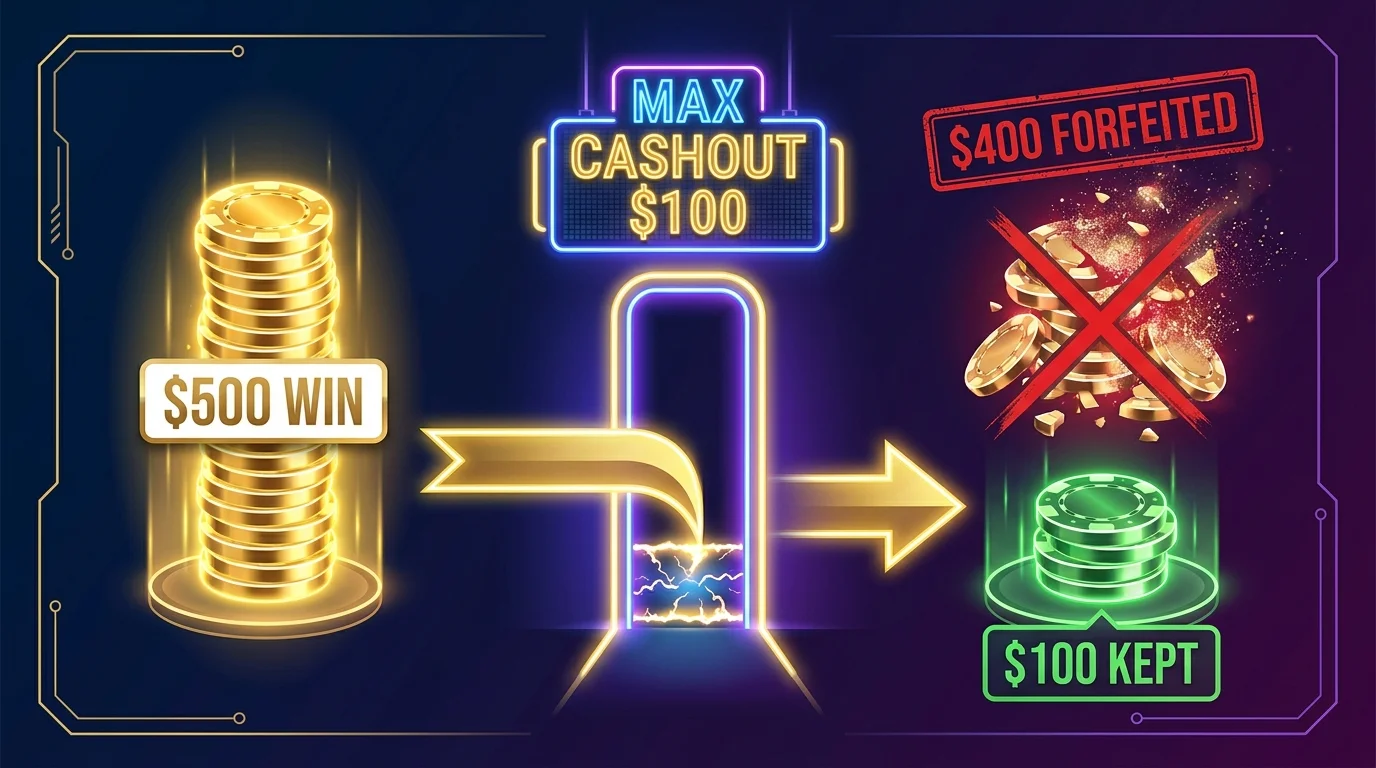
The wagering multiplier gets the attention, but four quieter terms usually decide the outcome. The first is the max cashout cap: most no-deposit offers limit withdrawable winnings to $50–$100, and anything above the cap is simply removed. Win $500 against a $100 cap and $400 evaporates at the cashier. The second is the max bet rule — commonly around $5 per spin or hand while the bonus is active, according to Casino Guru — and exceeding it even once is grounds to void the bonus and every cent won from it.
The third is game weighting. Slots usually contribute 100% of each bet toward wagering, while table games count for 10–25% or are excluded outright — many no-deposit offers are slots-only from the start. The fourth is the clock: offers expire anywhere from 24 hours to 30 days after claiming, with about 7 days the most common window. An unfinished wagering requirement at expiry voids the bonus and all derived winnings.
THE FOUR WAYS PLAYERS VOID THEIR OWN WINNINGS
Playing a restricted game · betting over the max bet limit · missing the wagering deadline · opening more than one account per person, device, household, or IP address. Casinos audit all four before approving a withdrawal, and any breach typically forfeits the bonus and all winnings from it.
Some "no deposit" offers also hide a deposit at the exit: BetMGM's $25 free-play offer, for example, requires at least a $10 deposit before no-deposit winnings can be withdrawn. Here is how five real offers, observed in June 2026, stack up — note how different the same product looks at an offshore casino, a US-regulated brand, and a UK operator.
| Casino | Offer | Wagering | Max Cashout | Conditions |
|---|---|---|---|---|
| Slotastic (offshore) | 50 free spins | 60x on winnings | $100 | Bonus code required |
| Sloto Tribe (offshore) | 99 free spins | 20x | $70 | Slots only |
| BetMGM Casino (US) | $25 free play | 1x | No stated cap | 3-day expiry; $10+ deposit required before withdrawal |
| Caesars Palace Online (US) | $10 bonus | 1x | No stated cap | 7-day expiry |
| Mr Q (UK) | 10 free spins (10p each) | None — wager-free | Winnings paid as cash | 48-hour expiry; debit card registration required |
Offer terms change frequently — treat these as a snapshot of the market in June 2026, not a recommendation. The structural pattern is the durable lesson: lighter wagering tends to come with smaller bonuses, deposit hooks, or strict regulation behind it.
What a No Deposit Bonus Is Actually Worth
Related tools: Bonus EV Calculator
If you skipped it on the way in, the calculator near the top of this page runs exactly this math for any offer you enter — this section shows where its numbers come from.
There is a clean formula for valuing any bonus, popularized by gambling mathematician Michael Shackleford (Wizard of Odds): a bonus breaks even when the required wagering multiplied by the house edge equals the bonus amount. Put differently, the breakeven house edge is the bonus divided by the total required wagering. A $25 bonus at 40x demands $1,000 in bets, so it breaks even only if the game's house edge is 2.5% or less — and most online slots run 3–6%. (Our primer on RTP and house edge explains where those percentages come from.)
Run the typical numbers and the "free $25" turns negative: clearing $1,000 of wagering on a 96% RTP slot costs an expected $40, against $25 of bonus value — an expected value of roughly −$15. And that is before the max-cashout cap does its real work, which is amputating the rare lucky run that would otherwise make up for all the losing ones.
None of this means a no-deposit bonus is worthless — it is a genuinely free sample, and someone wins the capped maximum every day. It means the realistic framing is entertainment with a small lottery ticket attached, not free money. The 1x offers at regulated US casinos and the UK's wager-free spins are the exceptions where the expected value is honestly positive, which is exactly why those offers are small.
Why Casinos Give Money Away
The economics are less generous than they look. Industry analyses put the cost of acquiring a single first-time depositor at $250–$650 in mature markets, with top gambling keywords costing more than $350 per thousand ad impressions. Against that, a $25 no-deposit bonus is the cheapest customer-acquisition tool the industry has ever had: a free sample that doubles as a lead with verified contact details, and whose terms ensure the sample rarely costs the full sticker price.
The scale of bonus spending shows how central the tool is. A Deutsche Bank analysis of US state regulatory data found operators gave back 35% of gross gaming revenue in promotions over Pennsylvania's first full year of online betting — and 82% during Michigan's launch months. Michigan's gaming law even budgets for the strategy: it lets casinos deduct bonus spend from taxable revenue at 10% in years one through three, tapering to zero by year six — a statutory acknowledgment that bonuses are a launch-phase acquisition tactic, not charity.
The strict terms also exist because casinos are fighting an actual adversary. Bonus abuse — claiming offers repeatedly through fake or duplicate accounts — is consistently ranked the industry's top fraud problem: 63.8% of operators named it a top threat in Sumsub's 2025 iGaming fraud report, and a separate Gambling IQ analysis attributed roughly two-thirds of online casino fraud volume to it. According to CRM platform Optimove, every $1 of bonus money captured by an abuser drives about $2.70 in negative net gaming revenue. The max bets, the one-per-household rules, and the KYC gate are all anti-abuse machinery that legitimate players inherit.
There is a quieter finding worth knowing too: the confusion is part of what regulators are reacting to. In user testing by the UK's Behavioural Insights Team, three of five participants did not realize wagering requirements applied to their bonus at all, and seven of ten could not calculate what the requirement actually demanded. A randomized controlled trial published in Frontiers in Psychiatry found wagering inducements increased both the money players wagered and their perceived loss of control. Free offers are engineered to feel lighter than they are — that is the business model working as intended.
The Rules Depend on Where You Play
The same "free $25" is a different legal object depending on the licence behind it. The UK now caps all wagering requirements at 10x — a change we covered when the Gambling Commission announced the cap — and bans calling an offer "free" in advertising if the customer must risk their own money. New Jersey legally defines bonus money as "restricted Internet gaming credit" and requires casinos to file promotional terms with the regulator before launch. Sweden allows exactly one bonus per operator, ever.
| Where | How No-Deposit Bonuses Are Regulated |
|---|---|
| United Kingdom | Wagering capped at 10x since 19 Jan 2026; mixed-product promos banned; "free" claims restricted in ads; CMA enforcement ended wagering on players' own deposits |
| Malta (MGA) | Promo terms must pass consumer-fairness rules; full T&Cs one click away and available before registration |
| US regulated states (NJ, PA, MI) | Bonuses are "restricted gaming credit"; terms filed with regulators with mandatory disclosures; offers small ($5–$25) but often 1x playthrough |
| US sweepstakes casinos | Free sweeps coins are the de-facto no-deposit model; banned in NY, CA, CT, MT, NJ and more during the 2025–26 crackdown |
| Ontario (Canada) | Bonuses legal but cannot be advertised publicly — only on the operator's own site or via consented direct marketing (BetMGM fined CA$110,000 in 2025) |
| Netherlands | Bonus amount, conditions, playthrough and expiry must be fully disclosed; cashback bonuses banned; no targeting players under 24 |
| Sweden | One bonus per operator — ever — and only on a player's first play occasion |
| Crypto casinos (offshore) | Licence-dependent (often Curaçao); bonus terms set by the operator with little consumer-law backstop |
"These changes will better protect consumers from gambling harm and give consumers much better clarity on, and certainty of, offers before they decide to sign up."
— Tim Miller, Executive Director for Research and Policy, UK Gambling Commission
The American situation deserves its own footnote. Because most US states have no legal online casinos, sweepstakes casinos — with their free daily coins — became the country's de-facto no-deposit bonus. That model is now collapsing under state-by-state bans, a wave we've tracked in our coverage of the sweepstakes casino crackdown. If you're unsure how that model differs from a real-money casino in the first place, our sweepstakes vs real money casino guide covers the dual-currency system in detail.
Crypto Casinos: The No-Deposit Bonus That Isn't
Search for a Stake, BC.Game, or Shuffle no-deposit bonus and you'll find plenty of affiliate pages promising one — but none of the three runs a standing, publicly listed no-deposit cash offer on its main crypto site. What exists instead is a different architecture for "free" value, built around play rather than sign-ups.
Stake distributes small bonus drop codes — typically $1–$5 — through its official Telegram and social channels, and eligibility usually depends on having wagered recently, making them retention rewards rather than welcome gifts. BC.Game credits promotional value as BCD, a locked in-platform token that unlocks at roughly $1 for every $500 wagered — a 0.2% drip that functions as rakeback, not a withdrawable bonus. Shuffle routes effectively all free value through its VIP program: daily, weekly, and level-up bonuses earned by wagering volume. The genuinely free sign-up value lives at the US sweepstakes siblings — Stake.us and Shuffle.us — where free sweeps coins on registration and daily login are required by the sweepstakes legal model itself.

One pattern does carry over from the mainstream casino world: identity verification at the value gate. Crypto casinos generally let you deposit and play with minimal checks, then require full KYC at withdrawal — and increasingly at bonus-claim time, since tying rewards to verified identity is their main defense against multi-account bonus farming.
How to Spot a Fair Offer (and Dodge a Trap)
FAIR OFFER VS TRAP
Signs of a fair offer
- Licence number verifiable on the regulator's own website
- Wagering at 35x or below (10x or less in the UK — it's the law)
- Max cashout, max bet, and expiry stated upfront, not buried
- Full terms reachable in one click before you register
- A realistic clock — seven days or more to clear wagering
Signs of a trap
- Wagering of 100x or more — a bonus never meant to be withdrawn
- No licence, or a licence seal that isn't clickable or verifiable
- Any request for a "verification deposit" to unlock free winnings
- Indefinite "verification" holds once you try to withdraw
- Oversized bonus promises ($1,000+ free) on an unknown brand
The scam variant of the no-deposit bonus deserves a direct warning: fraudulent sites use fake "free bonus" offers as bait to harvest identity documents through bogus KYC checks, or to extract a "small deposit to verify your account" that never comes back. A legitimate no-deposit bonus never requires payment to claim or to withdraw the advertised free winnings — the only money gate a real casino imposes is the wagering requirement itself. If a free offer asks for money, it isn't a bonus; it's the product.
Finally, keep the research finding in mind as a self-check: promotions measurably nudge people to gamble more than they intended, and they're specifically appealing to people who don't usually gamble. A no-deposit bonus is a fine way to trial a casino you were already curious about. It's a poor reason to open an account you otherwise wouldn't have.
FAQs
What is a no deposit bonus?
A no deposit bonus is a small amount of casino credit, free spins, or sweepstakes coins given for registering an account, with no payment required. Typical values run $10–$50 in credit or 5–50 free spins, and winnings are held as restricted funds until the casino's wagering requirements are met.
Can you actually win real money from a no deposit bonus?
Yes, but rarely much. You must first complete the wagering requirement (commonly 30x–60x), pass identity verification, and most casinos cap withdrawable winnings at $50–$100 — anything above the cap is forfeited.
Why do casinos give away no deposit bonuses?
Customer acquisition. Acquiring one depositing player costs operators roughly $250–$650 in mature markets, so a $25 bonus that converts even a small share of claimers into depositors is cheap marketing — and the terms ensure the casino rarely pays full price for the giveaway.
How do wagering requirements work on a no deposit bonus?
You must stake the bonus amount a set number of times before withdrawing — a $25 bonus at 40x requires $1,000 in total bets. For free spins, the multiplier usually applies to the winnings the spins generate, not the face value of the spins.
What is a maximum cashout limit?
A cap on how much you can withdraw from bonus winnings, typically $50–$100 on no-deposit offers. If you win $500 against a $100 cap, the extra $400 is removed when you cash out.
Do all games count toward wagering requirements?
No. Slots usually contribute 100% of each bet, while table games like blackjack count for 10–25% or nothing at all. Many no-deposit bonuses restrict play to slots entirely, so check the eligible-games list before betting.
How long do I have to use a no deposit bonus?
Anywhere from 24 hours to 30 days, with around 7 days the most common window. If the wagering requirement isn't finished when the offer expires, the bonus and any winnings from it are voided.
Do crypto casinos like Stake offer no deposit bonuses?
Not as standing public offers. Crypto casinos distribute free value through social bonus-drop codes, rakeback and VIP rewards, or locked tokens like BC.Game's BCD that unlock gradually as you wager. Stake's US sweepstakes sibling, Stake.us, offers free sweeps coins on signup instead.
KEY TAKEAWAYS
- "Free" means restricted — a no-deposit bonus arrives as locked credit, and nothing is withdrawable until wagering, betting limits, and KYC are all satisfied
- The math is the message — typical offers demand 30x–60x wagering, so a $25 bonus means $750–$1,500 in bets, with winnings capped at $50–$100
- Expected value is usually negative — about −$15 on a typical $25 bonus at 40x, with the cashout cap removing the lucky-run upside
- The exceptions are real — 1x offers at US-regulated casinos, the UK's wager-free spins, and the UK's new 10x legal ceiling genuinely change the deal
- The terms are anti-fraud armor — bonus abuse is the industry's top fraud category, and legitimate players inherit the defenses built against it
- Watch the four tripwires — restricted games, max bets, expiry deadlines, and one-account rules void more winnings than bad luck does
Sources
- Gambling promotions to be safer and simpler — UK Gambling Commission
- Online gambling consumer-law case — Competition and Markets Authority (gov.uk)
- Free bets and bonuses guidance — Advertising Standards Authority / CAP
- Internet gaming promotions regulations (N.J.A.C. 13:69O) — New Jersey Division of Gaming Enforcement
- Player Protection Directive (Directive 2 of 2018) — Malta Gaming Authority
- Attorney General James stops illegal online sweepstakes casinos — New York Attorney General
- Advertising and marketing in Ontario's igaming market — Alcohol and Gaming Commission of Ontario
- Lawful Internet Gaming Act, MCL 432.303 — Michigan Legislature
- Impact of free bets and promotions on gambling — Behavioural Insights Team
- Randomized controlled trial on wagering inducements — Balem et al., Frontiers in Psychiatry
- iGaming Fraud Report 2025 — Sumsub (via PR Newswire)
- Casino bonus house-edge calculator — Wizard of Odds

Aevan Lark
Aevan Lark is a gambling industry veteran with over 7 years of experience working behind the scenes at leading crypto casinos — from VIP management to risk analysis and customer operations. His insider perspective spans online gambling, sports betting, provably fair gaming, and prediction markets. On Dyutam, Aevan creates in-depth guides, builds verification tools, and delivers honest, data-driven reviews to help players understand the odds, verify fairness, and gamble responsibly.
Related coverage

Indian State Tamil Nadu’s 2023 Gambling Bill: Passed Twice, Governor Dispute Details
Why the Indian state of Tamil Nadu passed its gambling bill twice in 2023, and how the Governor dispute unfolded.

Crypto Casino Bonuses vs Traditional: The 25x Rule
Crypto vs traditional casino bonuses: the 25x break-even rule, rakeback's $10,000 gate, and the volatility that moves a bonus's value.

Kelly Criterion Betting: Optimal Staking Without Ruin
How the Kelly Criterion sizes bets from your edge: the formula, devigging, worked examples, and why fractional Kelly wins.