Texas Hold’em is the world’s most popular poker variant—and for good reason. It’s easy to learn, impossible to master, and offers endless strategic depth. From basement home games to the World Series of Poker’s $10 million prize pools, Texas Hold’em dominates the poker landscape. This complete guide covers everything you need to know to understand the game, play confidently, and start developing winning strategies.
What Is Texas Hold’em?
Texas Hold’em is a community card poker game where each player receives two private cards (“hole cards”) and shares five community cards with all other players. Your goal is to make the best five-card hand using any combination of your hole cards and the community cards—or to convince everyone else to fold before showdown.
Unlike casino table games where you play against the house, poker pits you against other players. The casino (or home game host) takes a small rake from each pot, but your profit comes from outplaying your opponents—not from beating fixed odds. To check your mathematical edge in real-time, professional players often use a Poker Odds Calculator.
This player-vs-player dynamic is what makes Hold’em special. Skill matters enormously. While luck determines individual hands, skilled players consistently profit over time. That’s why the same faces appear at final tables year after year.
The Deck and Table Setup
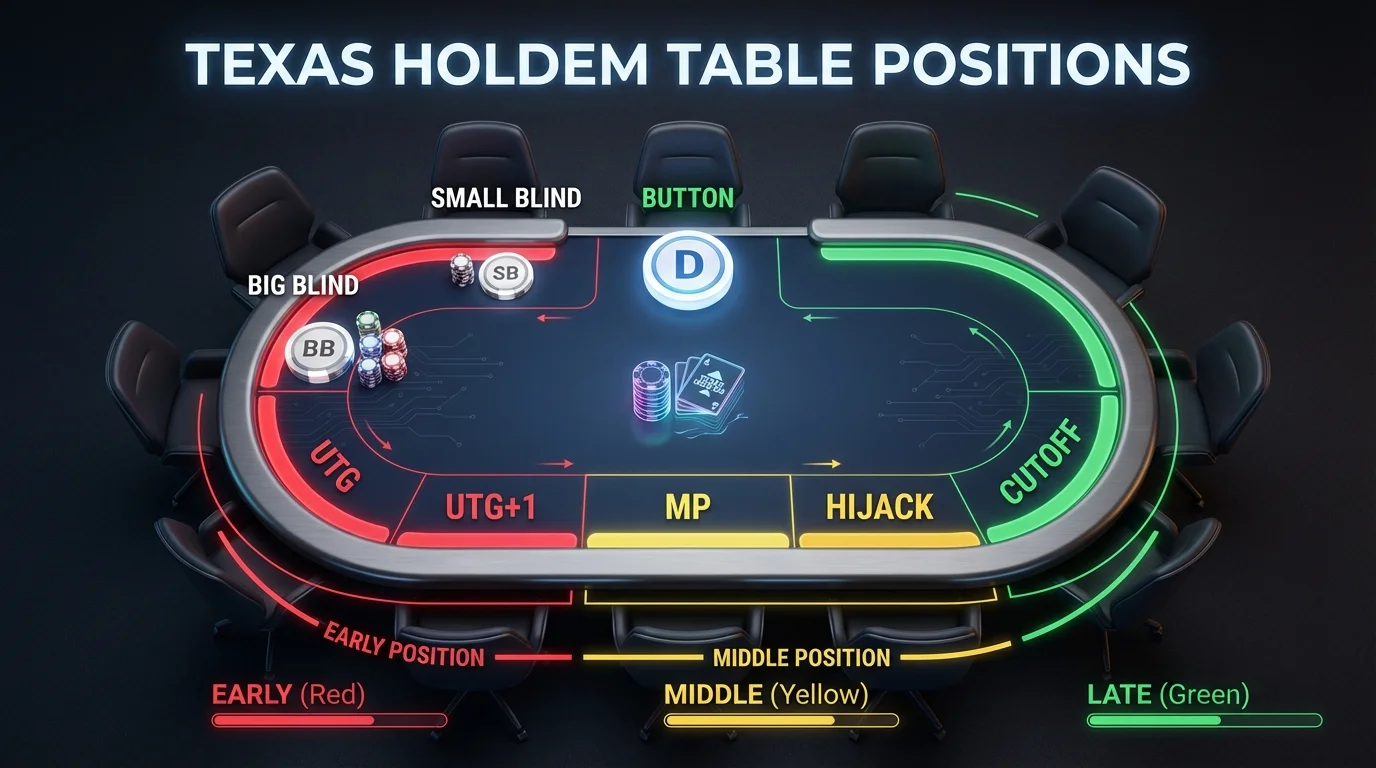
Texas Hold’em uses a standard 52-card deck with no jokers. A typical table seats 2-10 players, though 6-max (six players) and heads-up (two players) formats are also popular.
Key positions at the table:
- Dealer Button: A rotating marker indicating the nominal dealer. Moves clockwise after each hand.
- Small Blind (SB): Player immediately left of the button, posts forced bet (typically half the big blind)
- Big Blind (BB): Player left of small blind, posts forced bet (defines the stakes)
- Under the Gun (UTG): First player to act preflop (left of big blind)
- Cutoff (CO): Player to the right of the button
- Button (BTN): Last to act post-flop—the most advantageous position
The blinds are forced bets that create action. Without them, players could simply wait for premium hands forever. In tournaments, blinds increase over time to force action; in cash games, they stay constant.
Hand Rankings: What Beats What
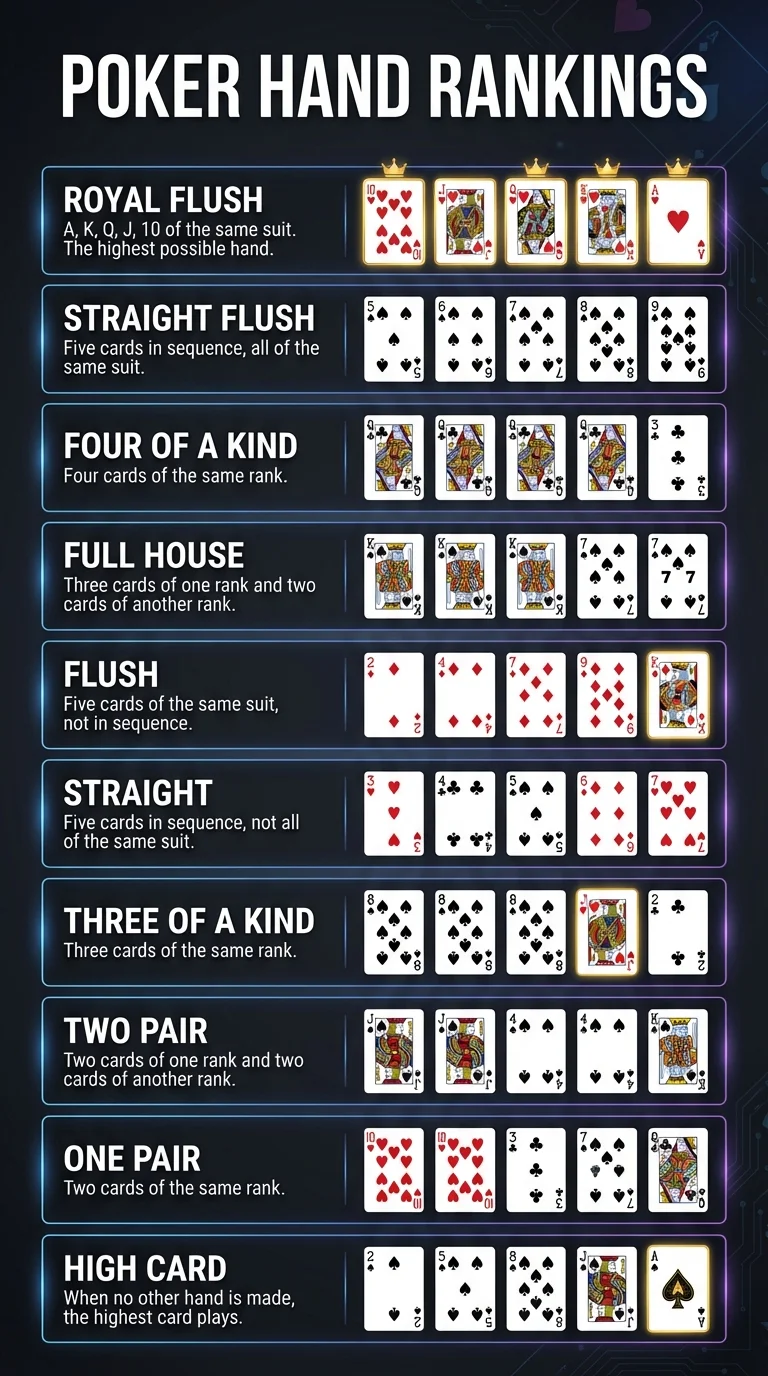
Before learning how to play, you must know hand rankings cold. From best to worst:
| Rank | Hand | Description | Example |
|---|---|---|---|
| 1 | Royal Flush | A-K-Q-J-10 all same suit | A♠ K♠ Q♠ J♠ 10♠ |
| 2 | Straight Flush | Five consecutive cards, same suit | 7♥ 8♥ 9♥ 10♥ J♥ |
| 3 | Four of a Kind | Four cards of same rank | K♠ K♥ K♦ K♣ 3♠ |
| 4 | Full House | Three of a kind + a pair | Q♠ Q♥ Q♦ 8♣ 8♠ |
| 5 | Flush | Five cards of same suit | 2♦ 5♦ 9♦ J♦ K♦ |
| 6 | Straight | Five consecutive cards, mixed suits | 4♠ 5♦ 6♥ 7♣ 8♠ |
| 7 | Three of a Kind | Three cards of same rank | 9♠ 9♥ 9♦ K♣ 2♠ |
| 8 | Two Pair | Two different pairs | J♠ J♥ 4♦ 4♣ A♠ |
| 9 | One Pair | Two cards of same rank | 10♠ 10♥ K♦ 7♣ 2♠ |
| 10 | High Card | No made hand; highest card plays | A♠ J♥ 8♦ 4♣ 2♠ |
Important Hand Ranking Rules
- Suits are equal: A flush in hearts is worth exactly the same as a flush in spades
- Kickers matter: If two players have the same hand type, the highest side cards (kickers) determine the winner
- Ace can be high or low: A-2-3-4-5 (the “wheel”) is the lowest straight; 10-J-Q-K-A is the highest
- Best five cards: You use exactly five cards for your hand—no more, no less
- Board plays: If the best five-card hand is on the community board, all remaining players split the pot
Step-by-Step: How to Play Texas Hold’em
Every hand follows the same structure with four betting rounds. Here’s exactly how a round unfolds:
- Deal Hole Cards. Each player receives two private cards face-down. This is followed by the first round of betting (Pre-flop).
- The Flop. Three community cards are dealt face-up. This is followed by the second round of betting.
- The Turn. A fourth community card is dealt face-up. This is followed by the third round of betting.
- The River. The fifth and final community card is dealt face-up. This is followed by the final round of betting.
- Showdown. If more than one player remains, hands are revealed. The best 5-card hand wins the pot.
Betting Structures Explained
Texas Hold’em comes in three main betting formats:
No-Limit Hold’em (NLHE)
The most popular format. You can bet any amount up to all your chips (“all-in”) at any time. This creates massive pots and dramatic all-in confrontations.
Pot-Limit Hold’em (PLH)
You can bet up to the current pot size. Less common than No-Limit but still played.
Limit Hold’em (LHE)
Fixed bet sizes. Preflop and flop use “small bet” increments; turn and river use “big bet” (double) increments.
Table Positions Explained
Position is one of the most important concepts in Hold’em. Acting later gives you information about opponents’ actions before you decide.
| Position | Location | Advantage |
|---|---|---|
| Early Position (EP) | UTG, UTG+1, UTG+2 | Weakest—act first, least information |
| Middle Position (MP) | MP1, MP2, Hijack | Moderate—some players have acted |
| Late Position (LP) | Cutoff, Button | Strongest—most information before deciding |
| Blinds | Small Blind, Big Blind | Act last preflop, first postflop—tricky |
The button is the most profitable seat because you act last on flop, turn, and river—maximum information, maximum control.
Starting Hand Selection
Not all hands are created equal. Playing tighter in early position and looser in late position is the foundation of a winning strategy. Premium hands like AA, KK, and AKs should be played aggressively from any seat.
Understanding Pot Odds and Implied Odds
Pot odds help you determine whether a call is mathematically profitable. If you want to refine your decision-making, use our Expected Value (EV) Calculator to find your long-term edge.
Basic Strategy Concepts
- Play Tight-Aggressive (TAG). Play fewer hands, but play them with aggression (betting and raising).
- Use Position. The later you act, the more information you have. Use the button to your advantage.
- Aggression Wins. You can win by having the best hand or by making others fold.
- Manage Your Bankroll. Never risk more than you can afford. Our Bankroll Calculator can help you stay in the game.
FAQs
Pocket Aces (A-A) is the best starting hand, winning roughly 85% of the time against a random hand heads-up. Pocket Kings (K-K) is the second strongest.
If both players have identical five-card hands (same rank and kickers), the pot is split equally. This is known as a ‘chop’ in poker terminology.
Both. Luck determines individual hands, but skill dominates long-term results. Consistent winning players profit because their mathematical and psychological edge compounds over thousands of hands.
Generally, no. Revealing folded cards while a hand is in progress is against most casino rules and is considered poor etiquette as it gives away free information.
It means the best possible five-card hand is entirely on the community board. In this case, all players remaining in the hand split the pot equally.
Final Thoughts
Texas Hold’em rewards patience, discipline, and continuous learning. Start tight, play aggressively, and always respect the power of position. Shuffle up and deal—the cards are waiting.
