Every time you spin a progressive jackpot slot, a small slice of your bet feeds a shared prize pool that grows until one lucky player claims it all. These jackpots can swell into the tens of millions — the largest online payout exceeded $23 million — but the odds of triggering one sit firmly in the millions-to-one range. Here’s everything you need to know about how progressive jackpots actually work, the different types, and what the math really looks like.

KEY FACTS AT A GLANCE
- What it is: A prize pool that grows with every bet placed on qualifying games
- Contribution rate: Typically 1–3% of each wager feeds the jackpot
- Three types: Standalone, local (in-house), and wide-area networked
- Largest online win: $23.6 million on Absolootly Mad: Mega Moolah (2021)
- Typical RTP: 88–92% (compared to 96–98% for non-progressive slots)
- Win odds: Millions-to-one on the top-tier jackpot
- Outcome engine: All results determined by a Random Number Generator (RNG)
How Progressive Jackpots Work
Think of a progressive jackpot like a community tip jar. Every time someone plays the qualifying slot, a small percentage of their wager — typically 1–3% — gets siphoned into a shared prize pool. A $1 bet might send 2 cents to the jackpot. That doesn’t sound like much, but when thousands of players are spinning simultaneously across dozens of casinos, the pool can balloon from its starting “seed amount” to several million dollars in a matter of weeks.
The seed amount is a guaranteed minimum set by the game provider or the casino — it’s the floor the jackpot resets to after someone wins. Mega Moolah, for instance, reseeds at $1 million, which is why its jackpot never dips below that threshold. Once the jackpot is claimed, the counter snaps back to the seed and the cycle begins again.
Every single spin outcome — including jackpot triggers — is governed by a Random Number Generator (RNG). There’s no pattern, no “hot” or “cold” streaks, and no way to predict when a jackpot will land. The RNG ensures that every spin has the same statistical probability of triggering the jackpot, regardless of what happened on the previous 10,000 spins.
Three Types of Progressive Jackpots
Not all progressive jackpots are built the same. The type determines how fast the pool grows, how large it can get, and — critically — your odds of winning it.
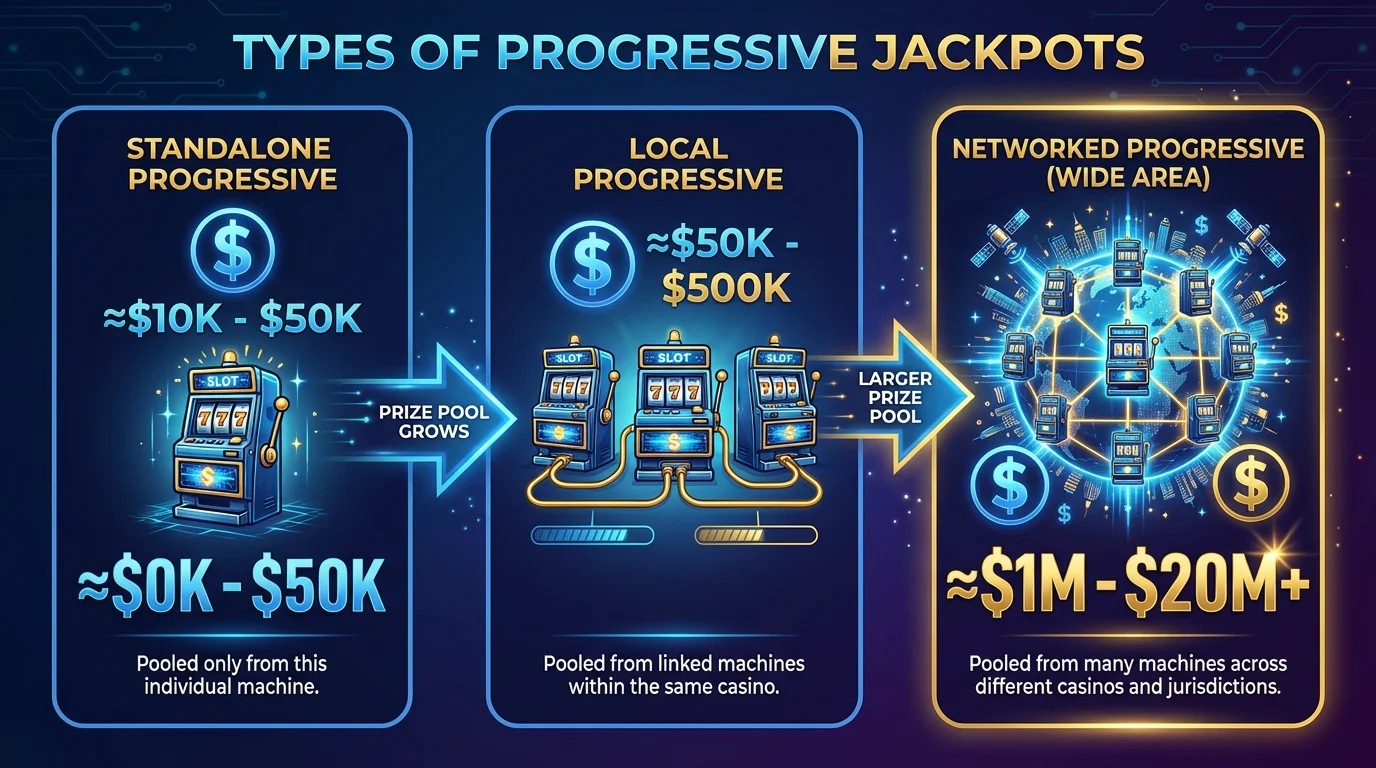
PROGRESSIVE JACKPOT TYPES COMPARED
Standalone
- Fed by a single game only
- Typical range: $10K–$50K
- Grows slowly
- Best odds of winning
Local (In-House)
- Links multiple games within one casino
- Typical range: $50K–$500K
- Medium growth speed
- Moderate odds
Wide-Area Networked
- Connects games across many casinos globally
- Typical range: $1M–$20M+
- Fastest growth
- Longest odds (millions-to-one)
Standalone progressives are tied to a single game. Only bets placed on that specific title contribute to the pool. The jackpot grows slowly and usually tops out in the tens of thousands, but you’re competing against fewer players, which means better relative odds.
Local (in-house) progressives link several games within a single casino or online platform. More players feeding the same pool means faster growth and bigger prizes, typically reaching six figures.
Wide-area networked progressives are the headline-makers. Games like Mega Moolah and Mega Fortune connect across hundreds of casinos worldwide. Every player on every connected site feeds the same jackpot, which is how these prizes reach $10 million, $20 million, and beyond. The trade-off? Your odds of winning are astronomically low because the entire global player base is competing for the same prize.
How Jackpots Are Triggered
Progressive jackpots use three main triggering mechanisms, and different games use different approaches:
SYMBOL COMBINATION
Land a specific combination of the highest-paying symbols across a payline. This is the classic trigger method used in traditional slot machines.
BONUS GAME
Trigger a special bonus round where the jackpot can be won. Mega Fortune uses a multi-tiered wheel — spin deeper into the wheel to reach the Mega Jackpot.
RANDOM TRIGGER
The jackpot can hit on any spin without requiring specific symbols or bonus rounds. Higher bets typically increase the probability of a random trigger.
Many modern progressive slots — including Mega Moolah — use a random trigger mechanism where higher bet sizes improve your chances of entering the jackpot round. However, even minimum-bet players remain eligible. A Michigan player famously won $9.28 million on a $0.20 spin, proving that the RNG doesn’t exclude lower bets — it simply weights trigger probability toward higher ones.
Progressive vs Fixed Jackpots
Understanding the difference between progressive and fixed jackpots helps you decide which suits your playing style and risk tolerance.
PROGRESSIVE VS FIXED JACKPOTS
Progressive Jackpot
- Prize: Grows with every bet until won
- Size: Can reach millions
- RTP: 88–92% (lower base game returns)
- Volatility: Very high
- Reset: Drops to seed amount after a win
Fixed Jackpot
- Prize: Set amount that never changes
- Size: Typically 1,000x–10,000x bet
- RTP: 96–98% (higher base game returns)
- Volatility: Low to high (varies)
- Reset: No reset — same prize every time
The core trade-off is straightforward: progressive slots sacrifice base game RTP to fund a massive top prize. If you’re playing for consistent returns and longer sessions, fixed-jackpot slots treat your bankroll better. If you’re comfortable with a lower hit rate in exchange for a shot at a life-altering payout, progressives are the ticket — just know the math is stacked heavily against you.
Biggest Progressive Jackpot Wins in History
Progressive jackpots have created some of the most dramatic moments in gambling history. Here are the largest verified online wins:
| Game | Amount | Year | Note |
|---|---|---|---|
| Absolootly Mad: Mega Moolah | $23.6M | 2021 | Belgian player |
| Mega Moolah | $23.5M | 2018 | Grand Mondial Casino |
| Mega Fortune | €17.9M | 2013 | Finnish player |
| Mega Moolah | €17.88M (~£13.2M) | 2015 | Guinness World Record — Jon Heywood, UK |
| Irish Pot Luck | $9.28M | 2024 | $0.20 bet — Michigan player |
Mega Moolah alone has paid out roughly €1 billion in total jackpot winnings since its launch in 2006 (as of 2023). Other popular progressive titles include Mega Fortune (luxury theme with a multi-tiered bonus wheel), Hall of Gods (Norse mythology with €7.8M+ payouts), and Wolf Gold (Pragmatic Play’s three-tier progressive with Mini, Major, and Mega jackpots).
Odds and RTP Explained
Here’s the part nobody likes to hear: progressive jackpot slots have lower returns than their non-progressive counterparts. A typical slot might offer 96–98% RTP, meaning you lose $2–$4 per $100 wagered over the long run. Progressive slots drop to 88–92% RTP because 1–3% of every bet is diverted to the jackpot pool instead of being recycled back to players through regular wins.
That missing 4–10% is essentially the price of admission to the jackpot lottery. Your base game experience — the small and medium wins that keep you playing — will be noticeably drier on a progressive slot than on a fixed-jackpot equivalent. If you’re interested in understanding how RTP and house edge affect your sessions, our dedicated guide breaks it down with real numbers.
As for odds, hitting the top-tier progressive jackpot typically sits in the range of 1 in 10 million to 1 in 50 million spins — comparable to a state lottery. Multi-tiered games like Mega Moolah offer Mini ($10+), Minor ($100+), and Major ($10,000+) jackpots with progressively better odds. You can use a variance survival calculator to see how high-volatility games like these affect session outcomes.
THE GAMBLER’S FALLACY
A jackpot that hasn’t paid out in months is not “due” to hit. Every spin uses an independent RNG — previous outcomes have zero influence on future results. A progressive jackpot at $15 million has the exact same per-spin trigger probability as when it was at $2 million. The only thing that changes is the prize size, not the odds.
Tips for Playing Progressive Jackpots
You can’t influence when a progressive jackpot lands — but you can be smarter about how you approach the session. These tips won’t improve your odds, but they’ll protect your bankroll and keep the experience enjoyable.
Set a strict session budget. Progressive slots eat through bankrolls faster than regular slots thanks to their lower RTP. Decide how much you’re willing to lose before you start spinning, and stop when you hit that number. Our bankroll calculator can help you plan sessions based on your total gambling budget.
Check max bet requirements. Some older progressive slots require a maximum bet to qualify for the top jackpot. Modern games like Mega Moolah let you compete on any bet size (with higher bets increasing trigger probability), but always read the game rules first. There’s nothing worse than landing the trigger sequence on a bet that doesn’t qualify.
Choose multi-tier games. Slots with Mini, Minor, Major, and Mega jackpots give you more frequent payouts at the lower tiers. You probably won’t hit the Mega, but landing a $100+ Minor jackpot every few hundred spins extends your session and entertainment value.
Track your risk. Progressive slots are high-volatility by nature. Use a risk of ruin calculator to understand how likely your bankroll is to survive a given number of spins at your chosen bet level.
Play for entertainment, not income. The math guarantees that the vast majority of players will never hit a progressive jackpot. Treat the jackpot as a bonus possibility, not the reason you’re playing. If the base game isn’t fun on its own, choose a different slot.
Pros and Cons
✅ Pros
- Life-changing payouts possible from small bet sizes
- Multi-tier jackpots provide frequent smaller wins
- Engaging bonus rounds and trigger mechanics
- Community excitement as the jackpot climbs
- Available online with low minimum bets ($0.10–$0.20)
- Multiple famous titles to choose from across providers
❌ Cons
- Odds of hitting the top jackpot are millions-to-one
- Base game RTP is 4–10% lower than non-progressive slots
- High volatility drains bankrolls faster
- Growing jackpot counter can fuel compulsive play
- Some games require max bet to qualify for the top prize
Conclusion
Progressive jackpots occupy a unique niche in the slot world: they’re the only format where a single spin can genuinely change your financial life. That said, the math is clear — you’ll experience lower base game returns than standard slots, longer dry streaks, and odds that resemble a lottery more than a casino game. The players who enjoy progressives most are those who treat the jackpot as a pleasant possibility rather than an expectation.
If you’re considering playing progressive slots, start by understanding how RTP affects your sessions, use our bankroll calculator to set realistic session budgets, and explore games risk-free on our free slot demos page before committing real money. That way, you’ll know exactly what you’re signing up for — and you can enjoy the chase without the regret.
KEY TAKEAWAYS
- Before playing: Check whether the game requires max bet to qualify — many modern progressives don’t, but some still do
- Bankroll rule: Allocate no more than 5% of your total gambling budget to progressive sessions
- Pick multi-tier games: Slots with Mini/Minor/Major/Mega jackpots give you more frequent payouts at lower tiers
- Understand the RTP cost: You’re trading 4–10% in base game returns for a shot at the top prize
- No patterns exist: Every spin is independent — a jackpot at $15M is no more likely to hit than at $2M
- Try before you buy: Use free demo modes to test games before playing with real money
FAQs
A progressive jackpot is a prize pool that grows every time someone plays the qualifying slot game. A small percentage (typically 1–3%) of each bet is added to the jackpot, which continues climbing until one player triggers the winning combination. After being won, the jackpot resets to a predetermined seed amount and starts growing again.
Every bet placed on the qualifying game contributes 1–3% to the jackpot pool. On a networked progressive like Mega Moolah, thousands of players across hundreds of casinos are all feeding the same pool simultaneously — which is why these jackpots can grow from $1 million to $20+ million in a matter of weeks.
The odds of hitting a top-tier progressive jackpot are typically between 1 in 10 million and 1 in 50 million spins — comparable to winning a state lottery. Multi-tier games offer better odds on smaller jackpots: you may have roughly 1 in 500,000 odds on a Major jackpot and 1 in 5,000 on a Mini jackpot.
The largest verified online progressive jackpot win was $23.6 million on Absolootly Mad: Mega Moolah in April 2021, won by a Belgian player. Other notable wins include €17.9 million on Mega Fortune (2013) and €17.8 million on Mega Moolah by Jon Heywood in 2015, which earned a Guinness World Record.
It depends on the game. Some older progressive slots require a maximum bet to qualify for the top jackpot. Most modern online progressives (like Mega Moolah) allow any bet size to trigger the jackpot, but higher bets increase the probability of entering the jackpot round. Always check the specific game rules before playing.
A fixed jackpot pays the same predetermined amount every time it’s won. A progressive jackpot grows with every bet until triggered, then resets to a seed amount. Fixed jackpots offer higher base game RTP (96–98% vs 88–92%) and more consistent returns, while progressives sacrifice regular payouts for a shot at a much larger prize.
Yes. All progressive jackpot outcomes are determined by a Random Number Generator (RNG) that is independently tested and certified by regulatory bodies. Each spin has the same statistical probability of triggering the jackpot, regardless of how long it’s been since the last win or how large the current prize pool is.
The jackpot resets to its seed amount — the guaranteed minimum set by the game provider or casino. For example, Mega Moolah reseeds at $1 million. The pool immediately begins growing again as new bets are placed. The winner typically receives the payout as a lump sum, though very large prizes at land-based casinos may be paid in installments.
