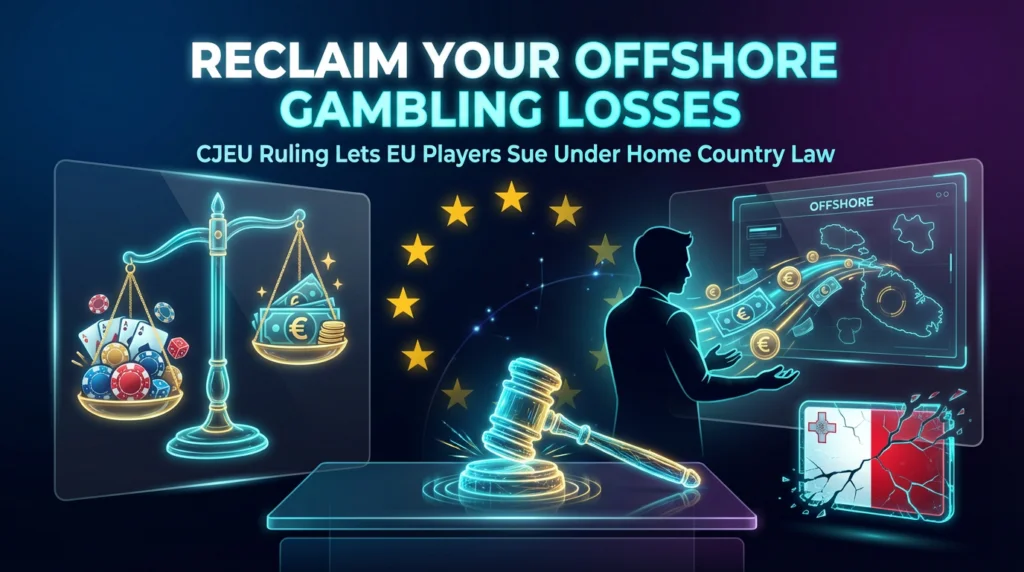
The Court of Justice of the European Union’s January 15, 2026 ruling in Case C-77/24 fundamentally transforms the legal landscape for European players seeking to recover losses from offshore gambling operators. Players can now sue unlicensed operators under their home country’s law, with damage deemed to occur where the player resides—not where the operator is licensed. This preliminary ruling confirms that millions of Europeans who gambled on Malta-licensed platforms may have valid claims for loss recovery, with Austrian and German players positioned to recover losses dating back decades under void-contract doctrines.
KEY FACTS AT A GLANCE
- Ruling: CJEU Case C-77/24 (Wunner), January 15, 2026
- Core Principle: Damage occurs where player resides, not where operator is licensed
- Director Liability: Executives can be personally sued under player’s home country tort law
- Austria Window: 30-year statute of limitations for loss recovery claims
- Pending Claims: 50,000+ across Germany and Austria combined
- Malta Defense: Bill 55 under EU infringement proceedings (INFR(2025)2100)
The Case That Changed Everything
An Austrian consumer identified only as “TE” lost €18,547.67 gambling on the DrückGlück online casino between November 2019 and April 2020. The operator, Titanium Brace Marketing Limited, held a valid Malta Gaming Authority license but lacked authorization under Austria’s gambling monopoly. When Titanium Brace entered liquidation, making corporate assets unavailable, the player pursued an innovative legal strategy: suing the company’s two former directors personally under Austrian tort law.
The Austrian Supreme Court referred two critical questions to Luxembourg. First, does the Rome II Regulation’s exclusion for “company law matters” shield directors from tort claims based on gambling violations? Second, where does “damage occur” in online gambling—the player’s location or the operator’s headquarters?
The CJEU’s First Chamber answered decisively in the player’s favor on both counts. The company law exclusion does not apply because the directors’ liability arose from violating a general statutory prohibition—Austria’s ban on unlicensed gambling—rather than from internal company governance duties. More significantly, the court ruled that under Article 4(1) of Rome II, “the damage sustained by the player is deemed to have occurred in the country in which that player resides.”
The practical mechanism works as follows: payment routing to Malta, server locations, and bank account jurisdictions do not determine where damage occurs. Instead, the interference with a player’s protected interests happens where they reside, where national gambling prohibitions apply, and where their financial loss materializes. Players can therefore rely on their home country’s protective legislation—whether that’s Austria’s void-contract doctrine, Germany’s Interstate Treaty on Gambling, or the Netherlands’ Remote Gambling Act—when bringing claims against foreign operators or their executives.
Austria’s 30-Year Window for Recovery
Austria’s gambling framework creates perhaps the most favorable environment for loss recovery anywhere in Europe. The country maintains a strict monopoly system under the Glücksspielgesetz (Federal Act on Games of Chance), granting exclusive online gambling rights to Österreichische Lotterien GmbH, which operates the Win2day.at platform as the sole legal option. All other operators—including household names like PokerStars, Bwin, Mr. Green, and Bet365—operate illegally under Austrian law despite holding Malta licenses.
The legal foundation for recovery is remarkably powerful. Section 879(1) of the Austrian Civil Code declares that contracts violating legal prohibitions are void. Since gambling contracts with unlicensed operators violate the Glücksspielgesetz, they are absolutely null from inception. Section 877 then mandates reversal: parties must return what they received. Players can claim net losses (deposits minus withdrawals) as unjust enrichment, with Austria’s extraordinary 30-year statute of limitations meaning the entire era of online gambling remains claimable.
Austrian courts have consistently supported this doctrine. The Supreme Court’s June 2021 landmark ruling ordered Flutter-owned PokerStars to refund €28,000 in player losses, rejecting the operator’s argument that Austria’s monopoly violated EU law. Since then, Austrian legal firms have filed thousands of claims—averaging approximately five per day—with over €75.8 million recovered for 2,500+ gamblers as of early 2023.
CRITICAL WARNING: BILATERAL NULLITY
- A 2024 Austrian Supreme Court ruling established that contract nullity works both directions
- In one case, a player was ordered to return €626.60 after claiming winnings while seeking loss recovery
- If players could keep winnings while reclaiming losses, gambling would become risk-free
- Net loss claimants are safer; anyone with significant winnings should obtain legal advice first
Malta’s Bill 55 Defense Is Under Siege
Malta hosts over 321 licensed gambling companies generating more than 12% of national GDP and employing approximately 16,000 people. When Austrian and German loss recovery lawsuits began threatening this lucrative industry, Malta responded with aggressive defensive legislation.
Bill 55, enacted in June 2023 and codified as Article 56A of the Gaming Act, empowers Maltese courts to refuse recognition and enforcement of foreign judgments against MGA-licensed operators when such judgments “conflict with or undermine the legality of the provision of gaming services in or from Malta.” The law has proven effective: in January 2026, Malta’s First Hall Civil Court rejected enforcement of an Austrian judgment ordering Betway to repay €83,000, ruling it “manifestly contrary to the public policy of the Maltese state.”
But Malta’s shield is cracking. The European Commission launched formal infringement proceedings (INFR(2025)2100) in June 2025, alleging Malta fails to comply with the Brussels I bis Regulation governing cross-border judgment recognition.
EU COMMISSION CHARGES AGAINST MALTA
The Allegations
- Malta requires courts to “systematically refuse” judgments from other member states
- The law discourages foreign litigants from pursuing legitimate claims
- It undermines mutual trust in EU judicial administration
- It exceeds limits of the public policy exception
Malta’s Defense
- MGA maintains Bill 55 “does not impose a blanket ban”
- Claims it codifies longstanding public policy consistent with EU law
- Committed to “engaging in constructive dialogue” with Commission
- Two-month response window was given in June 2025
Germany’s regulator GGL called Malta’s law “unlikely to be compatible with European requirements,” and critics have labeled it a “sledgehammer” creating “a free port for the gambling industry.” If proceedings advance, the case will reach the CJEU itself—potentially invalidating Article 56A entirely.
Practical Pathways to Recovery
For players seeking to reclaim losses, multiple enforcement strategies exist even while Malta’s defenses remain partially intact. Understanding these pathways—and which operators hold assets where—is essential for successful recovery. Players concerned about legal controversies surrounding major operators should note that enforcement mechanisms continue to expand.
Realistic timelines span 2-5 years depending on complexity and appeals. First-instance court rulings typically take 12-18 months; appeals add another 12-24 months; ECJ references (if EU law questions arise) add 18-24 more months. Enforcement in non-Malta jurisdictions takes 3-6 months once judgments are obtained.
Germany’s Litigation Wave Offers a Template
Germany is experiencing a massive wave of gambling loss recovery lawsuits, providing a template for what may unfold EU-wide. The German Federal Court of Justice (BGH) ruled in June 2024 that gambling contracts violating statutory prohibitions are void under Section 134 of the Civil Code, and payments must be reimbursed.
The licensing timeline creates clear liability windows. Sports betting licenses became available from October 2020; online casino licenses from October 2022. All player losses before these dates from unlicensed operators remain potentially recoverable. Courts in Giessen, Traunstein, Ulm, and Frankfurt have ordered operators including Bwin, Unibet, Bet-at-home, and 888 Casino to repay losses. The Köln Regional Court ordered a Gibraltar-based operator to refund €25,375.
| ECJ Case | Operator | Details | Status |
|---|---|---|---|
| C-530/24 | Tipico | German player seeking €3,719 for bets placed 2013-2018 | Decision expected Q2 2026 |
| C-440/23 | Lottoland | Similar reimbursement questions | Pending |
| AG Opinion | Multiple | Sept 2025: Seeking reimbursement is not abuse of EU law | Favorable signal |
The Netherlands’ Gambling Authority (KSA) operates one of Europe’s most aggressive enforcement regimes, with fines up to €2 million or 10% of annual turnover. Dutch courts ruled in April 2024 that losses from unlicensed poker sites must be repaid. A pending Dutch Supreme Court reference could clarify whether pre-October 2021 gambling agreements are categorically void.
US and UK Players Have No Equivalent Remedy
The EU’s recovery mechanism has no parallel in the United States or United Kingdom, making the European legal framework uniquely powerful for affected players.
American players using offshore casinos have no legal recourse. As one analysis noted, offshore operators “are not beholden to our laws regarding requisite cybersecurity measures, [and] U.S. citizens have no legal recourse in claims court.” The Wire Act and UIGEA target operators, not player recovery. Offshore sites operate from Antigua, Costa Rica, Panama, and Curaçao—jurisdictions beyond US enforcement reach. Despite 74% of US online gambling revenue ($67 billion annually) flowing through offshore operators, no recovery mechanism exists or is expected to develop given America’s state-by-state regulatory fragmentation.
UK players face similar limitations post-Brexit. The UK is no longer subject to CJEU jurisdiction or EU regulations like Rome II. Players at non-GamStop casinos (typically Malta or Curaçao licensed) are not covered by UK gambling laws and lack UKGC consumer protections. One potential avenue exists: players may pursue claims through banks under new scam-protection regulations, arguing unregulated gambling constitutes fraud. But this is untested and far narrower than the EU mechanism.
The EU’s unique position derives from its supranational legal architecture: treaty-based single market principles, harmonized conflict-of-law rules, CJEU authority binding on all member states, and Brussels I Recast enabling cross-border judgment recognition. Neither the US nor UK should expect similar developments without fundamental legal reform. Players in these jurisdictions should instead focus on understanding how house edge and RTP work and using tools like our bankroll calculator to manage their gambling responsibly.
Industry Faces an Existential Reckoning
Gambling industry analysts interpret the Wunner ruling as a watershed moment threatening Malta’s entire regulatory model. GTG Legal, a Maltese law firm, acknowledged the outcome is “likely unwelcome to gambling operators who may now face claims in multiple jurisdictions.” NEXT.io noted the ruling “calls into question the legal theory underpinning offshore gaming hubs in Malta and other European-facing jurisdictions.”
The financial exposure is staggering. Germany and Austria alone have an estimated 50,000+ pending claims. One Austrian law firm reports €18 million in claims against Flutter’s PokerStars alone. Flutter owes approximately €17 million in court-ordered refunds; 888’s Mr. Green owes €12.6 million. Industry-wide, the pending ECJ decisions could create billions of euros in liabilities.
| Operator Group | Key Brands | Known Liability |
|---|---|---|
| Flutter Entertainment | PokerStars, Betfair, Paddy Power | €17M+ court-ordered refunds |
| Evoke (formerly 888) | Mr. Green, William Hill, 888 Casino | €12.6M+ owed |
| Entain | Bwin, Ladbrokes, Coral | Multiple cases pending |
| Kindred Group | Unibet, 32Red | Named in Dutch class action |
Operators face difficult strategic choices. Conservative operators may proactively geo-block players from Austria (pending regulatory reform expected summer 2026), Germany (major Tipico decision expected Q2 2026), and the Netherlands (strong enforcement actions ongoing). Austria is exploring both IP blocking and payment blocking of unlicensed operators’ bank accounts. Germany’s GGL plans to tighten IP blocking measures from May 2026.
The ruling’s personal liability dimension creates novel executive risk. Directors may face claims in jurisdictions where they have personal assets, potentially affecting D&O insurance requirements and executive compensation structures.
What Players Should Do Now
For EU players with net gambling losses from operators lacking local licenses, the path forward is clearer than ever. Germany and Austria offer the most developed recovery infrastructure: strong precedents, active litigation funders, and favorable court treatment. The Netherlands provides opt-out class action mechanisms.
ACTION STEPS FOR AFFECTED PLAYERS
- Document losses: Submit GDPR Subject Access Requests to operators (30-day response deadline)
- Calculate net position: Deposits minus withdrawals to determine if claims are viable
- Contact litigation funders: AdvoFin (Austria/Germany) or Gokverliesterug (Netherlands) for risk-free representation
- Be cautious about winnings: If significant winnings were received, operators may counterclaim under bilateral nullity doctrine
- Consider timing: Austria’s 30-year window is generous, but Germany’s statute of limitations is shorter
The January 2026 CJEU ruling hasn’t eliminated all obstacles—Malta’s Bill 55 remains partially functional, enforcement timelines stretch years, and operators will fight every step. But the legal foundation for mass recovery is now firmly established. For the estimated 50,000+ claimants already in the pipeline, and the many more likely to follow, the ruling represents what one litigation financier called “the noose tightening for operators of illegal gambling.”
Players should use our realistic expectations calculator to understand gambling mathematics before engaging with any platform, and our risk of ruin calculator to assess their exposure.
KEY TAKEAWAYS
- Home country law now applies — Players can sue under their own jurisdiction’s consumer protection laws, not the operator’s license jurisdiction
- Damage occurs where you live — CJEU confirmed that financial harm materializes at the player’s residence, not Malta or Gibraltar
- Directors are personally liable — Executives can be sued individually when companies violate national gambling prohibitions
- Austria offers 30-year window — The entire era of online gambling remains claimable under void-contract doctrine
- Malta’s Bill 55 is under attack — EU infringement proceedings threaten the island’s judgment-blocking shield
- Litigation funders eliminate risk — No-upfront-cost representation available for qualifying claims
- 50,000+ claims pending — Germany and Austria leading the recovery wave across Europe
- US/UK players have no equivalent — The EU’s supranational legal architecture creates unique recovery mechanisms
Sources
- CJEU Case C-77/24 (Wunner) — Court of Justice of the European Union
- Malta Gaming Authority Official Statements — MGA
- EU Infringement Proceedings INFR(2025)2100 — European Commission
- Austrian Glücksspielgesetz (Federal Act on Games of Chance) — Austrian Legal Information System
- German Federal Court of Justice (BGH) Gambling Rulings — Bundesgerichtshof
- Netherlands Gambling Authority (KSA) Enforcement Actions — Kansspelautoriteit
