Indiana’s top gaming regulator admitted sweepstakes casinos aren’t breaking state law during a January 6 hearing—the clearest acknowledgment yet that the dual-currency model operates in a legal gray zone that lawmakers can’t touch without new legislation.
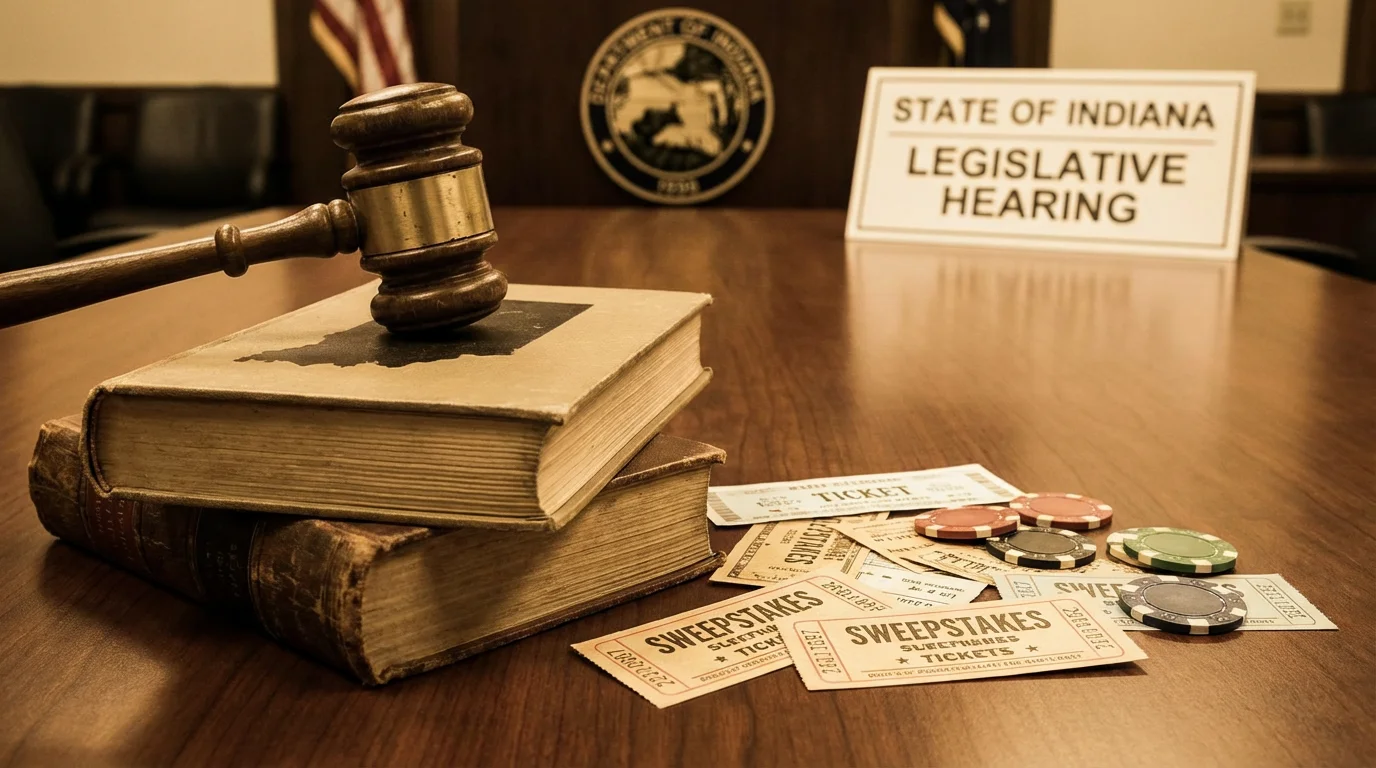
The admission set off a contentious debate that exposed deep divisions over whether to ban, regulate, or simply wait for broader iGaming legalization.
KEY FACTS AT A GLANCE
- What Happened: Indiana Gaming Commission testified sweepstakes casinos not illegal under current law
- Bill: HB 1052 by Rep. Ethan Manning (R-Cass)
- Penalty: $100,000 civil fine per violation
- Effective Date: July 1, 2026 (if passed)
- Indiana Players: ~200,000 estimated (industry testimony)
- At Stake: $67 million/month regulated gaming market
- Hearing Outcome: No vote taken; committee deeply divided
The Legal Gray Zone Explained
When Rep. Ethan Manning asked Indiana Gaming Commission officials what authority they had to act against sweepstakes casinos, General Counsel Natalie Huffman delivered a surprisingly candid answer.
“It’s nuanced, but we don’t think so, which is why we need this legislation. Other states think their gambling laws are written in a way that is able to be used against these online casinos. But I don’t think that the way that our gambling laws are written, we can move forward with sending a cease-and-desist letter in good faith, based on current law.”
— Natalie Huffman, IGC General Counsel
Manning himself acknowledged the uncomfortable reality: “They’re not breaking any current laws.” But he argued that without passing the prohibition, the legislature would effectively be endorsing sweepstakes casinos—even though Indiana has repeatedly failed to pass iGaming legislation for its licensed brick-and-mortar casinos.
The admission underscores why sweepstakes platforms have proliferated across the country. They’ve found a legal pathway that existing gambling statutes simply weren’t written to address.
How Sweepstakes Casinos Actually Work
To understand why the IGC can’t prosecute sweepstakes operators, you need to understand how gambling is legally defined. In Indiana—like most U.S. jurisdictions—an activity constitutes illegal gambling only when three elements are present simultaneously:
THE THREE PILLARS OF GAMBLING LAW
1. PRIZE
The participant can win something of value (cash or equivalents)
2. CHANCE
Outcome determined primarily by chance, not skill (slots, dice, etc.)
3. CONSIDERATION
Player must pay money or provide value to participate
Remove any single pillar and the activity becomes a legal contest or sweepstakes. Sweepstakes casinos exploit the “consideration” pillar using a dual-currency model that legally separates “payment” from “play.”
Gold Coins: Players purchase “gold coins” with real money. These coins are strictly for entertainment—they have no monetary value and cannot be redeemed for prizes. Legally, buying gold coins is equivalent to purchasing credits in any video game.
Sweeps Coins: This is the currency used to play games for redeemable cash prizes. The critical distinction: sweeps coins cannot be purchased directly. They’re given to players as a “free promotional bonus” when they buy gold coins, or through other free methods like daily login bonuses or social media promotions.
The Legal Argument: When a player spins a slot machine using sweeps coins, operators argue there is no “consideration.” The player didn’t pay for the sweeps coins—they were a free gift. The money spent was for gold coins (entertainment), not for the chance to win prizes. Therefore, the transaction lacks the “wager” component required under Indiana Code § 35-45-5-1, which defines gambling as “risking money or other property for gain.”
The AMOE Shield: To fortify this argument, platforms offer an Alternate Method of Entry (AMOE). Players can obtain sweeps coins without spending anything—typically by mailing a handwritten request to the operator’s headquarters. This proves that payment isn’t required to participate, cementing the legal position that gold coin purchases are voluntary and separate from the sweepstakes promotion.
This is the “nuance” Huffman referenced. Indiana’s statutes require a direct wager to constitute gambling. By decoupling payment from play through the dual-currency structure, sweepstakes operators have placed themselves beyond the IGC’s current enforcement authority.
Three Factions, Three Approaches
The hearing revealed that Indiana lawmakers are sharply divided into three distinct camps on how to handle sweepstakes casinos.
THE THREE FACTIONS
BAN IT
Rep. Ethan Manning (bill author) + IGC support
- Immediate prohibition via HB 1052
- $100K civil penalty per violation
- Clear the “weeds” before planting iGaming
REGULATE IT
Rep. Steve Bartels (proposed amendment)
- License and regulate instead of ban
- Capture tax revenue from existing market
- Consumer protections through oversight
LEGALIZE iGAMING
Rep. Kyle Miller (iGaming amendment)
- Sweeps exist because legislature failed to pass iGaming
- Authorize regulated online casinos for licensed operators
- Address root cause, not symptom
Rep. Bartels questioned the ban-first approach directly:
“We’re going to ban them without trying to regulate them first? The first time we’re here, we’re going to ban this? They’re not violating any laws, but maybe we need to regulate them.”
— Rep. Steve Bartels
Rep. Kyle Miller introduced an amendment to HB 1052 that would authorize iGaming, arguing that sweepstakes casinos are a direct result of the legislature’s failure to provide a regulated alternative:
“Clearly, [sweeps] have cleverly found a way that doesn’t quite fit the definition of iGaming. And my contention is they’re able to do this because we’ve not passed a legal framework for iGaming.”
— Rep. Kyle Miller
The IGC resisted this linkage. Huffman argued that regulating sweepstakes would be premature given that the legislature has repeatedly failed to pass iGaming bills for the state’s existing casino licensees:
“In light of the fact that this body has not regulated iGaming for our already regulated casinos, I think this would be out of order to regulate this type of conduct when we’ve not legalized iGaming for our already regulated casinos.”
— Natalie Huffman, IGC General Counsel
This creates a circular policy trap: the state can’t regulate sweepstakes because it hasn’t regulated iGaming, and sweepstakes proliferate because there’s no legal iGaming alternative.
The Consumer Protection Debate
Rep. Jim Lucas emerged as the most vocal critic of the ban approach, arguing that punishing companies for finding a legal path is bad policy.
“I don’t think it’s right that an industry found a way to work within the boundaries of the law, and just because we don’t have our ducks in a row to legislate these industries and regulate them, we should punish them by outright banning them. It’s incumbent upon us to find a way to make this work, because I don’t think we should be in the business of picking winners and losers.”
— Rep. Jim Lucas
The Social Gaming Leadership Alliance (SGLA), the industry’s primary lobbying group, testified that approximately 200,000 Hoosiers use sweepstakes platforms. SGLA Executive Director Jeff Duncan has consistently argued the industry wants regulation: “We want to be regulated, we want to pay taxes.”
The subtext of this debate is consumer protection. Proponents of regulation argue that banning compliant domestic operators doesn’t eliminate demand—it simply pushes players toward unregulated offshore platforms that offer no consumer protections, responsible gambling tools, or recourse for disputes.
The Economic Stakes
Indiana’s gaming market is a significant source of state revenue—and the “gray market” status of sweepstakes casinos represents a major leakage of potential tax dollars.
Regulated casinos in Indiana are subject to a robust tax regime. In June 2025 alone, the state collected over $67 million in wagering and supplemental taxes from licensed operators. Sports betting is taxed at 9.5% of adjusted gross receipts, with casino wagering taxes generating substantial additional revenue.
In contrast, sweepstakes casinos pay $0 in specific gaming taxes. Because they frame their business as the sale of “entertainment” (gold coins), they avoid the high-margin gaming levies entirely. This is the “free rider” problem that frustrates regulators and incumbents alike.
Legislative estimates for iGaming legalization suggest the state could generate over $300 million annually in new tax revenue. Since sweepstakes casinos are currently fulfilling the market demand for online gaming, they’re essentially capturing this market value without remitting the corresponding tax. By banning them without a regulated alternative, the state would effectively destroy a market rather than monetize it.
This economic reality underpins Rep. Bartels’ argument for regulation: if these operators are legal, Indiana is leaving money on the table by failing to tax them.
What Happens When States Ban vs. Regulate
Indiana’s debate is playing out against a backdrop of aggressive enforcement actions worldwide—and the results offer a cautionary tale about what happens when regulators choose prohibition over pragmatic regulation.
California banned, operators fled: When California enacted AB 831, Stake.us and over 20 other sweepstakes platforms exited the state. The $2.4 billion California market didn’t disappear—players simply migrated to offshore alternatives beyond state jurisdiction.
UK raised taxes, operators left: The UK’s decision to impose a 40% remote gaming duty triggered an exodus of licensed operators. GG.Bet and others surrendered their UK licenses, and industry analysts warn “around a dozen companies are actively looking to sell.” Players don’t stop gambling—they migrate to Curaçao-licensed crypto casinos with 0-2% effective tax rates and no consumer protections.
Turkey cracked down, betting went underground: Turkey weaponized its banking system against online gambling, seizing $379 million and blocking 233,000+ websites. But with 40-58% cryptocurrency adoption, Turkish bettors are simply shifting to crypto-based platforms beyond banking surveillance.
The pattern is consistent: ban compliant operators, and players migrate to unregulated alternatives. The gambling continues—just without consumer protections, responsible gambling tools, or tax revenue.
What’s Next
The House Public Policy Committee did not vote on HB 1052. Chairman Manning said he expects to bring the bill back “in the next couple of weeks” for further action.
The hearing exposed how unprepared lawmakers are to handle an industry that found a legal workaround to gambling prohibitions. Eight states have now legislatively banned sweepstakes casinos, with another two believing their existing regulations already prohibit the model. Nine states—including Indiana—are actively considering bans in 2026.
Indiana’s short 2026 legislative session ends in mid-March, giving lawmakers limited time to resolve whether to ban an industry that, by the state’s own admission, isn’t breaking any laws.
KEY TAKEAWAYS
- IGC confirmed legality — Sweepstakes casinos operate legally under current Indiana law; the commission can’t send cease-and-desist letters “in good faith”
- Three pillars defense — Dual-currency model eliminates “consideration” element required to constitute gambling under Indiana Code
- Lawmakers deeply divided — Three factions emerged: ban (Manning), regulate (Bartels), or legalize iGaming first (Miller)
- $300M revenue opportunity — State could capture significant tax revenue by regulating rather than banning
- Offshore migration risk — Banning compliant operators historically pushes players to unregulated platforms
- No vote taken — Bill expected to return for committee action in coming weeks
Sources
- Indiana House Bill 1052 — Indiana General Assembly
