Here’s a thought experiment that would have gotten you laughed out of any newsroom five years ago: What if, instead of watching a CNBC anchor speculate about whether the Federal Reserve will cut rates, you could bet actual money on it—right there on screen?
Congratulations. That’s no longer a thought experiment.
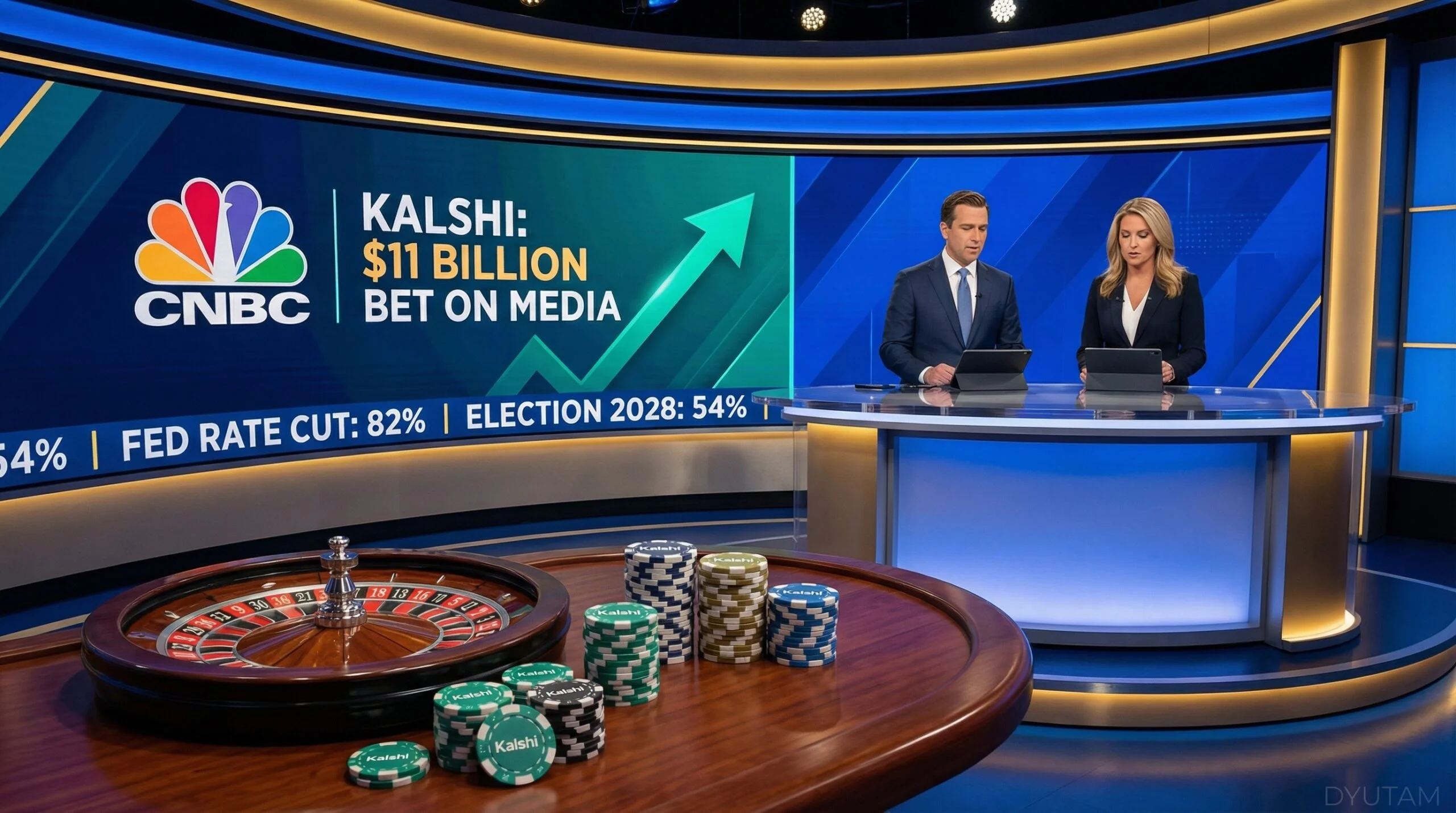
On December 4, 2025, CNBC announced a multi-year exclusive partnership with Kalshi, the prediction market platform that lets you wager on everything from Fed decisions to Super Bowl outcomes. Starting in 2026, real-time betting odds will appear on Squawk Box, Fast Money, and across CNBC’s digital ecosystem—complete with a dedicated Kalshi ticker and probability widgets on the app.
This isn’t just a business deal. It’s a philosophical shift in how we consume information—the moment prediction markets graduated from niche curiosity to mainstream media infrastructure. Depending on whom you ask, it’s either the dawn of a more honest information economy or proof that we’ve decided to financialize literally everything, including reality itself.
The Deal: What Actually Happened
The partnership arrived with almost comedic timing. Just one day earlier, Kalshi had announced a similar deal with CNN. Two days before that, the company closed a $1 billion funding round at an $11 billion valuation. The message was clear: prediction markets aren’t coming—they’re here.
| Component | Implementation |
|---|---|
| Linear TV | Permanent “Kalshi Ticker” on Squawk Box, Fast Money displaying live probabilities (e.g., “Fed Rate Cut: 82%”) |
| Digital | Embedded probability widgets on CNBC.com and mobile app; dedicated CNBC landing page on Kalshi.com |
| Subscription | Deep-dive analytics integrated into CNBC Pro and Investing Club as premium “alpha” source |
| Editorial | CNBC editors curate specific markets to feature, aligning news cycles with tradable contracts |
For CNBC’s parent company—newly spun off as Versant Media Group—this is strategic survival. Linear cable is dying. Subscription revenue is the future. And nothing says “premium content” quite like proprietary data you can’t get from Yahoo Finance.
“The long-term vision is to financialize everything and create a tradable asset out of any difference in opinion.”
— Tarek Mansour, Kalshi CEO
Critics called it “casino capitalism.” Mansour called it Tuesday.
From MIT Dorm Room to $11 Billion
Every Silicon Valley success story needs a dorm room, and Kalshi delivers. Tarek Mansour (raised in Lebanon) and Luana Lopes Lara (a former professional ballerina from Brazil) met as MIT computer science students before doing stints at Goldman Sachs, Citadel, and Bridgewater. They founded Kalshi in 2018 with a radical proposition: build the first federally-regulated prediction market in the United States.
The key word is “regulated.” While competitors like Polymarket embraced crypto rails to sidestep U.S. jurisdiction, Kalshi took the slow road—applying for designation as a Designated Contract Market under the CFTC. The process was brutal. The payoff was a regulatory moat that made the CNBC partnership possible.
| Date | Round | Amount | Valuation |
|---|---|---|---|
| Feb 2021 | Series A | $30M | ~$100M |
| Jun 2025 | Series C | $185M | $2B |
| Oct 2025 | Series D | $300M | $5B |
| Dec 2025 | Series E | $1B | $11B |
That’s a 110x valuation increase in four years. The investor list reads like a who’s who of tech and finance: Sequoia, Andreessen Horowitz, Paradigm, and ARK Invest. Co-founder Luana Lopes Lara, at 30, became the youngest female self-made billionaire following the December round.
Here’s the twist: the company’s explosive growth wasn’t powered by economic indicators or Fed rate contracts. It was powered by sports betting, which now accounts for 75% of platform volume.
Kalshi built its regulatory legitimacy on serious financial instruments, then rode the sports wave to unicorn status.
The Legal Battle That Made It All Possible
The CNBC partnership would have been legally impossible without a landmark judicial victory in late 2024. For years, the CFTC blocked Kalshi from listing political contracts, arguing that election betting constituted “gaming” under the Commodity Exchange Act.
Kalshi’s counter-argument was elegantly nerdy: “gaming” specifically refers to playing a game (poker, football, roulette), not the act of wagering itself. Elections aren’t games—they’re fundamental economic events with massive consequences for taxes, trade policy, and regulation.
“Kalshi’s contracts do not involve unlawful activity or gaming. They involve elections, which are neither.”
— Judge Jia Cobb, September 2024
The D.C. Circuit Court denied the CFTC’s emergency stay request weeks before the 2024 election. What happened next was the regulatory equivalent of the floodgates opening:
- One million new users signed up during the election period
- Trading volume hit $1 billion on Election Day alone
- Kalshi became the most-downloaded app on the App Store
- The platform’s 58-66% Trump odds proved more accurate than most polls showing a toss-up
The legal certainty was the green light institutional partners needed. CNBC, Robinhood, and Interactive Brokers could integrate without fear of aiding illegal gambling.
The 2024 Election: When Markets Beat Pollsters
If the legal victory was the catalyst, the 2024 election was the proof of concept—a massive, real-time A/B test between traditional polling and prediction markets.
The results weren’t close. Post-election analyses from Columbia and Vanderbilt found that prediction markets provided earlier and more stable signals of the eventual outcome than polling aggregates. In Pennsylvania, Nevada, and Georgia, markets favored Trump weeks before polls moved out of the margin of error. While polls needed 5-7 days to adjust after major events, markets repriced in minutes.
The defining moment was the “French Whale”—a single trader who wagered over $30 million on Trump through Polymarket. Critics screamed manipulation. Then it emerged that the trader had commissioned private polling using “neighbor-method” techniques that detected a silent majority public polls were missing. The whale wasn’t manipulating the market. He was correcting it.
For CNBC, this narrative is catnip. The market “knew” before the experts did. Crowds beat pundits. Capital beat credentials. The academic evidence is more nuanced—prediction markets mostly follow polls when high-quality polling is available—but nuance doesn’t make for good television.
The Sports Betting Graveyard: A Cautionary Tale
Before we crown Kalshi the future of financial media, let’s examine what happened when sports betting tried the same playbook.
ESPN, Fox, NBC—everyone wanted in. The theory was simple: marry trusted media brands with betting platforms, and users would flock to bet with the names they knew. The reality was a bloodbath:
| Partnership | Investment | Duration | Outcome |
|---|---|---|---|
| ESPN-Penn | $1.5B (10-year) | 2 years | 3% market share; terminated Dec 2025 |
| Fox Bet | $236M | 4 years | <1% share; shut down Aug 2023 |
| NBC-PointsBet | $500M (5-year) | 2 years | Sold for $150-225M to Fanatics |
The pattern is consistent: media brand recognition doesn’t translate to betting market share. DraftKings and FanDuel control approximately 70% of the market. Late entrants with famous brands—ESPN, Fox, SI Sportsbook—all failed.
Why should Kalshi be different? Timing. Unlike ESPN Bet launching into an entrenched market, Kalshi is establishing itself as prediction markets go mainstream. There’s no FanDuel of prediction markets—just Polymarket, which can’t legally operate in the U.S. directly. Kalshi isn’t a late entrant; it’s building the category.
But the cautionary tale remains: media integration is not a magic bullet.
The State vs. The Exchange: Regulatory Whack-a-Mole
Here’s the uncomfortable truth Kalshi doesn’t emphasize: the company’s federal approval hasn’t settled anything. Nine states have issued cease-and-desist orders. Kalshi faces 18 active lawsuits. And the fundamental question—are prediction markets gambling or derivatives?—remains unanswered.
| State | Action | Status |
|---|---|---|
| Connecticut | Cease & Desist | Issued Dec 3, 2025; Kalshi counter-sued same day |
| Nevada | Injunction | Federal court ruled Kalshi must stop operating; appeal pending |
| New York | AG Lawsuit | Pending in federal court |
| Massachusetts | AG Suit | Filed Sept 2025; preemption questions unresolved |
| New Jersey | Lawsuit | 34 state AGs filed brief supporting NJ’s case |
Connecticut’s order, issued one day before the CNBC announcement, explicitly labeled Kalshi’s products as “unlicensed online gambling, specifically sports wagering.”
“State law doesn’t really apply to us.”
— Tarek Mansour, Kalshi CEO
Kalshi argues that CFTC registration preempts state gambling laws—a theory that, if successful, would allow any betting product to bypass state licensing by structuring itself as a derivatives contract. A November 2025 Nevada ruling rejected this logic: “Kalshi’s interpretation would require all sports betting to come within CFTC jurisdiction… that upsets decades of federalism.”
The irony is thick. Kalshi spent years building regulatory legitimacy through CFTC approval. Now it’s arguing that federal approval makes state regulation irrelevant. If Kalshi wins, prediction markets become a regulatory arbitrage opportunity. If it loses, sports contracts—75% of volume—become illegal in key states.
The Competition: A Platform War
Kalshi isn’t alone in the prediction market gold rush. The competitive landscape is evolving rapidly.
| Feature | Kalshi | Polymarket |
|---|---|---|
| Regulatory Status | US CFTC-Regulated DCM | Offshore; geo-blocked US users |
| Currency | USD (Fiat) | USDC (Crypto) |
| Nov 2025 Volume | ~$5.8 billion | ~$3.7 billion |
| Media Strategy | Exclusive TV deals (CNBC, CNN) | Data integrations (Bloomberg, Yahoo) |
| Target User | Retail/institutional via brokerages | Crypto natives, global users |
Polymarket dominated the 2024 election with $3.7 billion in presidential betting volume, but its offshore status limits U.S. media partnerships. Combined, both platforms executed $10 billion in trading volume in November 2025 alone.
Then there’s Opinion, backed by Binance founder CZ, which launched with eye-popping volume figures—$1.5 billion weekly within four weeks. The catch? Forensic analysis suggests much of this is wash trading. This actually highlights Kalshi’s value proposition: regulated markets with surveillance against manipulation produce data you can trust on television.
The Uncomfortable Questions
The Feedback Loop Problem
When a CNBC reporter breaks news about a potential merger, the Kalshi contract will spike. The reporter can then cite the spike as “market confirmation.” This creates a closed loop where news drives markets drives news—a self-reinforcing cycle that can amplify rumors. Unlike stock prices tethered to cash flows, event contracts are tethered to outcomes that can be influenced by perception of their probability.
The Financialization of Suffering
A Kalshi contract asking “Will there be mass starvation in Gaza?” drew intense backlash for gamifying human suffering. Where exactly is the line? Will CNBC display tickers for casualty counts? The partnership forces editorial teams to make uncomfortable decisions about which aspects of reality are appropriate to commodify on national television.
The Conflict of Interest
By partnering with an exchange, CNBC has a financial incentive to drive volume. Will anchors disclose that the network benefits when viewers trade on the odds they’re discussing? The line between “reporting on the market” and “promoting the casino” becomes dangerously thin.
The Gambling Normalization Concern
Since the 2018 Supreme Court decision legalizing sports betting, problem gambling hotline calls have increased 124%. Pew Research found that 43% of Americans now say legal sports betting is “bad for society”—up from 34% in 2022. Prediction markets extend gambling opportunities into politics, economics, weather, and culture—all from one app, available to anyone 18 or older.
The Road Ahead
Kalshi’s future hinges on unresolved legal questions. The D.C. Circuit hasn’t ruled on the CFTC’s election contracts appeal. State lawsuits could take years. If prediction markets require state-by-state licensing like sports betting, Kalshi faces years of regulatory slog. If federal preemption holds, it operates nationwide without state oversight.
For now, Kalshi is betting that mainstream media integration creates facts on the ground. With CNBC displaying Kalshi prices on flagship programs, Google showing prediction data alongside stock quotes, and $11 billion of venture capital in the bank, prediction markets are normalizing faster than regulators can respond.
The Bottom Line
The Kalshi-CNBC partnership crystallizes a transformation years in the making. Prediction markets have evolved from academic curiosities to multi-billion-dollar platforms integrated with America’s most influential financial networks. The question is no longer whether they’ll go mainstream—they already have.
What remains contested is everything else: Is this regulated trading or gambling by another name? Should federal approval override state gambling laws? Can these markets maintain accuracy as they attract recreational bettors? Will media integration compromise journalistic integrity?
Kalshi has advantages its sports betting predecessors lacked—first-mover status, federal approval, and timing that favors category creators. But with 18 active lawsuits and increasingly coordinated state regulators, the company is building on contested legal ground.
The next year will determine whether prediction markets become a permanent fixture of American financial media or a cautionary tale about regulatory arbitrage. Either way, the experiment has begun. The casino is open. The ticker is live. And CNBC would like to show you the odds.
