New York’s AI Proposal Would Make Sportsbooks Prove Why Your Bonus Is Different
New York’s AI proposal would put data-linked betting offers under scrutiny, with public criteria, regulatory records and narrow exceptions.
Proposed New York AI sports betting rules would make a different bonus a question of proof: when an offer varies with a bettor’s personal data, the operator would need records showing the Gaming Commission that the difference came solely from permitted, published criteria. Regulators voted to propose the restrictions on October 9, 2026; they have not adopted them.
KEY FACTS AT A GLANCE
- Status: Proposal approved for rulemaking on October 9; not an adopted rule.
- Core restriction: Individual-data-driven automated promotions and wager suggestions.
- Proof: Logs supporting published, objective criteria that satisfy the permitted-use conditions.
- Exception: A separate, tightly restricted opt-in app for pari-mutuel horse-racing suggestions.
A different offer would need a defensible reason
Two customers can receive different offers for different reasons. A public eligibility rule is one possibility. A prediction about which customer will deposit again is another. New York’s draft would make that distinction enforceable through the operator’s records.
The proposal reaches beyond sportsbooks to casinos, video lottery operators, racing businesses and lottery couriers. It also covers affiliates, agents and vendors acting for licensees. Its definition of individual data includes cookie and device identifiers, inferred traits, third-party information and customer segments. Acquisition targeting could therefore fall within scope before someone opens an account.
Section 5404.1(c) would establish a rebuttable presumption: differences in recipients, content, timing or amounts associated with individual data would be presumed to violate the rule. The operator could overcome that presumption only with clear and convincing evidence, supported by logs, that permitted published criteria alone produced the variation.
That moves the issue beyond obtaining a copy of a sportsbook’s customer-profile data. The proposed obligation would fall on the operator to demonstrate compliance to the Commission.
STATUS CHECK: OCTOBER 22, 2026
The October 21 State Register and the Commission’s current proposed-rules list contain no formal notice or comment deadline for this October AI proposal. The Commission page still carries the earlier pre-proposal material. A formal notice’s publication in the Register starts the minimum 60-day comment period.
AI bet suggestions and bonuses face separate restrictions
The legal test would not depend on a product being advertised as AI. It covers automated decision systems and algorithmic profiling that process individual data to choose or deliver offers, odds, limits, messages and recommendations, or to suggest wagers, bet types and amounts.
“regardless of purpose or effect”
— Proposed §5404.1(b)(1) and (b)(2), New York State Gaming Commission
Those words apply to both specified prohibitions. Only a separate catchall provision uses an increased-wagering, engagement or revenue test. An operator could not assume the first two restrictions apply only after regulators prove harm. Human approval of a system’s output would not exempt it, and ordinary customer consent would not waive the restrictions.
Using individual data to select, customize, time or deliver an offer would be prohibited. Data-linked differences would trigger a presumption of violation.
Individualized suggestions about a wager, bet type or amount would be prohibited, subject to the narrow racing exception below.
The text includes odds and limits in the targeting restriction. How this would apply to commercial stake limits remains unsettled.
The same offer must be offered to all eligible patrons at the same time and through the same channels, using published, objective, nonpredictive criteria.
Specified volume-based tier criteria are permitted. This is not blanket permission for personalized promotions or marketing reuse of protected data.
Systems used solely for fraud prevention, anti-money-laundering or age checks remain permitted. Systems used solely for responsible-gambling interventions are also permitted if the interventions are designed to reduce wagering and do not promote it.
A dedicated pari-mutuel application could suggest wagers using limited inputs, separate consent and safeguards. The exception does not permit promotions or marketing messages.
The commercial reason for personalization is straightforward: make an offer or message more relevant to the customer expected to respond. Optimove’s own live-sports marketing page describes combining customer histories and preferences with live events to shape recommendations and messages. That establishes a marketed capability, not proof of deployment or a violation in New York.
Public eligibility rules, detailed records for regulators
The draft’s definition of published requires public availability and filing with the Commission before an offer takes effect. The uniform-offer exception requires objective criteria that are not derived from predicted behavior, with the offer made available to all eligible customers at the same time through the same channels.
Publishing a prediction-based targeting formula would not make it lawful. Rebutting the presumption means showing that the difference arose solely from criteria satisfying the exception. A detailed explanation of prohibited targeting is still evidence of prohibited targeting.
Use objective, nonpredictive terms for an offer available uniformly to eligible patrons.
Make the criteria public and file them with the Commission before the offer begins.
List every system that processes individual data, with its purpose, inputs and outputs.
Keep inputs, outputs, model versions, recipients and applied criteria in the required logs.
Provide records for Commission inspection and audit. Operators remain responsible for vendors acting on their behalf.
7 years: record retention. 30 days: advance notice of material system changes. Confidentiality applies only as permitted by law.
The boundary: explaining prohibited targeting would not make it lawful. The proposal does not create an individual right to a personalized explanation.
The records would let regulators examine how a system applied those rules. The Commission’s draft requires at least seven years of logs and advance reporting of material system changes at least 30 days before implementation. A chief executive or equivalent officer would certify compliance annually. Operators would remain responsible for violations by vendors acting for them.
Penalties could include fines, license conditions, suspension or revocation, and the draft would treat each affected patron or prospective patron as a separate violation.
Customers could see relevant offer criteria, but the text does not create an individual right to demand a personalized explanation. Inventories and logs would be secured and confidential to the extent permitted by law. This is regulatory accountability with a public eligibility component.
Why the horse-racing exception is narrow
Section 5404.2 would allow a dedicated pari-mutuel horse-racing app to suggest wagers after a customer separately opts in. It must be separate from other products and use only the customer’s pari-mutuel history and information the customer supplies. Cross-product data, third-party data, inferred vulnerability, and emotional or biometric signals are excluded.
The app must be unavailable to self-excluded patrons. Promotions, marketing reuse and suggestions exceeding a limit set by the patron or the operator would remain barred.
Consent must default to off, remain unbundled and be revocable in one action. It cannot be purchased with an incentive, must be reaffirmed at least every 12 months, and a refusal or withdrawal triggers a 90-day restriction on asking again. The app’s disclosure must acknowledge that it is designed to increase wagering.
The May comment record helps explain the debate. Waigr’s May 12 letter distinguished customer-directed analytical tools from behavioral targeting. NYRA’s May 15 submission argued that pari-mutuel takeout differs from a sportsbook taking the opposing side of a wager. Yet a commission on betting volume can still reward more play; Waigr’s submission also acknowledged the possibility of steering customers toward higher-takeout pools.
Those submissions addressed the March preproposal. Commission staff said the October version made substantive changes after evaluating feedback. That sequence does not establish that either submission caused the exception.
Odds, bet limits and drafting questions remain
The text expressly includes odds and limits in both the targeting prohibition and the presumption. It does not define “limit,” leaving an important question about application to commercial stake limits. The listed protective-use exceptions do not expressly name commercial risk management.
The presumption covers odds and limits, but the uniform-offer exception is written for promotions. How an operator could use that exception to justify data-linked commercial odds or stake limits remains unclear. The draft supports flagging that uncertainty, not declaring that algorithmic limits on winning bettors have been banned.
There are also apparent cross-reference errors: the promotion provision points to a nonexistent numbered paragraph within itself, and the racing exception points to the general licensee definition. The racing consent language authorizes access to profiles and segmentation while the input provision limits usable data. These are clarification questions for rulemaking, not established loopholes.
The promotion-criteria provision lists wagering history, spending, losses and inferred vulnerability, with an exception for volume-based loyalty tiers. That wording should not be read as permission for unrestricted VIP targeting.
The same subdivision bars data and outputs from covered systems, including self-exclusion systems, from use by affiliates, agents or vendors for marketing, retention or reward programs, or from being shared with such programs.
What the evidence can establish
In their May responses to the March draft, FanDuel questioned breadth and BetMGM favored regulating harmful conduct rather than technology. The October text expressly permits systems used solely for fraud prevention, anti-money-laundering or age verification. It also permits systems used solely for responsible-gambling interventions, when those interventions are designed to reduce wagering and do not promote it. The debate around AI targeting and protective tools therefore requires separating the purpose and use of each system.
Research supports scrutiny of inducements without measuring this proposal’s effects. An ESRI randomized experiment involving 622 men under 40 found inducements increased experimental spending by more than 10%; unspent funds and winnings were converted into raffle entries for a voucher. A 2025 Australian study followed 814 bettors over two weeks and associated direct messages from operators with more bets, higher spending and short-term harm, while acknowledging reverse causality and other limitations. Neither study isolates AI personalization in New York or estimates how much harm these rules would prevent.
The next step is formal rulemaking
The October 9 vote also advanced a separate proposal for identifying and assisting at-risk mobile sports bettors. It includes phased interventions, financial-vulnerability assessment and a three-day restriction on canceling withdrawals. Those duties should not be confused with an automatic betting cap; Dyutam’s analysis of gambling warnings and account restrictions explains why the distinction matters.
Massachusetts has taken a different step: its October 9 letter requested voluntary, confidential information about operators’ AI use. New York’s next observable milestone is publication of the formal rulemaking notice, followed by comments and a decision to adopt, revise or withdraw. No effective date for the AI proposal has been verified.
The 6–0 vote also came with a request from Commissioner John Crotty for academic scrutiny of whether the proposal would achieve its aims.
For bettors, the practical distinction is between public terms explaining eligibility and private systems predicting a response. The proposal would make operators document that boundary for regulators. Existing responsible-gambling tools and support resources remain relevant while the rulemaking proceeds.
FAQs
Has New York banned AI sportsbook bonuses?
The Commission voted to propose restrictions on October 9, 2026. They are not adopted rules. No formal notice or comment deadline for this October proposal was found in the records checked on October 22.
Could a customer consent to personalized AI bet suggestions?
Ordinary consent would not waive the general restriction. The draft provides a narrow exception for a separate, opt-in pari-mutuel horse-racing application meeting its safeguards.
Would sportsbooks have to explain each bonus directly to customers?
The draft requires regulatory evidence for data-linked differences and public criteria for permitted uniform offers. It does not create an individual right to a personalized explanation or access to the full decision logs.
Would public promotions and loyalty tiers disappear?
The proposal permits uniform offers under published, objective, nonpredictive criteria and contains a narrow volume-based loyalty-tier exception. Neither is unrestricted permission for personalized targeting.
KEY TAKEAWAYS
- The proposal is not in force — the October 9 vote authorized the rulemaking proposal.
- Data-linked differences would need evidence — logs must support permitted, published objective criteria.
- Exceptions have boundaries — uniform offers, loyalty tiers, protective systems and racing apps are not interchangeable permissions.
Dyutam participates in affiliate programs and may earn commissions through qualifying links. See the affiliate disclosure.
Sources
- October 9 meeting book: proposed §§5404.1–5404.2 and at-risk safeguards — New York State Gaming Commission, PDF pages 7–13.
- October 9 draft meeting minutes — New York State Gaming Commission.
- October 21, 2026 State Register — New York Department of State.
- Proposed rules and pre-proposal materials — New York State Gaming Commission.
- What is rulemaking in New York? — New York Department of State.
- May pre-proposal comments: Waigr, NYRA, BetMGM and FanDuel submissions — New York State Gaming Commission, PDF pages 119–126, 152–158, 216–221 and 239–242.
- Live sports marketing product capabilities — Optimove.
- Experimental research on betting inducements — Economic and Social Research Institute.
- 2025 study of wagering-marketing exposure and betting behavior — Hing and colleagues, Journal of Behavioral Addictions.
- October 9 operator letter concerning AI and machine learning — Massachusetts Gaming Commission.
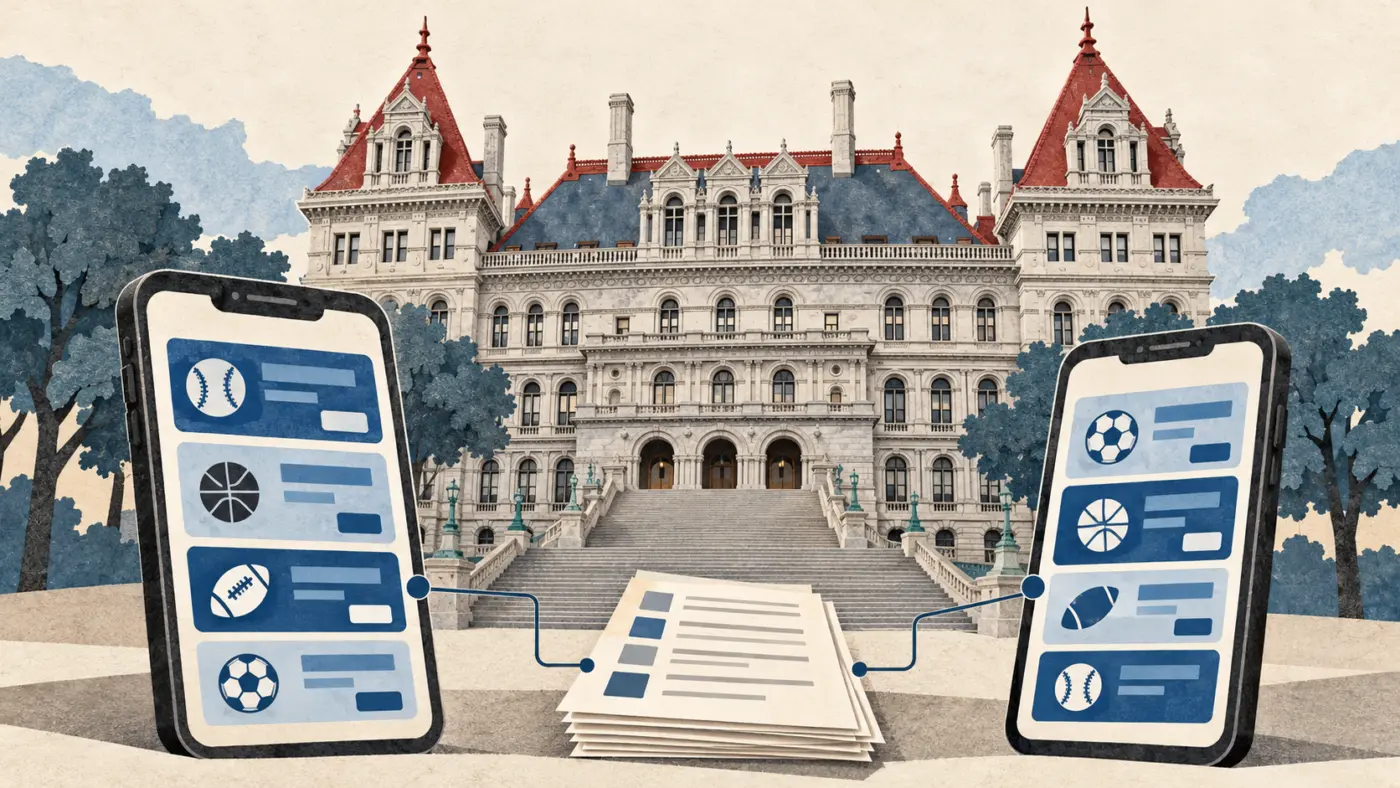
- Featured image: AI-generated editorial illustration with abstract screens, not an operator’s app. Architectural reference: Beyond My Ken’s New York State Capitol photograph, adapted under CC BY-SA 4.0. Illustration offered under the same license.

Aevan Lark
Aevan Lark is a gambling industry veteran with over 7 years of experience working behind the scenes at leading crypto casinos — from VIP management to risk analysis and customer operations. His insider perspective spans online gambling, sports betting, provably fair gaming, and prediction markets. On Dyutam, Aevan creates in-depth guides, builds verification tools, and delivers honest, data-driven reviews to help players understand the odds, verify fairness, and gamble responsibly.
Related coverage
The 2022 FanDuel Withdrawal Lawsuit: Must You Bet Your Deposit First?
A recirculated 2022 lawsuit raises questions about unused FanDuel deposits, current New Jersey rules and an unverified case outcome.

Kick Florida Lawsuit: The August Ban Request and the Seizure Claim
Florida’s August complaint targets Kick with operating-ban and forfeiture requests, but does not expressly seek seizure of its domain.

Gamdom Hack: Casino Back Online, but Loss Total Still Unclear
Gamdom announced its return on October 16, while the founder’s reported loss and an analyst estimate remain unreconciled.