The NFL has added prediction markets to its prohibited advertising list—the same category as tobacco, pornography, and firearms. Kalshi and Polymarket cannot buy Super Bowl LX ad inventory at any price, while the league’s own sportsbook partners DraftKings and FanDuel will air ads during the broadcast. The stated reason is “integrity concerns.” The unstated context: those same sportsbook partners are now launching their own prediction market products, entering the very category the NFL just banned from its airwaves.
KEY FACTS AT A GLANCE
- What happened: NFL added prediction markets to its prohibited advertising categories
- Who’s affected: Kalshi, Polymarket, and all prediction market platforms
- Who’s not affected: DraftKings and FanDuel (sportsbook ads still allowed, limit 6 per broadcast)
- Super Bowl ad cost: $8–10 million per 30-second spot
- NFL sportsbook partnerships: ~$1 billion across five-year deals with DraftKings, FanDuel, Caesars
- The irony: DraftKings and FanDuel both launched prediction market products in December 2025
What the NFL Actually Banned
Before the 2025 season kicked off, the NFL quietly updated its prohibited advertising categories. Prediction markets now sit alongside tobacco, firearms, and pornography on the league’s blacklist. The ban applies to all NFL broadcasts, not just the Super Bowl.
Sports betting ads, however, remain welcome—with a cap of six per Super Bowl broadcast. DraftKings has confirmed a Super Bowl ad slot. FanDuel secured pre-game ad placement. Neither company can mention their prediction market products in those ads, but their traditional sportsbook offerings get full airtime.
This isn’t a case of prediction market companies being unable to afford the exposure. Super Bowl LX 30-second spots average $8–10 million. NBC sold out its ad inventory by September 2025. Kalshi closed over $1 billion in new funding in December 2025. Polymarket is backed by the NYSE operator with roughly $2 billion in commitments. These companies have the capital. They’re simply prohibited from spending it.
| Category | NFL Status | Stated Reason |
|---|---|---|
| Tobacco | Prohibited | Health / legal restrictions |
| Firearms | Prohibited | Controversy / brand safety |
| Pornography | Prohibited | Brand safety |
| Prediction Markets | Prohibited | “Integrity concerns” |
| Sports Betting | Allowed (limit: 6 ads) | Official league partner |
The “Integrity” Argument Is Backwards
The NFL’s stated rationale centers on three claims: prediction markets lack the “safeguards” found in regulated sports betting, the markets are “easily manipulated,” and they don’t use “official league data.” Jeff Miller, the NFL’s EVP of communications, testified before the House Agriculture Committee that sports event contracts exist in a “gray area.”
The counter-evidence undermines every point. Kalshi has been a CFTC-regulated Designated Contract Market since 2020—the same regulatory class as the Chicago Mercantile Exchange and the Intercontinental Exchange. Under the Commodity Exchange Act, Kalshi is required to maintain surveillance systems, file trade reports, and implement manipulation prevention protocols. Federal courts in Nevada and Tennessee have granted preliminary injunctions preventing state enforcement, ruling that the CFTC has “exclusive jurisdiction” over DCM transactions. A Massachusetts court reached a similar conclusion.
Meanwhile, the sportsbooks the NFL promotes operate under a fragmented patchwork of 38 state regulatory frameworks plus Washington D.C.—each with different rules, oversight levels, and licensing requirements. There is no federal coordination or unified integrity framework governing these operators.
“The NFL’s integrity argument requires believing that a federally regulated derivatives exchange with CFTC oversight poses more manipulation risk than state-licensed sportsbooks operating under 38 different regulatory frameworks.”
The actual integrity track record tells its own story. Turkey’s referee scandal implicated 371 of 571 professional referees in betting misconduct. A Chinese tennis player received a 12-year ban for match-fixing. Twenty-six indictments came down in an NCAA point-shaving scandal. None of these cases involved prediction markets.
Follow the Money: The $1 Billion Partnership
In April 2021, the NFL named DraftKings, FanDuel, and Caesars as its “Official Sports Betting Partners” in five-year deals worth roughly $1 billion combined. Those deals bought exclusive rights to NFL intellectual property, marks, and media integration. The partners get logo placement, content integration with NFL highlights and Next Gen Stats, presence on NFL.com and the NFL App, and premium advertising inventory during games. DraftKings secured RedZone channel integration.
Prediction markets don’t fit this model. They operate as exchanges rather than “houses.” They don’t need official data partnerships because contracts settle on publicly available outcomes. Their lower margins mean less sponsorship revenue potential. And most critically, they threaten the customer base of the NFL’s sportsbook partners.
Related tools: Vig Calculator · Odds Converter · Arbitrage Calculator
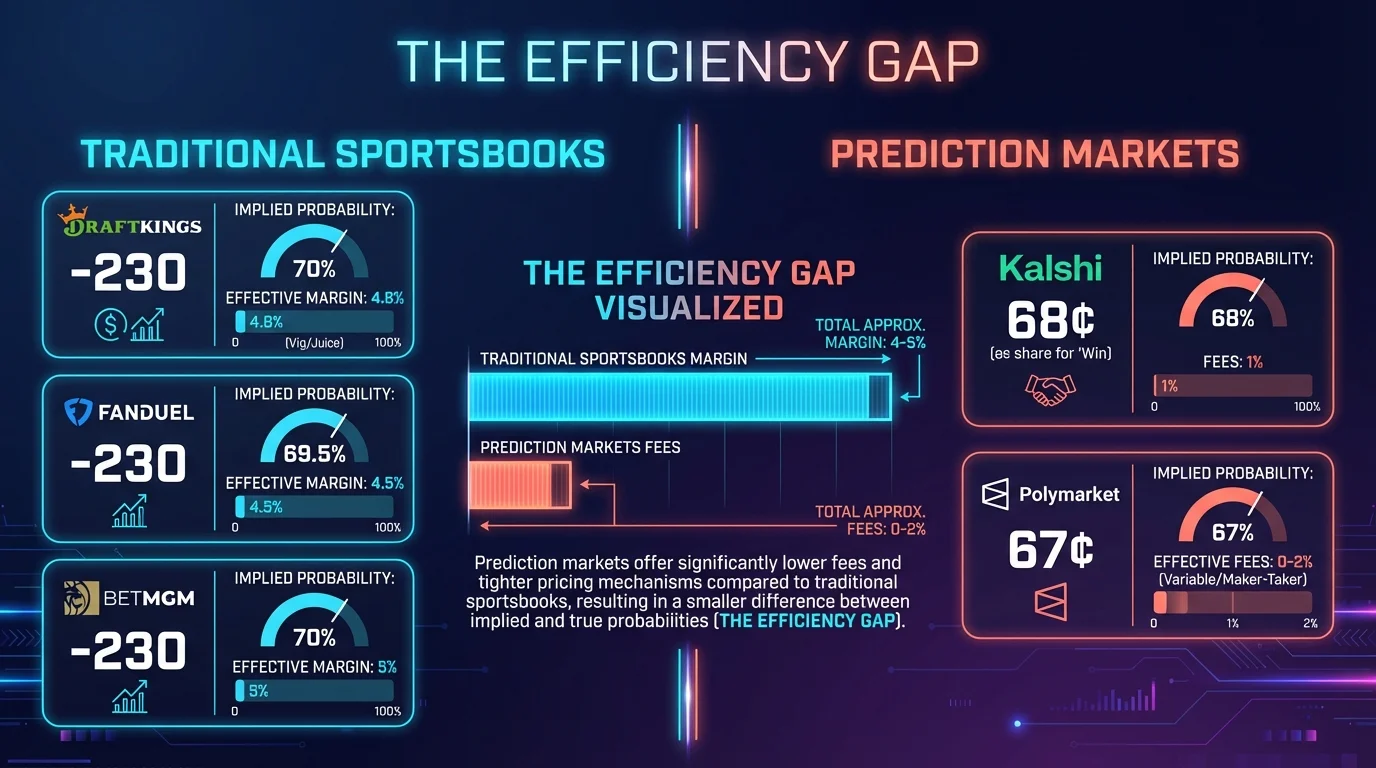
| Platform | Price | Implied Probability | Effective Margin |
|---|---|---|---|
| DraftKings | -230 | 69.7% | ~4.5% vig |
| FanDuel | -230 | 69.7% | ~4.5% vig |
| BetMGM | -225 | 69.2% | ~4.2% vig |
| Kalshi | $0.68 | 68.0% | ~1–2% fee |
| Polymarket | $0.67 | 67.0% | Gas/slippage |
Sophisticated bettors pay 2–3 percentage points less on prediction markets for equivalent exposure. Over volume, this structural efficiency gap is significant—and it’s one the NFL’s partners cannot close through product innovation alone, only through regulatory moats.
$150 Million Says the Ad Ban Won’t Work
Despite zero NFL advertising, prediction markets are capturing substantial Super Bowl action. Kalshi’s “Winner of Super Bowl LX” contract has exceeded $150 million in trading volume—a 450% year-over-year increase from Super Bowl LIX. Additional Kalshi markets cover MVP, halftime show, weather conditions, and commercial advertisers, with the “Which brands will advertise during the big game” market alone handling roughly $1.2 million in volume.
Polymarket’s international platform shows similar momentum, with active Super Bowl winner, commercial advertiser, and entertainment prop markets. Kalshi’s user base expanded 50x year-over-year, trading volume increased 100x, and the platform now offers over 3,500 individual markets with plans to exceed 4,500 by end of 2026.
Kalshi also operates in California despite the state having no legal sports betting framework—leveraging the federal preemption argument that the Commodity Exchange Act supersedes state gambling laws. A 9th Circuit Court of Appeals case scheduled for April 2026 could determine whether that argument holds. CFTC Chairman Michael Selig withdrew proposed bans on sports event contracts, signaling regulatory tailwinds at the federal level.
The Irony: NFL Partners Are Launching What the NFL Just Banned
This is where the NFL’s position becomes difficult to defend. The very sportsbook partners the league is protecting are pivoting their business models toward prediction markets—the product category the NFL banned from its broadcasts.
FanDuel Predicts launched in December 2025 in partnership with CME Group. It’s initially available in states without legal sports betting—Alabama, Alaska, South Carolina, North Dakota, and South Dakota—with plans to exit prediction markets in states that legalize sports betting. DraftKings launched its own prediction market product on December 19, 2025, available in 38 states at launch with a broader rollout than FanDuel.
THE STRATEGIC PIVOT
FanDuel Predicts
- Launched December 2025 with CME Group
- Available in states without legal sports betting
- Sports event contracts on NFL, NBA, MLB, NHL
- Surrendered Nevada gaming licenses
DraftKings Prediction Markets
- Launched December 19, 2025
- Available in 38 states at launch
- Broader rollout than FanDuel
- Left the American Gaming Association
Both companies left the American Gaming Association in November 2025. Flutter Entertainment, FanDuel’s parent company, surrendered its Nevada gaming licenses. The Nevada Gaming Control Board publicly stated that FanDuel and DraftKings intend to engage in “unlawful activities related to sports event contracts.” The NFL’s partners chose prediction markets over Nevada.
The contradiction is stark: the NFL bans prediction market ads to protect its sportsbook partners, and those same partners are pivoting their business models toward prediction markets. The league is defending a business model its own partners are abandoning.
What This Means for Bettors
The ad ban changes nothing about access. Kalshi remains available in most states as a CFTC-regulated exchange. Polymarket operates internationally as a crypto-based platform. FanDuel Predicts and DraftKings are rolling out prediction market products in select states. For bettors accustomed to the Super Bowl betting landscape, prediction markets offer a different toolkit.
PREDICTION MARKET USE CASES VS. SPORTSBOOKS
Best Use Cases
- Hedging existing sportsbook positions
- Trading in/out of positions (vs. locked bets)
- Lower-margin exposure on binary outcomes
- Non-sports markets (weather, economics, politics)
Current Limitations
- Less prop bet variety than sportsbooks
- Liquidity still building on some markets
- Regulatory uncertainty (state-by-state battles ongoing)
- Tax treatment unclear in some jurisdictions
The 2–3% efficiency gap between sportsbooks and prediction markets creates a structural advantage for informed bettors who shop across platforms. Volume limits on traditional sportsbooks make prediction markets particularly attractive for larger positions. For NFL bettors, the expanding prediction market landscape adds another dimension to line shopping.
The Bigger Picture
The NFL’s prediction market ad ban is one battle in a larger war between established gambling interests and exchange-based competition. Both sides understand that prediction markets offer better economics for bettors—that’s precisely why the established operators are pivoting to launch their own.
For now, the NFL is protecting its partners’ legacy revenue streams. But when those same partners are abandoning the model being protected—leaving the American Gaming Association, surrendering Nevada licenses, launching competing prediction market products—the ban looks less like integrity enforcement and more like a rearguard action in a losing battle. The ad ban is a speed bump, not a roadblock. The $150 million already flowing through Kalshi’s Super Bowl contracts says the smart money has already moved.
KEY TAKEAWAYS
- The ban is about money, not integrity — The NFL’s ~$1 billion sportsbook partnerships give it financial incentive to block lower-cost competitors
- Prediction markets are more regulated than sportsbooks — Kalshi operates under federal CFTC oversight while sportsbooks navigate 38 separate state frameworks
- NFL partners are pivoting anyway — DraftKings and FanDuel both launched prediction market products in December 2025 and left the American Gaming Association
- Volume is surging despite no ads — $150M+ in Super Bowl trading volume on Kalshi, up 450% year-over-year
- Bettors benefit from competition — The 2–3% efficiency gap between sportsbooks and prediction markets creates real savings at volume
Sources
- NFL Prediction Market Ad Ban Reporting — Front Office Sports
- CFTC Designated Contract Market Regulations — Commodity Futures Trading Commission
- Kalshi Market Data and Super Bowl Contracts — Kalshi
- Polymarket Super Bowl Markets — Polymarket
- House Agriculture Committee Testimony — Jeff Miller, NFL EVP — U.S. House of Representatives
