A new betting game called Rush Hour lets players wager on how many cars will pass through a live CCTV traffic camera feed in under 55 seconds—no RNG, no dealer, just real-world traffic and an AI counting vehicles. Built by 155.io and launched on January 28, 2026, it went from obscure novelty to industry headline after streamer Xposed turned a single $20,000 bet into $363,971 on February 12. Within a week, three of the largest crypto casinos in the world—Stake, Shuffle, and Roobet—all signed deals to carry the game.
KEY FACTS AT A GLANCE
- Developer: 155.io (founded 2024 by Sam Jones)
- Game Type: CCTV.Game (155.io’s brand name for the genre) — no RNG, real-world traffic outcomes
- Round Duration: Sub-55 seconds, running 24/7
- Max Payout: ~18x multiplier (exact vehicle count bet)
- Platforms: Stake, Roobet, Shuffle (all Curaçao-licensed)
- Launch Date: January 28, 2026
- Viral Moment: Xposed’s $363,971 win (February 12, 2026)
How Rush Hour Actually Works
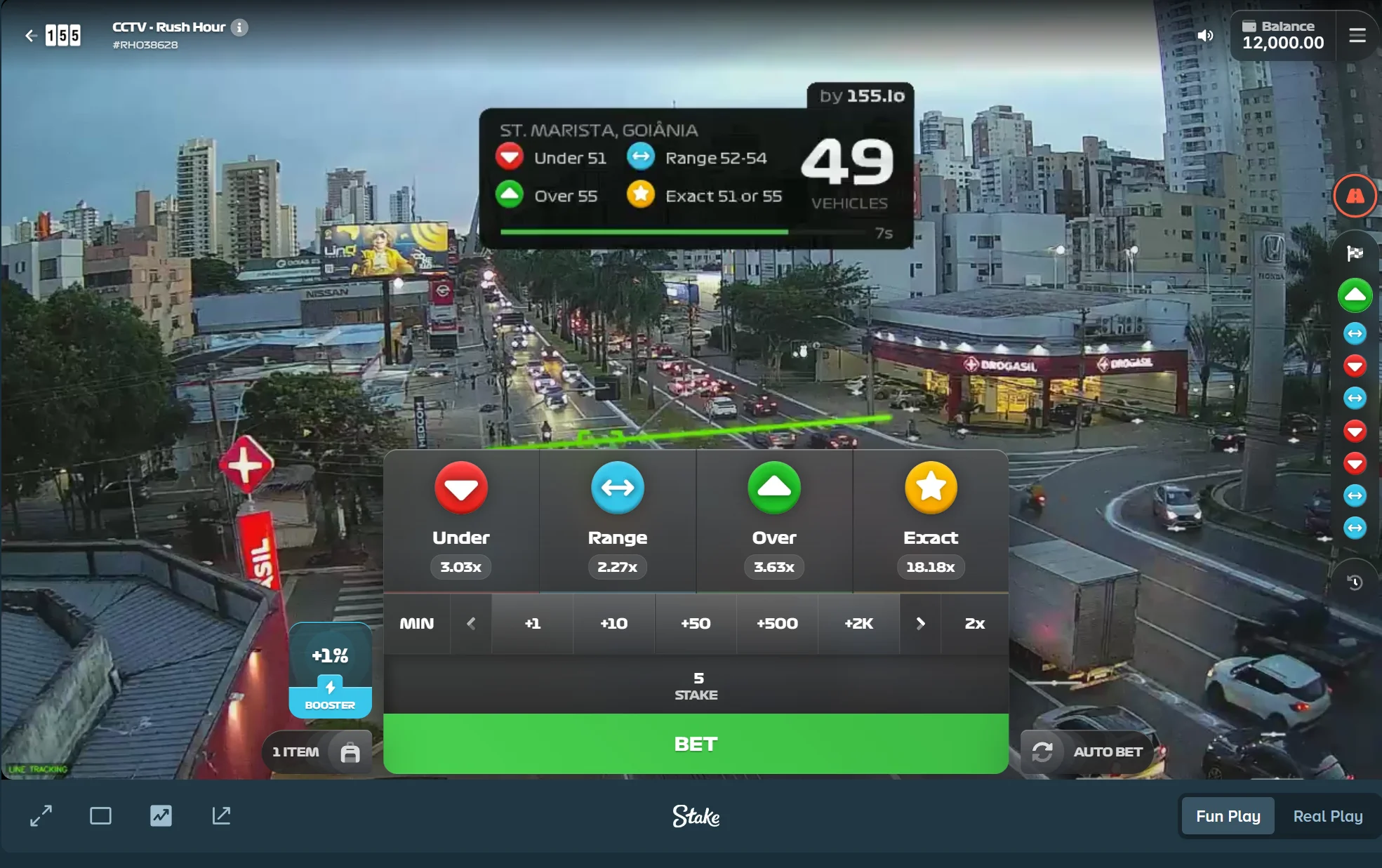
Rush Hour’s gameplay loop is deceptively simple. Players are shown a live CCTV feed from a real traffic camera—typically at a city intersection somewhere in the world—and place bets on how many vehicles will pass through the frame during a counting window of roughly 55 seconds. An AI-powered vehicle detection system tracks and counts cars, trucks, buses, and motorcycles in real time, with results displayed as an overlay on the feed.
The game runs 24/7 across multiple camera locations, meaning there’s always a round available. For each round, the algorithm randomly selects a camera feed from a different part of the world — players don’t know the location in advance. This prevents anyone from studying a specific intersection’s traffic patterns to gain an edge. Each round follows the same sequence: a betting window opens, players select their bet type and stake, the counting window begins on the live feed, the AI tallies vehicles, and the round resolves. The entire cycle completes in under a minute.
What makes it structurally different from traditional casino games is the outcome source. Slots, roulette, and crash games all use random number generators to determine results. Rush Hour’s outcomes are determined by actual traffic patterns—something that feels predictable but, as 155.io’s dynamic odds system ensures — adjusting thresholds and payouts each round based on historical traffic patterns — isn’t meaningfully exploitable.
Players can choose from four bet types, each carrying a different risk-reward profile:
| Bet Type | Description | Risk / Reward |
|---|---|---|
| Exact | Predict the precise vehicle count | Up to ~18x — highest variance |
| Over/Under | Total above or below a threshold | Moderate payout, moderate variance |
| Range | Count falls within a defined range | Lower payout — lowest variance |
| Odd/Even | Final count is odd or even | Near even-money — lowest risk |
The boundary-setting algorithms are the key to how 155.io maintains its house edge. Before each round, the system analyzes historical traffic data for the specific camera location, time of day, and day of week, then sets the thresholds, ranges, and exact-count payouts accordingly. If a particular intersection averages 12 cars per minute at 3 PM on a Tuesday, the boundaries are calibrated so that the house retains a 6.5%–8.5% edge regardless of which bet type you choose. You’re not outsmarting traffic—the algorithm already has.
To put the RTP and house edge in context, here’s how Rush Hour compares to other common casino games:
| Game | Typical RTP | House Edge |
|---|---|---|
| Blackjack (basic strategy) | 99.5% | 0.5% |
| Baccarat (banker) | 98.94% | 1.06% |
| European Roulette | 97.3% | 2.7% |
| Crash (typical) | 96%–97% | 3%–4% |
| Rush Hour | 91.5%–93.5% | 6.5%–8.5% |
| Online Slots (average) | 92%–96% | 4%–8% |
Rush Hour’s house edge sits at the worse end of the casino spectrum—comparable to slots and significantly worse than table games. Part of that is structural: live video infrastructure, AI processing, and multi-camera bandwidth cost significantly more to operate than an RNG server, and that cost is built into the edge. The difference is also speed. At sub-55-second rounds running continuously, the theoretical hourly loss rate at a given stake is much higher than a game with the same edge but longer round times.
The $363K Win That Changed Everything
On February 12, 2026, popular gambling streamer Xposed placed a $20,000 bet on an exact count of 14 vehicles at a camera in Watertown, Massachusetts. That’s the highest-variance bet type in Rush Hour—predict the precise number or lose everything. Exactly 14 cars crossed the frame during the counting window. The payout: $363,971.
The clip went viral immediately. Within hours, Rush Hour went from a niche curiosity to the most discussed new game in the crypto gambling space. The timeline shows just how fast this moved: the game launched on January 28 with minimal attention, Xposed’s win hit on February 12 and generated millions of views across Twitch and YouTube, and by February 18, 155.io announced integration deals with Stake, Shuffle, and Roobet, three of the largest Curaçao-licensed crypto casinos in the world.
It’s worth noting what kind of bet produced that headline number. Exact-count bets are the lottery tickets of Rush Hour. The maximum listed multiplier is approximately 18x — Xposed’s specific payout of ~18.2x on his $20,000 bet suggests exact odds vary slightly by round parameters. You need to nail the precise vehicle count—not a range, not over/under, not odd/even. Most exact bets lose. One streamer hitting a $363K payout on camera doesn’t change the underlying math; it just makes the math invisible behind the spectacle.
“Rush Hour is the first expression of our CCTV Game genre — think Big Brother blended with Polymarket.”
— Sam Jones, Founder of 155.io, via European Gaming
The Prediction Market Connection
Jones’s Polymarket comparison isn’t just marketing. Structurally, Rush Hour operates on the same fundamental mechanic as prediction markets: players bet on the outcome of a real-world event that neither the house nor the bettor can directly control. On Polymarket, you might bet on whether a political event will happen. On Rush Hour, you bet on whether 14 cars will cross a Massachusetts intersection in 55 seconds. The underlying logic—stake money on an observable real-world outcome—is identical.
The differences are speed, economics, and regulatory wrapper. Prediction markets resolve over hours, days, or weeks. Rush Hour resolves in under a minute. Prediction markets earn through bid-ask spreads and fees. Rush Hour takes a fixed house edge of 6.5%–8.5% per round. Prediction markets like Kalshi operate under CFTC oversight with registered exchange status. Rush Hour runs on offshore Curaçao-licensed casinos with no equivalent regulatory framework.
But the convergence is real. Both formats are moving toward the same destination: real-time wagering on real-world outcomes, driven by data feeds rather than random number generators. Rush Hour just gets there faster and with worse odds for the player. If prediction markets are the “serious” version of betting on reality, Rush Hour is the arcade version—faster, flashier, and with a steeper cost to play.
Why Only Offshore Crypto Casinos?
Rush Hour is currently available exclusively on Curaçao-licensed crypto casinos—Stake, Shuffle, and Roobet—and there’s no indication that’s changing anytime soon. The reason isn’t technical. It’s regulatory. It’s also worth noting that all three platforms geo-block players in the US, UK, Australia, and several other jurisdictions. Despite the English-language marketing and American camera locations, most players in regulated markets can’t legally access Rush Hour.
The game doesn’t fit neatly into any existing regulatory category. It’s not RNG-based, so it doesn’t qualify as a standard online casino game under most gaming commission frameworks. It’s not sports betting, because traffic isn’t a sport. It’s not a prediction market or financial instrument, because it doesn’t operate on a registered exchange. And the AI vehicle-detection system that determines outcomes hasn’t been audited by any recognized testing lab like eCOGRA or GLI—the organizations that certify game fairness for regulated markets.
For regulated operators in jurisdictions like the UK, Malta, or US states with legal online gambling, carrying Rush Hour would mean asking their gaming commission to approve a product category that doesn’t exist yet. That’s a process measured in years, not months. Curaçao licenses, by contrast, are permissive enough to allow novel game formats without requiring pre-approval from an independent testing authority.
REGULATED VS. OFFSHORE: THE TRADE-OFF
Regulated Casinos (UK, Malta, US)
- Independent game testing (eCOGRA, GLI)
- Verified RTP audits
- Player dispute resolution
- Deposit limits and self-exclusion tools
- Won’t carry Rush Hour (no approved category)
Offshore Crypto Casinos (Curaçao)
- No independent RTP verification
- Limited player protection frameworks
- Minimal dispute resolution options
- Self-exclusion tools vary by platform
- Can carry novel games like Rush Hour immediately
There’s also the surveillance question that most coverage glosses over. Rush Hour’s feeds come from publicly accessible municipal traffic cameras — the same DOT and city-operated streams that are already available online for commuters checking road conditions. 155.io doesn’t operate the cameras or have special access; it overlays its AI detection system on public feeds. But repurposing government surveillance infrastructure as gambling entertainment raises questions that neither the company nor its platform partners have publicly addressed.
This creates an uncomfortable reality for players. The only way to play Rush Hour is on platforms that don’t independently verify the game’s claimed 91.5%–93.5% RTP. You’re trusting 155.io’s stated numbers and the operator’s reputation—not a third-party audit. For experienced crypto casino players, that’s a familiar trade-off. For newcomers drawn in by a viral clip, it’s a risk they may not fully understand.
What’s Coming Next
155.io isn’t treating Rush Hour as a one-off. The company has signaled that CCTV-based betting is a genre, not a single game. Future camera categories, according to 155.io, in development include wildlife cameras (bet on animal sightings or movements), pedestrian counting (urban foot traffic), and sporting venue cameras (crowd activity near stadiums). The concept extends anywhere a camera can capture a countable, observable event.
The company also has two other titles in its portfolio — Marbles.io and Ducks.io, per 155.io’s website — though neither has generated the same attention as Rush Hour. The CCTV format clearly has the strongest product-market fit, and the Stake, Shuffle, and Roobet deals suggest that’s where 155.io is focusing its distribution strategy.
Whether Rush Hour becomes a lasting addition to the crypto casino landscape or burns out as a novelty depends on two factors: whether the game retains players after the initial viral wave fades, and whether the AI detection system proves reliable enough to avoid disputes over miscounted vehicles. One high-profile miscount caught on a livestream could unravel the trust that the Xposed clip built.
KEY TAKEAWAYS
- House edge is 6.5%–8.5% — worse than blackjack, baccarat, roulette, and most table games
- Sub-minute rounds accelerate losses — the same edge hurts more when rounds resolve every 55 seconds instead of every few minutes
- You’re not outsmarting traffic — 155.io’s boundary-setting algorithms normalize payouts regardless of camera location or time of day
- Only available on offshore crypto platforms — no independent RTP verification, limited player protections, Curaçao licensing only
- Entertainment value is real — watching live traffic with money on the line is genuinely engaging, and the novelty factor is undeniable
- Watch for wildlife and pedestrian variants — 155.io is building a full CCTV.Game genre, not just a single title
