In late November 2025, ABC News Australia obtained four years of private messages between Stake co-founder Ed Craven and a young Swedish player identified only as “Chris.” The correspondence, spanning 2020 to 2024, offers an unprecedented look inside the VIP operations of the world’s largest cryptocurrency gambling platform.

The conversation began in July 2020 with an outreach from Craven himself: “Sup Chris. You were one of the top players on Stake in August. Special bonus here… Hope you have a nice September dude.”
Chris was 17 years old at the time. He had already lost $150,000 on the platform over the preceding months.
What followed was a four-year relationship between the casino’s billionaire co-founder and one of its highest-volume players — a relationship that would eventually become the basis for a lawsuit seeking $1.5 million in recovered losses.
What the Messages Show
The leaked correspondence reveals several notable exchanges about gambling and Chris’s situation.
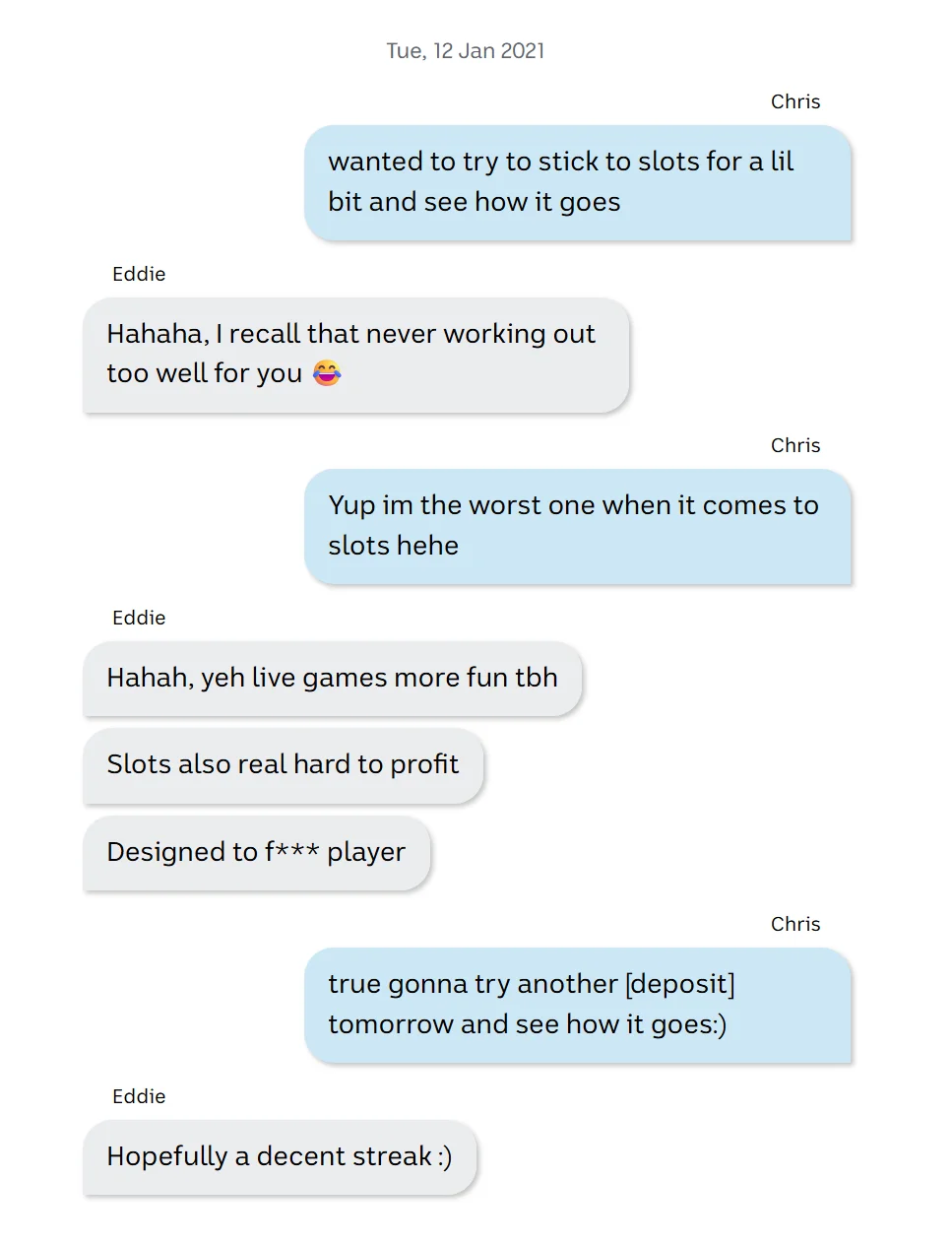
When Chris mentioned switching from blackjack to slots, Craven responded: “Hahah, yeh live games more fun tbh. Slots also real hard to profit. Designed to f*** player.” The message — an acknowledgment of how house edge and RTP work against players — did not include a warning to stop gambling. Instead, Craven wished him “a decent streak.”
In another exchange, after Chris revealed losing €2.3 million ($2.68 million) at rival casino Bitcasino, Craven replied: “Really, wow lol.” He then offered: “If you ever need Stake’s limits increased let me know,” adding that the platform could allow wagering up to $100,000 per hand on blackjack.
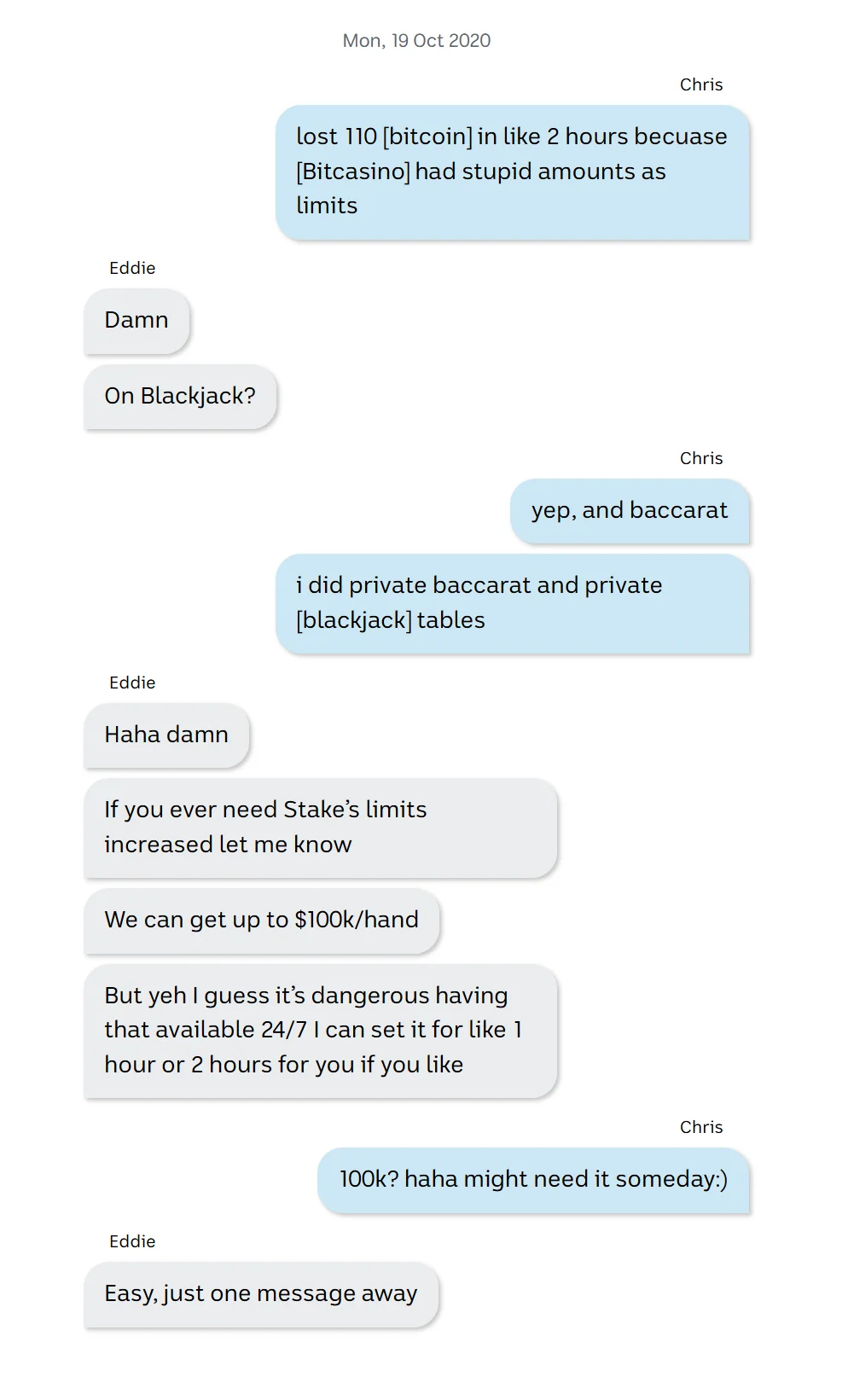
In a separate message, Craven acknowledged awareness of Chris’s gambling patterns: “I guess it’s dangerous having that available 24/7. I can set it for like 1 hour or 2 hours for you if you like.”
Throughout the four years of correspondence, Craven continued providing VIP bonuses, cashback offers, and raised betting limits.
The Self-Exclusion Question
Perhaps the most significant revelation involves Stake’s self-exclusion system.
In 2021, Chris attempted to self-exclude from Stake. He told Craven the ban was “accidental” and asked about circumventing it by starting a new account. Craven’s initial response: “Umm not the best idea to try get around the exclusion man.”
However, shortly after, Craven approved VIP perks on another account Chris said belonged to a “buddy.” “All set,” Craven wrote.
According to the ABC report, Chris then repeated this process across seven different accounts, notifying Craven each time. “Whenever I made a new account, I would just message,” Chris explained. “I would just give [Craven] the name and say, ‘This is my new account.'” Each time, VIP privileges were restored.
The Streaming Component
The messages also reveal how Chris became integrated into Stake’s influencer marketing ecosystem.
Chris had built an online following through cryptocurrency trading and streaming. Craven encouraged him to livestream his gambling sessions and attach affiliate links to his content. “Those things can pay for rest of ya life lol,” Craven wrote about the affiliate commissions.
Chris built a network of roughly 300 affiliates through this arrangement, generating ongoing commission income from new players he referred to the platform.
However, the streaming sessions proved difficult to sustain. “I would lose [everything] within the first five to seven minutes,” Chris said. Craven appeared aware of this dynamic, writing in January 2021: “Just like 10 Euro max spins preferably bro… Idea is to make some long streaming content haha.”
Stream viewers recalled watching Chris place six-figure blackjack bets and disappear after rapid losses. One viewer described watching him lose $800,000 “in what must have been a few minutes… he just instantly left the call.”
The Lawsuit
In 2025, Chris contacted the Foundation for the Representation of Victims of Online Gaming to pursue legal action against Stake and Craven. Working with attorney Roelof Bijkerk, he is seeking to recover $1.5 million in losses, arguing the company exploited his gambling addiction. This case joins other legal challenges facing Stake’s operations, including controversies surrounding their US-facing social casino platform.
Stake’s Response
Stake has contested Chris’s characterization of events, arguing he was a “professional gambler” now playing the “gambling addiction card” to recover losses. Their lawyers stated the company “continuously monitors player patterns that might indicate gambling addiction” and found “no specific pattern in the timing of [Chris’s] deposits that would indicate such a problem.”
Their position: “The only grounds for returning a player’s losses would be if its games had been rigged against them. In gambling, the fundamental rule is: if you lose, you lose; if you win, you win.” For those curious about game fairness verification, Stake does offer provably fair verification on its original games.
Craven declined to comment on the leaked messages. Stake’s head of PR, Audrey Fitzgerald, said the company would not address issues tied to ongoing litigation.
The Broader Context: Stake’s VIP System
The Chris correspondence offers insight into how Stake’s VIP operations functioned during its rapid growth period.
During the pandemic years, crypto casinos with limited regulatory oversight increasingly relied on influencer marketing. Operating under a Curaçao license, Stake faced restrictions on traditional advertising in many jurisdictions. Modern gambling platforms increasingly depend on sophisticated marketing and VIP systems. Akhil Sarin, hired in 2020 as Stake’s first marketer, explained the company’s philosophy: “Live-streaming is the absolute best way to market any product.”
The model converted high-volume players into both VIP customers and promotional assets. Chris, though younger than Stake’s high-profile celebrity partnerships like Drake, operated within this same ecosystem — receiving direct attention from the company’s co-founder while simultaneously promoting the platform to his own audience.
By 2023, the direct line to Craven ended. Chris was handed to another VIP host. “If you reach out to @TejmanVIP he’ll be able to renew the reload + send cashback etc & set all bonuses going forward,” Craven wrote. In their final message exchange in November 2024, Chris reported losing $700,000 playing blackjack and requested that Craven refund a quarter of the losses.
Who Is Ed Craven?
Ed Craven’s path to building one of the world’s largest gambling platforms began in virtual gaming environments.
Born in 1995 in Melbourne, Craven has said he won $6,000 on a family cruise at age 12, sparking an interest in gambling statistics. During his teenage years, he became active in RuneScape, where he and future business partner Bijan Tehrani operated informal gambling operations within the game. When RuneScape’s developers banned them in 2011, Craven and Tehrani had each made approximately $100,000.
In 2013, they launched Primedice, a cryptocurrency-based dice game. By 2016, they’d created Easygo, developing games for other online casinos. Stake launched in 2017. Until late 2021, Craven operated publicly under the pseudonym “Edd Miroslav.”
Craven’s father, Jamie Craven, was banned from working in Australia’s financial services industry and jailed for six months in the 1980s following the collapse of investment company Spedley Securities.
By February 2025, the Financial Review reported Craven’s personal wealth at $4.51 billion. Forbes Australia estimated the combined Craven-Tehrani fortune at $5.6 billion.
Stake’s Scale
According to litigation documents filed in separate US lawsuits against Stake, the platform processes approximately $219 billion in Bitcoin transactions annually — reportedly handling over 4% of all global Bitcoin transactions.
In 2024, Stake.com reported revenues of $4.7 billion. Industry analysts estimate the platform controls 54-59% of the crypto gambling market.
The company is registered in Curaçao but operated from Melbourne, Australia — where its services are not legal for local residents. Stake maintains offices in Serbia, Australia, and Cyprus, and has recently expanded into regulated markets including Italy and Brazil.
Questions Raised
The leaked messages raise several questions about crypto gambling operations:
Self-Exclusion Enforcement: If a player can create seven consecutive accounts after attempting self-exclusion, with VIP privileges restored each time after notifying the company’s co-founder, what protections do these systems actually provide?
Addiction Monitoring: Stake claims continuous monitoring found no problematic patterns in Chris’s behavior. The messages show Craven acknowledging that 24/7 gambling access was “dangerous” for Chris specifically. How are these positions reconciled?
Age Verification: Chris was 17 when Craven first contacted him. Stake operates under Curaçao licensing, which sets gambling age at 18. The timeline of initial registration versus first contact with Craven remains unclear from public reporting.
VIP Incentive Structures: The messages show bonuses, cashback, and limit increases continuing even as Chris discussed significant losses and gambling difficulties. What responsibility do operators have when providing enhanced services to players showing signs of problem gambling?
The Case Ahead
The lawsuit is ongoing. Similar cases against gambling operators have faced mixed results, with outcomes often depending on jurisdiction and the specific legal theories advanced.
Previous lawsuits against Stake in US courts have been sent to arbitration based on user agreement terms. Whether Chris’s case, filed through a European victims’ rights organization, follows a different path remains to be seen. Regulators worldwide are increasingly scrutinizing offshore gambling platforms operating in legal gray areas.
The Bottom Line
The leaked messages date from 2020 to 2024 — a period when Stake was a rapidly growing startup operating primarily under Curaçao’s permissive licensing framework. The correspondence suggests that during these early years, the company’s approach to responsible gambling measures, self-exclusion enforcement, and VIP management was less structured than what regulated markets typically require.
Stake has evolved since then. The company has expanded into strictly regulated jurisdictions including Italy and Brazil — markets that impose rigorous KYC requirements, mandatory self-exclusion systems, and comprehensive responsible gambling protocols. In March 2025, Craven announced a strategic shift away from cryptocurrency-only transactions, with 70% of the platform now processing traditional fiat currency.
What the leaked messages ultimately illustrate is how crypto gambling platforms operated during the industry’s less regulated era — and why the push for stricter oversight has intensified across multiple jurisdictions. The Chris case will be decided on its specific facts and applicable law, but the correspondence serves as a document of a particular moment in crypto gambling’s development.
Timeline
| Date | Event |
|---|---|
| July 2020 | Ed Craven first contacts Chris (age 17) offering VIP bonus |
| August 2020 | Chris recognized as “one of the top players on Stake” |
| October 2020 | Chris reveals €2.3 million losses at Bitcasino; Craven offers increased Stake limits |
| January 2021 | Craven tells Chris slots are “designed to f*** player”; encourages streaming |
| 2021 | Chris attempts self-exclusion; creates new account with Craven’s awareness |
| 2021-2023 | Chris creates seven accounts total, notifying Craven each time |
| 2023 | Craven transfers Chris to VIP host “@TejmanVIP” |
| November 2024 | Final message exchange; Chris reports $700,000 blackjack loss |
| December 2025 | ABC News publishes leaked messages; Chris files $1.5M lawsuit |
Key Figures
Ed Craven – Co-founder of Stake; net worth $4.51 billion (February 2025)
Chris – Swedish plaintiff; began gambling on Stake at age 17; seeking $1.5 million in recovered losses
Roelof Bijkerk – Attorney representing Chris through Foundation for Representation of Victims of Online Gaming
Bijan Tehrani – Co-founder of Stake; US-born business partner of Craven
