The NBA offers 82 games per team, nearly every night of the week from October through June—that’s over 1,200 regular season games for bettors to attack. Unlike football where you get one shot per team per week, basketball’s high-volume schedule means more opportunities, more data to analyze, and more situations where sharp bettors find consistent edges. Whether you’re betting point spreads, hunting for value in player props, or tracking which teams struggle on back-to-backs, this guide covers everything you need to know about betting on basketball.
Key Highlights
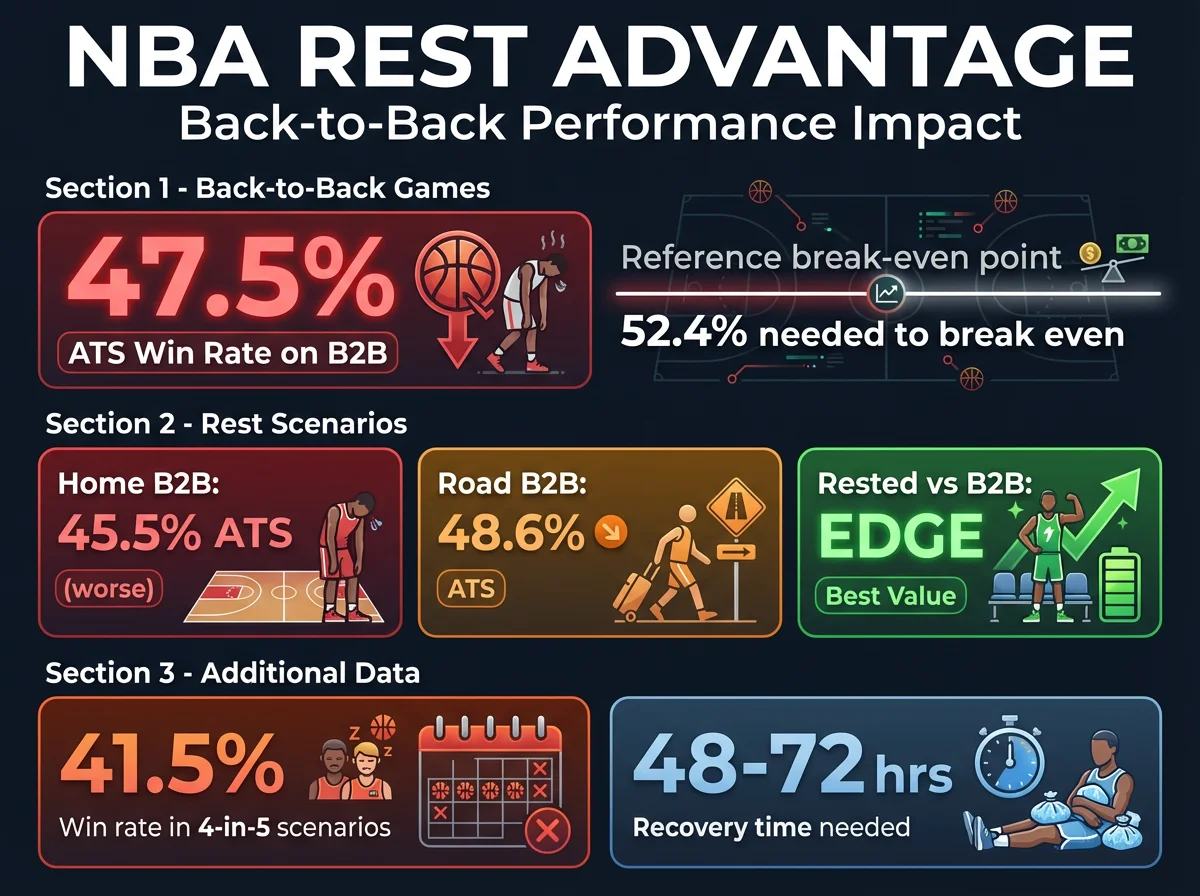
- Rest is everything — Teams playing the second game of a back-to-back cover just 47.5% of the time; tracking rest advantages is one of the most consistent NBA betting edges
- Home court advantage is shrinking — Once worth 3-5 points, it’s now closer to 2-3 points as three-point shooting neutralizes home crowds
- Totals range from 210-240 — Much higher than football; pace and defensive rating are critical factors
- Key numbers matter less — Unlike the NFL’s 3 and 7, NBA scores don’t cluster around specific margins
- Player props are huge — Points, rebounds, assists, and combination bets offer value that game lines don’t
- The season is a marathon — 82 games means trends stabilize; early-season overreactions create value
The Three Main NBA Bet Types
Just like in NFL betting, NBA wagering centers around three primary bet types: point spreads, moneylines, and totals. The mechanics are identical, but the numbers and strategies differ significantly.
1. Point Spread
The point spread levels the playing field between mismatched teams. NBA spreads typically range from 1 to 15 points, though blowout-prone teams can see spreads exceeding 15.
EXAMPLE: CELTICS -7.5 VS. WIZARDS +7.5
Betting Celtics -7.5: Boston must win by 8+ points for you to win
Betting Wizards +7.5: Washington can lose by up to 7 points (or win outright) and you still cash
If Boston wins 112-106 (6-point margin), Wizards bettors win—the favorite didn’t cover. If Boston wins 115-105 (10-point margin), Celtics bettors win.
NBA spreads are typically priced at -110 on both sides. Unlike the NFL where games cluster around key numbers (3, 7), NBA margins are more evenly distributed, making half-points less critical—though they still matter in close games.
2. Moneyline
Moneyline betting is simply picking the winner. NBA moneylines can get extreme—a heavy favorite might be -400 or more, requiring a $400 bet to win $100.
EXAMPLE: CELTICS -320 VS. WIZARDS +250
Celtics -320: Bet $320 to win $100. Boston just needs to win by any margin.
Wizards +250: Bet $100 to win $250. Washington must pull the upset.
Moneyline parlays are popular in the NBA—stringing together 2-3 heavy favorites to build a reasonable payout. But beware: upsets happen nightly, and one loss sinks the whole parlay.
Use our Moneyline Converter to calculate payouts and implied probabilities for any odds.
3. Totals (Over/Under)
Totals betting in the NBA means wagering on the combined score of both teams. Modern NBA totals typically range from 210 to 240 points—significantly higher than any other major sport.
EXAMPLE: PACERS VS. KINGS | TOTAL 235.5
Over 235.5: You win if the combined score is 236 or higher
Under 235.5: You win if the combined score is 235 or lower
A 124-118 final (242 total) cashes the over. A 108-102 final (210 total) cashes the under. Overtime points count toward the total.
NBA totals are heavily influenced by pace (how fast teams play) and three-point volume. High-pace teams like Indiana and Sacramento consistently see higher totals, while defensive-minded teams like Cleveland typically have lower lines.
NBA Player Props: The Biggest Edge
Player prop betting has exploded in the NBA, offering opportunities that game lines don’t. Instead of betting on team outcomes, you’re betting on individual player statistics: points scored, rebounds, assists, three-pointers made, and combinations thereof.
Common NBA Player Prop Types
| Prop Type | Example | What to Analyze |
|---|---|---|
| Points | LeBron James Over/Under 25.5 | Matchup, pace, teammate availability |
| Rebounds | Nikola Jokic Over/Under 12.5 | Opponent rebound rate, pace, game script |
| Assists | Tyrese Haliburton Over/Under 9.5 | Usage rate, teammate shooting, opponent defense |
| 3-Pointers Made | Stephen Curry Over/Under 4.5 | Attempts per game, opponent 3PT defense |
| PRA (Pts+Reb+Ast) | Luka Doncic Over/Under 45.5 PRA | Combined stats, usage, minutes projection |
| Double-Double | Giannis to Record DD (Yes -180) | Historical rate, matchup, minutes |
Why Props Offer Value
Sportsbooks spend enormous resources setting accurate point spreads for games—those lines are sharp. But player props? They’re often set by models that don’t account for every variable:
- Teammate absences: When a secondary scorer sits, the star’s usage skyrockets
- Matchup specifics: A center facing a team that allows the most rebounds to opposing bigs
- Recent trends: A player who’s been hot/cold over the last 5 games
- Minutes projections: Blowout risk (less playing time) vs. close game (more minutes)
PRO TIP: SPECIALIZATION WINS
The best NBA prop bettors specialize. Instead of trying to handicap every prop on every game, become an expert in one area—rebounds, for instance. Learn which teams allow the most boards, which players crash hard, which game scripts lead to more rebounding opportunities. Depth beats breadth in prop betting.
The Rest Factor: NBA’s Most Reliable Edge
If there’s one factor that separates NBA betting from other sports, it’s the importance of rest. The 82-game schedule crammed into roughly 6 months creates constant fatigue-related opportunities.
Back-to-Back Games
Teams playing the second game of a back-to-back are at a measurable disadvantage. The data is clear:
- Win rate: Just 41.5% straight up in “4-in-5” scenarios (4 games in 5 days)
- ATS rate: Only 47.5% against the spread—below the 50% break-even point
- Home B2B: Even worse at 45.5% ATS; the home advantage doesn’t compensate for fatigue
The science backs this up: NBA players need 48-72 hours to fully replenish glycogen stores and recover from the microtrauma of high-intensity games. On the second night of a back-to-back, they’re starting at a physiological deficit.
Rest Advantage Situations
The edge magnifies when one team is rested and the other isn’t:
| Situation | Edge For | Notes |
|---|---|---|
| Rested vs. B2B | Rested team | Most consistent edge in NBA |
| 3+ days rest vs. 1 day | More rested | Diminishing returns past 3 days |
| Road B2B (cross-country) | Opponent | Travel + B2B = compounding fatigue |
| End of road trip (4+ games) | Opponent | Cumulative fatigue, want to go home |
IMPORTANT: LINES ADJUST
Oddsmakers know about rest too. B2B situations are usually priced into the spread. The edge isn’t automatically betting against tired teams—it’s finding spots where the market underprices the fatigue factor. A team on a brutal schedule getting only 2 points worse might still be undervalued.
Home Court Advantage in the Modern NBA
Home court advantage exists in the NBA, but it’s smaller than you might think—and it’s been shrinking for years.
The Numbers
- Historical average: 3-5 points (prior to 2015)
- Current average: 2-2.5 points (2020s)
- Home win percentage: Dropped from 60% (2000-2013) to 54% (recent seasons)
- Bookmaker pricing: ~2.0-2.1 points built into home team lines
Why It’s Declining
The primary culprit is the three-point revolution. When teams attempt 35+ threes per game, variance increases dramatically. A visiting team can get hot from distance and neutralize any home crowd advantage. As Warriors coach Steve Kerr noted: “I don’t know if home court advantage is that important anymore.”
Exceptions That Matter
Some venues still provide meaningful edges:
- Denver: Altitude creates a genuine physiological advantage (~5,000 feet elevation)
- Oklahoma City: Consistently strong home court metrics (+7.0 points in recent seasons)
- Boston: TD Garden shows a .751 home winning percentage over three years
- Miami: Interestingly, shows minimal home advantage (-0.2 points)
NBA Betting Strategies
The NBA’s long season and nightly action create specific strategic opportunities:
1. Fade Early-Season Overreactions
The first 2-3 weeks of the NBA season are chaos. Teams haven’t gelled, rotations are unsettled, and the public overreacts to small samples. A team that starts 5-1 isn’t necessarily a title contender; a team that starts 1-5 isn’t always headed for the lottery.
Look for value on teams being written off too quickly and against teams being hyped after hot starts.
2. Track Load Management
Star players sitting out “rest” games has become common. When LeBron, Kawhi, or other high-profile stars are announced out, lines move fast. The key is staying ahead of the news:
- Follow team beat reporters on social media
- Check the injury report as soon as it drops (typically by 5 PM ET)
- Understand which teams load-manage frequently (Clippers, Lakers)
3. Bet Unders When Public Goes Over
The general public loves betting overs—it’s more fun to root for points. This tendency inflates over lines, making unders consistently undervalued. Sharp bettors profit by taking the contrarian under position, especially in games with inflated totals.
4. Exploit Schedule Spots
Beyond back-to-backs, look for these scheduling edges:
- Lookahead spots: Team plays a middling opponent before a marquee matchup—motivation may be lacking
- Letdown spots: After big emotional wins (rivalry games, nationally televised wins), teams often underperform
- Revenge games: Overblown by media, but occasionally provide motivation for certain players
- End of road trips: Teams finishing 4+ game road trips show measurable decline
5. Line Shop Religiously
With games every night, even small line differences compound quickly. Getting -4.5 instead of -5 or +7 instead of +6.5 over 100+ bets per season is the difference between profitable and break-even betting. Maintain accounts at multiple sportsbooks and always take the best number.
Betting Calculators & Tools
NBA vs. NFL Betting: Key Differences
If you’re coming from football betting, here’s how NBA wagering differs:
| Factor | NFL | NBA |
|---|---|---|
| Games per week | 1 per team | 3-4 per team |
| Average total | 43-48 points | 220-235 points |
| Key numbers | 3, 7, 10, 14 | Less significant |
| Home advantage | ~2 points | ~2.5 points |
| Rest impact | Minimal (week between) | Major factor |
| Player props | Popular but limited | Massive market |
| Injury impact | Significant (QB) | Massive (star players) |
Common NBA Betting Mistakes
Avoid these traps that catch casual NBA bettors:
1. Ignoring Rest Situations
Not checking the schedule before betting is one of the biggest mistakes. Always know if a team is on a back-to-back, finishing a road trip, or has a rest advantage.
2. Overvaluing Regular Season Records
Teams coast through the 82-game grind. A team with a 50-32 record isn’t necessarily better than a 48-34 team—context matters. Load management, strength of schedule, and when wins came all affect record interpretation.
3. Heavy Favorite Parlay Addiction
Stringing together -300 favorites looks like easy money until one 20-point underdog wins outright. NBA upsets happen multiple times per week. Parlays are entertainment, not strategy.
4. Betting Every Night
With 5-15 games per night, the temptation to bet constantly is real. But not every game offers value. Disciplined bettors wait for spots where they have an edge rather than forcing action.
5. Not Adjusting for Playoffs
Playoff basketball is a different sport. Stars play 40+ minutes, rotations shrink to 7-8 players, and effort levels spike. Regular season trends don’t always translate to the postseason. Recalibrate your approach come April.
Conclusion
NBA betting rewards preparation and discipline. The league’s nightly schedule provides endless opportunities, but that volume can also accelerate losses if you’re not careful. Focus on finding edges rather than betting volume—rest situations, player prop mismatches, and early-season overreactions are more actionable than trying to outsmart the spread on every marquee matchup.
Start by tracking rest advantages and specializing in one prop market. Use our bankroll calculator to set appropriate bet sizes, and remember that even sharp NBA bettors lose close to half their wagers. The goal is finding small, consistent edges—not hitting home runs every night. The 82-game season is a marathon, and the bettors who survive it are the ones who treat it that way.
NBA point spread betting requires the favorite to win by more than the spread, while the underdog can lose by less than the spread (or win outright) and still cover. For example, if the Celtics are -7.5, they must win by 8+ points. If the Wizards are +7.5, they can lose by up to 7 points and still cash. Most NBA spreads are priced at -110 on both sides.
Teams playing the second game of a back-to-back cover the spread only about 47.5% of the time—below the break-even rate. This is one of the most consistent edges in NBA betting. The disadvantage is even worse for home teams on B2Bs (45.5% ATS) and teams on road back-to-backs with cross-country travel. Always check schedules before betting.
NBA home court advantage is currently worth approximately 2-2.5 points on average, down from the historical 3-5 points. Home teams win about 54% of games (down from 60% in the 2000s). Some venues like Denver (altitude), Oklahoma City, and Boston show stronger home edges, while others like Miami show minimal advantage. The three-point shooting era has diminished home court’s importance.
NBA totals (over/unders) typically range from 210 to 240 points for the combined score of both teams. You bet whether the final combined score will be over or under the set number. High-pace teams like Indiana see higher totals, while defensive teams see lower lines. Key factors include team pace, defensive rating, and three-point volume. Overtime counts toward the total.
NBA player props are bets on individual player statistics rather than game outcomes. Common props include points scored, rebounds, assists, three-pointers made, and PRA (points + rebounds + assists combined). Player props often offer better value than game lines because they’re harder for sportsbooks to price accurately. Specializing in one stat category and understanding matchups is key to finding edges.
Unlike NFL betting where 3 and 7 are critical margins, NBA key numbers are much less significant. Basketball scores don’t cluster around specific margins the way football does because scoring (2s, 3s, free throws) doesn’t create predictable patterns. Half-points still matter in close games, but buying points off specific numbers isn’t as valuable in NBA betting.
Load management—when teams rest healthy star players—can dramatically shift betting lines. When a player like LeBron or Kawhi sits out, spreads can move 3-5 points and totals adjust accordingly. The key is getting ahead of the news by following team beat reporters, checking injury reports when they drop (typically 5 PM ET), and knowing which teams frequently load-manage their stars.
Start by tracking rest situations—it’s the most consistent edge in NBA betting. Focus on games where one team has a rest advantage over a tired opponent. Specialize in one player prop category (like rebounds) rather than trying to handicap everything. Line shop across multiple sportsbooks, avoid parlay addiction, and don’t bet every night just because games are available. Use bankroll management (1-3% per bet) and track all your wagers.
