Bench Press 1RM Calculator
Calculate your one-rep max using multiple proven formulas
What is a One-Rep Max (1RM)?
Your one-rep max (1RM) is the maximum weight you can lift for a single repetition with proper form. For the bench press, it's the ultimate test of upper body pressing strength and serves as the foundation for designing effective training programs.
Rather than risking injury by testing your true 1RM, you can estimate it accurately using submaximal lifts. This calculator uses five validated formulas to predict your max based on weights you can lift for multiple reps.
Why Calculate Your Bench Press 1RM?
- Program Design: Most strength programs prescribe training loads as percentages of 1RM (e.g., "5 sets of 5 at 80% 1RM"). Knowing your max enables precise programming.
- Progress Tracking: Your 1RM is the clearest measure of strength gains over time. Test every 4-8 weeks to see if your training is working.
- Competition Prep: Powerlifters and strength athletes need accurate 1RM estimates to select opening attempts and plan meet day strategy.
- Goal Setting: Comparing your 1RM to strength standards helps set realistic short and long-term goals.
1RM Formulas Explained
This calculator uses five research-validated formulas, each with slightly different mathematical approaches:
Epley Formula
1RM = weight × (1 + reps/30)
The most widely used formula. Slightly conservative, works best for 4-6 reps. Developed in 1985 and extensively validated.
Brzycki Formula
1RM = weight × (36 / (37 - reps))
Popular alternative to Epley. Tends to estimate slightly higher. Excellent for 2-10 rep ranges.
Lander Formula
1RM = (100 × weight) / (101.3 - 2.67123 × reps)
More complex calculation that accounts for the non-linear relationship between reps and load.
Lombardi Formula
1RM = weight × reps0.1
Uses exponential relationship. Generally more conservative than other formulas.
O'Conner Formula
1RM = weight × (1 + reps/40)
The most conservative formula. Best for higher rep ranges (8-12 reps).
Bench Press Strength Standards
Use these bodyweight multipliers to assess your current strength level. Standards assume proper competition-style bench press technique.
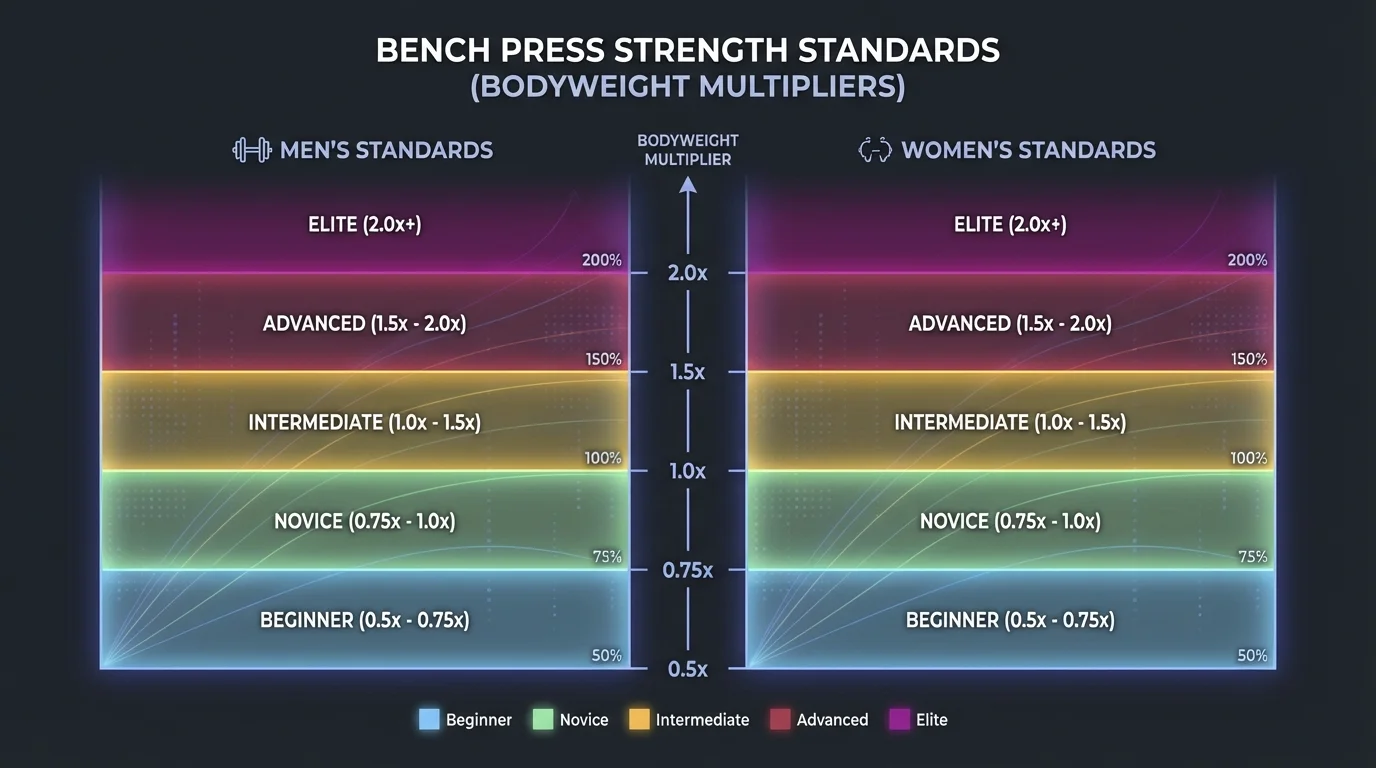
| Level | Male | Female | Description |
|---|---|---|---|
| Beginner | 0.5-0.75x BW | 0.25-0.5x BW | First 6-12 months of consistent training |
| Novice | 0.75-1.0x BW | 0.5-0.65x BW | 1-2 years of structured training |
| Intermediate | 1.0-1.5x BW | 0.65-0.9x BW | 2-4 years, focused programming |
| Advanced | 1.5-2.0x BW | 0.9-1.25x BW | 4+ years, competitive potential |
| Elite | 2.0x+ BW | 1.25x+ BW | National/world-class competitor |
Example: A 180 lb male benching 270 lbs (1.5x bodyweight) is at the Advanced level.
How to Get an Accurate 1RM Estimate
- Use 3-6 reps: This rep range provides the most accurate estimates. Higher reps (10+) shift toward endurance and become less reliable.
- Lift to true failure: Stop when you cannot complete another rep with good form. Stopping early will underestimate your 1RM.
- Maintain proper form: Full range of motion (touch chest, lock elbows). Partial reps inflate numbers and don't reflect true strength.
- Be well-rested: Test after 2-3 rest days, not after heavy training. Fatigue reduces performance and accuracy.
- Average multiple formulas: Each formula has slight biases. The average provides the most reliable single estimate.
Safety Tips for Bench Press
- Always use a spotter when approaching failure or attempting heavy singles.
- Warm up progressively: Start with empty bar, add weight gradually. 5-8 warm-up sets before testing.
- Use safety equipment: Consider safety bars/pins in a power rack if training alone.
- Control the descent: Never bounce the bar off your chest. Lower under control for 1-2 seconds.
- Lock your setup: Feet planted, shoulder blades retracted, slight arch in lower back. Never lift feet during the rep.
- Don't test true 1RM frequently: Reserve maximal attempts for every 8-12 weeks. Use calculators for weekly programming.
Related Training Tools
Once you know your 1RM, use these tools to design your program:
- General 1RM Calculator: Calculate 1RM for any exercise (squat, deadlift, overhead press).
- 5/3/1 Calculator: Program your training cycles using Wendler's proven 5/3/1 method.
- Bench Press Pyramid Calculator: Generate pyramid sets for strength and hypertrophy.
- Wilks Calculator: Compare your bench press strength across bodyweight classes.
Frequently Asked Questions
What is a 1RM in bench press?
1RM stands for "one-rep max" - the maximum weight you can lift for a single repetition with proper form. It's the gold standard for measuring raw strength in the bench press and is used to design training programs and track progress over time.
How accurate are 1RM calculators?
1RM calculators are most accurate when using 3-6 reps. The formulas become less reliable above 10-12 reps because muscular endurance starts to factor in more than pure strength. Testing with heavier weights (fewer reps) gives more accurate estimates. Different formulas (Epley, Brzycki, etc.) may vary by 2-5%.
Which 1RM formula is most accurate for bench press?
The Epley and Brzycki formulas are most commonly used and validated. Epley (weight × (1 + reps/30)) tends to be slightly more conservative, while Brzycki (weight × 36/(37-reps)) can estimate higher. Using the average of multiple formulas provides the most reliable estimate.
What is a good bench press for my bodyweight?
Strength standards vary by experience: Beginners typically bench 0.5-0.75x bodyweight, Intermediate lifters 1.0-1.25x, Advanced 1.5-1.75x, and Elite lifters 2.0x+ bodyweight. For example, a 180 lb intermediate lifter should aim for 180-225 lbs (1.0-1.25x bodyweight).
Should I test my actual 1RM or use a calculator?
Calculators are safer for most lifters. Testing true 1RM requires maximal effort, increases injury risk, and demands experienced spotters. Using a calculator with 3-5 reps at 85-90% effort is safer and nearly as accurate. Only advanced lifters in competition prep need to test actual 1RM.
Calculate Your 1RM
Enter your lift details