One-Rep Max Calculator
Estimate Your 1RM and Training Percentages
What is a One-Rep Max (1RM)?
Your one-rep max (1RM) is the maximum weight you can lift for a single repetition of any given exercise with proper form. It represents the pinnacle of your absolute strength for that movement and serves as the foundation for strength training programs worldwide.
While knowing your true 1RM is valuable, testing it carries inherent risks—particularly for beginners or when training alone. That's where 1RM calculators become essential tools. By using submaximal loads (weights you can lift for 3-10 reps), we can estimate your 1RM with reasonable accuracy without the injury risk of maximal attempts.
Why Your 1RM Matters
Understanding your one-rep max unlocks precise training programming:
- Strength Programming: Programs like 5/3/1, Wendler, and conjugate methods use percentages of your 1RM to prescribe daily training loads.
- Progress Tracking: Monitoring 1RM improvements over time provides objective evidence of strength gains.
- Volume Management: Knowing your max helps balance intensity and volume to prevent overtraining.
- Competition Prep: Powerlifters and weightlifters use 1RM estimates to select attempt weights on meet day.
The Science Behind 1RM Formulas
This calculator uses seven scientifically validated formulas to estimate your one-rep max. Each formula was developed through research on athletes across different strength levels and rep ranges:
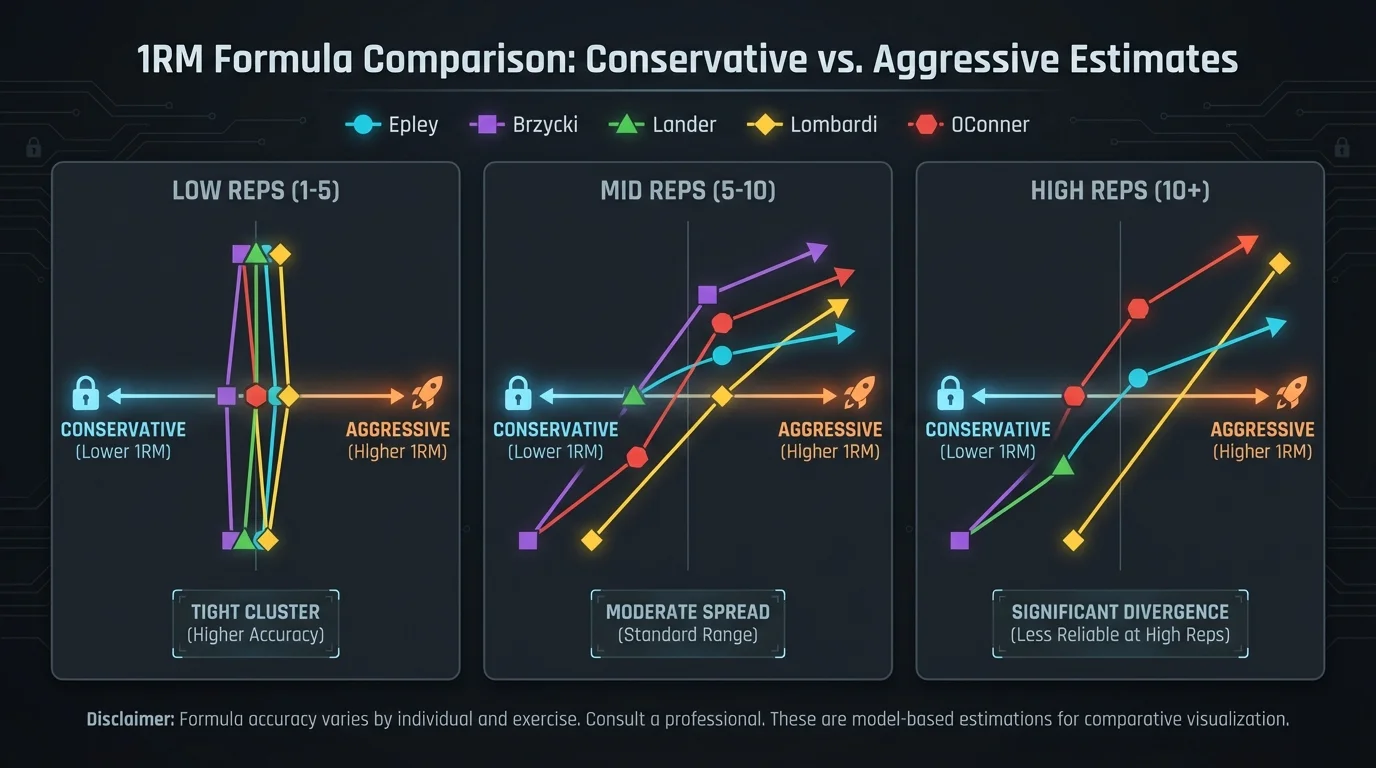
Epley Formula (1985)
1RM = Weight × (1 + Reps / 30)
Most widely used formula. Best for 4-10 reps. Standard in strength training programs.
Brzycki Formula (1993)
1RM = Weight × (36 / (37 - Reps))
Popular in powerlifting. Most accurate for 2-10 reps. Conservative estimates.
Lander Formula (1985)
1RM = (100 × Weight) / (101.3 - 2.67123 × Reps)
Works well across broad rep ranges. Developed from Olympic lifting data.
Lombardi Formula (1989)
1RM = Weight × Reps^0.10
Simple power function. Best for low rep ranges (1-5). Favored by powerlifters.
Mayhew Formula (1992)
1RM = (100 × Weight) / (52.2 + 41.9 × e^(-0.055 × Reps))
Exponential model. More accurate for higher reps (10-12). Used in research settings.
O'Conner Formula (1989)
1RM = Weight × (1 + Reps / 40)
Conservative linear model. Provides lower estimates for safety. Good for beginners.
Wathen Formula (1994)
1RM = (100 × Weight) / (48.8 + 53.8 × e^(-0.075 × Reps))
Advanced exponential model. Accurate across wide rep ranges. Research-validated.
How to Use Your 1RM for Training
Once you have your estimated 1RM, you can design intelligent training programs using percentage-based loading:
| % of 1RM | Rep Range | Training Effect | Example Use |
|---|---|---|---|
| 100% | 1 rep | Maximum Strength | Competition, Testing |
| 95% | 1-2 reps | Peak Strength | Singles, Heavy Doubles |
| 90% | 2-3 reps | Max Strength Development | Low-rep strength work |
| 85% | 3-5 reps | Strength Building | Core strength sets |
| 80% | 5-6 reps | Strength/Hypertrophy | Powerbuilding programs |
| 75% | 6-8 reps | Hypertrophy | Muscle building volume |
| 70% | 8-10 reps | Hypertrophy/Endurance | Bodybuilding work |
| 65% | 10-12 reps | Muscular Endurance | High-volume accessory |
| 60% | 12-15 reps | Endurance/Technique | Conditioning, deload |
| 55% | 15-20 reps | Endurance | Warm-up, recovery |
| 50% | 20+ reps | Active Recovery | Mobility, technique |
Best Practices for Accurate Estimates
- Use 3-8 Reps: Formulas are most accurate in the 3-8 rep range. Avoid using sets of 15+ reps.
- Lift to True Failure: The calculator assumes you reached muscular failure. Stopping 2-3 reps shy will underestimate your 1RM.
- Maintain Proper Form: Partial reps, bounce, or excessive body English will inflate estimates.
- Be Well-Rested: Test when fresh, not after fatiguing workouts or inadequate sleep.
- Compare Multiple Formulas: Look at the range of estimates. Large discrepancies may indicate poor rep selection.
Understanding the Percentage Chart
The percentage chart shows recommended training loads for various intensities. Use this to program your training cycles:
- Heavy Days: Work in the 85-95% range for strength gains (3-5 reps)
- Moderate Days: Train at 75-85% for strength and size (6-10 reps)
- Light Days: Use 60-70% for technique, speed, or recovery (10-15 reps)
Frequently Asked Questions
What is a one-rep max (1RM)?
Your one-rep max (1RM) is the maximum amount of weight you can lift for one complete repetition of a given exercise with proper form. It is the gold standard for measuring absolute strength.
How accurate are 1RM calculators?
Estimated 1RM calculations are most accurate when using 3-8 reps. Accuracy decreases with higher rep ranges (10+). Multiple formulas provide different estimates; the average gives a reasonable prediction. Direct testing is the most accurate method.
Should I test my actual 1RM?
Direct 1RM testing carries injury risk, especially for beginners. Use calculated estimates for programming unless you are an experienced lifter with proper spotting and technique. Competitive powerlifters should test periodically.
How do I use 1RM percentages for training?
Training percentages guide intensity: 85-100% builds max strength (1-5 reps), 70-85% develops strength and hypertrophy (6-12 reps), and 50-70% enhances endurance and technique (12+ reps). Adjust based on your training goals.
Which 1RM formula is most accurate?
The Epley and Brzycki formulas are most commonly used and reliable for moderate rep ranges (3-10). Lombardi works well for lower reps (1-5), while Mayhew is better for higher reps (10+). Using the average of multiple formulas provides the best estimate.