Wilks Calculator
Compare Powerlifting Strength Across Weight Classes
What is the Wilks Score?
In powerlifting, bigger athletes almost always lift more weight. But who is stronger pound-for-pound? The Wilks Score (also called the Wilks Coefficient) is the gold standard formula for comparing lifters of different body weights on a level playing field.
Developed by Robert Wilks in the 1990s, this formula adjusts your total weight lifted (squat + bench press + deadlift) based on your body weight, creating a normalized score that reveals true relative strength. A lightweight lifter with a high Wilks Score may be stronger pound-for-pound than a heavyweight with a higher absolute total.
How It Works
The Wilks formula uses a polynomial equation with six coefficients (a through f) that differ for men and women. Your body weight is plugged into the equation to generate a coefficient, which is then multiplied by your total weight lifted to produce your Wilks Score.
Wilks Score = Total Lifted × 500 / (a + bx + cx² + dx³ + ex⁴ + fx⁵)
Where x = body weight in kilograms, and a-f are sex-specific coefficients.
Formula Explained
The Wilks formula is a fifth-degree polynomial that creates a curve representing the relationship between body weight and lifting potential. The coefficients are:
- Male: a = -216.0475144, b = 16.2606339, c = -0.002388645, d = -0.00113732, e = 7.01863E-06, f = -1.291E-08
- Female: a = 594.31747775582, b = -27.23842536447, c = 0.82112226871, d = -0.00930733913, e = 4.731582E-05, f = -9.054E-08
These coefficients were derived from decades of powerlifting competition data to create the most accurate strength-to-weight relationship.
Wilks Score Benchmarks
What does your Wilks Score mean? Here are the general classifications for competitive powerlifters:
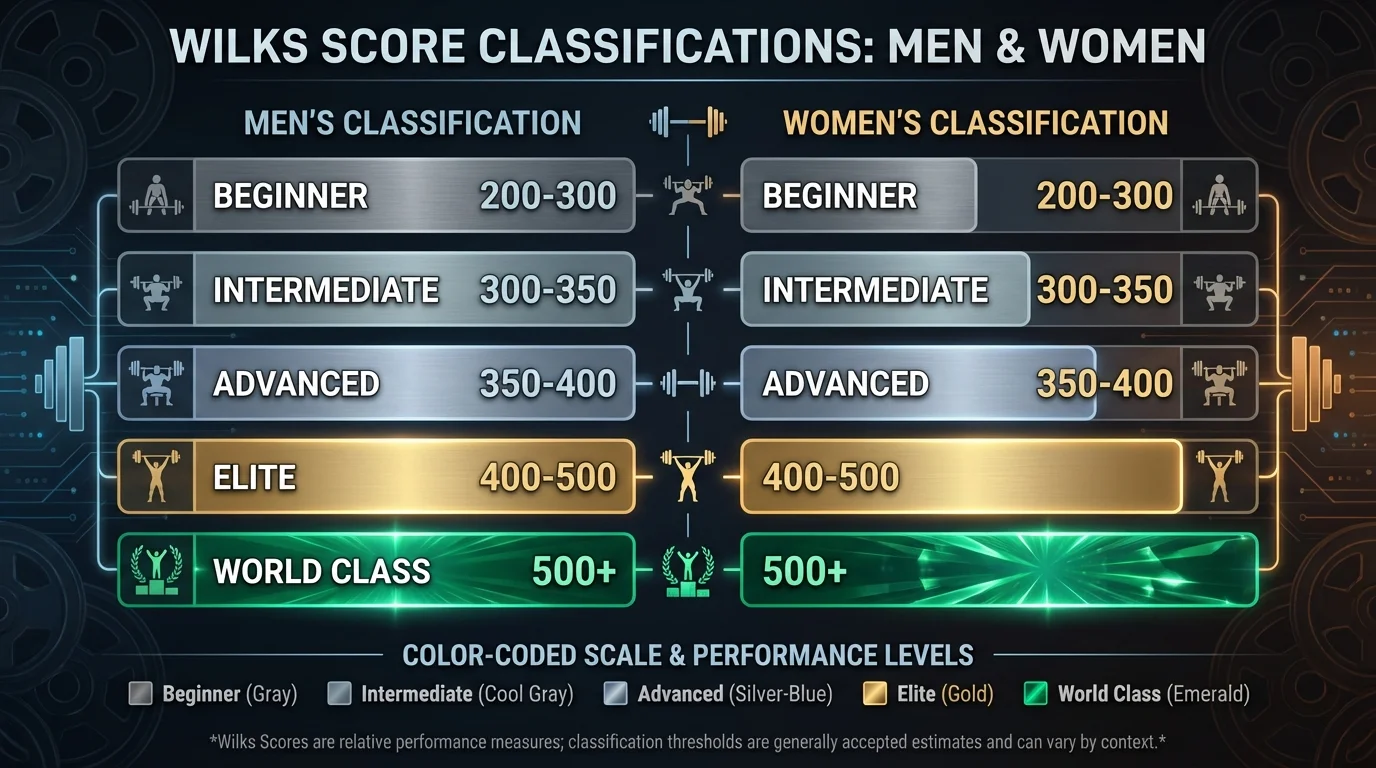
| Classification | Male Score | Female Score |
|---|---|---|
| Beginner | 200-300 | 150-250 |
| Intermediate | 300-350 | 250-300 |
| Advanced | 350-400 | 300-350 |
| Elite | 400-500 | 350-400 |
| World Class | 500+ | 400+ |
Wilks vs DOTS Comparison
In 2019, the International Powerlifting Federation (IPF) introduced a new formula called DOTS (Dynamic Objective Team Scoring) to replace the Wilks formula. While Wilks remains popular and widely used, DOTS addresses some statistical issues, particularly for lifters at extreme body weights (very light or very heavy).
Both formulas serve the same purpose: creating a fair comparison across weight classes. If you compete in IPF-sanctioned meets, you may want to calculate both scores. For most recreational lifters and non-IPF competitions, Wilks remains the standard.
How to Use This Calculator
- Enter your body weight in pounds or kilograms.
- Enter your powerlifting total (squat + bench press + deadlift) or individual lift weights.
- Select your sex (the formula uses different coefficients for men and women).
- Your Wilks Score will be calculated instantly along with your classification.
Frequently Asked Questions
What is the Wilks Score?
The Wilks Score (or Wilks Coefficient) is a formula used in powerlifting to compare the relative strength of lifters of different body weights. It levels the playing field by adjusting your total lifted weight based on your body weight, allowing fair comparison between a 150lb lifter and a 250lb lifter.
How is the Wilks Score calculated?
The Wilks Score is calculated using a polynomial formula based on body weight and total weight lifted (squat + bench press + deadlift). The formula uses different coefficients for men and women to account for physiological differences in strength-to-weight ratios.
What is a good Wilks Score?
For men: 300-350 is intermediate, 350-400 is advanced, 400-450 is elite, and 450+ is world-class. For women: 250-300 is intermediate, 300-350 is advanced, 350-400 is elite, and 400+ is world-class. Scores above 500 for men and 450 for women are extremely rare and indicate exceptional strength.
What is the difference between Wilks and DOTS?
DOTS (Dynamic Objective Team Scoring) is a newer formula that replaced Wilks in many competitions after 2019. DOTS was designed to address some statistical issues with the original Wilks formula, particularly at extreme body weights. Both formulas serve the same purpose of normalizing strength across weight classes.