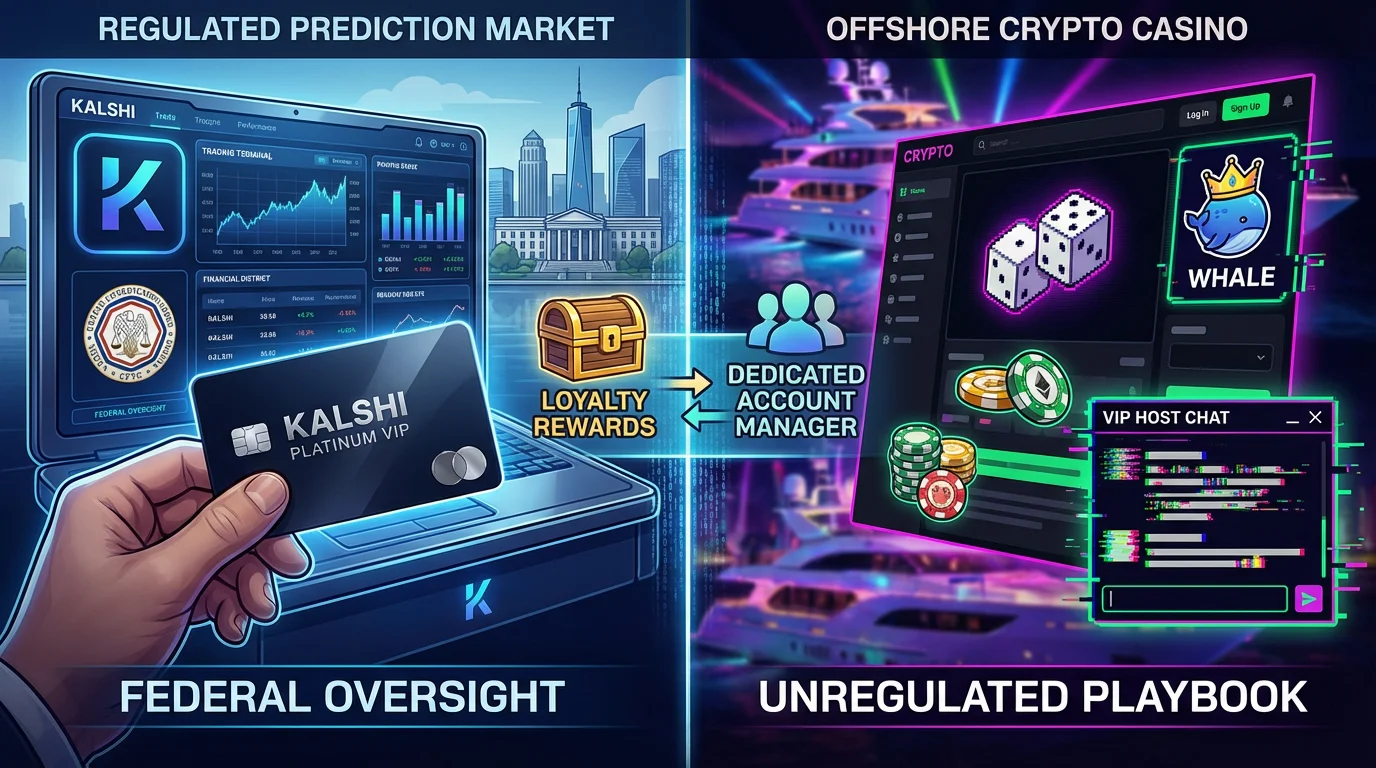
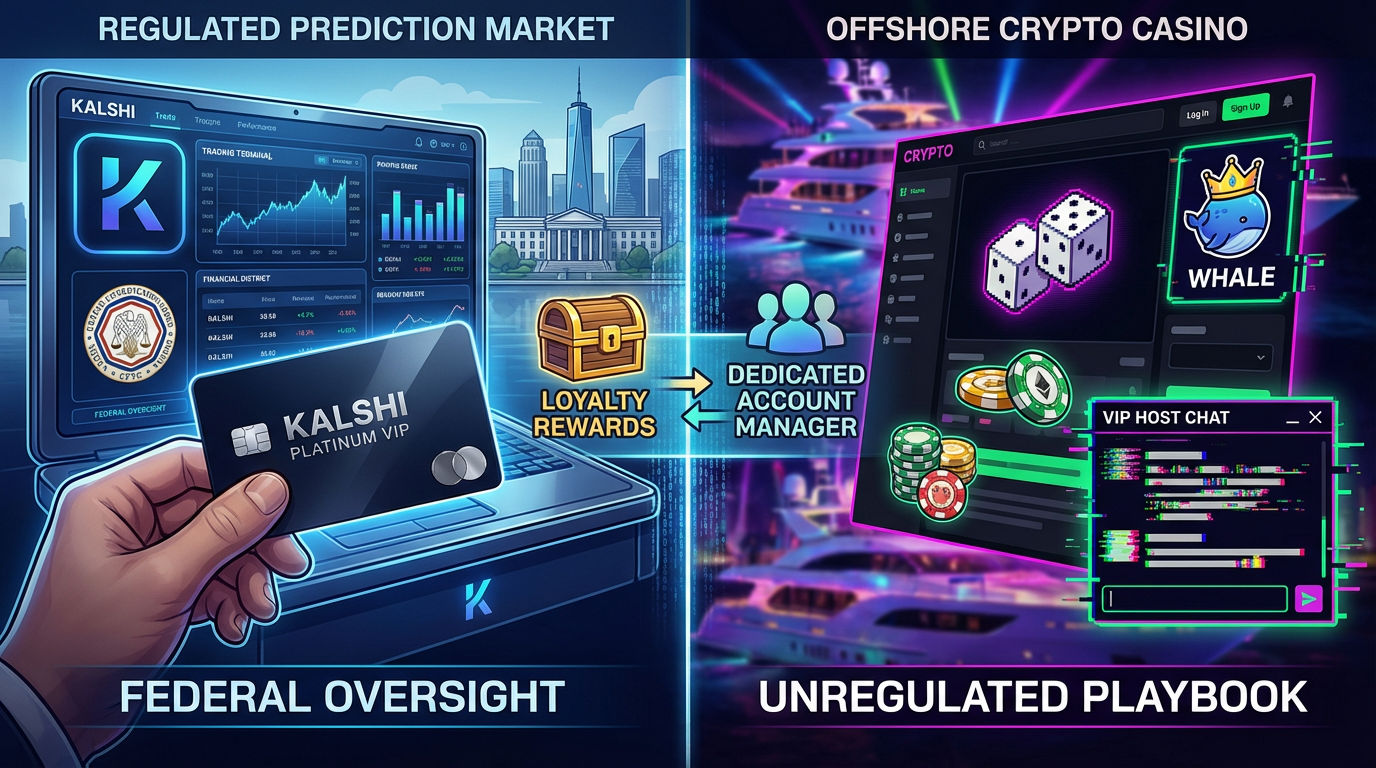
Kalshi Copies Crypto Casino VIP Playbook With New Platinum Program
Kalshi's new Platinum VIP program offers dedicated hosts and exclusive perks—the same retention playbook crypto casinos use.
The CFTC-regulated prediction market Kalshi just launched an invite-only “Kalshi Platinum” VIP tier that looks suspiciously familiar to anyone who has seen how crypto casinos retain their whales. Dedicated account managers, exclusive dinners, merchandise, referral bonuses—the regulated platform is copying the playbook written by Stake, BC.Game, and Shuffle.
KEY FACTS AT A GLANCE
- Program: Kalshi Platinum — invite-only VIP tier
- Perks: Dedicated account manager (7am-1am), priority support, exclusive events, merchandise, referral incentives
- Target: High-volume sports traders
- Context: 87% of Kalshi volume now comes from sports betting
- 2025 Volume: $23.8 billion (1,100% YoY growth)
- Valuation: $11 billion
The Crypto Casino Playbook
Look at the Kalshi Platinum perks and compare them to what offshore crypto casinos offer their VIPs:
| Feature | Kalshi Platinum | Stake / BC.Game / Shuffle |
|---|---|---|
| Dedicated Host | Account manager (7am-1am) | VIP host (24/7 Telegram) |
| Priority Support | Yes | Yes |
| Exclusive Events | In-person dinners, events | VIP trips, sporting events |
| Merchandise | Gifts, branded swag | Merch, physical rewards |
| Referral Bonuses | Enhanced incentives | Referral rewards |
| Access Model | Invite-only | Volume-based tiers |
| Regulator | CFTC (US) | Curacao (Offshore) |
The resemblance is not coincidental. On Stake.com, players unlock a dedicated VIP host at Platinum IV tier (requiring $2.5 million in wagered volume). BC.Game assigns personal account managers to high-tier players. Shuffle does the same at Sapphire level. Kalshi has essentially skipped the lower tiers and jumped straight to the casino-style host model.
Why Now? The Post-Election Volume Problem
Understanding why a federally regulated exchange is copying offshore gambling tactics requires understanding what happened after the 2024 election.
Kalshi rode the election betting wave to historic volumes. More than $430 million was staked on the presidential race alone. But political markets are episodic—they spike around major events and crash afterward. When the election ended, volumes dropped sharply.
The solution was sports. By early 2025, Kalshi pivoted hard into sports event contracts. The strategy worked—spectacularly. But it created a new problem: the customer base changed.
Political prediction traders are a different breed from sports bettors. The macro hedger buying election contracts might place a few large positions and wait. Sports bettors churn daily. They are high-frequency, high-maintenance, and conditioned by years of competing platforms to expect VIP treatment when they bring serious volume.
“Similar to other financial markets, brokerages, and large consumer brands, we’re piloting a program that offers priority support and other benefits to some of our most loyal customers.”
— Elisabeth Diana, Kalshi Head of Communications
Diana pointed to loyalty programs from Charles Schwab, Coinbase, and Kraken as inspirations. Notice what is missing from that list: Stake, BC.Game, Shuffle. The PR framing positions this as standard financial services practice. The feature set says otherwise.
The Retention Problem Kalshi Cannot Talk About
Here is the uncomfortable truth Kalshi faces: when 87% of your volume comes from sports trading, you are competing directly with sportsbooks and crypto casinos for the same customers. And those customers have options.
A high-volume sports trader can use DraftKings (which has its own VIP program with dedicated hosts at Onyx tier), Polymarket (crypto-native, no KYC hassle), or offshore platforms offering rakeback, instant withdrawals, and round-the-clock host support on Telegram.
When the core product—a price on the Chiefs vs. Bills game—is essentially identical across platforms, differentiation comes down to two things: liquidity and experience. Kalshi can compete on liquidity (thanks to its $11 billion valuation and institutional backing). But experience? That required copying what works.
THE RETENTION MATH
Sports markets are short-duration assets. A Super Bowl contract exists for a week. To maintain liquidity in ephemeral markets, Kalshi needs market makers and heavy bettors providing constant order flow. Losing a whale to DraftKings or Polymarket means losing both their volume and the liquidity they provide to other traders.
The Regulatory Irony
This is where the story gets interesting. Kalshi is not some offshore operation. It is a Designated Contract Market (DCM) regulated by the Commodity Futures Trading Commission under the Commodity Exchange Act. This status gave Kalshi the legal standing to offer election contracts when Polymarket could not. It provides banking rails and institutional credibility.
But CFTC regulation comes with constraints that crypto casinos do not face. Meanwhile, lawmakers are already introducing bills to address market integrity concerns on prediction platforms.
WHAT KALSHI CANNOT DO
Crypto Casino Tactics
- Rakeback (% of losses returned)
- Instant bonus credits to wallet
- Daily reload bonuses
- Level-up cash rewards
Kalshi Platinum Tactics
- External rewards (merch, dinners)
- Service differentiation
- Personal attention
- Status and exclusivity
CFTC Rule 1.25 governs how customer funds are segregated. Kalshi cannot simply “airdrop” bonus funds into a customer account the way Stake can credit a VIP’s wallet with a reload bonus. Financial segregation requirements make the casino-style wallet injection legally risky.
The solution is to substitute cash with stuff. Dinners, events, merchandise—external rewards that do not touch the segregated trading account. The host model without the wallet manipulation.
Who Is This Actually For?
Reports indicate Kalshi Platinum invitations went primarily to high-volume sports traders, not to equally active participants in political or economic markets. This is not about rewarding “loyal customers” broadly—it is about retaining the sports demographic that now drives the business.
These traders have specific expectations shaped by years of crypto casino VIP programs:
- Immediate attention — Problems solved in minutes, not days
- Human relationship — A name to text, not a support ticket number
- Status validation — Recognition that their volume matters
- Social access — Invitations to exclusive events, dinners, experiences
The 18-hour coverage window (7am to 1am Eastern) tells you everything about the target user. It covers European soccer in the morning through West Coast NFL games at night. This is sports trader hours—the same demographic that bets moneylines and spreads across multiple platforms.
The Competitive Pressure
Kalshi is not acting in isolation. DraftKings launched its own prediction market and already has an established VIP infrastructure through its Dynasty Rewards program. At Onyx tier, DraftKings users get a dedicated VIP host, 24/7 priority support, and access to exclusive experiences.
Polymarket, operating offshore, can move faster and with fewer constraints. The prediction market wars have intensified, with both platforms fighting for market share. And crypto casinos continue to set the bar for what high-volume players expect from platform service.
The prediction market space that once seemed like Kalshi’s protected territory is now a multi-front war against sportsbooks, crypto platforms, and offshore exchanges—all competing for the same pool of active traders.
What This Means
Kalshi Platinum is a survival adaptation, not a marketing gimmick. When your regulated business depends on retaining users who learned their expectations from unregulated platforms, you either meet those expectations or lose the users.
The irony is stark: the platform that positioned itself as the legitimate alternative to offshore prediction markets now needs to import offshore retention tactics to survive. The CFTC stamp of approval is not enough to keep a sports bettor who can get a dedicated Telegram host and 5% rakeback elsewhere.
To save the regulated market from the grey market, Kalshi had to become more like the grey market.
KEY TAKEAWAYS
- VIP playbook copied — Kalshi Platinum mirrors crypto casino host models (dedicated managers, events, merch, referral bonuses)
- Sports dependence — 87% of Kalshi volume now comes from sports betting, creating different retention needs
- Regulatory workaround — External rewards (dinners, merch) substitute for cash bonuses that segregation rules prohibit
- Competitive pressure — DraftKings, Polymarket, and crypto casinos all compete for the same high-volume traders
- The irony — The CFTC-regulated “legitimate” platform learned retention tactics from offshore grey market operators
Sources
- Incentive Programs — Kalshi
- Volume Incentive Program — Kalshi Help Center

Aevan Lark
Aevan Lark is a gambling industry veteran with over 7 years of experience working behind the scenes at leading crypto casinos — from VIP management to risk analysis and customer operations. His insider perspective spans online gambling, sports betting, provably fair gaming, and prediction markets. On Dyutam, Aevan creates in-depth guides, builds verification tools, and delivers honest, data-driven reviews to help players understand the odds, verify fairness, and gamble responsibly.
Related coverage

A $10 Parlay Skips FanDuel’s Illinois Fee. A $10 Straight Bet Doesn’t.
FanDuel’s 50¢ Illinois fee favors qualifying parlays over equal-sized singles, with a steep cost for small stakes.

What Does a DraftKings Gambling Warning Actually Change?
Safety Prompt, Then Promotion: Inside ProPublica’s DraftKings Test

Yasin Kol Arrested: Match-Fixing Allegations and a Disputed Money Trail
The Süper Lig referee denies wrongdoing as reported bank totals raise questions about the evidence behind the match-fixing allegations.