What Is a Correct Score Bet? How to Win
Predict exact final scores for high-odds payouts. Learn scoreline frequencies, score group strategies, and when to cash out on correct score bets.
Correct score betting is exactly what it sounds like—predicting the precise final score of a match. Not just who wins, not the total goals, but the exact numbers on both sides when the whistle blows. It’s one of the hardest bets to hit in sports betting, which is precisely why the odds are so attractive. A routine 1-0 soccer prediction might pay +600, while a bold 4-3 call can return +5000 or more. High risk, high reward, and more strategy involved than most bettors realize.
KEY FACTS AT A GLANCE
- Bet Type: Predict the exact final score of a match (e.g., 2-1, 0-0)
- Typical Odds: +500 to +5000+ depending on scoreline probability
- Most Common Soccer Score: 1-0 (~11% of matches) and 1-1 (~11%)
- Win Rate Reality: Even skilled bettors hit 8-12% of correct score bets
- Best Value: Low-scoring leagues and defensive matchups narrow outcomes
- Popular Variations: Scorecast, half-time correct score, correct score groups
- Key Strategy: Focus on matches where 3-4 scorelines cover 40%+ probability
What Is a Correct Score Bet?
A correct score bet requires you to predict the exact final score of a match. In soccer, if you bet on Manchester United to beat Liverpool 2-1, that’s the only outcome that wins. A 2-0 United win? You lose. A 3-1 United win? You lose. It has to be exactly 2-1.
This precision requirement is what makes correct score betting both frustrating and lucrative. You might correctly predict the winner, the margin, and the total goals—and still lose because you were off by one goal on one side. But when you do hit, the payouts justify the difficulty.
Correct score betting is most popular in soccer due to the sport’s low-scoring nature. With typical matches producing 2-3 total goals, there are only a handful of realistic scorelines to consider. In higher-scoring sports like basketball or American football, correct score markets are rare because the range of possible outcomes is enormous.
How Correct Score Odds Work
Sportsbooks calculate correct score odds based on the implied probability of each scoreline. They use statistical models that factor in each team’s attacking and defensive strength, home/away performance, and historical scoring patterns.
Common scorelines have shorter odds because they occur more frequently. A 1-1 draw at +700 implies roughly 12.5% probability. A 4-4 draw at +15000 implies about 0.6% probability. The math is straightforward: higher probability = lower payout.
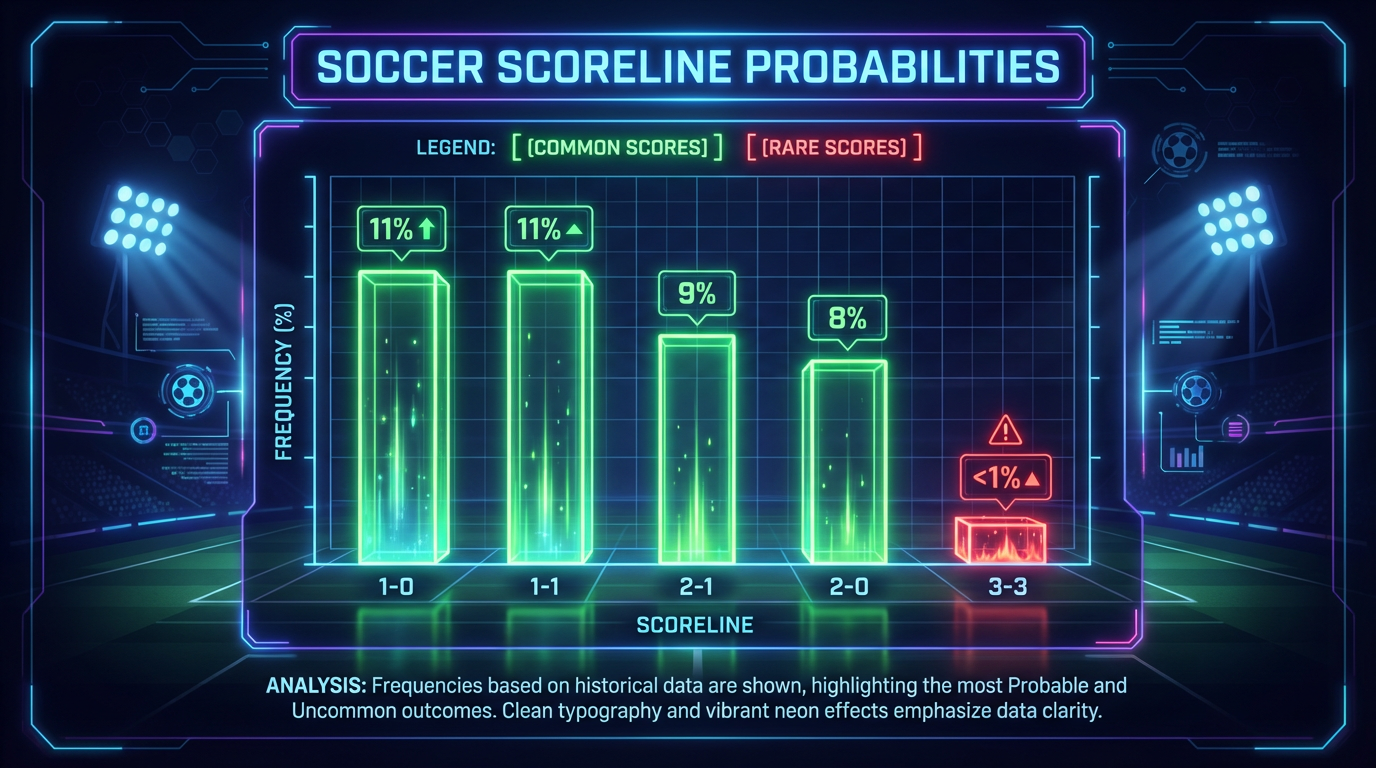
| Scoreline | Frequency (Soccer) | Typical Odds Range |
|---|---|---|
| 1-0 | 10-12% | +500 to +800 |
| 1-1 | 10-12% | +600 to +900 |
| 2-1 | 8-10% | +700 to +1000 |
| 2-0 | 7-9% | +600 to +900 |
| 0-0 | 7-9% | +800 to +1200 |
| 2-2 | 4-5% | +1200 to +1800 |
| 3-0 or 0-3 | 3-5% | +1000 to +2000 |
| 4+ Goal Scorelines | 1-3% each | +2000 to +10000+ |
Why Correct Score Bets Are Difficult
Even the most common soccer scoreline (1-0 or 1-1) only occurs about 11% of the time. That means you’ll lose roughly 9 out of 10 correct score bets even when betting the most likely outcome. The variance is brutal.
Consider this: if you randomly selected correct score bets at fair odds, you’d hit about 10% of them long-term. To profit, you need to either find scorelines that are underpriced by the bookmaker, or accept that correct score betting is entertainment with negative expected value.
The challenge compounds when you realize how many things must go right. Your team needs to score the exact number you predicted, prevent the opponent from scoring more or less than you predicted, and the game flow needs to align perfectly. A late equalizer or a missed penalty can swing your bet from winner to loser in seconds.
Correct Score Betting Strategy
Target Low-Scoring Matchups
The fewer goals expected, the fewer possible scorelines. A match projected for 1.8 total goals has maybe 6-8 realistic outcomes. A match projected for 3.5 total goals has 15+ realistic outcomes. Your probability of hitting any single scoreline is higher in low-scoring games.
Look for:
- Defensively solid teams with low goals-against averages
- Teams with poor finishing or low expected goals (xG)
- Leagues known for tight, tactical play (Serie A, Ligue 1)
- Cup matches where underdogs park the bus
- Rainy or windy conditions that suppress scoring
Study Scoring Patterns
Teams have tendencies. Some sides consistently win 1-0 at home. Others regularly draw 1-1 or 2-2. Historical patterns don’t guarantee future results, but they help narrow the range of likely outcomes.
Check the last 10-20 matches for both teams. What scorelines repeat? Do they tend to score early and hold leads, or come from behind? Do they concede late goals? These patterns inform which scorelines deserve your attention.
Use Correct Score Groups
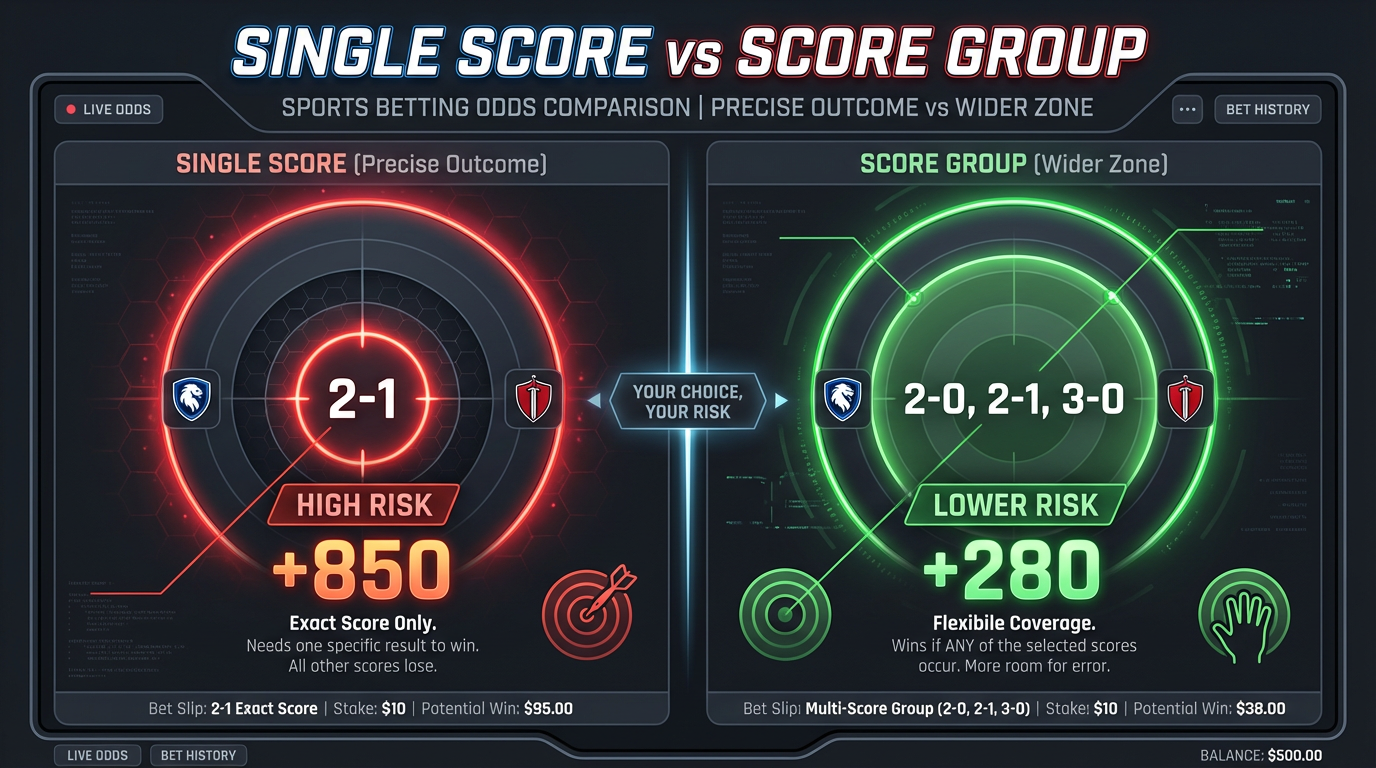
Many sportsbooks offer “correct score groups” or “score ranges” that pay less but cover multiple outcomes. Instead of betting on exactly 2-1, you might bet on “Home wins 2-1, 2-0, or 3-0” as a single wager. The odds are lower, but your chances of winning increase significantly.
CORRECT SCORE GROUP EXAMPLE
Single Correct Score
- Bet: Home team 2-1
- Odds: +850
- Win probability: ~9%
- High risk, high reward
Correct Score Group
- Bet: Home wins 2-1, 2-0, or 3-1
- Odds: +280
- Win probability: ~22%
- Lower payout, better hit rate
Consider the 0-0 Draw
The 0-0 draw is the only scoreline where both teams must achieve the same outcome: not scoring. It’s also one of the few correct scores where defensive performance alone determines success. In matchups featuring two strong defenses and weak attacks, 0-0 becomes a serious contender.
Look for 0-0 value when:
- Both teams rank bottom-half in goals scored
- Both teams rank top-half in clean sheets
- The match total is set below 2.0 goals
- Historical head-to-head shows multiple 0-0 or 1-0 results
Correct Score Variations
Half-Time Correct Score
Predict the exact score at halftime instead of full-time. Since only 45 minutes of play are involved, lower scorelines dominate. 0-0 at halftime occurs in roughly 30-35% of soccer matches, making it far more likely than 0-0 at full-time.
Half-time correct score odds are lower because the outcomes are more predictable. A 0-0 HT bet might pay +150 to +200, compared to +900 for 0-0 at full-time. The tradeoff is reasonable probability versus lower upside.
Scorecast Bets
A scorecast combines first goalscorer with correct score. You predict who scores first AND the final score. Both must hit for you to win. The odds multiply together, creating massive potential payouts—and massive difficulty.
Example: Harry Kane to score first + England 2-1 might pay +2500. If Kane scores first but England wins 3-1, you lose. If England wins 2-1 but someone else scores first, you lose. Both conditions must be met.
Wincast Bets
Similar to scorecast, but uses anytime goalscorer instead of first goalscorer. You predict a player scores at any point AND the correct final score. Slightly easier than scorecast since your player can score any goal, not specifically the first.
Half-Time/Full-Time Correct Score
The ultimate challenge: predict both the halftime score AND the fulltime score. Odds are astronomical because you’re essentially hitting two correct score bets simultaneously. A 0-0 HT / 1-0 FT bet might pay +2000 or more.
Live Betting and Cash Out Strategy
Correct score bets become interesting during live play. If you bet 2-1 and the score is 1-0 at halftime, your bet is very much alive. Many bettors use cash out at this point—taking a smaller guaranteed profit rather than risking the full swing.
When to consider cashing out:
- The current score is one goal away from your prediction
- Your team is dominating but the game is late (70+ minutes)
- You’d be happy locking in the offered profit
- The opponent is pushing hard and an equalizer seems likely
When to let it ride:
- Your team controls possession and limits chances
- Early in the match with plenty of time for your scoreline to materialize
- Cash out offer is low relative to potential full payout
- You’re comfortable with the bankroll risk
PRO TIP: HEDGING CORRECT SCORES
If your correct score bet is close to hitting late in the match, you can hedge by betting against your predicted scoreline. For example, if you have $20 on 2-1 at +800 and the score is 2-1 in the 80th minute, you could bet $50 on over 3.5 goals or the draw. If your original hits, you profit. If the scoreline changes, your hedge softens the loss. Run the math before hedging—sometimes letting it ride is correct.
Common Mistakes in Correct Score Betting
1. Betting High-Scoring Lines: A 4-3 prediction feels exciting but occurs less than 1% of the time. The odds look great, but you’ll almost never hit. Stick to realistic, common scorelines in most cases.
2. Ignoring Match Context: A league match between mid-table teams plays differently than a cup final or relegation battle. Tactical approaches change payoff structures. Defensive cup matches skew toward low scores; open attacking games spread probability across more scorelines.
3. Overweighting Recent Form: A team that scored 4 goals last match doesn’t necessarily score 4 again. Scoring is volatile. Long-term averages predict better than recent hot streaks.
4. No Bankroll Discipline: Correct score bets lose frequently. If you’re betting 5% of your bankroll on each correct score, a normal losing streak will devastate your account. Keep stakes small—1% or less per bet.
5. Chasing Losses: After three straight correct score misses, the temptation is to bet bigger on the next one. This is how accounts blow up. The next bet has the same probability regardless of your previous results.
Is Correct Score Betting Profitable?
Honestly? For most bettors, no. The bookmaker’s margin on correct score markets runs 15-25%, higher than the 5-10% on spreads and totals. That margin must be overcome through superior prediction, which is extremely difficult in a market with so many possible outcomes.
Where edges might exist:
- Niche leagues where bookmakers have less data
- Specific team tendencies the market underweights
- Weather or field conditions affecting scoring probability
- In-play markets where odds shift faster than reality
Most successful correct score bettors treat it as a small entertainment portion of their overall strategy. They accept the negative expectation in exchange for the excitement of potential big payouts. That’s a valid approach—just don’t confuse it with +EV betting.
Conclusion
Correct score betting is the precision rifle of sports wagering. When you hit, you hit big. But you’ll miss far more often than you hit, and the margins aren’t in your favor. Understanding score frequencies, targeting low-scoring matchups, and using score groups can improve your outcomes, but won’t overcome the fundamental difficulty of predicting exact results.
If you enjoy correct score betting, approach it with small stakes and realistic expectations. Look for 0-0 value in defensive battles. Consider score groups to boost your hit rate at lower payouts. Use cash out strategically when your bet gets close. And never chase losses with bigger correct score bets—that’s the fastest way to empty an account. The appeal is real; just make sure your bankroll management matches the variance.
KEY TAKEAWAYS
- Definition: Bet on the exact final score of a match—both teams’ goals must match your prediction
- Difficulty: Even common scorelines (1-0, 1-1) occur only ~11% of the time
- Best Targets: Low-scoring leagues and defensive matchups narrow possible outcomes
- Score Groups: Cover multiple scorelines for better hit rate at lower odds
- Variations: Half-time correct score, scorecast, and wincast offer alternative approaches
- Cash Out: Consider locking in profits when your scoreline is close late in matches
- Reality Check: High bookmaker margins make long-term profit difficult—treat as entertainment
FAQs
What is a correct score bet?
A correct score bet requires you to predict the exact final score of a match. If you bet on a 2-1 result, the match must end exactly 2-1 for you to win. Any other scoreline—including 2-0 or 3-1—loses. This precision requirement makes correct score bets difficult but offers high payouts when you hit.
What is the most common soccer scoreline?
The most common soccer scorelines are 1-0 and 1-1, each occurring in approximately 10-12% of matches. Other frequent results include 2-1 (8-10%), 2-0 (7-9%), and 0-0 (7-9%). These five scorelines combined account for roughly 45-50% of all soccer match outcomes.
What odds do correct score bets typically pay?
Correct score odds vary by scoreline probability. Common results like 1-0 or 1-1 typically pay +500 to +900. Less common scorelines like 3-0 or 2-2 pay +1000 to +2000. Rare high-scoring results like 4-3 or 5-2 can pay +5000 or higher. The higher the goal total, generally the longer the odds.
What is a scorecast bet?
A scorecast bet combines first goalscorer with correct score in a single wager. You predict both who scores the first goal AND the exact final score. Both predictions must be correct to win. The combined probability is very low, but payouts can reach +2000 to +5000 or higher depending on the player and scoreline.
Are correct score bets worth it?
Correct score bets are difficult to profit from long-term due to high bookmaker margins (15-25%) and low hit rates (8-12% even on common scorelines). Most successful bettors treat them as entertainment with small stakes rather than a core strategy. If you enjoy the excitement of potential big payouts, keep stakes at 1% of bankroll or less.
What is a correct score group bet?
A correct score group bet covers multiple scorelines in one wager. Instead of betting on exactly 2-1, you might bet on ‘Home wins 2-1, 2-0, or 3-0’ as a single bet. You win if any of those scorelines occur. The odds are lower than single correct score bets, but your probability of winning is significantly higher.
Should I cash out on correct score bets?
Cashing out on correct score bets can make sense when your prediction is close late in the match. If you bet 2-1 and the score is 1-1 in the 75th minute, cashing out locks in some profit while avoiding the risk of other scorelines. Consider the cash out offer relative to your original stake and the game situation before deciding.
What sports offer correct score betting?
Correct score betting is most popular in soccer due to low-scoring matches with limited possible outcomes. It’s also available for ice hockey, rugby, and occasionally other sports. High-scoring sports like basketball rarely offer correct score markets because the range of possible outcomes is too large for practical betting.

Aevan Lark
Aevan Lark is a gambling industry veteran with over 7 years of experience working behind the scenes at leading crypto casinos — from VIP management to risk analysis and customer operations. His insider perspective spans online gambling, sports betting, provably fair gaming, and prediction markets. On Dyutam, Aevan creates in-depth guides, builds verification tools, and delivers honest, data-driven reviews to help players understand the odds, verify fairness, and gamble responsibly.
Related coverage

Shuffle’s $235M Revenue and SHFL’s Price Rally: How Much Value Reaches the Token, and What Is It Worth?
Shuffle’s revenue is substantial. We examine how lottery staking, burns and supply releases translate into SHFL token value.

Indian State Tamil Nadu’s 2023 Gambling Bill: Passed Twice, Governor Dispute Details
Why the Indian state of Tamil Nadu passed its gambling bill twice in 2023, and how the Governor dispute unfolded.

Crypto Casino Bonuses vs Traditional: The 25x Rule
Crypto vs traditional casino bonuses: the 25x break-even rule, rakeback's $10,000 gate, and the volatility that moves a bonus's value.