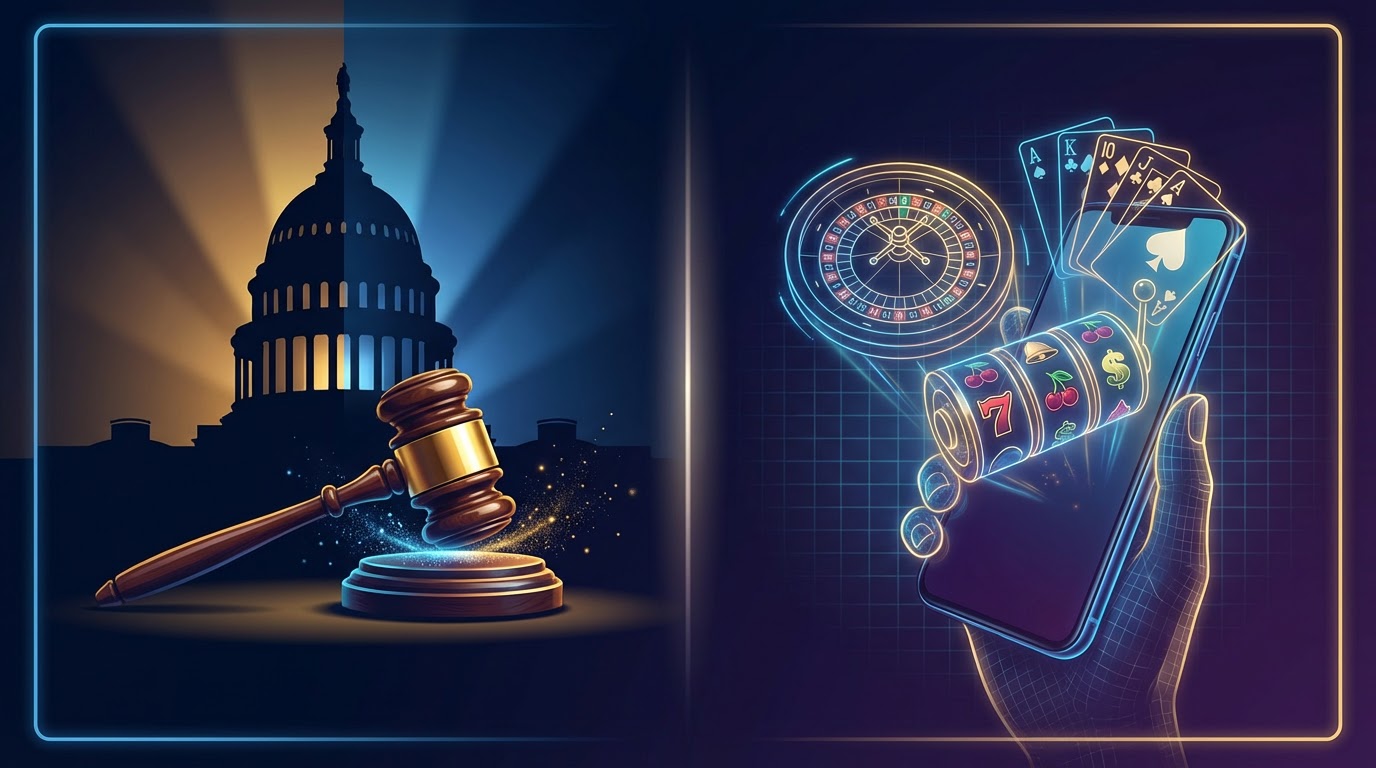
Virginia Online Casino Bills Clear Both Chambers in Dramatic Re-Votes — But Launch Date Is Far From Settled
Virginia iGaming bills survive dramatic re-votes in both chambers. 15 platforms, 20% tax, sweepstakes ban — but governor and lottery losses loom.
Virginia’s two iGaming bills both failed their initial floor votes — and both were resurrected the same day through rare procedural motions. SB 118 flipped from a 19-20 defeat to 19-17 passage after three senators conveniently switched from “no” to abstaining. HB 161 swung even harder, from a 49-46 defeat to a 67-30 landslide just hours later on the crossover deadline. The bills authorize up to 15 online casino platforms, impose a 20% tax on adjusted gross revenue plus a 6% economic development fee, and ban unregulated sweepstakes casinos — but reconciling two different versions, satisfying a governor who wants a gaming commission established first, and navigating projected lottery cannibalization losses means the hardest part of legalization hasn’t even started.
KEY FACTS AT A GLANCE
- The Bills: SB 118 + HB 161 both passed after failing initial votes and being resurrected via motions to reconsider
- What They Authorize: Up to 15 online casino platforms (slots, table games, poker) from Virginia’s 5 licensed casinos
- Tax Rate: 20% adjusted gross revenue + 6% economic development fee (effective ~26%)
- Sweepstakes Ban: Both bills ban unregulated sweepstakes casinos statewide
- The Governor: Spanberger wants a gaming commission established BEFORE any expansion — potential veto threat
- Timeline: Optimistic: July 2027 (Senate version). Realistic: January 2028 (House version requires 2027 re-passage)
Failed, Then Passed: The Re-Votes That Changed Everything
On the morning of February 17, SB 118 — the Senate’s iGaming bill sponsored by Sen. Aaron Rouse — went down 19-20. By that afternoon, Sen. Schuyler VanValkenburg moved to reconsider. The second vote passed 19-17, with VanValkenburg, Sen. Bill DeSteph, and Sen. Stella Pekarsky all switching from “no” to abstaining. Three votes didn’t change — three votes simply disappeared.
The House followed an even more dramatic arc. HB 161 failed 49-46 on the morning of February 18 — the crossover deadline, the last day any bill could pass its chamber of origin. A motion to reconsider brought it back for a second vote that afternoon, and the result was a 21-vote swing: 67-30 in favor. Delegates who voted no in the morning apparently spent the lunch break reconsidering what killing iGaming at the deadline would mean for Virginia’s competitive position.
Motions to reconsider are procedurally rare. Getting two of them on the same bill type in consecutive days is extraordinary. The most likely explanation is straightforward: leadership didn’t have the votes locked, the bills failed, and the political cost of letting iGaming die on the floor was high enough to justify the unusual procedural maneuver.
“We are being asked to take the single most addictive device in human history, the smartphone… and now we’re being asked to put a slot machine on it.”
— Sen. Bill Stanley, opposing SB 118
“You don’t even have to have on pants to gamble with this one!”
— Del. Marcia Price, who voted a reluctant yes on HB 161
SB 118 vs. HB 161: What’s Actually in the Bills
Both bills authorize online casino gaming — slots, table games, and poker — tied to Virginia’s five licensed casino operators. Each casino can partner with up to three platform operators (“skins”), creating a maximum of 15 online casino platforms. The tax structure is identical: 20% of adjusted gross revenue plus a 6% economic development fee, for an effective rate of roughly 26%. But the details diverge in ways that will matter during conference committee negotiations.
| Provision | SB 118 (Senate) | HB 161 (House) |
|---|---|---|
| Sponsor | Sen. Aaron Rouse | Del. Terry Kilgore |
| Initial Vote | Failed 19-20 | Failed 49-46 |
| Final Vote | Passed 19-17 (3 abstentions) | Passed 67-30 (21-vote swing) |
| Launch Timeline | July 1, 2027 | Requires 2027 re-passage (effective Jan 2028) |
| Gaming Commission Funding | Stripped from bill | Retained |
| Hold Harmless Fund | Covers casino revenue losses | Covers casino revenue losses (different allocation) |
| Licensing Fees | $500K operator + $2M per skin | $500K operator + $2M per skin |
| Sweepstakes Ban | Yes | Yes |
The conference committee will fight over three key points: the launch timeline (July 2027 vs. a delayed 2028 effective date), gaming commission funding (stripped from SB 118 but retained in HB 161), and the Hold Harmless fund allocation structure. The gaming commission issue is particularly loaded because of where the governor stands.
The Five Casinos: Who’s In, Who’s Fighting It
Virginia’s five licensed casino operators are not unified on iGaming. The split tracks a predictable pattern: operators with existing iGaming operations in other states see online casino as additive revenue, while operators whose business model depends on physical foot traffic see it as a direct threat.
| Casino | Location | Status | iGaming Stance |
|---|---|---|---|
| Hard Rock Bristol | Bristol | Open | Supportive |
| Rivers Casino Portsmouth | Portsmouth | Open | Supportive |
| Caesars Virginia | Danville | Open | Supportive (iGaming in NJ/PA/MI) |
| Live! Casino | Petersburg | Opened Jan 22, 2026 | Opposed — “a step too far” |
| Headwaters Resort (Boyd) | Norfolk | Interim gaming hall | Supportive (iDEA member) |
“The fact that we’re still alive at this point in the session is a good sign for brick-and-mortar operators.”
— Tom Reeg, CEO of Caesars Entertainment (which posted record $1.41B digital revenue in 2025, up 21% YoY)
The Cordish Companies (Live! Casino) and Churchill Downs — which projects a 16.3% foot traffic decrease and matching revenue decline at Colonial Downs — represent the physical-footfall opposition. Operators like Caesars, which already runs iGaming platforms in New Jersey, Pennsylvania, and Michigan, see Virginia as a natural expansion. The current national iGaming market leaders — BetMGM (29.8% share), DraftKings (22.8%), and FanDuel (16.1%) — would likely compete for skin partnerships under any Virginia framework.
The Governor Problem
Governor Abigail Spanberger, the Democrat who took office on January 17, 2026, has staked out a clear position: Virginia needs a unified gaming commission before any gambling expansion. Her administration isn’t opposed to iGaming in principle — it’s opposed to expanding gaming under the current fragmented regulatory structure.
“Governor Spanberger is deeply concerned about any discussions of gaming expansion in Virginia without first establishing a single entity with clear authority over all forms of gaming.”
— Katie Frazier, Virginia Secretary of Agriculture & Forestry, testifying February 11
The gaming commission itself is moving separately. SB 271, which establishes a consolidated Virginia Gaming Commission, passed the House 90-7 — near-unanimous support. But here’s the catch: the Senate version of the iGaming bill (SB 118) stripped gaming commission funding language during committee. That means the bill most likely to reach the governor’s desk may not include the exact provision she’s demanded as a prerequisite. The North American Association of iGaming (NAAiG) has formally called on Spanberger to veto any iGaming bill that reaches her desk.
VETO MATH
The Senate’s 19-17 margin cannot override a gubernatorial veto (requires 27 of 40 senators). The House’s 67-30 could clear the override threshold (requires 67 of 100 delegates — exactly the margin it passed by). In practice, a Spanberger veto likely kills iGaming this legislative session. The conference committee’s best path is incorporating enough gaming commission language to avoid the veto entirely.
The $220 Million Question: Revenue vs. Lottery Cannibalization
The revenue projections for Virginia iGaming are substantial, but they come with an asterisk the size of the state lottery budget.
| Metric | Projection | Source |
|---|---|---|
| Year 1 Gross Revenue | $343 million | Industry estimates |
| FY2028 Net State Revenue | $240 million | JLARC fiscal analysis |
| FY2032 Projected Revenue | $845+ million | JLARC fiscal analysis |
| Mature Market Handle | $3.56 billion | JLARC long-term model |
| iLottery Revenue Drop (Year 1) | -25.5% | DPB estimate |
| iLottery Shortfall by FY2032 | 53% below expected | DPB estimate |
| Annual Lottery Profit Loss | $77M–$163M per year | DPB estimate |
| Education Funding Loss | $220 million annually | NAAiG projection |
This is the hidden political landmine. The Virginia Lottery funds K-12 education — it’s not general fund revenue, it’s earmarked for schools. When the Department of Planning and Budget estimates $77 million to $163 million in annual lottery profit losses, that’s money directly subtracted from education funding. NAAiG’s more aggressive projection of $220 million in annual education funding losses is the number opponents will cite in every committee hearing and floor speech from here forward.
Churchill Downs has separately projected a 16.3% decrease in foot traffic and a matching revenue decline at Colonial Downs if iGaming launches. The Hold Harmless Fund in both bills addresses casino revenue cannibalization — but notably does not address lottery losses. That gap is where the fiscal argument against iGaming lives.
The Sweepstakes Kill Switch
Both SB 118 and HB 161 include provisions banning unlicensed sweepstakes casinos in Virginia. This follows an accelerating national pattern — California’s AB 831 and Mississippi’s SB 2104 represent the same trend of states cracking down on unregulated online casino operations while simultaneously creating regulated alternatives.
Virginia is using iGaming legalization as the enforcement vehicle. A standalone sweepstakes ban bill (SB 579) was pushed to 2027, but both iGaming bills accomplish the same outcome: once regulated online casino platforms launch, unregulated sweepstakes operators become illegal. For players currently using sweepstakes casino sites in Virginia, the writing is on the wall — whichever version passes, unregulated options disappear from the state.
How Virginia Compares: The iGaming State Landscape
Virginia would become the ninth state to legalize online casino gaming. Here’s how it stacks up against the existing iGaming states, with Maine’s January 2026 legalization being the most recent addition.
| State | Tax Rate | Launch | Key Detail |
|---|---|---|---|
| New Jersey | 15% | 2013 | Oldest US market |
| Delaware | 57% slots / 15.5% table | 2013 | State-managed |
| Pennsylvania | 54% slots / 16% table | 2019 | Highest slot tax |
| West Virginia | 15% | 2020 | Small market |
| Michigan | 20–28% tiered | 2021 | Growing rapidly |
| Connecticut | 18% (rising to 20%) | 2021 | Tribal compact model |
| Rhode Island | 62.45% slots / 16.5% table | 2024 | Highest effective rate |
| Maine | TBD | Legalized Jan 2026 | Wabanaki tribal exclusivity |
| Virginia (proposed) | 20% + 6% fee (~26%) | 2027 or 2028 | Up to 15 platforms |
Virginia’s effective ~26% rate is mid-pack nationally. It’s far more operator-friendly than Pennsylvania’s 54% slot tax or Rhode Island’s 62.45%, but higher than New Jersey (15%) or West Virginia (15%). The 15-platform cap through the skin model is comparable to how other states structure market access through existing licensees. Maryland’s SB 885, filed for a November 2026 voter referendum, could create a Mid-Atlantic iGaming corridor stretching from New Jersey through Delaware, Maryland, and Virginia — a significant market cluster for operators.
What This Means for Virginia Players
- Don’t expect to play soon. The optimistic timeline is July 2027 under the Senate version. If the House version’s reenactment clause prevails, the bill would need to pass again in 2027 with a realistic launch of January 2028. Either way, this is at minimum 16 months away.
- 15 platforms means serious competition for your business. With five casinos each allowed three skins, expect major operators like BetMGM, DraftKings, FanDuel, Caesars Digital, and BetRivers competing for Virginia market share. That typically means aggressive launch bonuses and promotional offers.
- Sweepstakes casino sites will be banned. Both bills include sweepstakes prohibition language. If you’re currently playing on unregulated sweepstakes platforms in Virginia, plan your transition — those options disappear when either bill becomes law.
- Your sports betting isn’t affected. Virginia’s 12+ legal sportsbooks continue operating under existing law. iGaming adds online casino (slots, table games, poker) as a separate product — it doesn’t change or replace sports betting.
- Watch the governor. Spanberger’s gaming commission position is the single biggest variable. If SB 271 (gaming commission) passes and the conference committee includes adequate commission language in the final iGaming bill, the path clears. If not, a veto is the most likely outcome. For tax implications of any future winnings, review the 2026 gambling tax rules.
What to Watch Next
The conference committee must reconcile SB 118 and HB 161 before the March 14 session end. The reconciled bill then goes to Governor Spanberger’s desk, with the April 22 reconvened session serving as the veto override window. The key dominoes: SB 271 (gaming commission) completing its path through the Senate, Spanberger’s public statements signaling whether she’ll sign or veto, and whether the conference committee incorporates enough gaming commission language to satisfy the governor’s prerequisite.
If the House version’s reenactment clause survives conference, the entire process repeats in 2027 — a second passage would be needed before iGaming could launch. Meanwhile, Maryland’s SB 885 moves toward a November 2026 voter referendum that could reshape the Mid-Atlantic gaming landscape entirely. Virginia’s iGaming bills survived their most dramatic test, but the procedural drama of re-votes may end up being the easy part.
KEY TAKEAWAYS
- Both bills survived re-votes — SB 118 passed 19-17 after 3 senators abstained; HB 161 passed 67-30 after a 21-vote swing
- 15 platforms at 20% + 6% tax — sweepstakes casinos banned in both versions
- Governor Spanberger wants gaming commission first — Senate margins can’t override a veto (need 27/40, have 19)
- Virginia’s effective ~26% tax rate is mid-pack nationally — more favorable than PA (54%) but higher than NJ (15%)
- Lottery cannibalization is the central policy fight — NAAiG projects $220M in annual education funding losses
- Earliest launch July 2027 — conference committee reconciliation and governor’s desk are the next hurdles
Sources
- SB 118 — Online Casino Gaming Authorization — Virginia Legislative Information System
- HB 161 — Online Casino Gaming Authorization — Virginia Legislative Information System
- SB 271 — Virginia Gaming Commission Establishment — Virginia Legislative Information System
- JLARC Fiscal Impact Analysis — iGaming Revenue Projections — Joint Legislative Audit and Review Commission
- NAAiG Economic Impact Statement on Virginia iGaming — North American Association of iGaming (via PR Newswire)

Aevan Lark
Aevan Lark is a gambling industry veteran with over 7 years of experience working behind the scenes at leading crypto casinos — from VIP management to risk analysis and customer operations. His insider perspective spans online gambling, sports betting, provably fair gaming, and prediction markets. On Dyutam, Aevan creates in-depth guides, builds verification tools, and delivers honest, data-driven reviews to help players understand the odds, verify fairness, and gamble responsibly.
Related coverage
A $10 Parlay Skips FanDuel’s Illinois Fee. A $10 Straight Bet Doesn’t.
FanDuel’s 50¢ Illinois fee favors qualifying parlays over equal-sized singles, with a steep cost for small stakes.
What Does a DraftKings Gambling Warning Actually Change?
Safety Prompt, Then Promotion: Inside ProPublica’s DraftKings Test
Yasin Kol Arrested: Match-Fixing Allegations and a Disputed Money Trail
The Süper Lig referee denies wrongdoing as reported bank totals raise questions about the evidence behind the match-fixing allegations.