Six States, One Month: The Sweepstakes Casino Crackdown Just Went From Wave to Avalanche
Six US states advanced sweepstakes casino bans in a single month, signaling the fastest crackdown the $4.6 billion industry has faced.
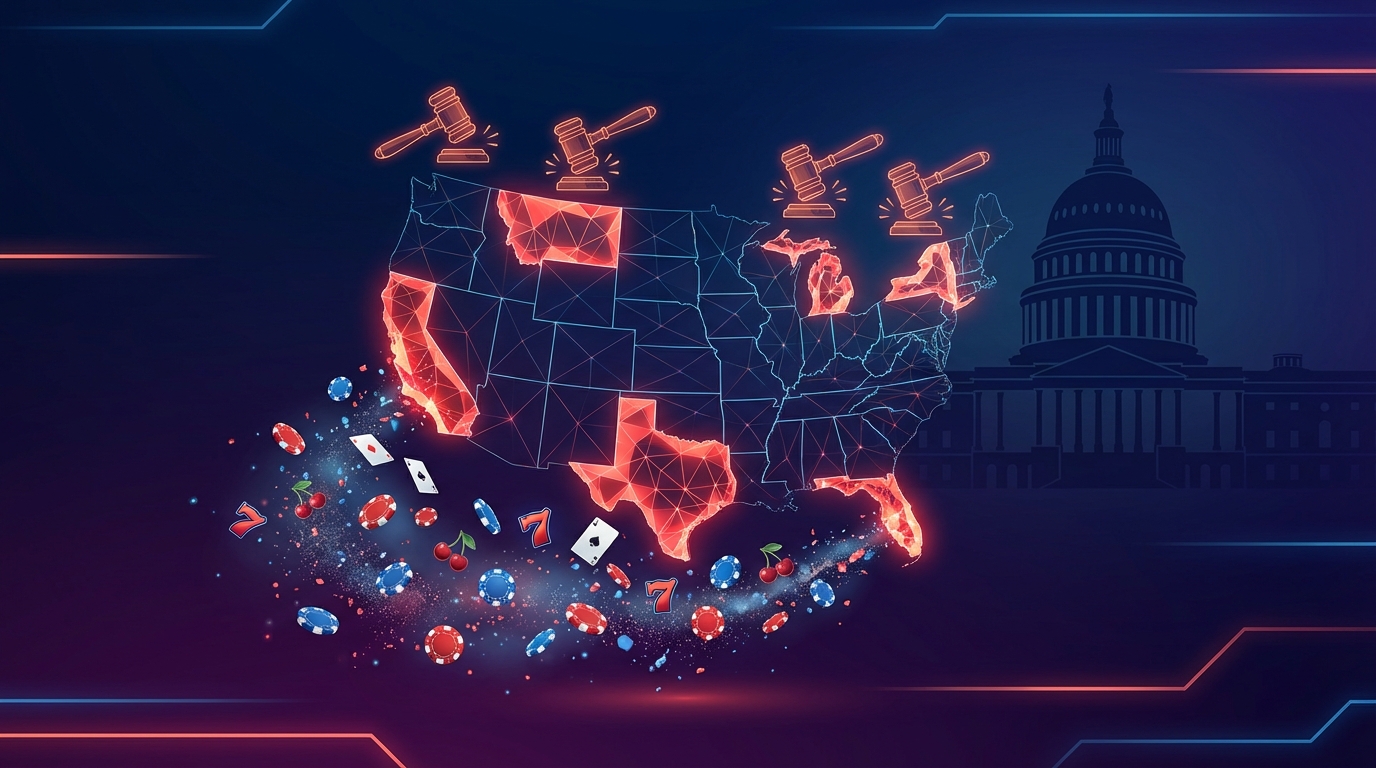
In a single February, six US states advanced sweepstakes casino bans through legislative chambers or enforcement actions, signaling the fastest regulatory acceleration the unregulated $4.6 billion industry has ever faced. Indiana’s HB 1052 landed on Governor Mike Braun’s desk on February 26 after clearing both chambers with veto-proof margins. Florida escalated to felony-level penalties for operators. Tennessee, Mississippi, Maine, and Illinois each pushed their own distinct crackdown strategies forward within days of each other. What began as a trickle of cease-and-desist letters in 2024 became a legislative flood in 2025, when six states passed outright bans. Now, the flood has become an avalanche — and sweepstakes operators are running out of ground.
The February 2026 wave didn’t emerge in isolation. It follows a 2025 in which Montana, Connecticut, New York, New Jersey, California, and Nevada all enacted restrictions on dual-currency sweepstakes platforms. Add the long-standing prohibitions in Idaho, Washington, and Michigan, and at least nine states now restrict or ban sweepstakes casinos outright. Indiana Gaming Commission Legislative Liaison Nate Friend told the Indiana House Public Policy Committee in January that Indiana was “one of nine states tackling this issue during the 2025–2026 legislative session,” naming Maine, Arkansas, Maryland, Mississippi, Florida, Illinois, Ohio, and Massachusetts alongside his home state. That prediction now looks conservative — Louisiana, Virginia, Oklahoma, Iowa, and Tennessee have all introduced their own measures.
Key Facts
- States acting in Feb 2026: Indiana, Florida, Mississippi, Tennessee, Maine, Illinois
- Indiana HB 1052: Passed both chambers, on governor’s desk
- Florida HB 189: Third-degree felony for operators, misdemeanor for users
- Industry revenue drop: $4.6B (2025) → $3.6B projected (2026)
- Total states restricting sweepstakes: 9+ with bans, 15+ with active legislation
- Class action lawsuits filed (2025): 100+
Indiana becomes the first 2026 domino to fall
Indiana’s HB 1052, authored by House Public Policy Committee Chair Rep. Ethan Manning (R-Logansport), sailed through the legislative process with bipartisan support that left little doubt about lawmakers’ intent. The House passed the bill 87–11 on February 2 after the Public Policy Committee approved it 10–0. The Senate followed on February 17–18 with a 37–8 vote, its own Public Policy Committee having reported favorably 8–0.
The only friction came when the House dissented from Senate amendments on February 18, triggering a conference committee that convened on February 23. Manning described the dissent as necessary only to “fix small, substantive conflicts and a few technical issues” — the core disagreement centered on a tobacco wholesaler licensing amendment the Senate had attached. The conference committee report, adopted February 26, saw the House vote narrow to 68–21 while the Senate expanded to 46–4. Both margins sit well above the two-thirds veto override threshold, and no reporting suggests Governor Braun intends to block the bill. He has seven days after receiving it before it becomes law without signature.
The bill’s penalty structure evolved during committee. The original version included criminal penalties, but an amendment in the House Public Policy Committee downgraded to civil penalties of up to $100,000 per violation. The definition of “sweepstakes game” also expanded from targeting “dual-currency” systems to encompassing any “dual-currency or multi-currency system of payment” — a broader net designed to capture operators who might restructure their token systems to evade a narrower definition.
IGC General Counsel Natalie Huffman told the January 6 hearing that sweepstakes casinos are not currently illegal under Indiana law: “It’s nuanced, but we don’t think so, which is why we need this legislation. The multi-currency model is what allows it to operate outside of our current regulatory scheme.”
A notable carve-out survived the legislative process. Sen. Ryan Walker introduced an exemption for peer-to-peer skill-based poker games, arguing: “A sweepstakes game is a chance-based game, it’s the player vs. the house, peer-to-peer poker is a skill-based game and it is player vs. player.” The carve-out passed conference committee unanimously, preserving access to platforms like Global Poker and ClubWPT Gold.
Perhaps the most telling moment came from Sen. Ron Alting (R-Lafayette), the Senate sponsor, who initially explored a regulatory framework that would have taxed and licensed sweepstakes operators. “I offered the amendment for the sweepstakes which regulated and taxed it that I thought would be appropriate, but got a tremendous amount of feedback of ‘no go,'” Alting said. “Both chambers were heavily against it, even the leaders.” He apologized to sweepstakes supporters before the conference committee: “In lieu of time in this short, short session and trying to beat this thing to death in a conference committee, I chose it was just best to listen to my colleagues.”
Manning framed the stakes plainly: “They’re not breaking any current laws, but if we don’t pass the prohibition, then we’re effectively saying we’re okay with the sweepstakes casinos continuing to operate as they are today, even though this legislature has been unable to pass iGaming.” The bill takes effect July 1, 2026.
Florida’s felony escalation targets users, not just operators
Florida’s approach stands apart from every other state in one critical respect: it would criminalize not just operators, but individual users. HB 189, filed by Rep. Dana Trabulsy (R-Fort Pierce), and its Senate companion SB 1580 from Sen. Jonathan Martin, establish the most punitive penalty structure of any state targeting sweepstakes casinos.
Operating a sweepstakes casino would constitute a third-degree felony carrying up to five years in prison and $5,000 in fines. Individual users would face a second-degree misdemeanor on first offense — up to 60 days in jail and a $500 fine — escalating to a first-degree misdemeanor on repeat offense, with up to one year in prison and $1,000 in fines.
⚠ User-Level Penalties — Florida
- First offense: 2nd-degree misdemeanor — up to 60 days jail, $500 fine
- Repeat offense: 1st-degree misdemeanor — up to 1 year prison, $1,000 fine
- Operators: 3rd-degree felony — up to 5 years prison, $5,000 fine
HB 189 cleared all three House committees — Industries and Professional Activities (13–0), Criminal Justice (13–4), and Commerce (approximately 18–19 to 5) — and is now eligible for a full House floor vote. SB 1580 cleared the Senate Regulated Industries Committee 9–0 on February 10, then the Appropriations Committee on Agriculture, Environment, and General Government 8–0 on February 26. It now heads to the Rules Committee before a potential Senate floor vote. The session ends March 13, giving both bills limited runway.
The bills define internet gambling as “any game in which money or other thing of value is awarded based on chance, regardless of any application of skill” that is accessible online and “simulates casino-style gaming.” That phrase — “regardless of any application of skill” — is designed to neutralize the skill-element defense sweepstakes operators have relied on in other states.
Trabulsy tied the legislation directly to Florida’s $2.5 billion Seminole compact: “We have a compact for a reason. The Seminole Tribe pays the state about $2.5 billion over five years, and illegal gambling that doesn’t pay taxes creates an unfair playing field.” The compact grants the tribe exclusive rights to sports betting and casino-style gambling.
The Florida Gaming Control Commission’s 2025 enforcement statistics underscore the scale of the problem: $14.5 million seized in illegal gambling funds and 6,725 illegal slot machines confiscated, with cash seizures doubling and machine confiscations increasing fivefold over 2024. FGCC Executive Director Alana Zimmer warned that unregulated operations “exist entirely outside consumer safeguards” and that unregulated machines “may put it at a 10% payout because they’re not being regulated,” compared to the legally required 85% minimum.
Sen. Martin stated: “Illegal gaming is a growing predatory problem targeting vulnerable Floridians, and current penalties are too weak to deter operators. This bill restores real deterrence by making the operation of illegal gambling houses a felony.” He noted that venues raided under current misdemeanor penalties frequently “reopen under the same or different names.”
Opposition has emerged from veterans organizations — the VFW, American Legion, and Florida Moose Association — which raised concerns the broad language could “inadvertently restrict charitable fundraising games.” Law professor Robert Jarvis of Nova Southeastern University expressed skepticism about passage given Florida’s historic difficulty with multi-faceted gambling bills and the limited remaining session days.
Mississippi’s second attempt could succeed where sports betting killed the first
SB 2104, filed by Sen. Joey Fillingane and Sen. David Blount, passed the Mississippi Senate 52–0 in early February and now sits in the House Gaming Committee. Mississippi was the first legislative chamber in the nation to pass a sweepstakes ban in 2025, when SB 2510 cleared the Senate unanimously — but the bill died after the House attached an amendment legalizing mobile sports betting with two skins per casino and a 12% tax rate, creating a gridlock that doomed the conference committee.
This year’s dynamics have shifted. House Gaming Committee Chairman Rep. Casey Eure introduced standalone mobile sports betting bill HB 4074, which passed the House 100–11 on February 25. The bill allows each of Mississippi’s 26 casinos to partner with one online sportsbook at a 22% tax rate, projected to generate $100 million annually. “By legalising mobile sports betting, we can eliminate much of the illegal market — including protecting underage bettors — and provide real consumer safeguards in a regulated environment,” Eure said. Because sports betting now has its own legislative vehicle, House members may have less incentive to attach it to SB 2104.
SB 2104’s penalty structure ranks among the most aggressive. Operating or promoting a sweepstakes casino would be a felony carrying up to $100,000 in fines and up to 10 years in prison, with asset forfeiture authorized for property connected to violations. Penalties extend to promoters and affiliates — anyone who would “encourage, promote or play” at illegal gaming faces the same felony exposure. The bill strips safe harbor from any entity that “promotes a platform it knows is illegal” or “receives any portion of revenue generated by that platform.”
A distinctive provision authorizes the Mississippi Gaming Commission to enter into contingency-fee agreements for asset forfeitures, creating a financial incentive for aggressive enforcement that industry analysts described as “more typical in other types of financial enforcement.” Fillingane characterized the bill as “a collaboration between the Mississippi Gaming Commission and the state’s licensed brick-and-mortar casinos.”
A risk factor remains: Sen. Blount’s Senate Gaming Committee has historically bottled up mobile sports betting, and if HB 4074 dies in the Senate, some House members might again use SB 2104 as a bargaining chip. But consensus among industry observers is that the cleaner separation of issues improves the sweepstakes ban’s chances considerably.
Tennessee and Maine advance through committees with industry exits already underway
Tennessee’s crackdown began before legislators even filed a bill. Attorney General Jonathan Skrmetti launched a cease-and-desist campaign in late 2025, sending letters to nearly 40 platforms — and achieved a 100% compliance rate. Every operator either disabled illegal components or agreed to wind down operations. Chumba Casino, LuckyLand Slots, Global Poker, Stake.us, McLuck, and Crown Coins all exited the state.
“The only thing you can be sure about with an online sweepstakes casino is that it’s going to take your money,” Skrmetti said in December 2025. “They work hard to make these sweepstakes casinos look legitimate, but at the end of the day they are not.” His office described the dual-currency model as “a facade to hide the fact that participants may engage in real-money gambling.”
SB 2136, sponsored by Senate Pro Tempore Ferrell Haile, advanced through the Senate Commerce and Labor Committee 8–0 on February 25 with no debate before the unanimous vote. Haile said the bill “was brought to me by the Attorney General’s office and the Tennessee Sports Wagering Council to address growing concerns about illegal online gambling.” Companion bill HB 1885 is scheduled for a House Departments and Agencies Subcommittee hearing on March 3.
The bill classifies sweepstakes operations as violations of the Tennessee Consumer Protection Act, carrying civil penalties of $5,000 to $15,000 per violation alongside restraining orders, injunctions, and private lawsuits. Criminal penalties are also available. Critically, enforcement extends to “any entity such as payment processors that support, facilitate, or assist the operations” — targeting the financial infrastructure that enables sweepstakes platforms to process transactions.
Maine’s LD 2007, sponsored by Sen. Craig Hickman on behalf of the Department of Public Safety, advanced 8–2 through the Joint Committee on Veterans and Legal Affairs on February 18. The bill features one of the most technically precise definitions of the sweepstakes model, introducing the concept of “indirect consideration” — tokens “provided for free through a promotion or bonus or with the purchase of a related product, service or activity” that “may be exchanged for a prize, award, cash or cash equivalents.”
Maine Gambling Control Unit Executive Director Milton Champion set the stage in June 2025 with a consumer warning declaring sweepstakes platforms “illicit iGaming,” advising residents they play “at your own peril.” He estimates roughly 60 sweepstakes casinos operate in the state. The timing is strategic: Maine legalized online casino gaming through LD 1164 in January 2026, granting the state’s four Wabanaki Nations exclusive iGaming rights. LD 2007 would clear the competitive field for that regulated market. DraftKings testified in support of the ban.
Illinois exposes the enforcement gap no one can ignore
On February 4, the Illinois Gaming Board and Attorney General Kwame Raoul sent 65 cease-and-desist letters to sweepstakes operators, demanding they “immediately block Illinois residents from accessing their internet sites or discontinue offering prizes to Illinois users.”
Two weeks later, two operators had complied: JefeBet and Jumbo88 — a 3% compliance rate. Every major platform continued operating: Chumba Casino, Stake.us, WOW Vegas, McLuck, Pulsz, High 5, and Modo. Rolling Riches voluntarily restricted Illinois access despite not being named in the campaign — described as “the rarest of creatures: a preemptively compliant sweepstakes casino.”
IGB Administrator Marcus D. Fruchter stated: “Illegal online gambling operations threaten consumer protections, undermine responsible gaming safeguards, and are antithetical to the public’s interest in regulated gaming.” AG Raoul added: “The law is clear: Gambling in Illinois must be properly licensed and regulated. Unlicensed gaming operators put Illinois consumers at risk.”
The mass non-compliance prompted Sen. Bill Cunningham to file SB 3439, which would criminalize sweepstakes casinos by expanding the definition of “gambling device” to include machines or devices that offer entry into sweepstakes involving chance and value. Under existing Illinois gambling law, offering gambling without a license is a Class 4 felony carrying one to three years in prison and fines up to $25,000. Cunningham has introduced similar legislation in prior sessions without success.
The Illinois enforcement failure highlights a national pattern. Maryland sent 75 cease-and-desist letters and achieved roughly 33% compliance; Maryland Lottery and Gaming Control Agency Director John Martin told the Senate Budget and Taxation Committee the rate was “pretty good” nationally but acknowledged “there are significantly more bad actors out there in the marketplace.” Minnesota’s Alcohol and Gambling Enforcement Division sent letters to over 20 operators in June 2025, followed by AG Keith Ellison’s second round to 14 operators in November. CasinoBeats found “no evidence of compliance” after reviewing operator terms and conditions.
Tennessee’s near-total compliance stands as the outlier. The differentiating factor appears to be the credibility of threatened consequences — Tennessee backed its letters with constitutional authority, as the state constitution prohibits lotteries, while Illinois and Minnesota relied on more ambiguous statutory interpretations. Evolution Gaming anticipated the regulatory shift: in early January 2026, its entire live dealer portfolio and subsidiary studios — NetEnt, Red Tiger, NoLimit City, Big Time Gaming — became inaccessible on Stake.us for Illinois players, affecting nearly 300 games. CEO Martin Carlesund stated the company only deploys products “in states where it is not prohibited or where there are no legal uncertainties.”
The industry fights back, but the map is shrinking
Even as the regulatory noose tightens, the sweepstakes industry is not going quietly. VGW launched LuckyLand Casino on December 11, 2025, with a second brand, United Slots, in development for 2026. A1 Development introduced Stormrush as a new platform. UTech Solutions rolled out six new sites. Blazesoft launched American Luck and is preparing Luck Party.
But the supplier side tells a different story. Pragmatic Play exited the US sweepstakes segment entirely in September 2025, becoming the first major game supplier to do so: “Pragmatic Play has chosen to discontinue licensing its games to sweepstake operators in U.S. states where restrictions were not already in place, in light of regulatory developments and evolving legislation.” Play’n GO declared it would “never” supply sweepstakes casinos. CEO Johan Tornqvist stated: “Sweepstakes casinos do not operate inside a regulated framework and that’s not something we support.” Evolution’s quiet state-by-state withdrawals suggest even willing suppliers are building exit plans.
The courtroom has become another front. More than 100 class action lawsuits were filed against sweepstakes operators in 2025. VGW alone is defending over 20 federal suits. A Montana case was filed by spouses of addicted players. Utah saw 12 lawsuits filed on a single day. Cases routinely name payment processors like Trustly and tech platforms like Apple and Google as co-defendants. High 5 Casino was ordered to pay $25 million in damages. VGW settled a Kentucky case for $11.75 million.
Industry trade groups are pushing for a regulatory alternative. Social Gaming Leadership Alliance Executive Director Jeff Duncan told the NCLGS Winter Conference in December: “We want to be regulated, we want to pay taxes… We want you to go after the bad actors.” The SGLA estimated about 200,000 Indiana players and argued the ban would “criminalize law-abiding businesses while doing nothing to stop illegal operators.” The Social and Promotional Games Association attacked Montana’s ban as criminalizing “everyday digital promotions” with a law “so broadly written it fails to name what it bans.”
NCLGS President Shawn Fluharty, a West Virginia delegate who also heads government affairs at Play’n GO, summed up the legislative consensus: “This issue has brought lawmakers together — it represents illegal gambling and revenue theft in many states. Rarely do we agree on anything as lawmakers, but on this issue, we agree that this represents illegal gambling operations.”
Beyond the six: Louisiana, Virginia, and the next front lines
Louisiana may be preparing the most aggressive response of all. HB 53, pre-filed by Rep. Bryan Fontenot, would add gambling offenses as predicate crimes under the state’s racketeering statute, with fines up to $1 million and prison terms up to 50 years at hard labor. Governor Jeff Landry vetoed a 2025 sweepstakes ban, arguing existing laws already prohibited the conduct. The state subsequently issued over 40 cease-and-desist letters and filed suit against VGW and WOW Vegas to recover roughly $44 million in unpaid sales taxes.
Virginia is threading the needle by embedding sweepstakes bans within iGaming legalization bills. SB 118 passed the Senate 19–17 and HB 161 passed the House 67–30. Both include provisions making operating a sweepstakes casino illegal unless licensed as an iGaming operator, with penalties up to $250,000.
The pipeline extends further: Massachusetts has HB 4431 with a March 16 reporting deadline. Oklahoma’s SB 1589 cleared committee unanimously. Iowa has a pre-filed bill giving its Racing and Gaming Commission cease-and-desist authority.
Revenue projections from Eilers & Krejcik Gaming paint a stark picture. Sweepstakes market revenue is projected to fall from $4.6 billion in 2025 to $3.6 billion in 2026, driven by bans and cumulative state-by-state market exclusion. California alone represented 17–20% of industry revenue. Florida accounts for roughly 8.5%.
Enforcement escalation matrix
| State | Bill | Status (Feb. 27) | Penalty Type | Operator Penalties | User Penalties | Key Provision |
|---|---|---|---|---|---|---|
| Indiana | HB 1052 | On governor’s desk | Civil | $100K per violation | None | Multi-currency definition; poker carve-out |
| Florida | HB 189 / SB 1580 | Committees cleared; awaiting floor votes | Criminal (felony) | 3rd-degree felony: 5 yrs / $5K | Misdemeanor: 60 days–1 yr | “Regardless of any application of skill” |
| Mississippi | SB 2104 | House Gaming Committee | Criminal (felony) | Felony: 10 yrs / $100K + asset forfeiture | Same for “players” (play/promote) | Promoter liability; contingency-fee enforcement |
| Tennessee | SB 2136 / HB 1885 | Passed Senate committee 8-0; House hearing March 3 | Civil + Criminal | $5K–$15K per violation; injunctions | None specified | Payment processor liability |
| Maine | LD 2007 | Heading to Senate floor | Civil | $10K–$100K per violation | None | “Indirect consideration” definition |
| Illinois | 65 C&Ds + SB 3439 | C&Ds issued (3% compliance); bill filed | Administrative → Criminal (proposed) | Class 4 felony proposed: 1–3 yrs / $25K | None specified | Only 2 of 65 operators complied |
Cease-and-desist effectiveness
| State | Letters Sent | Compliance Rate | Outcome |
|---|---|---|---|
| Tennessee | ~40 | ~100% | All operators exited or complied |
| New York | 26 | ~100% | All ceased sweepstakes coin sales |
| Louisiana | 40+ | High | Most major platforms exited |
| Maryland | 75 | ~33% | Partial; repeated efforts needed |
| Illinois | 65 | ~3% | Mass non-compliance |
| Minnesota | 20+ | ~0% | No evidence of compliance |
The regulatory ratchet only turns one direction
For years, operators maintained that dual-currency models placed them outside gambling statutes. State after state is now explicitly rejecting that claim with increasingly sophisticated statutory language. Indiana expanded from “dual-currency” to “multi-currency.” Maine introduced the “indirect consideration” framework. Florida wrote “regardless of any application of skill” into its definition. Each new bill learns from and builds upon its predecessors.
Two parallel enforcement stories are emerging. States with strong constitutional or statutory foundations — Tennessee, New York, Louisiana — achieve near-total compliance through cease-and-desist campaigns alone. States with ambiguous legal authority — Illinois, Minnesota — see operators simply ignore the letters. This gap is driving the legislative push. Lawmakers in Illinois, Mississippi, and Maine are explicitly crafting statutes to close the enforcement credibility gap that allows 97% of operators to disregard a cease-and-desist letter.
The industry’s preferred alternative — regulation and taxation — has found no champion in any statehouse. Alting tried in Indiana and was told no by “both chambers, even the leaders.” The SGLA’s pitch to tax sweepstakes purchases has attracted interest in trade publications but zero legislative sponsors.
Meanwhile, the erosion indicators are compounding. The supplier exodus — Pragmatic Play, Play’n GO, Evolution’s selective withdrawals — is degrading product quality on the platforms that continue to operate. Over 100 class action lawsuits are bleeding legal budgets. Revenue projections are declining by nearly a billion dollars year over year.
The question is no longer whether sweepstakes casinos will face regulation or prohibition in most US states. It is whether any legislative body will choose regulation before the prohibition wave makes the question moot. As of February 27, 2026, no state has.
Key Takeaways
- Legislative momentum is accelerating — six states in one month, up from six in all of 2025
- The “not gambling” argument is dead — states are writing definitions that explicitly close the dual-currency loophole
- Enforcement credibility matters — Tennessee’s 100% vs Illinois’s 3% compliance shows letters only work with legal backing
- Regulation has no champion — Indiana’s Alting tried and was rejected by both chambers
- Supplier exodus is underway — Pragmatic Play, Play’n GO out; Evolution withdrawing state by state
- Revenue is shrinking fast — $1 billion projected decline from 2025 to 2026
Sources
- Indiana General Assembly — HB 1052 Bill Page
- Florida Senate — SB 1580 Bill Page
- Florida House — HB 189 Bill Page
- Mississippi Legislature — SB 2104 Status
- Tennessee General Assembly — SB 2136
- Maine Legislature — LD 2007
- Illinois General Assembly — SB 3439
- Louisiana Legislature — HB 53
- Virginia Legislative Information System — SB 118
- Tennessee Attorney General’s Office
- Illinois Gaming Board
- Eilers & Krejcik Gaming — Market Projections

Aevan Lark
Aevan Lark is a gambling industry veteran with over 7 years of experience working behind the scenes at leading crypto casinos — from VIP management to risk analysis and customer operations. His insider perspective spans online gambling, sports betting, provably fair gaming, and prediction markets. On Dyutam, Aevan creates in-depth guides, builds verification tools, and delivers honest, data-driven reviews to help players understand the odds, verify fairness, and gamble responsibly.
Related coverage
The 2022 FanDuel Withdrawal Lawsuit: Must You Bet Your Deposit First?
A recirculated 2022 lawsuit raises questions about unused FanDuel deposits, current New Jersey rules and an unverified case outcome.
New York’s AI Proposal Would Make Sportsbooks Prove Why Your Bonus Is Different
New York’s AI proposal would put data-linked betting offers under scrutiny, with public criteria, regulatory records and narrow exceptions.
Kick Florida Lawsuit: The August Ban Request and the Seizure Claim
Florida’s August complaint targets Kick with operating-ban and forfeiture requests, but does not expressly seek seizure of its domain.