Esports betting has exploded from a niche corner of online gambling into a multi-billion dollar market, yet most sportsbooks still treat it as an afterthought with thin lines and limited markets. If you understand how CS2 rounds work, why a Dota 2 draft matters, or what first dragon control means in League of Legends, you already have an edge over the average bettor — you just need to know how to use it.

KEY FACTS AT A GLANCE
- Market Size: Global esports betting market valued at over $10 billion annually and growing
- Top Games: CS2, League of Legends, and Dota 2 account for the majority of esports betting volume
- Bet Types: Match winner, map handicap, over/under, first blood, tournament outrights, and game-specific props
- Key Edge: Game knowledge translates directly to betting edge — understanding meta, maps, and team form matters more than in traditional sports
- Biggest Risk: Match-fixing remains more prevalent in lower-tier esports than in traditional sports leagues
- Format Matters: Bo1 matches are high-variance coin flips; Bo3 and Bo5 series reward better teams and sharper analysis
What Is Esports Betting?
Esports betting is wagering on competitive video game matches and tournaments. Just like betting on the NFL or NBA, you can bet on match winners, point spreads (called map handicaps), totals, and props — but the underlying events are professional gaming competitions instead of physical sports.
The core mechanics are identical to traditional moneyline betting: a favorite gets negative odds, an underdog gets positive odds, and sportsbooks take a margin. What changes is the context — instead of analyzing rushing yards and quarterback ratings, you’re analyzing map pools, team compositions, and patch meta.
How Esports Betting Differs from Traditional Sports
ESPORTS VS TRADITIONAL SPORTS BETTING
Esports Advantages
- Softer lines — books have less sharp data
- Game knowledge creates real edge
- More matches daily across regions
- Patch updates create exploitable meta shifts
- VODs and stats freely available
Esports Challenges
- Lower betting limits than major sports
- Higher match-fixing risk in lower tiers
- Frequent roster changes disrupt analysis
- Online matches have ping/connection variables
- Less historical data for modeling
Understanding the Three Major Esports Titles
CS2, League of Legends, and Dota 2 dominate esports betting volume. Each game has fundamentally different mechanics that create unique betting markets and analytical frameworks. Knowing how each game works is essential before placing bets.
CS2 (Counter-Strike 2)
CS2 is a tactical first-person shooter where two teams of five compete in round-based matches. One team plants a bomb (T-side), the other defends (CT-side). Matches are played across a pool of seven active maps, and teams switch sides at halftime.
A standard map is first to 13 rounds (MR12 format). If tied 12-12, overtime extends the match. Professional matches are typically best-of-1 (Bo1) in group stages and best-of-3 (Bo3) in playoffs, with grand finals sometimes Bo5.
Why it matters for betting: CS2’s map veto system is critical. Teams ban and pick maps from the pool, and map-specific win rates can vary dramatically — a team might be 85% on Mirage but 40% on Vertigo. Analyzing map pools is the single most important edge in CS2 betting.
League of Legends (LoL)
League of Legends is a multiplayer online battle arena (MOBA) where two teams of five select champions and battle across three lanes and a jungle to destroy the enemy Nexus. Games typically last 25-40 minutes, with the meta shifting every two weeks with balance patches.
LoL has the largest esports ecosystem with regional leagues across the world — LCK (Korea), LPL (China), LEC (Europe), LCS (North America) — feeding into international events like the Mid-Season Invitational and World Championship.
Why it matters for betting: LoL games are played on a single map (Summoner’s Rift), so analysis focuses on champion drafts, team playstyles, and objective control. Early-game metrics like first blood rate, first tower rate, and gold leads at 15 minutes are strong predictors of match outcomes.
Dota 2
Dota 2 is another MOBA but with deeper complexity than LoL. Over 120 heroes are available in every match (no rotation restrictions), and the draft/ban phase is a strategic chess match that heavily influences outcomes. Games run longer — typically 35-55 minutes — with massive team-fight potential at any stage.
Dota 2’s flagship event, The International (TI), has featured prize pools exceeding $40 million, funded by the community through in-game battle passes. The Dota Pro Circuit structures the competitive calendar with Major and Minor tournaments throughout the year.
Why it matters for betting: Dota 2’s hero pool depth means draft analysis is more complex than LoL. Comeback mechanics are stronger — teams can win from significant gold deficits — making Dota 2 matches harder to predict and live betting more volatile. Regional differences in playstyle (Chinese Dota vs European Dota) also create betting angles.
| Feature | CS2 | League of Legends | Dota 2 |
|---|---|---|---|
| Genre | Tactical FPS | MOBA | MOBA |
| Match Length | 30-50 min/map | 25-40 min | 35-55 min |
| Maps/Arenas | 7 active maps | 1 (Summoner’s Rift) | 1 (Main map) |
| Key Betting Factor | Map pool veto | Champion draft & meta | Hero draft complexity |
| Comeback Potential | Moderate (economy resets) | Low (snowball meta) | High (buyback, Rosh) |
| Biggest Event | PGL Major | Worlds | The International |
| Betting Volume | Highest | High | Moderate |
Types of Esports Bets
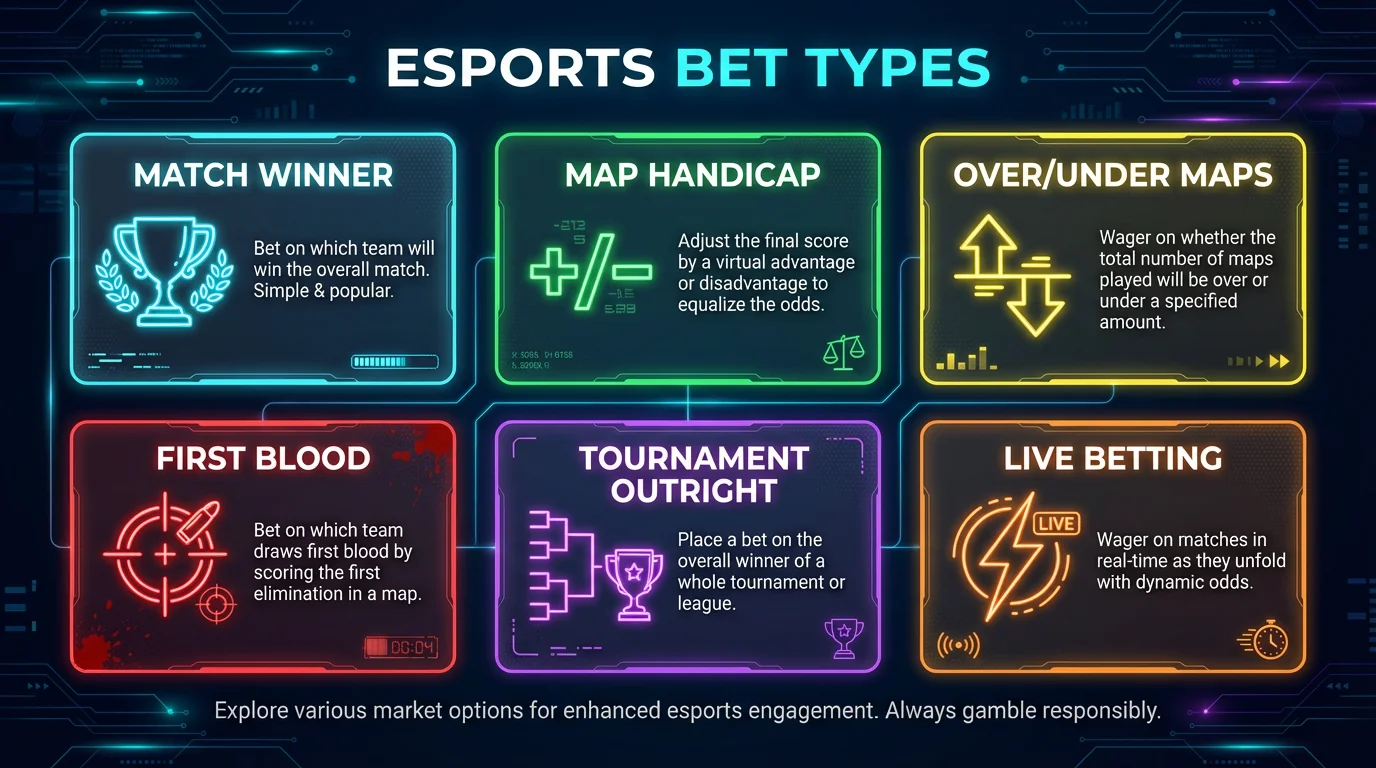
Esports betting markets mirror traditional sports in structure but differ in specifics. Here are the main bet types you’ll encounter.
Match Winner (Moneyline)
The simplest bet — pick which team wins the match. In a Bo3, you’re betting on who wins 2 maps first, regardless of the score. This works identically to a moneyline bet in traditional sports. Heavy favorites in esports can go past -300, especially in regional leagues where top teams dominate weaker opponents.
Map Handicap (Spread)
Map handicap works like a point spread. If Team A is -1.5 maps in a Bo3, they need to win 2-0 for the bet to hit. If you take Team B at +1.5, they just need to win one map. This is particularly useful in Bo3s where you think the underdog can steal a map but not the series.
In CS2, round handicaps go even deeper — you can bet on a team with a +4.5 or -4.5 round advantage on a specific map.
Over/Under (Totals)
Bet on whether the total number of maps (or rounds/kills) will be over or under a set line. In a Bo3, the total maps line is typically 2.5 — over 2.5 means a 2-1 result, under 2.5 means a 2-0 sweep. This is a good market when you have a read on how competitive a match will be without picking a winner.
First Blood / First Kill
Bet on which team scores the first kill in a map or game. In CS2, this often relates to early aggression on pistol rounds. In LoL and Dota 2, it depends on invade strategies and early jungle skirmishes. First blood rates are trackable statistics that create legitimate edges when sportsbooks don’t adjust lines quickly after meta shifts.
Tournament Outrights (Futures)
Bet on who wins an entire tournament before it starts. Futures bets in esports can offer significant value because public perception often lags behind roster changes, meta shifts, and regional form. A team that just signed a star player or thrived on a new patch might be undervalued in outright markets.
Live / In-Play Betting
Esports live betting is where game knowledge pays off most. If you’re watching a CS2 match and recognize that a team’s economy is broken after a crucial round loss, you can bet on the opponent before odds adjust. In LoL, snagging a live line after a team secures an early dragon soul setup can be +EV if you understand the snowball dynamics.
Player Props
Prop bets on individual player performance — kills, deaths, assists, or specific in-game achievements. These markets are often softer than match winners because sportsbooks have less data and modeling for individual player lines. If you closely follow a player’s recent form, you can find mispriced props regularly.
Game-Specific Betting Markets
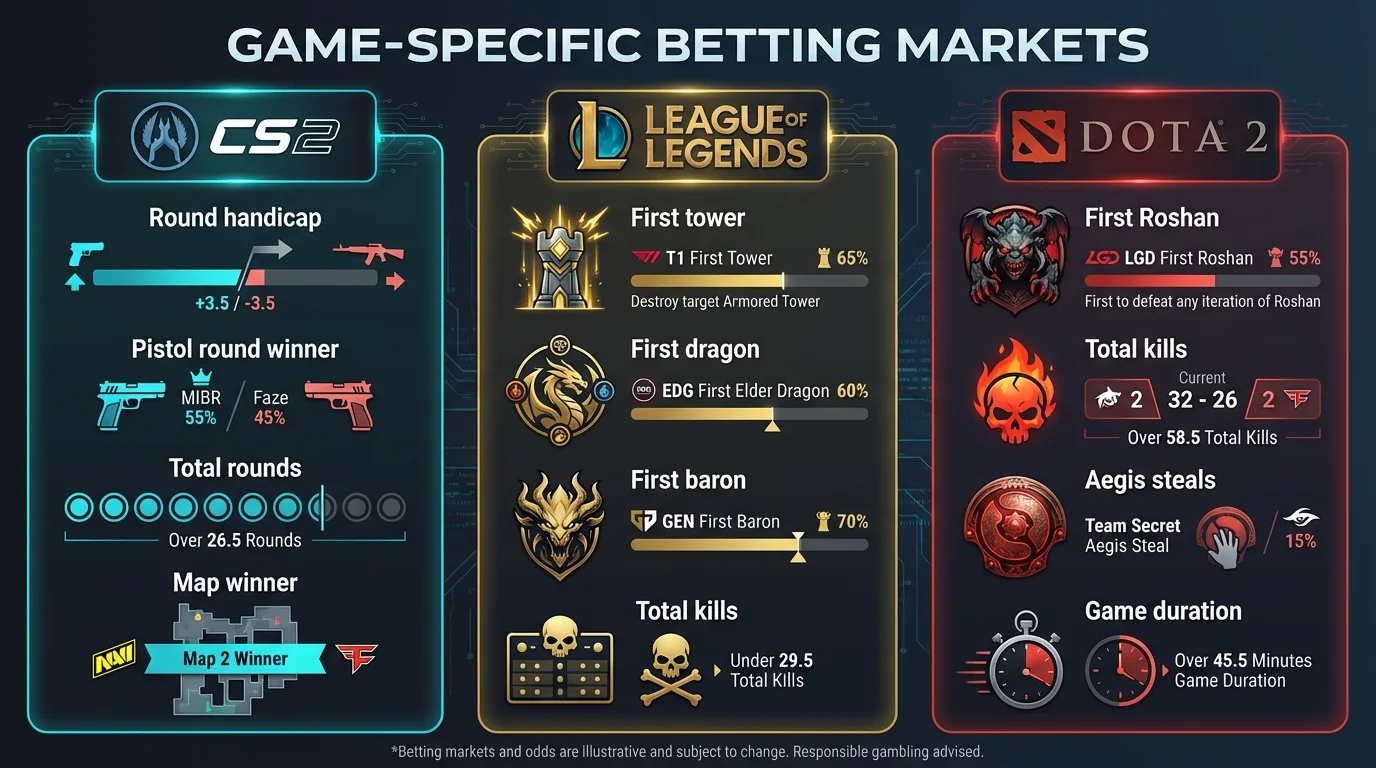
Each game offers unique betting markets tied to its specific mechanics. These game-specific props are where deep knowledge creates the biggest edge.
CS2 Markets
CS2-SPECIFIC BETS
- Round Handicap: Spread applied to individual map round counts (e.g., Team A -4.5 rounds on Inferno)
- Pistol Round Winner: Which team wins the opening round of each half — high variance but predictable for teams with strong pistol strats
- Total Rounds: Over/under on the total rounds played in a map (typically set around 24.5-26.5)
- Map Winner: Bet on who wins a specific map in a Bo3 series — useful when you know map veto tendencies
- Knife Round: Which team wins the initial knife round to choose starting side — essentially a coin flip
League of Legends Markets
LOL-SPECIFIC BETS
- First Tower: Which team destroys the first turret — heavily influenced by lane matchups and jungle pathing
- First Dragon: Which team secures the first elemental dragon — a strong indicator of early game control
- First Baron: Which team takes the first Baron Nashor — correlates highly with winning since Baron buff enables siege
- Total Kills: Over/under on combined kills in a game — meta-dependent (some patches produce bloodbaths, others are slow)
- Game Duration: Over/under on how long the game lasts — early-game teams push under, scaling comps push over
Dota 2 Markets
DOTA 2-SPECIFIC BETS
- First Roshan: Which team kills Roshan first — critical because the Aegis of the Immortal enables high-ground pushes
- Total Kills: Over/under on combined kills — Dota 2 averages higher kills than LoL due to longer games and buyback mechanics
- Game Duration: Over/under on match length — draft-dependent (push lineups end fast, late-game carries extend)
- Tower Kills: Total towers destroyed across the game — more volatile than LoL due to Dota’s buyback system
- Barracks Destroyed: Whether a team destroys a barracks (equivalent to inhibitors) — signals one team gaining a decisive advantage
How to Read Esports Odds
Esports odds work exactly like traditional sports odds. If you’re unfamiliar with how odds formats work, our odds converter can help you translate between American, decimal, and fractional formats.
What’s different in esports is how the match format affects odds interpretation:
| Format | What It Means for Odds | Betting Implication |
|---|---|---|
| Bo1 (Best of 1) | Higher variance; upsets more common | Underdogs have more value; don’t lay heavy juice on favorites |
| Bo3 (Best of 3) | Standard format; variance reduced but upsets possible | Most reliable format for analysis; map vetoes critical in CS2 |
| Bo5 (Best of 5) | Lowest variance; better team almost always wins | Favorites are more reliable; look for value in map-specific bets instead |
BO1 TRAP: DON’T OVERVALUE FAVORITES
The biggest mistake new esports bettors make is laying -250 or higher on favorites in Bo1 matches. In a single map, anything can happen — a lucky timing, an off round, or an inspired performance from an underdog AWPer. Bo1 favorites win at a lower rate than their odds imply, which means underdogs are systematically undervalued in this format.
Esports Betting Strategy
Profitable esports betting requires the same discipline as any form of sports betting — bankroll management, value identification, and emotional control. But the specific analytical edge comes from game knowledge.
Research Team Form and Roster Changes
Esports rosters change far more frequently than traditional sports teams. A single player swap can transform a team’s performance overnight. Before betting on any match, check whether the roster from last week is the same roster playing today.
Resources like HLTV (CS2), Liquipedia (all games), and Oracle’s Elixir (LoL) provide detailed roster and match history data. Use these to identify recent form trends — a team’s last 10 matches tell you more than their season-long record.
Map Pool Analysis (CS2)
In CS2, map pool analysis is arguably the most important factor. Every team has maps they dominate and maps they avoid. When you know Team A always bans Nuke and Team B always bans Ancient, you can predict which three maps will likely be played — and bet on individual map winners where you see mismatches.
HLTV.org provides map-specific win rates for every team. If Team A is 90% on Inferno and Team B is 45%, a map winner bet on Inferno offers massive value even if the overall match odds are close.
Patch Meta Analysis (LoL & Dota 2)
LoL patches every two weeks. Dota 2 patches less frequently but with bigger changes. When a major patch drops, the meta shifts — previously weak champions or heroes become dominant, and teams that adapt quickly gain a temporary edge.
Watch for teams whose playstyle aligns with a new patch. If the patch buffs early-game aggression and Team A is known for fast-paced play, they gain value before sportsbooks adjust their lines. The window of exploitable odds is usually 1-2 weeks after a major patch.
Bo1 vs Bo3 vs Bo5: Variance Matters
Understanding variance across formats is essential for proper bet sizing. Bo1 matches are inherently high-variance — the better team wins less often than in longer series. This means:
BO1 STRATEGY
Bet smaller. Look for underdog value. Avoid heavy favorites. Map selection is everything in CS2.
BO3 STRATEGY
Standard sizing. Best format for analysis. Map veto prediction is your main edge in CS2.
BO5 STRATEGY
Bet on the better team with confidence. Look for map handicap value if the underdog can steal one map.
Live Betting Opportunities
Live betting is where esports knowledge creates the widest edge over sportsbooks. Automated odds engines don’t understand the game as deeply as experienced players or viewers.
CS2 live edges: If a team wins a key eco round and breaks the opponent’s economy, the next 2-3 rounds are heavily favored for them — but odds may not fully reflect the economy advantage. Similarly, recognizing when a team is on a “force buy” versus a full buy creates opportunities.
LoL/Dota 2 live edges: After a decisive team fight or objective take, live odds shift — but if you understand the game state (item timings, ultimate cooldowns, map control), you may recognize the win probability shift before the algorithm does.
Bankroll Management for Esports
Esports betting requires disciplined bankroll management. With matches happening daily across multiple regions and games, the temptation to overbet is real. Use a bankroll calculator to set proper unit sizes, and consider the Kelly Criterion to optimize bet sizing based on your perceived edge.
A common approach: 1-3% of bankroll per bet on standard matches, scaling down to 0.5-1% on high-variance Bo1s and scaling up to 3-5% only on Bo3/Bo5 matches where you have strong conviction.
Common Mistakes in Esports Betting
MISTAKE 1: BETTING ON NAME RECOGNITION
FaZe Clan, Fnatic, Team Liquid — big names attract casual bettors who don’t check current form. Esports rosters change constantly. A legendary org with a rebuilt roster might be significantly weaker than their name suggests. Always check the current roster and recent results, not the team’s historical reputation.
MISTAKE 2: IGNORING PATCH AND META CHANGES
A team that dominated last patch may struggle after a major balance update. In LoL, a patch that nerfs a team’s signature champions can turn a top-3 team into a mid-table squad overnight. In CS2, map pool changes or weapon balance tweaks similarly shift power dynamics. Always check if a major patch dropped between a team’s last results and today’s match.
MISTAKE 3: OVERVALUING ONLINE RESULTS VS LAN
Online results don’t always translate to LAN performance. Some teams thrive in the pressure of a live crowd; others crumble. Ping advantages in online play disappear at LAN. When a major LAN tournament starts, discount recent online results and weigh previous LAN experience and performance more heavily.
MISTAKE 4: BETTING LOWER-TIER MATCHES
Lower-tier esports carries higher match-fixing risk than any traditional sport. Stick to Tier 1 and established Tier 2 leagues. If you’ve never heard of either team in a match, don’t bet it — the integrity of the result is uncertain, and sportsbook odds may not reflect the true outcome probability.
Building a Multi-Match Betting Strategy
With multiple esports matches running daily across different games and regions, parlay betting is tempting. A three-leg esports parlay combining a CS2 favorite, an LCK match, and a Dota 2 regional game can offer attractive combined odds.
Use a parlay calculator to see what your potential payout would be, and use an expected value calculator to determine whether the combined odds actually represent positive expected value. Most esports parlays are -EV because the margins compound across legs — but correlated parlays (same team to win map 1 AND the series) can sometimes offer legitimate value.
PRO TIP: CORRELATED ESPORTS PARLAYS
In CS2, parlaying a team to win map 1 with the over on total maps can be correlated value — if a team wins map 1, the series is less likely to be a sweep the other way, pushing toward a 2-1 result. Similarly, parlaying first blood with match winner on a team known for aggressive early plays is a smarter construction than random multi-game parlays.
Where to Find Esports Data
Informed betting requires data. Unlike traditional sports where stats are universally accessible, esports data is scattered across specialized platforms. Here are the essential resources:
| Resource | Game | What It Offers |
|---|---|---|
| HLTV.org | CS2 | Map stats, player ratings, head-to-head records, team rankings |
| Oracle’s Elixir | LoL | Early-game stats, gold differentials, objective control rates |
| Dotabuff / OpenDota | Dota 2 | Hero stats, match history, player performance, draft analysis |
| Liquipedia | All Games | Roster changes, tournament brackets, match schedules, team wikis |
KEY TAKEAWAYS
- Game knowledge is your edge — understanding mechanics, meta, and team dynamics creates real advantages over sportsbooks
- CS2 map pools are everything — map-specific win rates are the single most predictive factor in Counter-Strike betting
- Patch meta matters in MOBAs — LoL and Dota 2 meta shifts after patches create windows of exploitable odds
- Bo1 = high variance — reduce bet sizing and look for underdog value; avoid heavy favorites in single-map formats
- Live betting rewards game sense — economy breaks in CS2, dragon stacks in LoL, and Roshan timing in Dota 2 create live edges
- Stick to Tier 1 leagues — lower-tier matches carry match-fixing risk that makes results unpredictable regardless of analysis
- Roster changes happen constantly — always verify the current lineup before betting on any team’s historical form
- Use data platforms — HLTV for CS2, Oracle’s Elixir for LoL, Dotabuff for Dota 2, and Liquipedia for everything else
FAQs
Esports betting legality depends on your jurisdiction. In most US states where sports betting is legal, licensed sportsbooks offer esports markets alongside traditional sports. However, some states restrict esports betting or limit it to specific games. Check your local regulations before placing bets.
CS2 is generally considered the best esports game for betting due to its high match volume, extensive statistical data (via HLTV), map-based analysis opportunities, and the largest betting markets. League of Legends offers the most regional league coverage, while Dota 2 has fewer matches but higher prize pools and deeper strategic complexity.
A map handicap is the esports equivalent of a point spread. It adds or subtracts maps from a team’s final score. For example, if you bet Team A at -1.5 maps in a Bo3, they must win 2-0 for your bet to hit. If you bet the underdog at +1.5, they only need to win one map. This market is most common in CS2 and is useful when you think the underdog can compete but not win the series.
Yes, match-fixing is a real concern, particularly in lower-tier tournaments and regions with less oversight. Tier 1 events from established organizers like PGL, Riot Games, and Valve have integrity measures, but semi-professional and amateur leagues are vulnerable. Stick to betting on well-known leagues and teams to minimize this risk.
Bo1 means best-of-one (single map/game decides the winner), Bo3 means best-of-three (first to win two maps/games), and Bo5 means best-of-five (first to win three). The format significantly affects betting strategy: Bo1 matches are high-variance where upsets are common, while Bo3 and Bo5 series reduce variance and favor the stronger team.
Use specialized data platforms: HLTV.org for CS2 (map stats, player ratings, head-to-head records), Oracle’s Elixir for League of Legends (early-game stats, objective control), Dotabuff or OpenDota for Dota 2 (hero stats, match history), and Liquipedia for all games (roster changes, tournament brackets). Focus on recent form, current roster, and performance on the specific format being played.
Yes, most major sportsbooks offer live betting on esports, especially for CS2 and League of Legends. Live odds update based on in-game events like kills, objectives, and round wins. This is where game knowledge creates the biggest edge — if you understand economy breaks in CS2 or power spike timing in MOBAs, you can spot mispriced live lines before the algorithm adjusts.
Start with match winner (moneyline) bets on Bo3 matches in Tier 1 leagues. This is the simplest market with the most reliable outcomes. Avoid Bo1s (too much variance), exotic props (too complex), and lower-tier matches (integrity concerns). As you build experience and game knowledge, gradually explore map handicaps, totals, and game-specific props.
