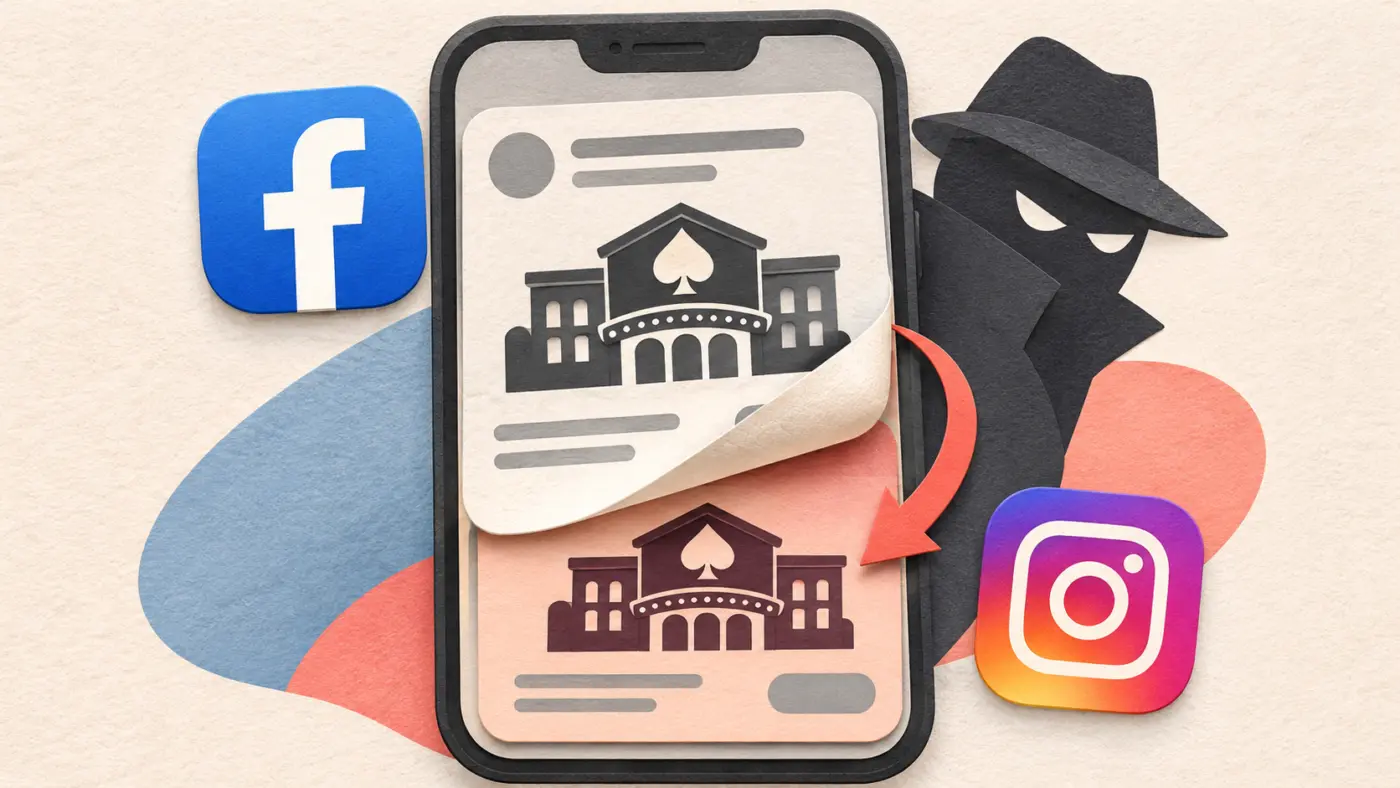
Fake Casino Ads on Facebook and Instagram: How the Scam Works and How to Spot It
How to spot cloned casino ads, check the destination and license, and respond after sharing information or paying.

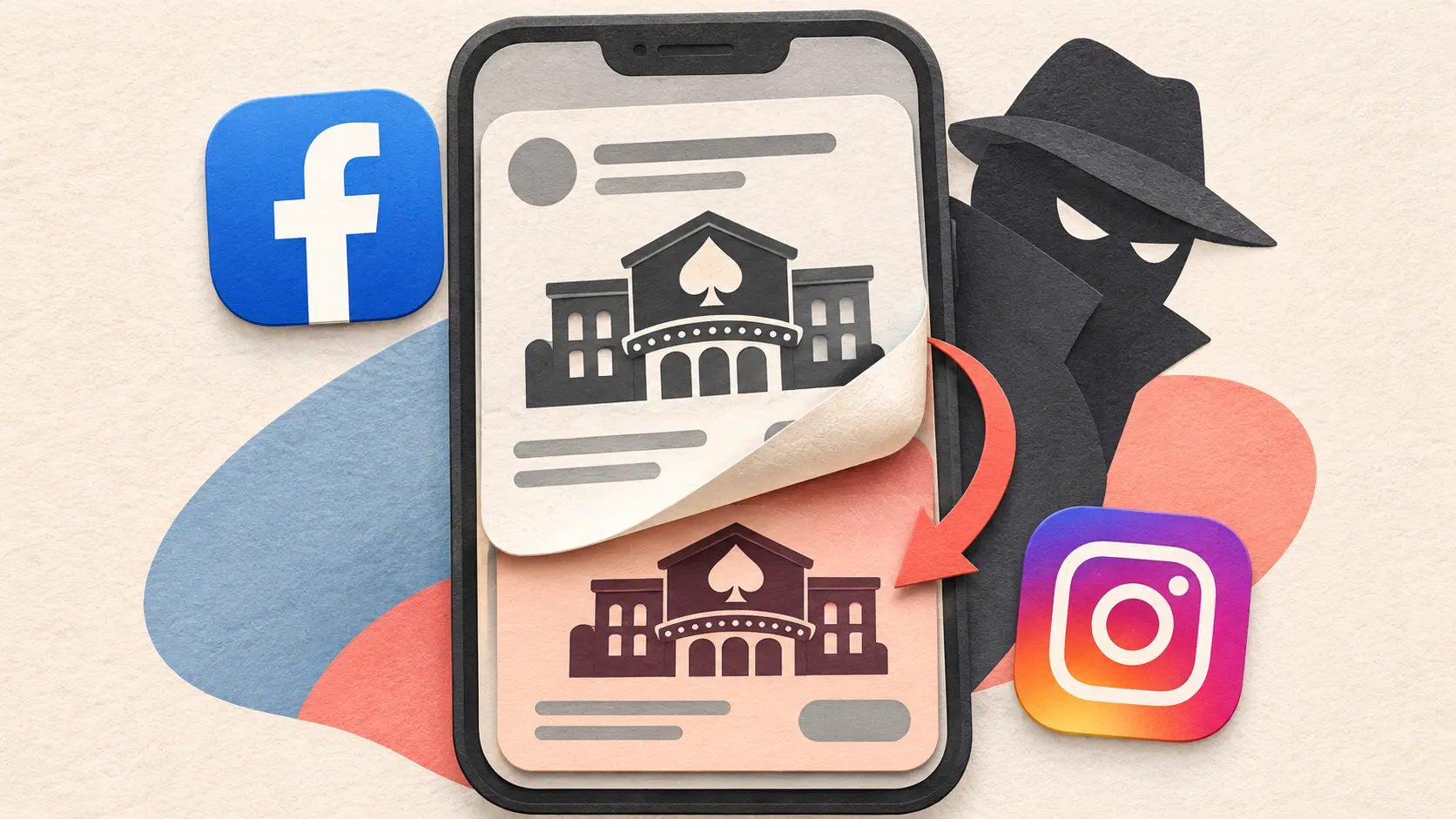
Fake casino ads on Facebook and Instagram borrow familiar logos, casino photos and celebrity faces to make an unfamiliar offer feel trustworthy. Before you register or pay, check who runs the destination website and whether that exact site is authorized where you live.
KEY FACTS AT A GLANCE
- Check the destination: A familiar brand, convincing video or copied license badge does not authenticate a casino offer.
- Already paid or shared details? Stop further payments, preserve the evidence and contact the relevant bank or payment provider promptly. Recovery is not guaranteed.
Check a casino ad before you trust it
Start outside the ad. Find the brand through its established website, then check whether it confirms the offer. A logo copied onto a social account proves very little. The same applies to a screenshot that appears to show a celebrity announcing a casino.
Next, compare the actual website address with the brand’s official domain. Do not rely on the address printed inside the image or the words on a download button. If the page is already open, read the browser’s address bar. Stop if the destination or business identity does not match.
Then check the operator’s local authorization through the relevant regulator. Match the exact domain, business name, license status and permitted activity. Our guide to checking whether an online casino is licensed and safe walks through those checks in detail.
Finally, pause at any demand to send money to release supposed free winnings. Do not make a small payment just to test the promise. A failed check is a reason to stop, even when the ad looks polished.
Why FDJ and Barrière have challenged Meta
On November 16, 2026, FDJ United confirmed that it had taken legal action against Meta over fraudulent use of its brands. According to an updated AFP report, FDJ seeks an urgent court order to remove ads promoting online casinos while copying its branding. The company said some material also reproduced retailers and newspaper front pages.
FDJ told AFP that a hearing was scheduled for the first quarter of 2027 at the Paris judicial court. The action remains pending in the reporting reviewed for this guide. It is not a ruling that FDJ has won.
There is an earlier Barrière case. On January 28, 2026, the Paris Court of Appeal upheld an order concerning a defined filtering measure for EU-targeted ads. Its conditions included specified Barrière trademarks and advertiser verification. The judgment did not impose a worldwide ban on casino advertising.
The practical problem predates this week’s FDJ coverage. In January 2024, France’s gambling regulator, ANJ, warned about fake Facebook accounts using Barrière and JOA identities. It described copied casino photos and logos leading people through imitation app-download pages to unauthorized gambling sites.
How the cloned-ad journey works
The borrowed identity gets attention. The next page keeps that trust alive long enough to obtain a registration, an installation or a payment. However, the destination and the way the advertiser makes money can differ.
Reported advance-fee variant
- Supposed free balance or winnings
- Payment demanded to unlock withdrawal
- Stop: do not send an additional payment
Observed affiliate route
- Fake app-store page
- Browser-based app added to phone
- Unrelated casino reached through affiliate links
- Verify destination and local authorization before depositing
These are separate routes, not one reconstructed campaign. Not every destination steals deposits or installs malware.
The fake-store route
Netcraft documented social ads that led to fake app-store listings and then to unrelated casinos through affiliate links. The intermediary uses the familiar brand to attract a customer, while the destination can have a different name. Netcraft could not verify the exact affiliate payment terms.
Malwarebytes found a related route in its FriendlyDealer investigation, including fake MrBeast-branded listings. The apparent download installed a browser-based app, known as a progressive web app, that redirected users to casino offers. Fabricated reviews helped the page resemble a real store.
That investigation explicitly distinguished the campaign from password theft and traditional malware. The deception still matters: the person reaches a gambling site through a false claim about the brand or app. But the evidence does not support saying every cloned casino ad infects a phone or steals every deposit.
The payment-to-unlock route
A separate warning sign is a supposed windfall that requires a payment before withdrawal. In August 2026, Curaçao Chronicle reported on a complaint involving an Instagram-linked promotion using MrBeast’s identity. The outlet said it reviewed screenshots showing a supposed $2,500 balance and a demand for a $150 deposit.
Run that comparison: $150 ÷ $2,500 × 100 = 6%. The requested payment looks small beside the displayed reward. Yet the deposit would involve real money, while the balance on the screen remained unverified. The complainant refused to pay. The report said the regulator had not issued a determination.
Keep that distinction in mind when reading bonus terms. Genuine offers can have restrictions, as our no-deposit bonus guide explains. Those restrictions do not authenticate an unknown site, and an impressive account balance does not prove that money is available to withdraw.
Warning signs in Facebook and Instagram casino scams
Look for borrowed authority: a familiar casino exterior, a celebrity clip, a news logo or a page styled as an official launch. In 2024, Lead Stories checked a manipulated Fox News clip that appeared to promote a MrBeast casino. A Fox spokesperson denied that the segment had aired.
Unnatural speech or mismatched lips can raise suspicion, but a convincing video still needs independent verification. Nor does the presence of a famous person establish endorsement. Check the specific campaign through the person’s or brand’s established channels.
Urgency adds pressure. An offer that will supposedly disappear soon gives you less time to check the address and operator. Promises of easy money or free spins deserve the same pause. Our guide to free-spin wagering and withdrawal conditions explains why the promotional headline is only part of an offer.
Store-like pages and customer reviews are also signals that can be copied. Check the destination independently rather than treating its design as approval. Seeing an ad on a large platform does not complete that check for you.
Meta says it pursues scam advertisers and works against cloaking, where a website shows reviewers different content from real visitors. Its February 2026 statement describes broader anti-scam work. It is not a response to FDJ’s new case, and it does not authenticate an individual ad.
Check the license for your location
A genuine license claim and permission to serve your location are separate checks. Start at the regulator’s own website, rather than trusting a badge on the casino page. The Malta Gaming Authority warned in July 2026 that some websites were impersonating its licensed operators.
France: ANJ says online casino sites are not authorized. Other forms of online gambling have different rules. Check its approved operators, and remember that absence from its blacklist does not mean approval: the list is incomplete.
Great Britain: A business needs a Gambling Commission license to provide remote gambling to consumers there, even when based abroad. Its public register shows website domains, trading names, current status and permitted activities.
A claimed Malta license: Use the MGA’s official Licensee Register or URL Checker to verify that claim. A match does not settle whether the offer is authorized in your country. Readers elsewhere should use their own jurisdiction’s regulator.
Do not treat every identity request as fraud. The Gambling Commission explains that licensed businesses must verify age and identity, and further legal checks can sometimes arise. However, a request for documents does not prove a site is genuine. Verify the operator before sending sensitive information.
What to do if you already clicked or deposited
Act according to what you shared or installed. A click alone does not establish that an account or device is compromised. If several exposures apply, follow each relevant response below.
Follow every branch that applies.
Only clicked
Close the page; do not provide information or pay; report the suspicious content.
Shared a password
Change it on the genuine service and anywhere reused; enable two-factor authentication.
Installed an app or gave device access
Remove suspicious software/web apps; review permissions; update security tools and scan if software or device access was involved.
Shared payment details
Contact the bank/provider immediately; block affected payment methods and monitor transactions.
Sent money
Contact the payment provider now; explain the deception and ask what recovery options apply.
A click alone does not establish compromise. Blocking a payment method does not reverse a completed payment. Recovery is not guaranteed.
If you sent money, contact the bank, card issuer, payment app or transfer provider through a known channel. Explain exactly what happened. Distinguish a deposit you authorized after deception from later charges you did not authorize. Ask what reversal, dispute or refund options apply to the payment.
The FTC advises contacting the provider promptly, while warning that money may already be gone. For cryptocurrency, contact the exchange or service involved and preserve transaction records. Recovery can be difficult; do not assume an exchange can reverse a completed transfer.
French Cybermalveillance guidance advises contacting the bank immediately when payment details are exposed or fraudulent debits appear. Blocking a compromised card helps prevent further use. It does not itself reverse an earlier payment.
Also preserve the ad, website address, messages and payment records. Change any exposed password on the genuine service, including other accounts where you reused it. If you installed suspicious software or granted device access, follow the relevant security and recovery steps instead of relying on a password change alone.
Report the ad and avoid recovery scams
Use Facebook or Instagram’s reporting option for the suspicious ad, post or account. Choose the closest scam or misleading-content category available; wording varies. Save the evidence first, because the content may disappear. You can also alert the impersonated brand through its official contact channel.
Report suspected illegal gambling to the relevant regulator and fraud to the appropriate local authority. In France, ANJ accepts illegal-site reports, but says it and its mediator cannot resolve disputes with illegal operators. Its guidance points consumers to DGCCRF through SignalConso. Cybermalveillance also advises a police complaint for fraudulent debits or identity misuse.
Finally, be wary of anyone offering to recover the money for an upfront fee. The FTC identifies this as a follow-on scam pattern. A report can help authorities act, but neither a report nor a paid recovery promise guarantees repayment.
FAQs
Does appearing on Facebook or Instagram make a casino ad legitimate?
No. An ad’s appearance on a large platform does not verify the operator or offer. Check the brand independently, then match the actual destination with the relevant regulator’s records and local rules.
Is a MrBeast casino ad real?
Documented scams have used MrBeast’s identity, including manipulated news footage and fake app-store listings. A face, logo or video cannot authenticate a particular offer. Check the specific campaign through established official channels before sharing information or paying.
How do I check a casino’s license?
Go directly to the relevant regulator’s website. Match the exact domain, operator, license status and permitted activity, then check whether that authorization covers your location. A copied badge or a license for another business proves nothing.
Should I pay to unlock free casino winnings?
A demand for money to release supposed free winnings is a major warning sign. Stop and verify the operator independently. Do not send a test payment or assume that a balance displayed on a website represents money you can withdraw.
Is every ID check or withdrawal delay a scam?
No. Licensed operators can have legal duties to verify identity, and a delay alone does not prove fraud. However, neither an ID request nor a verification label proves legitimacy. Check the operator before sending documents or money.
What should I do after depositing through a suspicious ad?
Stop further payments, preserve the ad and transaction records, and contact your bank or payment provider promptly. Explain the deception and ask what recovery options apply. Secure any exposed accounts and report the incident locally; repayment is not guaranteed.
Where do I report a fake casino ad?
Use the reporting option on the Facebook or Instagram ad, post or account, and preserve evidence first. Report suspected illegal gambling to your local regulator and fraud to the appropriate authority. Reporting helps address the activity but does not guarantee reimbursement.
KEY TAKEAWAYS
- Verify beyond the ad — check the brand independently, then match the exact destination and local authorization.
- Respond to the exposure — stop further payments, secure affected accounts, preserve records and contact the relevant provider. Do not pay someone upfront to recover funds.
Sources
- Statement confirming action over misuse of FDJ’s brand — FDJ United, November 16, 2026
- FDJ United’s action against Meta and hearing update — AFP, published by TradingView, November 16, 2026
- Meta Platforms Ireland v Groupe Lucien Barrière, RG 24/12568 — Paris Court of Appeal, January 28, 2026; judgment PDF hosted by Édition Multimédi@
- Warning about French casino brands impersonated on Facebook — ANJ, January 30, 2024
- Branded gambling campaigns and casino redirects — Netcraft, July 2, 2026
- FriendlyDealer investigation and cleanup guidance — Malwarebytes, March 23, 2026
- Complaint concerning a promotion using MrBeast’s name — Curaçao Chronicle, August 17, 2026
- Fact-check of a manipulated MrBeast casino news clip — Lead Stories, August 15, 2024
- Action against scam advertisers and cloaking — Meta, February 26, 2026
- Avoiding and reporting scams — Meta Safety Centre
- Blacklist limits, approved operators and illegal-site reporting — ANJ
- Remote gambling licensing in Great Britain — Gambling Commission
- Public register details and license checks — Gambling Commission
- Age, ID and financial verification — Gambling Commission
- Notice about websites impersonating licensees — Malta Gaming Authority, July 16, 2026
- Licensee Register and URL Checker — Malta Gaming Authority
- Phishing prevention and victim response — Cybermalveillance.gouv.fr
- What to do after paying or sharing information with a scammer — Federal Trade Commission
- Refund and recovery scams — Federal Trade Commission
- Disputes with illegal gambling sites — ANJ

Aevan Lark
Aevan Lark is a gambling industry veteran with over 7 years of experience working behind the scenes at leading crypto casinos — from VIP management to risk analysis and customer operations. His insider perspective spans online gambling, sports betting, provably fair gaming, and prediction markets. On Dyutam, Aevan creates in-depth guides, builds verification tools, and delivers honest, data-driven reviews to help players understand the odds, verify fairness, and gamble responsibly.
Related coverage
Australia’s Offshore Casino Payment Blocks: Can I Deposit?
How the 1 January 2027 rules affect cards, PayID, wallets, crypto and money an offshore casino already owes you.
Casino Multi-Accounting: MetaWin Says Its Filter Misfired
MetaWin says a faulty filter blocked promo credits. Here is how casino account rules and appeals work.

How to Check if an Online Casino Is Licensed and Safe
Test the new casino checker, verify Curaçao and Anjouan records, and separate licensing from local authorization and withdrawal protection.