NFL betting generates more action than any other sport in America—and it’s not even close. Every Sunday, millions of bettors pore over point spreads, moneylines, and totals, trying to find an edge against the sportsbooks. But between the confusing odds formats, the jargon, and the sheer volume of information, getting started can feel overwhelming. This guide breaks down everything you need to know about NFL betting: how to read the lines, what the numbers actually mean, and strategies that separate casual bettors from those who take it seriously.
Key Highlights
- Three main bet types — Point spread (betting on margin of victory), moneyline (betting on who wins), and totals/over-under (betting on combined score)
- Standard odds are -110 — You risk $110 to win $100 on most spread and total bets; this 4.76% “vig” is the sportsbook’s cut
- Key NFL numbers — 3 and 7 are critical because they’re the most common margins of victory (field goal and touchdown)
- Home field advantage has shrunk — Once worth 3 points, it’s now closer to 1.5-2 points in modern NFL
- Break-even rate is 52.38% — At -110 odds, you need to win more than half your bets just to break even
- Line movement matters — Sharp money and injury news can move lines significantly before kickoff
The Three Main NFL Bet Types
Almost every NFL bet you’ll encounter falls into one of three categories. Understanding how each works is fundamental to betting on football.
1. Point Spread (Betting the Line)
The point spread is the most popular way to bet on NFL games. It’s designed to level the playing field between mismatched teams by requiring the favorite to win by a certain margin.
EXAMPLE: CHIEFS -6.5 VS. BRONCOS +6.5
Betting Chiefs -6.5: Kansas City must win by 7+ points for you to win
Betting Broncos +6.5: Denver can lose by up to 6 points (or win outright) and you still cash
If the Chiefs win 24-20, Broncos bettors win—the 4-point margin is less than 6.5. If the Chiefs win 27-20, Chiefs bettors win—they covered the 7-point margin.
The half-point eliminates the possibility of a “push” (tie). When you see whole numbers like -7, a push returns your original stake. Most spreads are priced at -110 on both sides, meaning you risk $110 to win $100 regardless of which side you take.
2. Moneyline (Picking the Winner)
Moneyline betting strips away the spread entirely—you’re simply betting on which team wins. The catch? The odds adjust dramatically based on which team is favored.
EXAMPLE: CHIEFS -280 VS. BRONCOS +220
Chiefs -280 (Favorite): Bet $280 to win $100. High risk, low reward—but Kansas City just needs to win by any margin.
Broncos +220 (Underdog): Bet $100 to win $220. Low risk, high reward—but Denver must pull the upset.
Moneyline is ideal when you expect a close game where the favorite might win but not cover the spread, or when you love an underdog to win outright.
Use our Moneyline Converter to calculate payouts and convert between American, decimal, and fractional odds.
3. Totals (Over/Under)
Totals betting ignores who wins—you’re betting on whether the combined score of both teams will be over or under a number set by oddsmakers.
EXAMPLE: CHIEFS VS. BRONCOS | TOTAL 47.5
Over 47.5: You win if the final combined score is 48 or higher
Under 47.5: You win if the final combined score is 47 or lower
If the game ends 27-24 (51 total points), over bettors win. If it ends 20-17 (37 total), under bettors win. Overtime counts toward the total.
Totals are particularly useful when you have a read on game script (defensive slugfest vs. shootout) but aren’t confident about picking a side.
How NFL Odds Work
American odds use a baseline of $100 to show you either how much you need to risk (negative odds) or how much you’ll win (positive odds). Understanding this is essential before placing any bet.
Reading Negative Odds (Favorites)
When you see a minus sign, the number tells you how much you must risk to win $100:
- -110 → Risk $110 to win $100 (standard spread/total odds)
- -150 → Risk $150 to win $100
- -300 → Risk $300 to win $100 (heavy favorite)
Reading Positive Odds (Underdogs)
When you see a plus sign, the number tells you how much you’ll win on a $100 bet:
- +110 → Win $110 on a $100 bet
- +200 → Win $200 on a $100 bet
- +500 → Win $500 on a $100 bet (big underdog)
The Vig (Juice): The Sportsbook’s Cut
Notice how the standard odds are -110, not -100? That extra $10 you’re risking beyond the potential $100 profit is the “vig” or “juice”—the sportsbook’s commission for taking your bet.
| Odds Format | Vig % | Break-Even Rate |
|---|---|---|
| -110 / -110 (Standard) | 4.76% | 52.38% |
| -105 / -105 (Reduced) | 2.38% | 51.22% |
| -115 / -115 | 6.98% | 53.49% |
At standard -110 odds, you need to win 52.38% of your bets just to break even. That 2.38% above 50% is the sportsbook’s edge. Finding books with reduced juice (-105) or shopping for the best lines across multiple sportsbooks can significantly improve your long-term results.
NFL Key Numbers: The Most Important Margins
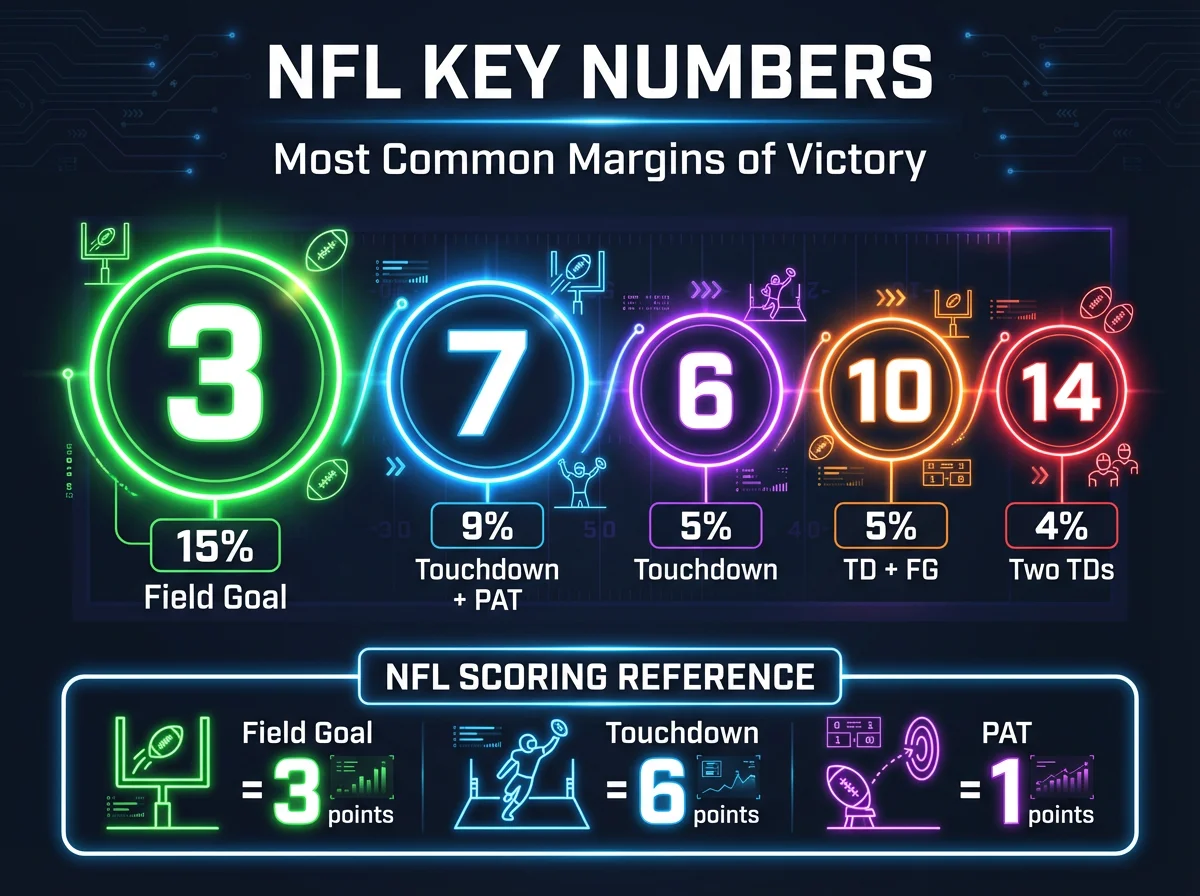
Not all point spreads are created equal. In football, certain margins of victory occur far more frequently than others because of how scoring works (field goals = 3, touchdowns with PAT = 7).
| Margin | Frequency | Why It Matters |
|---|---|---|
| 3 | ~15% | Most common margin (one field goal difference) |
| 7 | ~9% | Second most common (one touchdown + PAT) |
| 6 | ~5% | One touchdown (missed PAT or 2pt conversion) |
| 10 | ~5% | TD + field goal |
| 14 | ~4% | Two touchdowns |
PRO TIP: BUYING POINTS ON KEY NUMBERS
When a spread sits at -3 or -7, consider “buying” a half-point to get -2.5 or -6.5 (for favorites) or +3.5 or +7.5 (for underdogs). This costs extra juice (e.g., -120 instead of -110), but getting to the right side of key numbers can be worth the premium. Moving off non-key numbers like 5 or 8 is less valuable.
Factors That Move NFL Lines
Lines don’t stay static—they move from the opening number through kickoff based on betting action and new information. Understanding what moves lines helps you time your bets and spot value.
Home Field Advantage (Declining)
Historically, oddsmakers gave home teams a built-in 3-point advantage. That number has steadily declined. Modern data shows home field advantage now sits closer to 1.5-2 points league-wide, with significant variation by stadium:
- Best home field edges: Detroit (+6.4 pts), Green Bay, Seattle (loud crowds, weather factors)
- Minimal home advantage: Some dome teams and warm-weather cities show little to no edge
- Weather divisions dominate: NFC North and AFC North have the best overall home field advantages (~+3.5 pts)
Injuries
Quarterback injuries move lines the most—sometimes 3+ points for elite QBs. Other key positions to monitor:
- Offensive line starters — Affects both passing and rushing game
- Star pass rushers — Impacts defensive pressure and sack rates
- Top cornerbacks — Changes matchup dynamics significantly
Lines adjust once injuries become public. Betting early before injury news drops (or quickly after) can capture value before the market corrects.
Weather
Weather primarily affects totals, not spreads. Cold, wind, and precipitation suppress scoring:
- Wind over 15 mph: Significantly impacts passing games—lean unders
- Rain/snow: Increases fumble risk, reduces passing efficiency
- Extreme cold: Balls become harder to throw and catch
Home teams acclimated to harsh weather (Green Bay, Buffalo, Chicago) have genuine edges in late-season games against warm-weather or dome opponents.
Sharp Money vs. Public Money
Not all bets carry equal weight. Sportsbooks track “sharp” action from professional bettors separately from “public” money from recreational bettors:
- Public money — Tends to favor favorites, overs, and popular teams
- Sharp money — Often takes contrarian positions, underdogs, unders
- Line movement — When lines move against the public betting percentage, sharps are likely involved
If 70% of bets are on the Chiefs but the line moves from -7 to -6.5, sharp money is likely on the underdog despite public sentiment.
NFL Betting Strategies
No strategy guarantees wins—sportsbooks are sophisticated operations that adjust quickly. However, these approaches have shown historical edges:
Fade the Public (Contrarian Betting)
When the public overwhelmingly backs one side, the other side often provides value. Early-season data from 2024 showed underdogs of 5.5+ points going 13-2 ATS in the first three weeks—and nine of those 15 games were won outright by the underdog.
This doesn’t mean blindly bet against popular teams, but recognize that inflated lines against perceived “bad” teams often overcorrect.
Buy Low, Sell High
Overreaction is the public bettor’s biggest enemy. After a team gets blown out, their line the following week often moves too far in the opposite direction. Similarly, a team coming off a dominant win may be overvalued.
- Buy low: Back teams after ugly losses when the market overcorrects
- Sell high: Fade teams after impressive wins when lines become inflated
Line Shopping
The single most important thing you can do to improve your NFL betting results: have accounts at multiple sportsbooks and always take the best available line.
Getting +3.5 instead of +3 or -6.5 instead of -7 doesn’t seem like much, but over hundreds of bets, those half-points are the difference between winning and losing bettors. A half-point on a key number like 3 is worth significantly more than a half-point from 4 to 3.5.
Target Early Week Lines
Lines are typically “softer” (easier to beat) when they first come out on Sunday night for the following week. By game day, sharp bettors have pushed the lines toward their fair value. If you do your research early, you can often find value before the market corrects.
REALITY CHECK: BANKROLL MANAGEMENT
Even winning bettors experience significant losing streaks. A 55% win rate—considered excellent—still means losing 45% of the time. Never bet more than 1-3% of your bankroll on a single game. Use our Bankroll Calculator to determine appropriate bet sizing based on your edge and risk tolerance.
Common NFL Betting Mistakes
Avoiding mistakes is just as important as finding winners. Here are the most common traps:
1. Betting With Your Heart
Your favorite team isn’t special to the sportsbook. If anything, public bias toward popular teams often makes betting against them more profitable. Separate fandom from betting.
2. Chasing Losses
After a bad Sunday, the instinct is to bet heavier on Monday Night Football to “get back to even.” This is how bankrolls evaporate. Stick to your unit size regardless of recent results.
3. Ignoring Line Value
Asking “who wins this game?” is the wrong question. The right question is “does this team cover this number?” A team can be the correct side to bet at +7 but a terrible bet at +3. The line is everything.
4. Overloading on Parlays
Parlays are fun but mathematically worse than straight bets. The house edge compounds with each leg. Occasional small parlays for entertainment are fine, but they shouldn’t be your primary betting strategy.
5. Not Shopping Lines
Betting at only one sportsbook is leaving money on the table. The difference between -110 and -105 juice, or getting +3.5 vs +3, compounds over time into thousands of dollars for serious bettors.
Tools to Improve Your NFL Betting
The right tools can help you make smarter decisions and find value faster:
Betting Calculators & Converters
Conclusion
NFL betting isn’t about finding “locks” or guaranteed winners—those don’t exist. It’s about making informed decisions, finding small edges where the market has mispriced a game, and having the discipline to execute consistently over time. The sportsbooks need you to win just under 52.4% to break even; they’re betting you won’t do your homework.
Start with understanding the three main bet types, learn to read lines and calculate implied probabilities, and respect key numbers. Shop for the best lines, manage your bankroll conservatively, and treat betting as a long-term endeavor rather than a get-rich-quick scheme. The bettors who last are the ones who understand that losing weeks are inevitable—the goal is to make sure the wins outpace the losses over the course of a season.
Point spread betting requires the favorite to win by a specific margin, while moneyline betting simply requires picking the winner regardless of margin. Spread bets typically have -110 odds on both sides, while moneyline odds vary based on each team’s expected chances. Spread betting is more popular because it evens out mismatched games.
At standard -110 odds, you need to win 52.38% of your bets to break even. This means out of every 100 bets, you need to win at least 53 to profit. Professional bettors typically achieve 54-58% win rates over large sample sizes. Finding reduced juice books (-105) lowers this threshold to 51.22%.
Key numbers in NFL betting are 3 and 7—the most common margins of victory because of football’s scoring structure (field goals worth 3, touchdowns with PAT worth 7). About 15% of NFL games are decided by exactly 3 points, and 9% by exactly 7 points. Other important numbers include 6, 10, and 14. Spreads on or near these numbers are particularly significant.
The vig (vigorish) or juice is the sportsbook’s commission on your bet—their built-in profit margin. At standard -110 odds, you risk $110 to win $100, meaning the extra $10 is the vig. This translates to approximately 4.76% that the sportsbook takes. Some books offer reduced juice (-105) with only 2.38% vig, which significantly improves your long-term expected value.
Home field advantage in the NFL has declined significantly. Historically valued at 3 points, it now averages closer to 1.5-2 points league-wide. Some stadiums like Detroit and Green Bay show stronger home edges (4-6 points) due to crowd noise and weather factors, while dome teams and warm-weather cities show minimal advantage. Modern bettors should account for roughly 2 points, not the historical 3.
Lines move due to betting action (sportsbooks adjust to balance their risk), injury news (especially quarterback injuries can move lines 3+ points), weather forecasts (primarily affects totals), and sharp bettor activity. When lines move against public betting percentages, it often signals sharp money taking the other side. Monitoring line movement can help you identify value and optimal betting timing.
Start with these fundamentals: (1) Focus on spread betting rather than parlays, (2) open accounts at multiple sportsbooks to shop for best lines, (3) bet 1-3% of your bankroll per game maximum, (4) avoid betting on your favorite team, (5) bet early in the week when lines are softest, and (6) track all your bets to identify patterns. Most importantly, understand that even professionals lose 45% of their bets—long-term discipline matters more than any single game.
Over/under (totals) bets are wagers on the combined final score of both teams. If the line is 47.5 and you bet the over, you win if the teams combine for 48+ points. Under bettors win at 47 or fewer combined points. Weather (especially wind) significantly impacts totals, and overtime counts toward the final score. Totals are useful when you have a read on the game script but aren’t confident picking a side.
