A new report reveals that Czech authorities are losing CZK 330 million ($15.9 million) every month in gambling taxes to illegal offshore operators. But the headline number obscures the more troubling finding: 66.2% of problem gamblers who self-excluded from legal sites are now gambling on unregulated platforms—a devastating indictment of responsible gambling tools when offshore access remains unrestricted.

KEY FACTS AT A GLANCE
- Monthly tax loss: CZK 330M (~$15.9M USD)
- Annual tax loss: CZK 2.9-3.6B (~$140-174M USD)
- Annual player losses to illegal sites: CZK 14.5B (~$700M USD)
- Licensed operators: 27
- Known illegal brands targeting Czechs: 1,113
- Players knowingly using illegal sites: 400,000
- Players who can’t tell legal from illegal: 400,000
- Self-excluded players gambling illegally: 66.2%
The Self-Exclusion Failure
The most damning finding in the 2026 “Black Book of Illegal Gambling” isn’t the tax loss—it’s the complete failure of responsible gambling infrastructure when offshore access is unrestricted.
According to the report, compiled by Robert Klobuck of the Sociological Institute at the Slovak Academy of Sciences, 66.2% of players who previously self-excluded from legal Czech gambling sites now gamble “occasionally or regularly” with illegal operators. Two-thirds of the people who recognized they had a problem and took steps to address it are now gambling in an environment with zero protections.
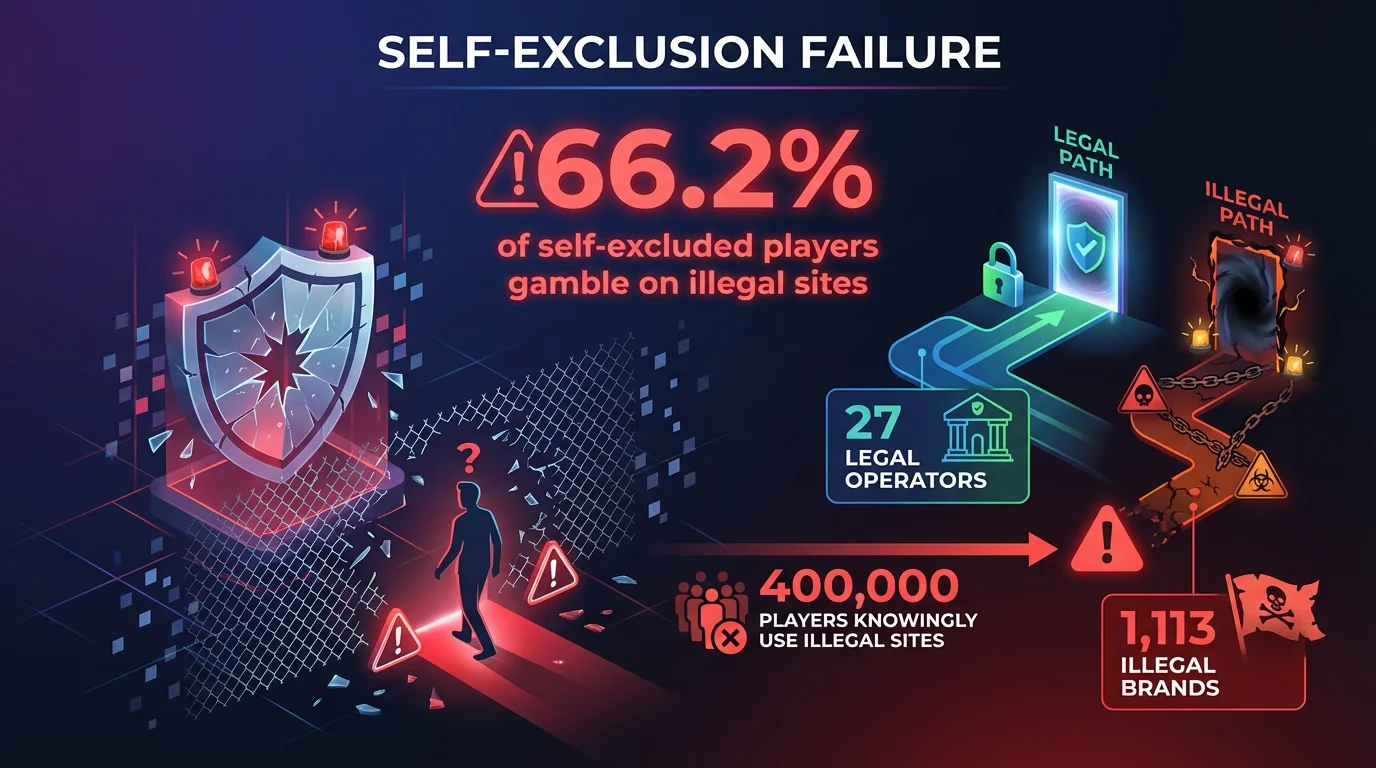
This isn’t a Czech problem—it’s a structural flaw in how regulated markets approach responsible gambling. Self-exclusion registries only work if all operators participate. Offshore crypto casinos and unlicensed platforms don’t check national registries, don’t implement cooling-off periods, and don’t limit deposits. For vulnerable players, the “protection” offered by licensed operators simply redirects them to unregulated alternatives.
THE RESPONSIBLE GAMBLING PARADOX
Self-exclusion programs are a cornerstone of regulated gambling. They’re cited in every licensing application, every regulatory framework, every operator’s responsible gambling policy. But when 66.2% of self-excluded players simply migrate to offshore sites, the entire premise collapses. You’re not protecting vulnerable players—you’re just losing them to operators with no protections at all.
The 41:1 Ratio: When the Black Market IS the Market
Czech Republic has 27 licensed gambling operators. It has 1,113 known illegal brands specifically targeting Czech players. That’s not a black market operating at the margins—that’s a parallel market that dwarfs the legal one in brand count by 41 to 1.
The top three illegal gambling brands alone generate over 111,000 monthly searches from Czech browsers. According to the Black Book analysis, over 50% of organic search results on Google for gambling terms feature ads or results for illegal operators. An estimated 30% of all online gambling in the Czech Republic occurs with unauthorized platforms.
| Metric | Legal Market | Illegal Market |
|---|---|---|
| Number of Operators/Brands | 27 | 1,113 |
| Market Share (Online) | ~70% | ~30% |
| Self-Exclusion Registry | Participates | Does not check |
| Player Fund Protection | Required | None |
| Dispute Resolution | Regulatory recourse | None |
| Tax Contribution | CZK 20B+ annually | Zero |
The Institute for the Regulation of Gambling (IPRH), which represents 95% of the legal Czech gambling market, estimates the black market represents 20-30% of the legal market’s size. But in brand proliferation and player acquisition, illegal operators are winning decisively.
The Prague Prohibition Backfire
Prague provides a case study in prohibition’s unintended consequences. The city council banned all slot machines effective January 1, 2024. The result wasn’t less gambling—it was more illegal gambling.
Since 2017, Czech customs authorities have discovered over 1,400 illegal gambling dens nationwide—nearly double the 700 legal establishments currently operating. Many of these illegal venues emerged in areas where municipalities banned legal gambling, including Prague.
“Illegal operation in brick-and-mortar gambling establishments is still a reality. These are places where the law is broken, municipal regulations are circumvented and often other forms of crime occur.”
— Czech Customs Administration
An investigation in Prague’s Střížkov district (Prague 9) uncovered an illegal gambling hall with 16 gaming machines worth CZK 1.6 million. Officers seized equipment, reset keys, and cash. This is the predictable outcome when you ban supply without addressing demand—the market goes underground.
The pattern mirrors what we’ve documented in other jurisdictions. Turkey’s aggressive crackdown on online gambling pushed players toward cryptocurrency and offshore operators. Indonesia’s $56 billion enforcement campaign reduced transactions but didn’t eliminate demand. Prohibition creates black markets—it doesn’t eliminate gambling.
The Crypto Casino Factor
IPRH Director Jan Řehola specifically called out crypto casinos and social media as having “fundamentally changed the black market.”
“This is an environment that is virtually beyond any control and often attracts children and young people.”
— Jan Řehola, IPRH Director
Cryptocurrency gambling presents unique enforcement challenges. Transactions don’t flow through traditional banking rails, making payment blocking ineffective. Operators can accept deposits without KYC verification, making player identification impossible. And platforms operating from jurisdictions like Curaçao—which hosts the majority of illegal operators targeting Czechs—face no meaningful regulatory consequences.
The Black Book report notes that most operators of illegal gambling sites targeting Czech players are based in Curaçao, the Caribbean island that has become the global hub for unlicensed gambling operations. Czech authorities have blocked over 3,450 illegal gambling pages since 2017, but operators simply create mirror sites with different domains.
What IPRH Wants: Enforcement Recommendations
The industry body isn’t just documenting the problem—it’s pushing for specific policy changes.
WEBSITE BLOCKING
Strengthen technological tools for blocking illegal gambling websites. Current blocking is reactive—462 sites blocked in 2025 alone, but mirror sites appear immediately.
PAYMENT BLOCKING
Simplify cooperation with banks and payment service providers to cut off fund flows to illegal operators. This is the enforcement approach Turkey has weaponized effectively.
PUBLIC AWARENESS
Systematically raise public awareness of illegal gambling risks. 400,000 players can’t distinguish legal from illegal operators.
“Based on the data, we can see that the current repressive measures are not enough. It is necessary to strengthen the technological tools for blocking illegal websites, simplify cooperation with banks and payment service providers and at the same time systematically raise public awareness of the risks of illegal gambling.”
— Jan Řehola, IPRH Director
What “Illegal” Actually Means for Players
For the 800,000 Czech players using unlicensed sites—400,000 knowingly, 400,000 who can’t tell the difference—the risks are concrete:
RISKS OF ILLEGAL GAMBLING SITES
Financial Risks
- No fund segregation requirements
- No withdrawal guarantees
- Payment processor seizure risk
- No recourse if operator disappears
- Potential crypto volatility exposure
Protection Gaps
- No dispute resolution mechanism
- No self-exclusion tools
- No deposit limits enforced
- No responsible gambling interventions
- No regulatory oversight
The 400,000 players who can’t distinguish legal from illegal operators are particularly vulnerable. They may believe they have protections that don’t exist. When disputes arise—and they will—there’s no regulator to appeal to, no ombudsman to contact, no legal framework to enforce their claims.
The Broader Pattern
Czech Republic isn’t unique. The tension between regulated markets and offshore competition is playing out globally:
| Country | Approach | Black Market Result |
|---|---|---|
| Czech Republic | Licensed market + municipal bans | 20-30% black market share |
| Turkey | Total prohibition + bank enforcement | 40-58% shift to crypto |
| Indonesia | $56B crackdown campaign | 57% transaction drop, demand persists |
| UK | Heavy regulation + high taxes | Operators exiting, offshore growth |
The UK’s regulatory squeeze—including a 40% remote gaming duty—is pushing operators out of the licensed market. When legal gambling becomes too expensive or restrictive, players and operators alike migrate to alternatives. The question isn’t whether black markets will exist, but how large you’re willing to let them grow.
KEY TAKEAWAYS
- Self-exclusion is broken — 66.2% of self-excluded players gamble on illegal sites, defeating the purpose of responsible gambling tools
- 41:1 brand ratio — 1,113 illegal brands vs 27 licensed operators shows the scale of offshore competition
- $15.9M monthly tax loss — Annual losses of $140-174M flow offshore instead of funding Czech public services
- Prohibition backfires — Prague’s slot ban led to 1,400+ illegal gambling dens discovered nationwide since 2017
- Crypto changes everything — Curaçao-based operators using cryptocurrency are “virtually beyond any control”
- 800,000 players exposed — Half knowingly use illegal sites; half can’t tell the difference
Sources
- Illegal Gambling Statistics — Institute for Gambling Regulation (IPRH/IFGR)
- Record Number of Blocked Illegal Gambling Websites — IPRH/IFGR
