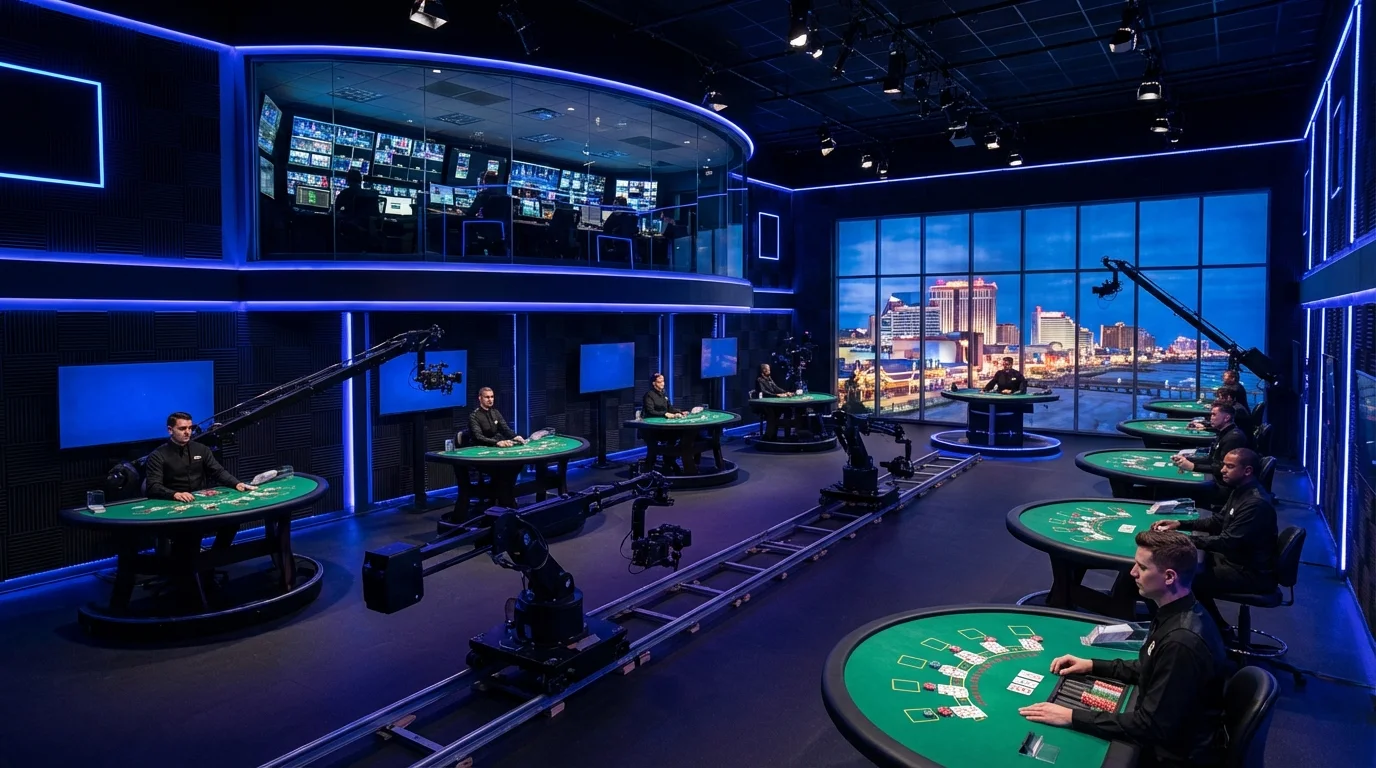
Evolution AB, the Swedish live casino supplier that quietly powers virtually every live dealer table in the United States, is building a 60,000-square-foot tech center and live dealer studio on the second floor of the Showboat Resort in Atlantic City. The facility — occupying a space that once housed a bowling alley — will add approximately 1,200 employees to Evolution’s existing New Jersey workforce of roughly 1,000, making the company one of Atlantic City’s largest private employers. Jacob Claesson, Evolution’s North America CEO, aims to have the studio running by mid-2026 pending Division of Gaming Enforcement approval. But the headline is jobs. The story is something else entirely. In January 2026, New Jersey’s online casino revenue hit $258.9 million — outpacing the state’s nine land-based casinos for the third consecutive month. Full-year 2025 marked the first time online casino revenue ($2.91 billion) surpassed in-person casino revenue ($2.89 billion) in state history. And behind every live dealer stream feeding that record — every shuffled deck, every spun wheel, every dealt hand across every major NJ online casino — sits one company. Here’s what that concentration means for the market, the regulators, and the players sitting at those virtual tables.
KEY FACTS
- NJ online casino revenue (Jan 2026): $258.9 million — up 16.8% year-over-year
- First full-year crossover: 2025 online ($2.91B) overtook land-based ($2.89B) for the first time
- Evolution’s North America market share: Approximately 90% of live dealer infrastructure
- Showboat studio: 60,000 sq ft, ~1,200 employees, targeting May 2026 opening
- $75M Fairmount campus: CRDA-approved in mid-2024 — current status unclear
- Ezugi (Evolution subsidiary): Already live in NJ as a “second brand”
- Total NJ gaming revenue (Jan 2026): $586.4 million across all channels
The Revenue Crossover: Online Overtakes Land-Based
New Jersey legalized online casino gaming in 2013, becoming the third US state to do so. In 2019, the state’s online casino market generated $482.7 million — roughly 15% of the $2.68 billion produced by Atlantic City’s land-based casinos. Six years later, the gap has not just closed — it has inverted. In 2025, online casino revenue reached $2.91 billion, an increase of more than 500% from 2019. Land-based casino revenue grew just 8% over the same period, reaching $2.89 billion. For the first time in state history, online overtook in-person casino revenue for the full year.
The January 2026 numbers reinforced the trend. Online casino platforms generated $258.9 million — up 16.8% from $221.6 million in January 2025. Land-based casinos posted $213.3 million, growing just 1.6%. Online now accounts for 48.1% of New Jersey’s total gaming revenue, compared to 39.7% for land-based. Add in sports wagering revenue of $114.2 million, and the state’s total gaming haul for the month reached $586.4 million. That generated $86.5 million in total tax revenue, with online gaming alone contributing $57.4 million — more than three times the $15.7 million from land-based operations, thanks to a higher effective tax rate on internet gaming (approximately 22.5% combined versus 8% for brick-and-mortar).
The full-year 2025 total — $6.98 billion across all channels — set an all-time record for New Jersey gaming. This is no longer an emerging supplement to Atlantic City’s casino floors. It is the dominant revenue channel, and it is accelerating while land-based growth plateaus.
| Period | Online Casino | Land-Based | Online Share | Online YoY |
|---|---|---|---|---|
| Jan 2026 | $258.9M | $213.3M | 48.1% | +16.8% |
| Dec 2025 | $273.2M | $216.1M | ~48% | +19.8% |
| Full Year 2025 | $2.91B | $2.89B | First crossover | +22% |
| Full Year 2024 | $2.39B | $2.81B | Online trailing | +24% |
| Full Year 2019 | $482.7M | $2.68B | ~15% | — |
“With casinos often relying on third-party operators to manage their internet gaming sites, it seems that much of the benefit of this growing segment is experienced outside of Atlantic City.”
— Jane Bokunewicz, Faculty Director, Lloyd D. Levenson Institute of Gaming, Hospitality, and Tourism, Stockton University
The Supplier Nobody Sees: Evolution’s Infrastructure Monopoly
Evolution AB is not a casino. It does not take bets from players, and you will never see its name on a betting app. It is a business-to-business supplier — the company that builds the studios, hires the dealers, develops the streaming software, and broadcasts the games that appear on platforms like FanDuel Casino, DraftKings Casino, BetMGM, Borgata Online, Caesars Online, and Hard Rock Bet. When you sit at a live blackjack table, a live roulette wheel, or a live baccarat session on any regulated New Jersey platform, you are playing through Evolution’s infrastructure. The dealer is an Evolution employee. The camera is Evolution hardware. The software processing your bet is Evolution code. The studio where it all happens is an Evolution facility in Atlantic City.
This is not an exaggeration. Evolution holds an estimated 60% of the global live dealer market and approximately 90% of the North American market. In New Jersey specifically, there is currently no other scaled live dealer supplier. Claesson acknowledged this reality in a February 2026 interview, framing it with characteristic understatement.
“Live dealer has become a must these days, and we’re kind of fortunate for the position we’re in that we work with all the licensed operators in New Jersey.”
— Jacob Claesson, CEO North America, Evolution AB
Part of what created this dominance is regulatory architecture. Under New Jersey law (N.J.A.C. § 13:69O-1.2), all internet gaming equipment, servers, and personnel must be physically located within Atlantic City. This requirement anchors Evolution’s operations in AC — its current studios operate out of Hard Rock Hotel & Casino, Tropicana, and Ocean Casino Resort — but it also creates an enormous barrier to entry. Any competitor must build a physical studio in Atlantic City, hire and train local staff, integrate with every casino operator’s platform, and secure DGE approval before streaming a single hand. Evolution has been doing this since the US market opened. The result is a moat built as much by regulation as by product quality — though Evolution’s product portfolio, from Lightning Roulette to Crazy Time to game show formats that redefined the category, has given competitors little room to differentiate even where they do have access.
WHO POWERS YOUR LIVE DEALER TABLE?
If you play live blackjack, roulette, baccarat, or game shows on any of these NJ-licensed platforms, the dealer, cameras, studio, and software are all provided by Evolution AB or its subsidiary Ezugi:
FanDuel Casino · DraftKings Casino · BetMGM · Borgata Online · Caesars Online · Hard Rock Bet · Golden Nugget Online · Unibet · PokerStars Casino · bet365 Casino
There is currently no other scaled live dealer supplier in New Jersey’s regulated market.
| Supplier | Global Share | NA Share | NJ Presence | Relationship |
|---|---|---|---|---|
| Evolution AB | ~60% | ~90% | All operators | Market leader |
| Ezugi | Subsidiary | Via Evolution | Live (Oct 2025) | Owned by Evolution |
| Pragmatic Play | ~15% | Minimal | Not present | Growing challenger |
| Playtech | ~10% | Limited | Not present | Global competitor |
Then there is Ezugi. Evolution acquired the live dealer brand in 2019, and in October 2025, it relaunched Ezugi as a “second brand” in the US regulated market. Ezugi’s initial NJ offerings — EZ Baccarat and Ultimate Auto Roulette — are now live, with more titles planned for 2026. Evolution describes this as doubling their product offerings for operators. The market reality is different: when the only “competitor” entering your market is your own subsidiary, marketed separately to create the appearance of supplier diversity, that is not competition. It is brand segmentation. The cameras, studios, and corporate reporting all roll up to the same Stockholm-listed parent company.
The $75 Million Question
The Showboat studio is not Evolution’s first major commitment to Atlantic City real estate — it may not even be their largest. In mid-2024, Evolution announced plans for a $75 million, 130,000-square-foot, four-story standalone campus at 2301 Fairmount Avenue. The Casino Reinvestment Development Authority approved the project, which was projected to accommodate 2,000 employees operating in three shifts around the clock. The estimated economic impact: at least $113 million over five years.
Now Evolution is leasing 60,000 square feet at Showboat for approximately 1,200 employees, with a construction timeline that puts it operational by mid-2026. Neither Evolution nor current reporting has clarified whether the Showboat lease replaces, supplements, or serves as an interim measure while the Fairmount campus moves through development. No cancellation of the Fairmount project has been announced, but no construction updates have emerged either. Dyutam will update this comparison when more information becomes available.
FAIRMOUNT CAMPUS VS. SHOWBOAT STUDIO
FAIRMOUNT AVE CAMPUS (2024 PLAN)
- Size: 130,000 sq ft, 4-story
- Investment: $75 million
- Employees: ~2,000 projected
- Type: Purpose-built on CRDA land
- Status: CRDA approved; no construction updates
SHOWBOAT STUDIO (2026 ANNOUNCEMENT)
- Size: 60,000 sq ft, single floor
- Investment: “Tens of millions” (undisclosed)
- Employees: ~1,200 projected
- Type: Leased space in existing building
- Status: Under construction; May 2026 target
The Showboat Paradox
When Caesars Entertainment sold the Showboat Atlantic City in 2014, it placed a deed restriction on the property preventing casino gaming. The building would not compete with Caesars’ remaining Atlantic City properties. Developer Bart Blatstein purchased Showboat and invested over $100 million transforming it into a family-oriented resort — home to what he calls the world’s largest beachfront indoor waterpark, New Jersey’s largest arcade, luxury apartments, and a rooftop pool. His pursuit of a casino license was ultimately shelved.
Now the second floor of a building that cannot legally operate a single slot machine or table game for walk-in customers will house one of the largest live dealer production facilities in the United States. Evolution’s studio will broadcast real-money blackjack, roulette, baccarat, and game shows to every NJ online casino — streaming from a non-casino resort to phones and laptops across the state. The studio operates under the casino licenses of Evolution’s operator partners (Hard Rock, Ocean Casino Resort, and others), not under Showboat’s own licensing. Blatstein called the lease “the largest office use in Atlantic City in many decades.” He is not wrong. It is also one of the stranger regulatory structures in American gaming — a building barred from gambling that serves as a factory for it.
What This Means for Players
More tables, more games. Evolution’s Showboat expansion directly increases live dealer capacity in New Jersey. Players should expect shorter wait times during peak hours, a broader selection of table limits, and new game launches. Evolution has been rolling out titles aggressively — from Monopoly Big Baller to Lightning Storm — and the additional studio space provides room for more simultaneous streams. Ezugi’s arrival adds titles like EZ Baccarat and Ultimate Auto Roulette to NJ lobbies. For players, more capacity is straightforwardly good news.
Identical catalogs across casinos. Because every NJ operator sources live dealer content from the same supplier, the live lobbies at FanDuel Casino, DraftKings Casino, BetMGM, and Borgata are functionally interchangeable for live games. The Lightning Roulette table you see at one casino is the same stream you would see at another. Differentiation between platforms comes down to bonuses, the user interface, and the RNG slot libraries — not the live dealer experience itself. If you are choosing between NJ casinos specifically for live dealer, the product is identical. Focus on which platform offers better promotional terms for live play.
Concentration risk is real. If Evolution experiences technical failures, regulatory complications, or operational disruptions at its Atlantic City facilities, there is no backup live dealer supplier in New Jersey. The live dealer tables go dark across every platform simultaneously. This is not hypothetical — Evolution has faced a UK Gambling Commission review and studio-level labor issues in other markets. For most players on most days, this is invisible. But it is worth understanding that the resilience of NJ’s live dealer market is exactly as robust as one company’s operational capacity — and no more. Understanding how house edge and RTP work across these games can help you make informed decisions regardless of which platform you choose.
The Bigger Picture
New Jersey’s revenue crossover is not an isolated event. It is a preview. As more states move toward iGaming legalization — Maine legalized iGaming recently, Virginia is advancing bills through both chambers — Evolution’s first-mover advantage compounds. The company already operates studios in New Jersey, Michigan, Pennsylvania, and Connecticut. It holds live dealer supplier relationships with the major operators in every legal state. Each new market that opens is a market where Evolution arrives with technology, talent pipelines, regulatory experience, and operator relationships that no competitor can match on day one.
The Showboat studio is one node in that expansion — a company building the physical infrastructure of American live casino while the revenue data confirms online is now the dominant gaming channel. Evolution built this position through genuine innovation, relentless execution, and a regulatory landscape that rewards incumbency. The question is not whether Evolution is good at what it does — it is. The question is whether a market segment approaching $3 billion annually in a single state should depend on one supplier for its fastest-growing vertical — and whether players and regulators are paying attention to the answer.
KEY TAKEAWAYS
- Revenue crossover is structural — NJ online casino revenue overtook land-based in 2025 and the gap is widening, not closing
- Evolution controls ~90% of NA live dealer infrastructure — every major NJ online casino sources live dealer content from Evolution or its subsidiary Ezugi
- Ezugi is brand segmentation, not competition — Evolution’s “second brand” creates the appearance of supplier diversity while maintaining total market control
- The Showboat expansion doubles down on AC — 60,000 sq ft and ~1,200 jobs anchor live dealer production in Atlantic City, partially addressing concerns about iGaming value leaking out of the city
- The $75M Fairmount campus remains an open question — neither cancelled nor visibly progressing, it represents a potential doubling of Evolution’s AC footprint
- For players, game quality is high but choice is limited — live dealer lobbies across NJ casinos are functionally identical because they all run through the same supplier
Sources
- January 2026 Total Gaming Revenue Results — New Jersey Division of Gaming Enforcement
- Atlantic City’s Evolution Tech Hub to Open 60,000-Square-Foot Tech Center — 100.1 WJRZ
- Evolution to Open 60,000 Sq Ft Live Dealer Studio at Showboat Atlantic City — Yogonet International
- Evolution Proposes $75 Million Live Dealer Casino Campus for Atlantic City — PlayNJ
- Evolution Introduces Ezugi as Second Live Dealer Brand in the U.S. — Evolution AB
- N.J.A.C. § 13:69O-1.2 — Internet Gaming Equipment Location Requirements — Cornell Law Institute
- New Jersey Smashes Gambling Revenue Record in 2025 — iGamingBusiness
