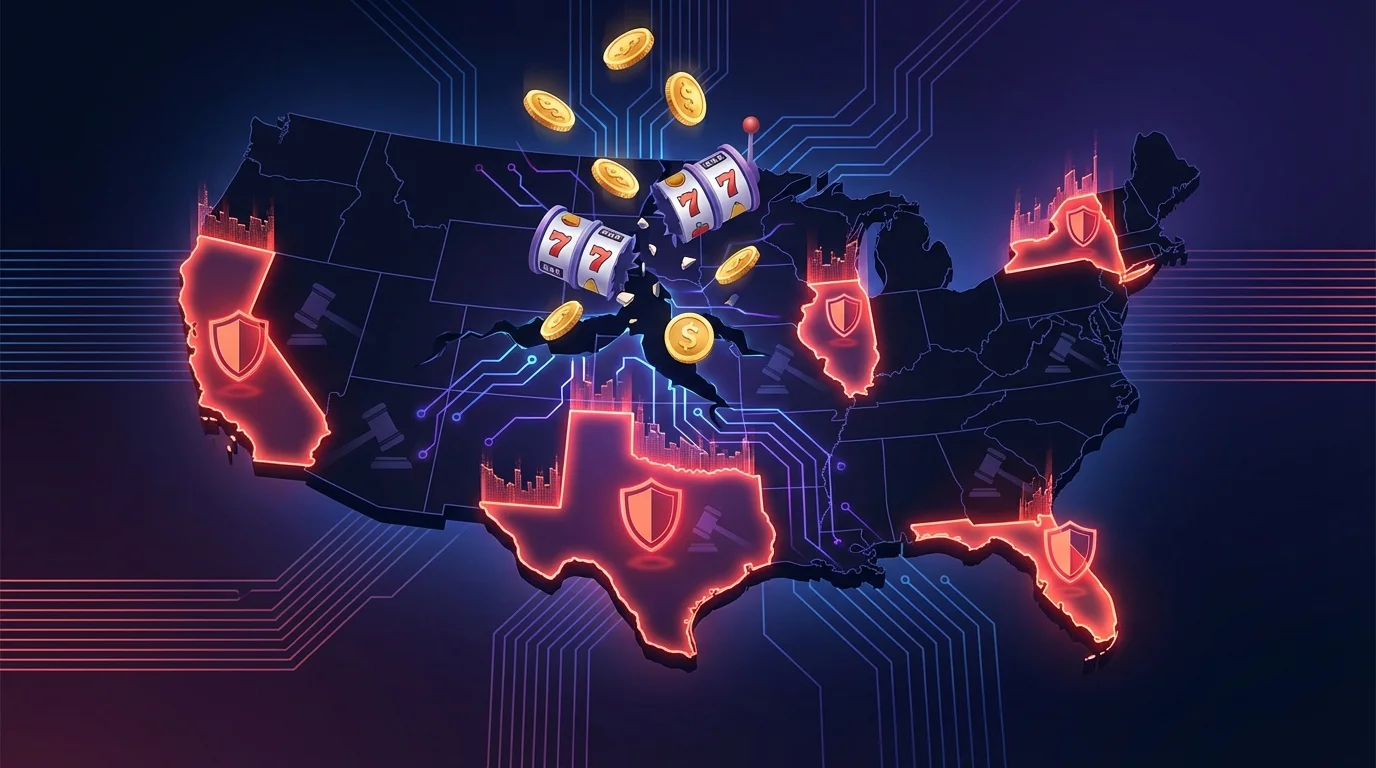
Six states enacted sweepstakes casino bans in 2025, at least four more are advancing legislation in 2026, and the infrastructure enabling gray market gambling — from game suppliers to payment processors to advertising platforms — is being systematically dismantled. This coordinated state-level assault has already excluded nearly 20% of the US population from sweepstakes casinos and forced Eilers & Krejcik Gaming to revise its 2025 US sweepstakes revenue estimate from $4.7 billion down to $4 billion. What follows is the complete intelligence picture across every front.
KEY FACTS AT A GLANCE
- States with enacted bans (2025): Montana, Connecticut, New Jersey, California, New York, Nevada
- States advancing bans (2026): Florida, Indiana, Oklahoma, Illinois, Maine, Utah, Virginia, Mississippi
- Population excluded: Nearly 20% of the US population now blocked from sweepstakes casinos
- Revenue impact: Eilers & Krejcik revised 2025 estimate from $4.7B to $4B
- Florida enforcement: 525 machines seized, $190K in proceeds from Operation Reels of Fortune
- Indiana HB 1052: Passed both chambers with veto-proof margins, awaiting governor’s signature
- Illinois compliance: Only 2 of 65 platforms (3%) complied with cease-and-desist orders
- Lawsuits: 100+ class action suits filed against sweepstakes operators in 2025
- First supplier exit: Pragmatic Play became first major game supplier to fully withdraw from US sweepstakes
Florida — The Enforcement Superpower
Florida has emerged as the most aggressive anti-sweepstakes enforcement state in the country, combining undercover stings, federal partnerships, and legislative escalation into a coordinated campaign that seized more illegal gambling machines in 2025 than the previous four years combined.
On February 27, 2026, AG James Uthmeier announced the results of a two-day undercover sting dubbed “Operation Reels of Fortune” at a news conference in Titusville. Led by the Flagler County Sheriff’s Office across four counties, the operation seized 525 illegal gambling machines from 39 locations across Flagler, Volusia, Brevard, and Duval counties, along with $190,000 in illicit proceeds. In Duval County alone, the Jacksonville Sheriff’s Office made 5 felony arrests, 14 misdemeanor arrests, seized 112 machines and over $62,000 in funds.
The machine types seized fell into five categories: stand-up slot machines, PC slot machines, tabletop machines, coin-push machines, and fish table machines. The raided businesses included restaurants, bars, gas stations, “sham arcades,” standalone illegal casinos, nail salons, and beauty supply stores — some completely unmarked or masquerading as legitimate businesses.
“Unlawful gambling operations often play a role as the financial backing behind criminal networks. These illegal casinos fuel organized crime, prostitution, and other illicit activities. Florida will see a major statewide crackdown on illegal gaming in 2026. If you’re running an illegal operation, don’t roll the dice; shut it down now.”
— AG James Uthmeier, February 27, 2026
Uthmeier said two warehouses are now “stuffed to the ceiling” with seized illegal casino games and confirmed he has been “calling on the legislature to heighten the penalties” with optimism that felony-level charges are coming.
The operation was the latest in a year-long escalation. The Florida Gaming Control Commission’s 2025 year-end statistics, published December 30, 2025, showed a dramatic surge across every enforcement metric.
| Metric | 2024 | 2025 | Change |
|---|---|---|---|
| Cash seized | $7,110,613 | $14,474,336 | +103% |
| Machines confiscated | 1,287 | 6,725 | +422% |
| Tips received | — | 3,300+ | — |
| Law enforcement MOUs | — | 29 new | — |
“I thank Governor Ron DeSantis and the Florida Legislature for their ongoing support of the Florida Gaming Control Commission. Their actions strengthen Florida’s gambling laws and help protect our communities.”
— FGCC Executive Director Alana Zimmer
Since July 2025 alone, the FGCC closed approximately 80 operations across the state, resulting in 65 arrests and the seizure of $11 million and 3,300+ illegal slot machines. The Commission entered into 29 new memoranda of understanding with local, state, and federal law enforcement agencies in 2025.
In a separate federal operation on December 11, 2025 — dubbed “Operation Funny Money” — Homeland Security Investigations served as lead agency alongside the IRS, FGCC, and Clay County Sheriff’s Office, raiding three locations across Duval and Clay counties. The operation seized 230 illegal slot machines and 23 fish tables. FGCC Director of Law Enforcement Carl Herold revealed: “We have been told of upwards of five murders across the state directly or indirectly related to these illegal casinos.”
The highest-profile enforcement action came in June 2025, when AG Uthmeier’s Office of Statewide Prosecution charged Osceola County Sheriff Marcos López in a “massive Central Florida illegal gambling operation” that generated nearly $22 million in illicit proceeds. López faces racketeering and conspiracy charges, and Gov. DeSantis suspended him the same day.
GAMBLING HELPLINE CRISIS
Data from the Florida Council on Compulsive Gambling (888-ADMIT-IT) shows online gambling calls surged from 589 in 2023 to 1,401 in 2025 — a 138% increase. Total contact volume jumped 88% to over 61,000 in 2024. The majority of callers are men aged 20-25, and 13% of online sports betting callers report losing more than $200,000. The Council has only 7 employees handling 170+ contacts per day, with state funding having dried up 8 months prior.
Florida’s Legislative Push — HB 189 and SB 1580
While enforcement ramps up on the ground, the Florida Legislature is advancing bills that would fundamentally change the legal landscape. HB 189, sponsored by Rep. Dana Trabulsy (R–Fort Pierce), is the most significant piece of gambling legislation Florida has considered in years.
| Bill | Sponsor | Committee Progress | Status |
|---|---|---|---|
| HB 189 | Rep. Trabulsy (R) | Passed 3 committees (13-0, 13-4, 18-5) | On House calendar |
| SB 1580 | Sen. Martin (R) | Passed 2 committees | Needs Rules Committee |
| HB 591 | Rep. Jacques (R) | Referred to committee | Not advanced |
HB 189’s key provisions include raising illegal gambling violations from misdemeanors to third-degree felonies, defining “internet gambling” to capture sweepstakes casinos without naming them directly — any game “in which money or other thing of value is awarded based on chance, regardless of any application of skill, that is available on the Internet and simulates casino-style gaming, including slot machines, video poker, and table games.” The bill explicitly exempts Seminole compact gaming, formally codifies daily fantasy sports with restrictions, and creates an FGCC slot machine surrender program.
“The Seminole Tribe paid the state of Florida, over the course of five years, $2.5 billion. And when we have illegal activity happening where taxes are not being paid to the state, it’s just an unfair playing field.”
— Rep. Dana Trabulsy, sponsor of HB 189
The companion bill SB 1580 largely mirrors HB 189, though DFS provisions were amended out before advancing. It includes a device surrender window running September 1 through October 31, 2026, and makes transporting 5 or more persons for illegal gambling a felony.
The most significant threat to both bills comes from an unexpected source: veterans’ organizations. HB 189 creates a slot machine verification process requiring VFW halls and American Legions to prove their machines are legal. As attorney Marc W. Dunbar (Jones Walker, Seminole legal counsel) noted, “The vast majority of those would not pass, which is why organizations like the VFW and American Legion are loath to undertake the process.” The penalty for failure would increase from misdemeanor to third-degree felony.
This is not an abstract concern. Bill Helmich, an ex-Marine who lobbies on behalf of the VFW, currently serves as interim executive director of the Florida Republican Party — critically significant given Republican control of Florida government. Language involving charitable halls scuttled a similar bill in the Senate two years ago.
“The bill provides the ability for somebody who’s engaged potentially in a crime to walk down to law enforcement, the gaming commission, and say, ‘Tell me if I’m committing a crime.’ And then if you believe I’m committing a crime, I’m not going to be in trouble as long as I get rid of this illegal device. Imagine a drug dealer walking down to the police department and saying, ‘Hey, is this cocaine that I plan on selling? If it is, don’t arrest me. It’s yours.’ Frankly, it doesn’t exist anywhere else in law.”
— Sen. Jonathan Martin, sponsor of SB 1580
DEADLINE ALERT
Florida’s 2026 legislative session ends March 13, 2026. HB 189 is on the House calendar for second reading but has not yet received a floor vote. SB 1580 still needs to clear the Rules Committee before reaching the Senate floor. Both bills face a narrow window for passage.
Meanwhile, Hard Rock Bet has introduced a product that highlights the emerging two-tier system in Florida gambling. On October 29, 2025, the Seminole-operated platform launched “Games Powered by Past Motor Races” — 21 slot-style titles supplied by Playtech that use historical NASCAR race data to determine outcomes rather than random number generation. The interface looks and feels exactly like online slots, with spinning reels, themed animations, and sound effects, while Hard Rock Bet classifies them as a “form of sports betting” authorized under the 2021 Compact. The FGCC has not publicly confirmed or denied compliance.
Illinois — Mass Defiance of Cease-and-Desist Orders
On February 5, 2026, the Illinois Gaming Board issued 65 cease-and-desist letters to sweepstakes casino operators in coordination with the Office of AG Kwame Raoul — the largest single wave of enforcement letters targeting sweepstakes platforms in US history.
The legal basis was Illinois Criminal Code Section 720 ILCS 5/28-1(a)(12), covering operation of an illegal online casino. The IGB stated it had observed on January 12, 2026 that operators were offering Illinois users slots, bingo, and table games via internet and mobile platforms.
The targets included every major platform in the industry: Chumba Casino, LuckyLand Slots, Global Poker, Stake.us, Pulsz, Modo, WOW Vegas, Fortune Coins, McLuck Casino, Fliff, High 5 Casino, Legendz, Sportzino, and more than 50 others. Every SGLA member company was targeted.
The result was near-total defiance. Two weeks after the letters were issued, only 2 of 65 platforms — Jumbo 88 and JefeBet — had complied by updating their terms to restrict Illinois players. Rolling Riches also voluntarily restricted. All major platforms continued operating, exposing the fundamental limitation of enforcement-by-letter.
“Illegal online gambling operations threaten consumer protections, undermine responsible gaming safeguards, and are antithetical to the public’s interest in regulated gaming.”
— IGB Administrator Marcus D. Fruchter
The stakes in Illinois are enormous. The state has 17 casinos, approximately 9,000 licensed video gaming locations with 49,000+ VGTs, and 14 active sportsbooks. Regulated gambling generated over $2.2 billion in tax revenue in 2025, with VGTs alone producing $3.086 billion in net terminal income in FY 2025.
The IGB’s enforcement approach has followed a clear escalation pattern: 11 C&D letters to offshore sports wagering and DFS sites in February 2025, letters to prediction market operators Kalshi, Robinhood, and Crypto.com in April 2025, and then the 65 sweepstakes letters in February 2026. The 3% compliance rate now fuels the case for SB 1705, introduced by Sen. Bill Cunningham, which would expand the “gambling device” definition to cover sweepstakes devices and make violations a Class 4 felony. The bill must advance by March 17, 2026 to remain viable.
Separately, Rep. Edgar González Jr.’s HB 4797 would take the opposite approach — creating the “Internet Gaming Act” with licensed iGaming at a 25% tax rate, $250K license fees, up to 3 skins per licensee, and interstate poker via MSIGA. Prior versions failed in 2023 through 2025.
Indiana — The Seventh State Ban
Indiana is poised to become the first state to enact a sweepstakes casino ban in 2026 and the seventh overall. HB 1052, primarily sponsored by Rep. Ethan Manning (R), passed both chambers with veto-proof margins and was transmitted to Gov. Mike Braun on February 27, 2026 (see our detailed coverage of Indiana HB 1052 for full background).
| Date | Action | Vote |
|---|---|---|
| Dec 5, 2025 | Filed | — |
| Jan 6, 2026 | First hearing — IGC testified existing law insufficient | — |
| Feb 2, 2026 | House passed | 87-11 |
| Feb 17-18, 2026 | Senate passed with amendments | 37-8 |
| Feb 26, 2026 | Conference committee report adopted | Senate 46-4, House 68-21 |
| Feb 27, 2026 | Enrolled and transmitted to Governor | Awaiting signature |
The bill creates new Indiana Code section IC 4-33-10-7, defining and prohibiting sweepstakes games that use a “dual-currency or multi-currency system of payment” simulating casino-style gaming accessible via internet or mobile. The Indiana Gaming Commission is authorized to impose civil penalties up to $100,000 per violation against operators or individuals, including out-of-state parties. Peer-to-peer skill-based poker was carved out via an amendment secured by Sen. Ryan Walker.
Gov. Braun has 7 days to sign, veto, or take no action (auto-becomes law). Given the passage margins far exceeding the simple majority override threshold, signing appears to be a formality. The ban would take effect July 1, 2026.
The industry’s attempts to pivot from prohibition to regulation failed completely. Sen. Ron Alting (R) explored a regulation-over-ban amendment but abandoned it after receiving “a tremendous amount of feedback of ‘no go,’ particularly with leadership with both chambers.” The SGLA estimated regulation could generate approximately $20 million in revenue for Indiana — an argument that gained zero traction against a state with 13 regulated commercial casinos generating $5.65 billion in sports betting handle alone in 2025.
Oklahoma — Tribal Protection Drives Criminal Penalties
Oklahoma represents the purest example of tribal gaming interests driving sweepstakes legislation. Two companion bills — HB 4130 (Rep. Scott Fetgatter, R) and SB 1589 (Sen. Todd Gollihare, R-District 12) — are advancing through their respective chambers with the explicit goal of restricting online casino games to tribal IGRA authorization only.
HB 4130 passed two House committees unanimously on February 17 and February 26, 2026, and awaits a full House floor vote. SB 1589, introduced February 2, 2026, cleared the Senate Business and Insurance Committee and was placed on General Order on February 24.
Both bills create a statutory definition of “online casino games” covering internet-accessible gambling simulations and redefine “representatives of value” to cover dual-currency systems. SB 1589 goes further, extending liability to geolocation providers, gaming suppliers, platform providers, promoters, and media affiliates — mirroring the supply-chain approach pioneered by California’s AB 831. Criminal penalties include Class C2 felonies with fines of $500 to $2,000 and potential imprisonment.
The tribal gaming context explains the urgency. Oklahoma’s 33 federally recognized tribes operate 138 Class III gaming facilities across 50 of 77 counties — the most casinos of any state and second-most gaming machines nationally. In FY 2025, tribal facilities generated over $3.6 billion in Class III gaming revenue, contributing approximately $221 million in exclusivity fees to the state, with a total economic impact of $23.4 billion and 139,860 supported jobs.
OIGA Chairman Matthew Morgan stated at the December 2025 NCLGS winter meeting that sweepstakes legislation “is something that should be pursued in the next legislative session.” The bills originated directly from tribal advocacy. Oklahoma’s legislative session runs through May 29, 2026, providing ample time for passage. If enacted, both bills carry an effective date of November 1, 2026.
The Expanding State-by-State Map
The four states above are not acting in isolation. They are building on a foundation laid by six states that enacted sweepstakes bans in 2025, supplemented by aggressive enforcement-only campaigns in at least nine more.
| State | Bill | Signed | Key Detail |
|---|---|---|---|
| Montana | SB 555 | May 12, 2025 | First state to ban; felony up to 10 years, $50K fine |
| Connecticut | SB 1235 | Jun 12, 2025 | Passed 146-0 / 36-0; protects tribal compacts |
| New Jersey | A5447 | Aug 15, 2025 | Fines $100K-$250K; NJ Casino Assoc. supported ban |
| California | AB 831 | Oct 11, 2025 | ~20% of industry revenue; criminalizes full supply chain |
| New York | S5935A | Dec 5, 2025 | Fines $10K-$100K; extends to payment processors |
| Nevada | SB 256 | 2025 | Passed 42-0; profit disgorgement, elevated offenses |
California’s AB 831 deserves special attention as the template other states are copying. The law doesn’t just ban operators — it criminalizes the entire supply chain, extending criminal liability to payment processors, geolocation providers, gaming content suppliers, platform providers, financial institutions, and media affiliates. California accounts for approximately 20% of sweepstakes casino revenues nationwide, and the state’s 70+ tribal casinos generate over $9 billion annually.
ENACTED BANS VS. ENFORCEMENT-ONLY STATES
ENACTED BANS (6 States)
- Statutory prohibition with criminal penalties
- Felony-level charges in most states
- Supply chain liability (CA, NY, CT)
- Operators forced to geo-block permanently
- No pathway to regulation without repeal
ENFORCEMENT-ONLY (9+ States)
- C&D letters under existing gambling laws
- Mixed compliance rates (3% to 100%)
- No new statutory authority created
- Operators may return if enforcement weakens
- Often a precursor to formal legislation
The enforcement-only states tell their own story. Tennessee’s AG Skrmetti sent approximately 40 C&D orders on December 29, 2025, and all operators “indicated their intent to comply” — a 100% compliance rate that stands in stark contrast to Illinois’s 3%. West Virginia’s AG McCuskey sent 47 subpoenas in July 2025, driving 40+ platforms to cease operations. Delaware, Maryland, Mississippi, Arizona, Michigan, and Minnesota all conducted similar campaigns with varying degrees of success.
Louisiana represents a cautionary tale: the legislature unanimously passed SB 181, but Gov. Landry vetoed it. The Louisiana Gaming Control Board then sent 40 C&D letters and AG Liz Murrill declared sweepstakes illegal, achieving mass operator withdrawal through enforcement alone — but without the statutory permanence a signed law would provide.
Looking ahead to 2026, bills are advancing in Maine (LD 2007), Utah, Virginia, and Mississippi beyond the Florida, Indiana, Oklahoma, and Illinois efforts already detailed. Some analysts argue these bans are less about consumer protection than creating taxable iGaming markets — Virginia’s paired legislation banning sweepstakes while projecting $343 million in iGaming tax revenue by FY28 is the most transparent example.
The Supplier Choke Point Strategy
While legislative bans get the headlines, the most strategically significant development may be the systematic targeting of the infrastructure that makes sweepstakes casinos possible. Rather than playing whack-a-mole with individual operators, regulators and litigants have identified that destroying the supply chain is faster and more permanent.
Pragmatic Play became the first major game supplier to formally exit the US sweepstakes market on September 2, 2025, after being named in a civil lawsuit filed by the LA City Attorney against Stake.us. The company stated it was discontinuing licensing “in light of regulatory developments and evolving legislation.” Affected operators lost access to major titles including Sweet Bonanza, Gates of Olympus, Big Bass Bonanza, and Wolf Gold.
Evolution Gaming followed, pulling content from Stake.us in August 2025 and withdrawing approximately 300 game titles from the platform in Illinois in January 2026. CEO Martin Carlesund stated Evolution would supply sweepstakes operators only where there are “no regulatory or legal problems.” Hacksaw Gaming, NetEnt, and Red Tiger — all named in the Stake.us LA lawsuit — pulled games from California, with Hacksaw’s US partnerships now “under review.”
“It turns out that game content suppliers — and not payment processors (as previously thought) — may be the choke point in the sweepstakes casino ecosystem. The regulatory risk regarding licensing suitability and the reputational risk — especially for publicly traded companies — make them the weak links in the chain.”
— Gaming attorney Daniel Wallach
Google’s October 28, 2025 advertising policy update delivered another blow. The company reclassified sweepstakes casinos from “social casino games” — which could advertise under lighter certification requirements — to online gambling operators requiring state-issued gambling licenses and responsible gambling messaging. Major operators including WOW Vegas, Pulsz, and McLuck lost their ability to advertise on Google Search and YouTube. Existing social casino certificates for sweepstakes apps are being retroactively revoked.
On the payments front, new state laws in California, New York, and Connecticut explicitly criminalize payment processing for sweepstakes casinos. Key lawsuits are testing the boundaries: in Knapp v. VGW (Florida), a court denied WorldPay’s motion to dismiss as co-defendant — a significant precedent. A VGW class action in Northern California named Trustly and Yodlee as co-defendants, while Bargo v. Apple & Google in New Jersey became the first RICO suit naming Apple Pay and Google Pay as payment facilitators for sweepstakes gambling.
GAME SUPPLIERS
Pragmatic Play, Evolution, Hacksaw, NetEnt, Red Tiger — exiting or under review due to licensing and reputational risk
PAYMENT PROCESSORS
WorldPay, Trustly, Apple Pay, Google Pay — facing lawsuits and new statutory criminal liability in CA, NY, CT
ADVERTISING PLATFORMS
Google reclassified sweepstakes as gambling operators, cutting the primary acquisition channel overnight
APP DISTRIBUTION
Apple and Google facing RICO charges for hosting sweepstakes apps; Play Store enforcing age-screening since Jan 2026
TECH PROVIDERS
Geolocation firms like Jumio named in VGW class action lawsuit as enablers of sweepstakes operations
MEDIA AFFILIATES
CA/NY laws extend liability; Kick named in Stake.us suit; influencer Brian Christopher named in VGW suit
The multi-vector approach mirrors the UIGEA strategy of 2006, which destroyed offshore poker not by targeting operators directly, but by criminalizing the third-party facilitators — payment processors, banks, and ISPs — that made the ecosystem function. History is repeating, and the playbook is proving even more comprehensive this time around.
Industry Response — The SGLA’s Losing Battle
The sweepstakes casino industry’s primary defensive organization is the Social Gaming Leadership Alliance (SGLA), launched May 20, 2025 with VGW (Chumba Casino, LuckyLand Slots, Global Poker) as its founding partner. Led by former US Congressman Jeff Duncan as Executive Director and Sean Ostrow as Managing Director, the SGLA’s membership includes B-Two Operations, Yellow Social Interactive (Pulsz), ARB Interactive (Modo Casino), PLAYSTUDIOS, and payment processor Nuvei.
The SGLA merged with the Social and Promotional Gaming Association in September 2025, adding Blazesoft, Fliff, High 5 Entertainment, and others. On November 7, 2025 — two days after Minnesota’s AG warned operators and days after Google’s reclassification — the alliance unveiled its “Social Plus” rebrand, with Ostrow calling it “a bite-sized term that can positively describe online social games with sweepstakes promotions.”
The SGLA’s core argument is economic: regulation over prohibition. In Florida, an Eilers & Krejcik study found the state accounts for 8.5% of sweepstakes revenue ($1.04 billion in player purchases), with regulation potentially generating $70 million annually. In New York, the alliance estimated $762 million in sweepstakes sales in 2024 and approximately $100 million in potential annual tax revenue.
But the economic argument has gained zero legislative traction. Every bill to regulate rather than ban has failed in committee. Every state where bans were introduced chose prohibition. The SGLA’s regulation-over-prohibition pitch has a perfect losing record across all legislative battles in 2025 and 2026.
The industry’s core legal theory — that players buy “Gold Coins” for entertainment with no real-world value, while “Sweeps Coins” are given free and merely “redeemed” for prizes — has been systematically undermined. An American Gaming Association study found 90% of users consider sweepstakes casino play to be gambling, 69% describe them as “real-money online casinos,” and 68% said their primary motivation was winning cash.
The litigation landscape reflects this collapse. Over 100 class action lawsuits were filed against sweepstakes operators in 2025, with VGW alone facing 20+ suits. The LA City Attorney’s civil action against Stake.us in August 2025 became the first by a US official directly targeting sweepstakes casinos. A Washington state court ruled in High 5 Games that virtual coins constitute “things of value” irrespective of free giveaways — finding the platform offered illegal gambling.
VGW’s counter-strategy has been one of retreat and repositioning. The company has voluntarily exited Montana, Delaware, New York, Nevada, Connecticut, Washington, Michigan, Idaho, and Canada. It also partnered with the Kletsel Dehe Wintun Nation of the Cortina tribe in California to position sweepstakes as beneficial for tribal economic development — though this hasn’t stopped California’s ban from taking effect.
The scoreboard as of March 2026: an estimated nearly 20% of the US population is excluded from sweepstakes casinos. Despite crackdowns, sweepstakes platforms grew their player base at approximately 3x the rate of real-money online casinos in 2025 — but the trajectory has reversed sharply. The walls are closing in from every direction simultaneously.
KEY TAKEAWAYS
- Legislative escalation is accelerating — misdemeanors are becoming felonies across every state, with penalties reaching 10 years imprisonment and $500,000 fines
- Infrastructure destruction is the decisive strategy — targeting suppliers, processors, advertisers, and tech providers simultaneously makes the ecosystem unsustainable
- Tribal compact protection is the political engine — Florida’s $2.5B Seminole compact, Oklahoma’s $221M in exclusivity fees, and California’s $9B tribal economy all create powerful constituencies driving legislation
- Voluntary compliance has failed — Illinois’s 3% C&D compliance rate proves operators will not retreat without statutory force
- Supplier exits are the choke point — Pragmatic Play and Evolution’s withdrawals cut operators off from premium content that drives player engagement
- The regulation argument has zero wins — every state that considered sweepstakes legislation chose prohibition over regulation, giving the SGLA a perfect losing record
- The addressable market is shrinking rapidly — nearly 20% of the US population is already excluded, with the trajectory accelerating as more states advance bans
Sources
- CS/CS/HB 189 — Gambling — Florida House of Representatives
- SB 1580 — Gambling — Florida Senate
- House Bill 1052 — Indiana General Assembly
- HB 4130 — Online Casino Games — Oklahoma Legislature
- SB 1589 — Online Casino Games — Oklahoma Legislature
- Illinois Gaming Board — Enforcement Actions — Illinois Gaming Board
- Florida Gaming Control Commission — 2025 Enforcement Statistics — FGCC
- Gambling and Games Policy Update — Google Ads Help
- Consumer Survey on Sweepstakes Gaming — American Gaming Association
- AB 831 — Gambling: Sweepstakes — California Legislature
- S5935A — Unlawful Sweepstakes Gaming — New York State Senate
- Operation Reels of Fortune Press Release — Florida Attorney General’s Office
