Sri Lanka has embarked on an ambitious overhaul of its gambling industry, with new tax rates and doubled entry fees taking effect January 1, 2026—but the regulatory authority meant to oversee this newly taxed industry won’t exist until June. The six-month gap between money flowing and oversight existing raises questions about whether this is primarily a revenue grab or a genuine reform effort.
KEY FACTS AT A GLANCE
- Casino Entry Fee: Doubled from $50 to $100 for Sri Lankan citizens
- Gaming Tax: Increased from 15% to 18% gross collection levy
- Effective Date: January 1, 2026 (tax and entry fee changes)
- GRA Launch: Target date June 30, 2026
- Online Gaming: 60-70% of activity, currently untaxed and unregulated
- Projected Revenue: ~$74 million annually from 18% levy
- FATF Review: Third AML/CFT evaluation scheduled for 2026
What Changed on January 1
The Betting and Gaming Levy (Amendment) Act, No. 25 of 2025, certified on December 17, 2025, introduced two significant changes that took effect immediately on January 1, 2026:
Casino Entry Levy: Sri Lankan citizens now pay $100 (or equivalent in foreign or local currency) to enter any licensed gaming establishment—double the previous $50 fee. This is a player-side friction mechanism, not an operator tax. Casinos are required to collect this levy directly from patrons at the door.
Gross Collection Levy: The tax on gaming businesses increased from 15% to 18% on monthly gross collections exceeding LKR 1 million (~$3,250). This applies to all licensed betting and gaming operators. With the market projected to reach $410 million by 2026, an 18% levy would generate approximately $74 million annually in direct gaming taxes.
For comparison, Macau imposes an effective tax rate of nearly 40% on gross gaming revenue. By keeping the rate at 18%, Sri Lanka aims to remain attractive to international operators while still extracting significantly more value for the state. The lesson from jurisdictions like the UK—where operators are fleeing a new 40% remote gaming duty—is that overtaxing drives operators offshore. Gaming businesses subject to this levy are exempt from VAT and the Social Security Contribution Levy, simplifying the tax structure.
The Regulatory Gap
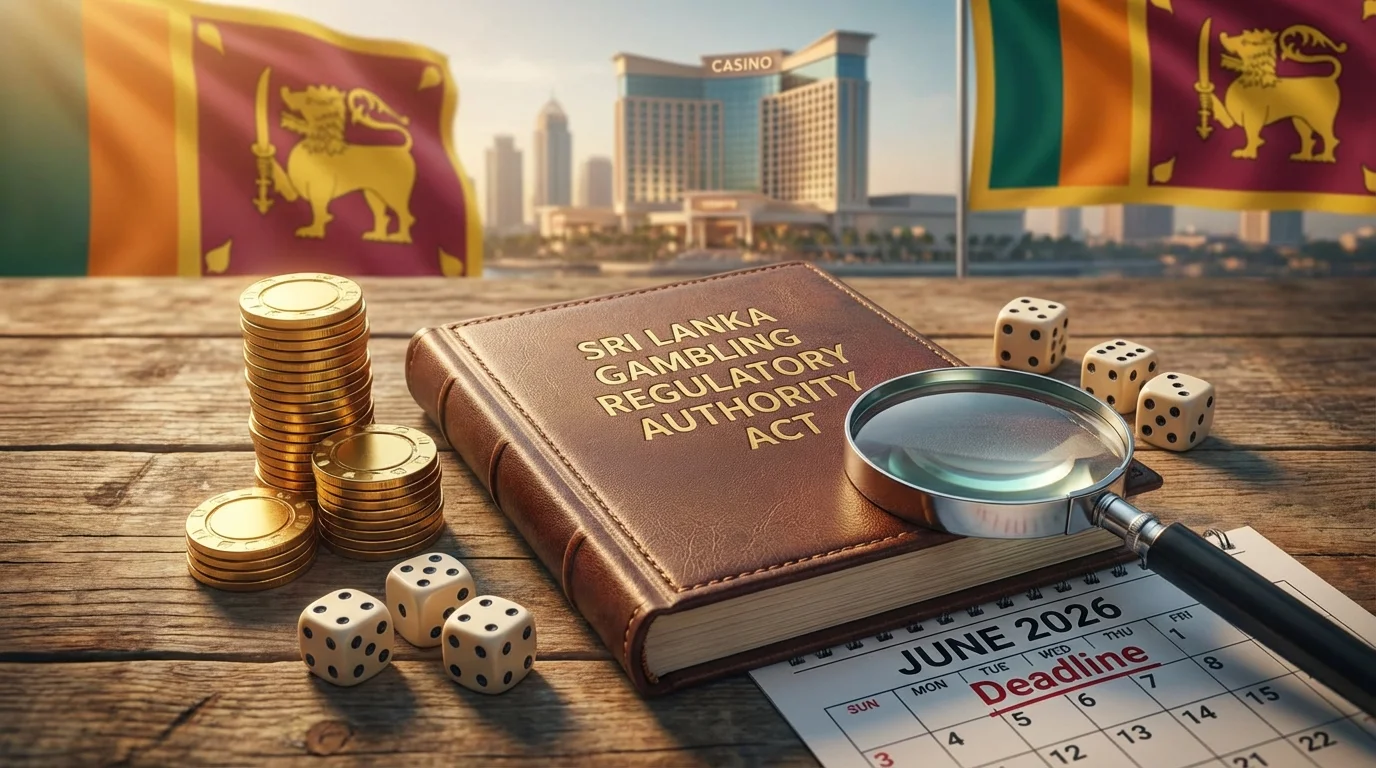
Here’s the structural problem: Sri Lanka has increased taxes and entry fees effective immediately, but the Gambling Regulatory Authority (GRA) that’s supposed to oversee the industry won’t be operational until June 30, 2026.
THE SIX-MONTH GAP
Tax collection begins January 1, 2026. Regulatory oversight begins June 30, 2026. For six months, money flows before the infrastructure to monitor it exists. This timeline suggests revenue collection was the priority; regulatory framework was secondary.
“The legislation to establish the authority is already in place,” said Harsha de Silva, Chairman of the Committee on Public Finance. “What we now need are the detailed regulations that will make it operational.”
The GRA will be governed by a seven-member board including the Finance Secretary, Commissioner General of Inland Revenue, Head of the Financial Intelligence Unit, and Inspector General of Police. The Finance Minister will appoint three additional members. This composition signals the government’s priorities: revenue collection and anti-money laundering compliance, with law enforcement at the table.
The Legislative Overhaul
The GRA is authorized by the Gambling Regulatory Authority Act, No. 17 of 2025—legislation that explicitly repeals three obsolete colonial-era laws:
| Repealed Law | Limitation |
|---|---|
| Betting on Horse-Racing Ordinance | Colonial-era statute ill-equipped for modern betting or digital integration |
| Gaming Ordinance | Ambiguous on “games of skill” vs. chance; often unenforceable |
| Casino Business (Regulation) Act of 2010 | Interim measure with provisional licensing but weak AML enforcement |
The new Act consolidates regulatory power into a single apex body. Previously, oversight was fragmented between the Inland Revenue Department, Police, and Ministry of Finance—leading to coordination failures and regulatory arbitrage.
Why Now? Three Converging Pressures
Sri Lanka’s gambling reform isn’t happening in a vacuum. Three distinct pressures are forcing the government’s hand.
1. POST-CRISIS REVENUE DESPERATION
In 2022, Sri Lanka became the first Indo-Pacific country in decades to default on its external debt. The $2.9 billion IMF bailout came with stringent conditions: the tax-to-GDP ratio had fallen to 7.3%—one of the lowest in the world. The IMF explicitly urged the government to double this to 15%. The World Bank called the subsequent austerity “one of the largest fiscal adjustments in history.”
2. FATF GREY-LIST THREAT
Sri Lanka’s third mutual evaluation by the Financial Action Task Force is scheduled for 2026. The country was grey-listed in 2017 and only removed in 2019-2020. “The bottom line is we cannot afford to be grey-listed again,” said FIU Director Subhani Keerthiratne. Grey-listing means higher risk premiums, blocked correspondent banking, and damaged sovereign ratings.
3. THE ONLINE GAMBLING PROBLEM
Officials revealed that 60-70% of casino activity now takes place online, with only 30-40% at physical casinos. Currently, six land-based casino licenses exist, but online operators remain unregistered and untaxed. There’s no system to collect online gaming revenue—the country is hemorrhaging potential tax income.
The gambling market, valued at $293.93 million in 2020, is projected to reach $410.04 million by 2026. The government sees an industry growing without contributing proportionally to recovery—and that calculus changed after the economic collapse.
The Entry Fee Strategy: Friction at the Door
The doubled $100 entry fee for Sri Lankan citizens is notable because it’s a player-side intervention, not an operator tax. This approach creates friction at the point of entry rather than taxing winnings or losses.
The policy has dual goals: generate revenue and reduce problem gambling by making casual visits more expensive. A $100 fee (roughly LKR 30,000) represents significant money for the average Sri Lankan—the median monthly income is approximately LKR 60,000-80,000. This effectively prices out lower-income casual gamblers while allowing wealthy patrons and tourists to proceed.
But here’s the catch: this friction only applies to physical casinos. Online platforms—where 60-70% of gambling already occurs—have no such barrier. The entry fee may accelerate the shift to online gambling, where players face no $100 toll and no one is checking IDs at the door.
License Fees: Engineering an Oligopoly
Beyond operational taxes, the cost of holding a casino license has undergone dramatic revision—creating high barriers to entry that favor large, capitalized conglomerates over smaller operators.
| Operator Category | Initial License (5 Years) | Renewal (15 Years) |
|---|---|---|
| Existing Operators | ~$1.55M/year | ~$4.66M/year |
| New Investment (<$250M) | ~$31M total package | ~$31M |
| Mega-Projects (>$500M) | ~$15.5M initial | ~$31M |
This fee structure deliberately oligopolizes the market. By making licenses prohibitively expensive for small players, the government effectively consolidates the market into a few manageable, high-compliance entities—simplifying the GRA’s oversight burden and ensuring that only financially robust operators remain. The structure also incentivizes mega-investments (>$500M) with lower initial fees, directly supporting the integrated resort model.
The “Macau of South Asia” Strategy
At the heart of Sri Lanka’s gambling ambitions sits City of Dreams Sri Lanka—a $1.2 billion joint venture between local conglomerate John Keells Holdings (JKH) and Hong Kong-based gaming giant Melco Resorts & Entertainment. The project, formerly known as Cinnamon Life, has been rebranded under Melco’s global “City of Dreams” marquee.
Melco CEO Lawrence Ho has explicitly stated the geopolitical strategy:
“Sri Lanka can be to India what Macau is to China.”
— Lawrence Ho, CEO of Melco Resorts & Entertainment
This reveals the commercial logic: Sri Lanka sits just off the coast of India, a massive market with 1.4 billion people and a growing high-net-worth population. Casino gambling in India is heavily restricted (limited to Goa, Sikkim, and Daman, which often lack the luxury infrastructure of global integrated resorts). The City of Dreams aims to intercept the flow of Indian gamblers who currently travel to Singapore, Macau, or London. The proximity—under 4 hours flight from Mumbai, Delhi, and Bangalore—offers a significant logistical advantage.
The $1.2 billion facility represents the largest private investment in Sri Lankan history, featuring an 800-room luxury hotel, retail mall, convention facilities, and a gaming floor designed to compete with regional heavyweights. Phase 1 (hotel and non-gaming) commenced operations in late 2024/early 2025, with casino operations ramping up as the regulatory framework solidifies.
Crypto and Online: The Unregulated Majority
Sri Lanka’s 2022 economic crisis drove significant cryptocurrency adoption as citizens sought hedges against the collapsing rupee. This creates a challenge for gambling regulation.
The government has taken a hard line: cryptocurrency gambling is explicitly not authorized. All gambling transactions must use fiat currency. The government has shut down several Colombo casinos due to illegal operations and banned crypto betting sites.
But enforcement is another matter. Offshore platforms remain widely accessed by Sri Lankan players in what officials acknowledge is a “legal grey area.” Under the planned GRA framework, only platforms licensed by the authority will be legal—and the GRA will have power to block access to unlicensed sites and penalize both operators and promoters.
The challenge mirrors what Turkey discovered when it weaponized its banking system against online gambling: in a country with significant crypto adoption, determined bettors simply shift to crypto-based platforms beyond banking surveillance. Sri Lanka’s high cryptocurrency penetration—driven by the 2022 currency collapse—may undermine the GRA’s enforcement capabilities before it even launches.
The GRA Act specifically empowers the authority to issue “Digital Gambling Licenses”—a pivotal shift from prohibition to regulation. The regulations will likely require player data to be stored or accessible within Sri Lanka, aiding audit and dispute resolution. Only Sri Lanka-registered companies will be eligible; foreign companies can operate only through joint ventures or subsidiaries registered locally.
Anti-Money Laundering: The Junket Problem
Casinos are classic conduits for money laundering—converting illicit cash into chips, playing specifically to minimize loss, and cashing out as “winnings,” thereby legitimizing funds. This risk is exacerbated by “junket operators,” intermediaries who bring groups of high-rollers to casinos and often handle their financial arrangements.
The GRA Act explicitly regulates junket organizers, mandating strict record-keeping requirements for all transactions and patron identities. Critically, licensed casino operators are now held liable for the compliance of the junket operators they work with. If a junket facilitates money laundering, the casino’s license is at risk—creating a powerful incentive for self-policing.
These reforms are designed to satisfy FATF Recommendation 22, which covers “Designated Non-Financial Businesses and Professions” (DNFBPs), including casinos. The inclusion of the FIU Head and Inspector General of Police on the GRA board ensures that financial intelligence is shared in real-time, allowing for rapid freezing of assets and investigation of suspicious transactions.
Regional Context: South Asia’s Gambling Patchwork
Sri Lanka’s reforms position it uniquely within South Asia’s fragmented gambling landscape.
SOUTH ASIAN GAMBLING LANDSCAPE
INDIA
State-by-state chaos. Most gambling federally banned, but Goa, Sikkim, and Daman have regulated casinos. Skill-based games like poker permitted in some states. Massive population with suppressed demand.
NEPAL
Casinos legal but only for foreign nationals—Nepali citizens banned. Primary customer base: Indian tourists (30% of visitors). New rules slashing foreign ownership from 90% to 49%, one license per location.
BANGLADESH
Total prohibition. World’s second-largest Muslim country bans all gambling under the Public Gambling Act of 1867. Players resort to offshore sites and crypto—legal framework unchanged since British colonial era.
SRI LANKA
Moving toward comprehensive regulation. Land-based, online, and offshore gambling under single authority. Entry fees for locals, foreign-currency zone for integrated resorts. Most ambitious framework in the region.
Sri Lanka’s approach is distinct: rather than prohibition (Bangladesh) or selective allowance for foreigners only (Nepal), it’s attempting comprehensive regulation across all formats. The contrast with the U.S. is also instructive—American states like Indiana are still debating whether to ban or regulate emerging gambling formats, while Sri Lanka is building a unified framework from scratch.
If the GRA successfully launches, Sri Lanka could become a model—or cautionary tale—for regional gambling reform.
What the GRA Will Actually Do
When operational, the Gambling Regulatory Authority will consolidate oversight across all gambling formats—land-based casinos, online platforms, ship-based gambling, and the Port City offshore zone. Its mandate includes:
Licensing: Determining permissible gambling activities, issuing and revoking licenses. Only locally registered companies eligible. Software developers and distributors must also obtain licenses, ensuring algorithms are fair and audited.
Revenue Collection: Centralizing gambling-related tax collection that currently operates through fragmented mechanisms.
AML Compliance: Coordinating with the Financial Intelligence Unit and law enforcement to prevent money laundering—critical for the upcoming FATF review.
Consumer Protection: Standardizing responsible gambling measures, including self-exclusion lists. Currently, no unified framework exists for problem gambling intervention.
Enforcement: Blocking unlicensed platforms (working with the Telecommunications Regulatory Commission) and penalizing illegal operators. The government has stated it will seek “international expertise” on gaming regulations, looking to Singapore as a model.
The Bottom Line
Sri Lanka’s gambling reforms reveal the tension between revenue urgency and regulatory capacity. The government needs money now—hence immediate tax increases. But building institutional oversight takes time—hence the six-month gap.
The bigger question is whether the GRA can meaningfully regulate online gambling, which represents the majority of activity and currently operates in a grey zone. Entry fees at physical casinos may simply accelerate the shift online, where enforcement is far more difficult. The experience of California’s sweepstakes ban—which pushed a $2.4 billion market to offshore alternatives—illustrates how prohibition without viable alternatives merely displaces rather than eliminates demand.
For the broader region, Sri Lanka’s experiment matters. If a post-crisis economy can build a functional gambling regulatory framework while satisfying FATF requirements and capturing tax revenue, it offers a template for countries like India contemplating similar reforms. If the GRA launches late, underperforms, or fails to contain online gambling, it becomes another example of regulation that looks good on paper but changes nothing on the ground.
The June 30, 2026 deadline is now the date to watch. The dice have been rolled.
KEY TAKEAWAYS
- Immediate changes — Casino entry fee doubled to $100, gaming tax increased to 18% (competitive vs. Macau’s 40%), effective January 1, 2026
- Regulatory gap — GRA won’t launch until June 30, 2026, creating six-month period of taxation without oversight
- Legislative overhaul — Act No. 17 of 2025 repeals three colonial-era laws, creates centralized regulatory authority
- Market oligopolization — License fees deliberately favor large operators; new entrants face $31M+ barriers
- “Macau of South Asia” — $1.2B City of Dreams joint venture targets India’s 1.4B population
- Online majority — 60-70% of gambling activity occurs online, currently unregulated and untaxed
- FATF pressure — 2026 review looming; junket regulations and AML compliance critical to avoid grey-listing
