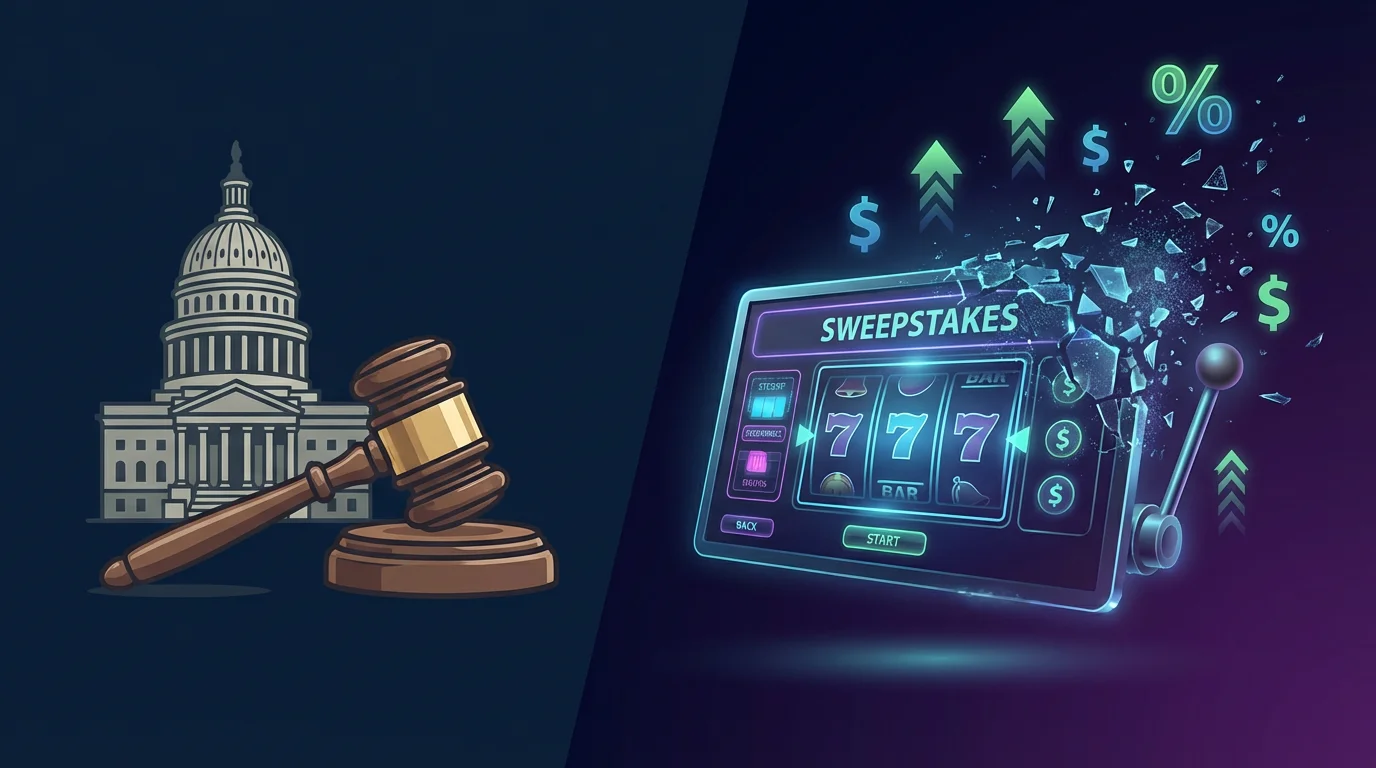
Virginia’s SB 118 and HB 161 do something no state has done this explicitly before: in the same legislative text, they ban sweepstakes casinos and legalize state-taxed online casino gaming, projecting hundreds of millions in annual revenue. Six states banned sweepstakes casinos in 2025. At least six more — Virginia, Indiana, Mississippi, Florida, Maine, and Tennessee — are advancing bans in 2026. Indiana’s HB 1052 cleared its conference committee on February 24 with the legislative session ending February 27. The official justification across every state is consumer protection. But the sweepstakes industry generates roughly $4 billion in annual revenue that currently produces zero dollars in state taxes. States are not shutting it down — they are capturing it. The fiscal impact statements, the licensing structures, and the lobbying records make that clear.
KEY FACTS
- 2024 Industry Revenue: $10.6 billion gross / ~$3.4 billion net (Eilers & Krejcik / KPMG)
- State Tax Collected: $0 — sweepstakes casinos operate in a legal gray zone with no state tax obligations
- 2025 Bans: 6 states (Montana, Connecticut, New Jersey, California, New York, Nevada)
- 2026 Active Bills: Virginia, Indiana, Mississippi, Florida, Maine, Tennessee — up to 9 states expected (IGC Chairman Nate Friend)
- Virginia iGaming Tax Rate: 20% of adjusted gross revenue
- Virginia FY28 Projection: $343 million in new state revenue
- California Impact: AB 831 wiped out ~20% of US sweepstakes revenue effective Jan 1, 2026
The State-by-State Crackdown
The sweepstakes crackdown has unfolded in two waves. In 2025, six states enacted bans — most with bipartisan or unanimous support. In 2026, at least six more have active legislation advancing through committees, floor votes, and conference committees. The 2026 wave has a distinguishing feature that the first wave lacked: several of these bans are explicitly paired with iGaming legalization, making the fiscal motivation impossible to ignore.
| State | Bill | Effective | Notes |
|---|---|---|---|
| Montana | SB 555 | Oct 1, 2025 | First state to ban; signed May 2025 |
| Connecticut | SB 1235 | Oct 1, 2025 | Passed unanimously; protects tribal compact |
| New Jersey | A5447 | Aug 15, 2025 | Coin redemption cutoff Sep 24; protects $6B+ regulated market |
| California | AB 831 | Jan 1, 2026 | Wiped out ~20% of US sweepstakes revenue |
| New York | S5935A | Dec 8, 2025 | Signed by Gov. Hochul; effective immediately |
| Nevada | SB 256 | 2025 | Passed unanimously in both chambers |
The 2026 wave is larger, faster, and — in several states — directly bundled with iGaming legalization. Indiana Gaming Commission Chairman Nate Friend has predicted up to nine states will introduce sweepstakes ban bills this year.
| State | Bill | Status | iGaming Bundled? | Key Detail |
|---|---|---|---|---|
| Virginia | SB 118 / HB 161 | Passed both chambers | Yes — 20% tax | $343M FY28 projection |
| Indiana | HB 1052 | Conference committee cleared | No | Ban only — no alternative |
| Mississippi | SB 2104 | Passed Senate 52-0 | Sports betting separate | Felony — 10 years prison |
| Florida | HB 189 / SB 1580 | House committees cleared | No | Seminole Tribe backing |
| Maine | LD 2007 | Committee passed 8-2 | Yes — separate bill | Bans dual-currency systems |
| Tennessee | SB 2136 | Senate Commerce 8-0 | No | AG sent ~40 C&Ds in Dec 2025 |
Mississippi’s approach is the most punitive. SB 2104 makes operating an unlicensed sweepstakes game a felony punishable by up to $100,000 in fines, 10 years in prison, and full asset forfeiture. The bill was drafted “in collaboration with” the state’s licensed brick-and-mortar casinos and the Mississippi Gaming Commission. The Senate passed it 52-0. Meanwhile, the House is separately advancing online sports betting — banning one form of untaxed competition while preparing to launch a taxable replacement.
Florida’s HB 189 cleared all House committees and is eligible for a floor vote before the March 13 session end. The primary backer is the Seminole Tribe, which holds exclusive casino gaming rights in Florida and has the most to lose from unregulated sweepstakes operators. Florida represents approximately 8.5% of US sweepstakes revenue — more than $1 billion in annual player purchases.
INDIANA: THE BAN WITH NO ALTERNATIVE
Indiana’s HB 1052 passed the House 87-11 and the Senate 37-8, clearing its conference committee on February 24. But unlike Virginia, Indiana offers no iGaming alternative. Senator Ron Alting proposed an amendment to regulate and tax sweepstakes instead of banning them — leadership in both chambers killed it. The Indiana Gaming Commission had acknowledged sweepstakes casinos were not clearly illegal under existing state law, yet the legislature chose to make them so without providing a regulated replacement. If signed by Governor Braun, enforcement could begin July 1, 2026. Players with active balances on sweepstakes platforms operating in Indiana should withdraw before that date — no state has guaranteed balance protection during platform shutdowns.
The Virginia Smoking Gun
Virginia is the most explicit example of what is driving this crackdown. SB 118 and HB 161 do not merely ban sweepstakes casinos. They simultaneously create a fully licensed, fully taxed iGaming market restricted to five existing brick-and-mortar casino operators. The revenue projections are in the publicly available fiscal impact statements — this is not a hidden agenda. But it is revealing that legislators consistently frame these bills as consumer protection measures when the fiscal impact statements tell a revenue story.
WHAT SB 118 / HB 161 ACTUALLY DO
- Ban sweepstakes casinos: Unlicensed operations face civil penalties of $100,000 (first offense) and $250,000 (second offense), with each day counting as a separate violation
- Legalize iGaming: Online slots, table games, and poker through up to 15 licensed platforms
- Restrict licenses to 5 casinos: Rivers Casino Portsmouth, Hard Rock Hotel & Casino Bristol, Caesars Virginia (Danville), Norfolk Casino, and Live! Casino (Petersburg)
- Platform fee structure: $500,000 initial license fee per casino + up to 3 online “skins” at $2 million each = $32.5 million in upfront licensing revenue
- Tax rate: 20% of adjusted gross revenue (increased from the originally proposed 15%)
- Revenue projection: $343 million in FY28 (JLARC fiscal review)
- Lottery cannibalization: JLARC projects a 25.5% decline in iLottery revenue by FY28, growing to 53% by FY32 — meaning the state is redirecting existing gambling dollars into a channel with higher licensing fees and tax rates, not creating new gambling activity
- Enforcement: Virginia Lottery Board, Attorney General, and State Police given enforcement power against unlicensed operators
The vote sequence shows how close this revenue nearly slipped away. SB 118 was defeated 20-19 on its initial Senate vote on February 16 — then passed 19-17 after reconsideration on the same day when three senators switched from “no” to abstaining. HB 161 was defeated 49-46 in the House — then swung to a 67-30 passage on the same day, February 17. A separate standalone sweepstakes ban bill, SB 579, was punted to 2027 by a 14-1 committee vote that replaced the ban with a working group study. The signal: banning sweepstakes without capturing the associated tax revenue was not worth the political capital.
“SB 118 will legalize iGaming in the commonwealth of Virginia and dramatically curtail Virginia’s thriving illegal iGaming market and generate upwards of $14 billion in new taxable revenue over the first five years and tens of tens of billions of dollars every subsequent five years in perpetuity.”
— Senator Mamie Locke (D-Hampton), presenting SB 118 on the Senate floor, February 16, 2026
The Spanberger administration has signaled conditional support. Katie Frazier, Secretary of Agriculture and Forestry, stated on the governor’s behalf that the administration is “deeply concerned about any discussions of gaming expansion in Virginia without first establishing a single entity with clear authority, consistent standards and strong compliance and enforcement capabilities.” The governor wants a Virginia Gaming Commission established before iGaming launches — a position that underscores the state’s intent to build permanent regulatory infrastructure around this revenue stream.
Who Benefits from Banning Sweepstakes Casinos?
The beneficiaries and casualties of the sweepstakes crackdown are not evenly distributed. When the stated goal is consumer protection, it is worth asking who actually benefits from the specific policy mechanism chosen — and who does not.
WHO WINS AND WHO LOSES
WHO WINS
- State treasuries — Virginia’s fiscal projections are the template other states will follow
- Existing casino licensees — Eliminated unregulated competition; gain exclusive iGaming licenses
- Gaming commissions — New licensing revenue, expanded enforcement authority, bigger budgets
- AGA (American Gaming Association) — Lobbied heavily for bans; members are the iGaming licensees
WHO LOSES
- Sweepstakes operators — A multi-billion dollar industry facing state-by-state elimination
- Players in no-iGaming states — Indiana bans sweepstakes with no regulated alternative
- Players pushed offshore — Unregulated foreign platforms offer zero consumer protections
- SGLA — Proposed 6% tax on player purchases as compromise; no state has adopted it so far
THE MESSAGING VS. THE MECHANISM
WHAT THEY SAY
- “Consumer protection”
- “Unregulated gambling”
- “Protecting vulnerable populations”
- “Closing legal loopholes”
WHAT THEY DO
- Ban sweepstakes AND legalize taxed iGaming in the same bill
- Restrict iGaming licenses to existing casino operators
- Charge millions in upfront licensing and platform fees
- Punt standalone bans (SB 579) when not paired with revenue
To be clear: sweepstakes casinos are not blameless. Many platforms operate without meaningful KYC verification, lack responsible gambling tools, offer no real dispute resolution process, and provide little transparency on return-to-player rates. These are legitimate consumer protection concerns. But the policy choice matters. Regulation — like the SGLA’s proposed framework of a 6% tax on player purchases with licensing requirements — would address these problems while preserving consumer access and generating state revenue. Prohibition does not fix the consumer protection gaps. It eliminates the platforms, pushes players offshore to sites with even fewer protections, and hands the domestic market to incumbents. The question is not whether sweepstakes casinos need oversight. It is why states consistently chose the one solution that also happens to maximize state tax revenue and protect existing licensees’ market share.
As detailed in Indiana’s case above, the rejection of the regulation-and-tax alternative is the most telling signal. This pattern echoes the regulatory dynamics seen in prediction markets, where established interests use legislation to eliminate emerging competitors before they can mature into regulated participants.
More than 100 class-action lawsuits were filed against sweepstakes operators in 2025. California’s AB 831 wiped out roughly 20% of US sweepstakes revenue when it took effect January 1, 2026. If Florida’s HB 189 passes, another 8.5% of the market — more than $1 billion in annual player purchases — vanishes. The SGLA proposed the 6% tax framework as an alternative that would have generated approximately $63 million annually in Florida alone. It has not been adopted — the SGLA was still actively lobbying in Pennsylvania and Virginia as of February 2026.
What This Means for Players
If you use sweepstakes casinos, here is what is actually changing and what you should do about it.
Check your state’s timeline. California’s ban took effect January 1, 2026, though many operators were slow to comply. Indiana’s HB 1052, if signed, would take effect July 1, 2026. New Jersey’s coin redemption cutoff was September 24, 2025. If your state has an active ban bill, the enforcement date is the date that matters — not the day the bill passes. Withdraw any balances before your state’s enforcement date. No state has enacted balance protection provisions for sweepstakes platform shutdowns.
Watch for the bundled ban. If your state is advancing a sweepstakes ban, check whether an iGaming legalization bill is attached to it or moving through the same session. Virginia and Maine have paired bans with iGaming legalization. Massachusetts (HB 4431) and Ohio (HB 298) have introduced similar bundled bills, though neither has advanced past committee yet. When a ban is bundled with licensing fees and tax rate projections, the fiscal motivation is the primary driver.
Understand the offshore risk. In states like Indiana that ban sweepstakes without providing a regulated iGaming alternative, the vacuum gets filled by offshore platforms operating outside US jurisdiction. These sites offer no KYC protections, no responsible gambling tools, no meaningful dispute resolution, and no state regulatory oversight. The gambling tax landscape is shifting fast, and players in ban-only states face the worst of both outcomes — no legal sweepstakes access and no regulated alternative.
Most states still allow sweepstakes platforms — for now. The six 2025 bans and six active 2026 bills cover a significant share of the US population, but the majority of states have not yet enacted legislation. That window is narrowing. IGC Chairman Nate Friend’s prediction of up to nine states introducing ban bills in 2026 suggests the map will look very different by year-end.
“Sweepstakes casinos aren’t currently illegal under Indiana law.”
— Indiana Gaming Commission testimony, January 2026
KEY TAKEAWAYS
- The ban-and-legalize pattern is the story — when states ban sweepstakes and legalize taxed iGaming in the same legislative session, the fiscal motivation is the primary driver, regardless of consumer protection framing
- Prohibition was chosen over regulation — the SGLA’s proposed 6% tax framework would have addressed consumer protection concerns while preserving access, but no state has adopted it
- Indiana is the counterexample that exposes the logic — a pure ban with no alternative, after leadership killed a regulation amendment, pushing players toward offshore platforms with fewer protections than the sweepstakes sites being banned
- Sweepstakes operators have real problems — but prohibition benefits incumbents and state treasuries, not the consumers it claims to protect
- The revenue is being redistributed, not eliminated — the same players will gamble through state-licensed, state-taxed operators; the question is who captures the margin

Great resource for anyone interested in staying updated with California Lottery games and results.
The official website makes it really easy
to check winning numbers, view jackpot updates, and learn about different
lottery games in one place. I especially like how the platform
also explains prize claim procedures and provides clear information for new players who may be trying lottery
games for the first time.