Wisconsin Sues Kalshi, Polymarket, Coinbase, Robinhood and Crypto.com — 14 Days After Legalizing Sports Betting
Just 14 days after legalizing online sports betting, Wisconsin sued Kalshi, Polymarket, Coinbase, Robinhood and Crypto.com over event-contract sportsbooks.
Just 14 days after Wisconsin became the 33rd state to legalize online sports betting, Attorney General Josh Kaul sued five of the country’s largest prediction-market platforms — accusing Kalshi, Polymarket, Coinbase, Robinhood and Crypto.com of running illegal sportsbooks dressed up as “event contracts.”
KEY FACTS AT A GLANCE
- Who: Wisconsin AG Josh Kaul vs. Kalshi, Polymarket, Coinbase, Robinhood, Crypto.com
- What: Three civil lawsuits filed in Dane County circuit court alleging illegal sports betting disguised as “event contracts”
- When: April 23, 2026 — 14 days after Wisconsin became the 33rd state to legalize online sports betting
- Why it matters: Wisconsin’s 11 tribal nations hold exclusive sports-betting rights under the new law; prediction markets allegedly bypass that compact
- What’s next: Joins ~10 other states already moving against prediction markets, with the federal preemption fight headed toward the Supreme Court
What Kaul Filed
The Wisconsin Department of Justice filed three separate complaints in Dane County circuit court on April 23, 2026, each styled as a “complaint to abate public nuisance.” Together they target five companies and their affiliates, organized into three parallel ecosystems: one targeting Crypto.com and its derivatives arm, a second naming Polymarket, and a third pulling in Kalshi alongside its distribution partners Robinhood and Coinbase.
The state’s legal theory is straightforward. Sports betting and most forms of commercial gambling have long been illegal in Wisconsin. The complaints argue that “event contracts” — the financial-instrument framing that prediction markets use to describe wagers on sporting outcomes — are bets in everything but name. Kaul put it plainly in the DOJ release, accusing the companies of “flouting Wisconsin law by thinly disguising the sports betting that they facilitate through what are called event contracts.”
Wisconsin isn’t asking for damages. It wants three things: a declaration that the platforms’ sports-related event contracts violate state law, a preliminary injunction blocking the companies from offering them to Wisconsin residents, and a permanent injunction once the cases are decided.
“Thinly disguising unlawful conduct doesn’t make it lawful. No company is above this law, no matter how creatively those companies try to disguise the activity that they’re engaged in.”
— Josh Kaul, Wisconsin Attorney General
The 14-Day Paradox
The timing is the story. April 2026 was an unusually busy month for the legal status of online wagering in the United States, and Wisconsin sits squarely in the middle of it. The CFTC sued Arizona, Connecticut and Illinois three weeks earlier, arguing that those states had intruded on exclusive federal jurisdiction over derivatives. Then Gov. Tony Evers signed a tribal-only sports-betting bill on April 9, making Wisconsin the 33rd state with legal online sports betting. Two weeks after that, the Wisconsin DOJ filed against the prediction markets.
Read in sequence, the three events tell a coherent story. Wisconsin watched the federal government sue its neighbors over prediction-market enforcement, decided which side of that fight it wanted to be on, built a legal-betting framework on its own terms, and then sued the platforms it sees as competing with that framework outside the rules.
Why Wisconsin’s Tribes Are Watching
The new sports-betting law gives Wisconsin’s 11 federally recognized tribes an exclusive franchise. Servers processing bets must sit on tribal land, all 11 tribes supported the legislation, and federal law requires roughly 60% of gambling revenues to flow back to the tribes. The Sports Betting Alliance — the lobbying arm of FanDuel, DraftKings, BetMGM, bet365 and Fanatics — opposed the bill precisely because of that exclusivity.
The Ho-Chunk Nation is not waiting for Kaul’s suits to play out. It filed its own lawsuit against Kalshi in August 2025, with trial scheduled for May 2027. The Oneida Nation moved to publicly back the AG’s action this week, with chairman Tehassi Hill saying the disparity between what tribes have to do to run regulated games and what prediction markets get away with is unsustainable.
“There’s a very large disparity between what tribes face and have to do to have regulated gambling in the state of Wisconsin as opposed to what these prediction markets are putting forth.”
— Tehassi Hill, Chairman, Oneida Nation
The 90/10 Problem
Wisconsin’s complaints lean hard on a single financial figure to make the case that this isn’t about a fringe product. The state estimates that roughly 90% of the fees Kalshi collects come from sports-related event contracts, and that those fees represent an annualized revenue stream of about $1.3 billion. That’s the so-called 90/10 problem the prediction-market industry has wrestled with for the past year: the contracts that drive the business look a lot more like sportsbook bets than like classic derivatives.
The complaints also cite the platforms’ own marketing. Kalshi’s Instagram ads have explicitly described it as “The First Nationwide Legal Sports Betting Platform.” Polymarket bills itself as “a platform where people can bet on the outcome of future events.” Specific contracts called out by name include NCAA tournament markets — Final Four picks and first-team-to-10-points wagers among them.
How Wisconsin Fits Into the National Map
Wisconsin is not the first state to move against prediction markets, and it won’t be the last. Roughly 10 states have now taken some form of enforcement action, ranging from quiet cease-and-desist letters to the criminal-charge route Arizona took. Wisconsin and Arizona currently sit at the most aggressive end of that spectrum. Most states have stuck with cease-and-desist orders or court filings that ask for injunctions rather than damages.
The Companies Push Back
The defendants are not conceding anything. Kalshi insists it operates a “regulated, nationwide exchange for real-world events” that sits exclusively under the Commodity Futures Trading Commission’s jurisdiction. Robinhood says its event contracts are federally regulated by the CFTC through Robinhood Derivatives LLC, and that it intends to defend itself. Earlier this month the Third Circuit sided with Kalshi on federal preemption, giving the industry a meaningful federal-court win heading into the Wisconsin fight.
Coinbase has been the most public about the broader legal stakes. Chief Legal Officer Paul Grewal has framed every state-level enforcement action as part of a fragmentation problem that he says Congress did not intend.
“Congress intended prediction and derivatives markets to be regulated at the national level through the CFTC, not by state gambling laws.”
— Paul Grewal, Chief Legal Officer, Coinbase
Where This Lands
The Wisconsin filings land on top of a fight that was already escalating across at least two layers of the court system. The CFTC is suing states. States are suing prediction markets. Federal courts are issuing injunctions in both directions: a Massachusetts judge issued a preliminary injunction against Kalshi in January, while a federal court in Tennessee handed Kalshi a temporary restraining order against the state the same month. Arizona went further and filed criminal charges against the company.
Thirty-eight state attorneys general have filed in support of Massachusetts in its Kalshi case, signaling that most states see the question the way Wisconsin does. The federal government, including the CFTC, has been pushing the opposite line. With circuit-level rulings cutting both ways and a growing number of states piling on, the fight is now headed toward the Supreme Court, where the underlying question — whether sports event contracts are derivatives, gambling, or both — will eventually have to be settled.
Until then, Wisconsin’s lawsuits will move through Dane County circuit court while the tribes wait for their first sportsbook apps to go live. The Bureau of Indian Affairs has to approve each tribal-state compact, a process that can take anywhere from a few months to a few years. The window during which Wisconsin’s residents can legally bet on sports through neither the prediction markets nor a tribal app remains open.
KEY TAKEAWAYS
- Wisconsin sued five at once — Kalshi, Polymarket, Coinbase, Robinhood and Crypto.com all named in three Dane County lawsuits
- The 14-day window is the story — legalization on Apr 9, lawsuits on Apr 23, signaling state regulators won’t tolerate parallel unlicensed markets
- Tribal exclusivity is the legal theory — Wisconsin’s 11 federally recognized tribes hold the sports-betting franchise; “event contracts” allegedly violate that grant
- The 90/10 problem is the financial driver — roughly 90% of Kalshi’s fees come from sports contracts, an estimated $1.3B annualized stream Wisconsin says is illegal in-state
- A circuit split is forming — Wisconsin joins ~10 states moving against prediction markets while the CFTC sues states back; Supreme Court review increasingly likely
Sources
- Kaul Sues Prediction Markets, Accuses Them Of Facilitating Illegal Betting — Wisconsin Department of Justice (via WisPolitics)
- Wisconsin DOJ sues online prediction markets, charging illegal sports betting — Wisconsin Examiner
- Wisconsin DOJ sues Kalshi, other prediction markets for illegal online sports betting — Wisconsin Public Radio
- Evers signs law legalizing tribal-run online sports betting in Wisconsin — PBS Wisconsin

Aevan Lark
Aevan Lark is a gambling industry veteran with over 7 years of experience working behind the scenes at leading crypto casinos — from VIP management to risk analysis and customer operations. His insider perspective spans online gambling, sports betting, provably fair gaming, and prediction markets. On Dyutam, Aevan creates in-depth guides, builds verification tools, and delivers honest, data-driven reviews to help players understand the odds, verify fairness, and gamble responsibly.
Related coverage
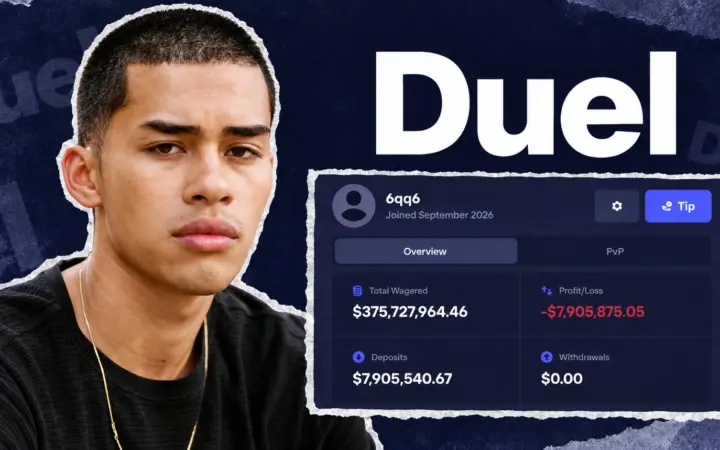
Duel.com Controversy: Fake-Volume Claims and the Sneako Clip
Conflicting wager records and an unconfirmed AI label: what the evidence establishes about Duel.com’s volume dispute and the Sneako clip.
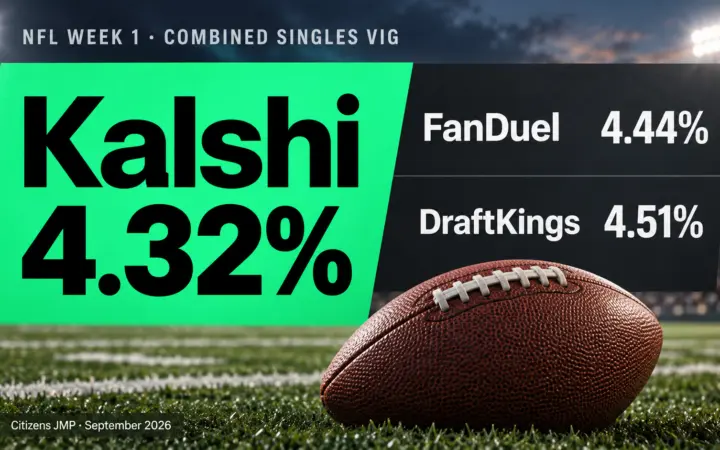
Kalshi NFL Week 1 Vig: Totals Drive Its Pricing Lead
Citizens' NFL pricing snapshot gives Kalshi a narrow overall lead, while FanDuel wins moneylines and sportsbooks lead sampled combos.

Mark Locke: Prediction Markets Can Outlast Today’s Rules
Mark Locke expects enduring wagering demand, while taxes, court disputes and settlement questions test the structure of sports prediction markets.