Heart Rate Zone Calculator
Updated:Free 5-zone calculator for running, cycling, swimming & triathlon using Karvonen or max HR methods
Understanding Heart Rate Training
Heart rate training is one of the most accessible and effective ways to manage training intensity in triathlon. By training in specific heart rate zones, you can target different physiological adaptations: building aerobic endurance, improving lactate threshold, or developing VO2 max capacity. For triathletes, understanding how heart rate varies across swimming, cycling, and running is essential for effective training.
Max HR: Measured vs Estimated
Your maximum heart rate is the foundation for calculating all training zones. There are two approaches:
- Age-Based Estimation (220 - Age): A simple formula that works reasonably well for most people. However, individual variation can be significant, with actual max HR differing by 10-15 bpm from the estimate.
- Measured Max HR: The gold standard. This can be determined through a lab test (graded exercise test) or a field test. For triathletes, max HR is typically highest during running, so a running-based test is recommended.
After a thorough warm-up, perform a 3-5 minute all-out effort on a slight incline. The highest HR recorded in the final minute is close to your max HR. This should only be done when fully rested and healthy.
Karvonen Formula Explained
The Karvonen formula (Heart Rate Reserve method) provides more personalized zones by accounting for your resting heart rate. This is particularly valuable for trained athletes who typically have lower resting heart rates.
Target HR = ((Max HR - Resting HR) x % Intensity) + Resting HR
For example, with Max HR of 185 and Resting HR of 50, Zone 2 (60-70%) would be:
Low: ((185 - 50) x 0.60) + 50 = 131 bpm
High: ((185 - 50) x 0.70) + 50 = 145 bpm
Why HR Differs by Sport
Heart rate response varies significantly between swimming, cycling, and running due to several physiological factors:
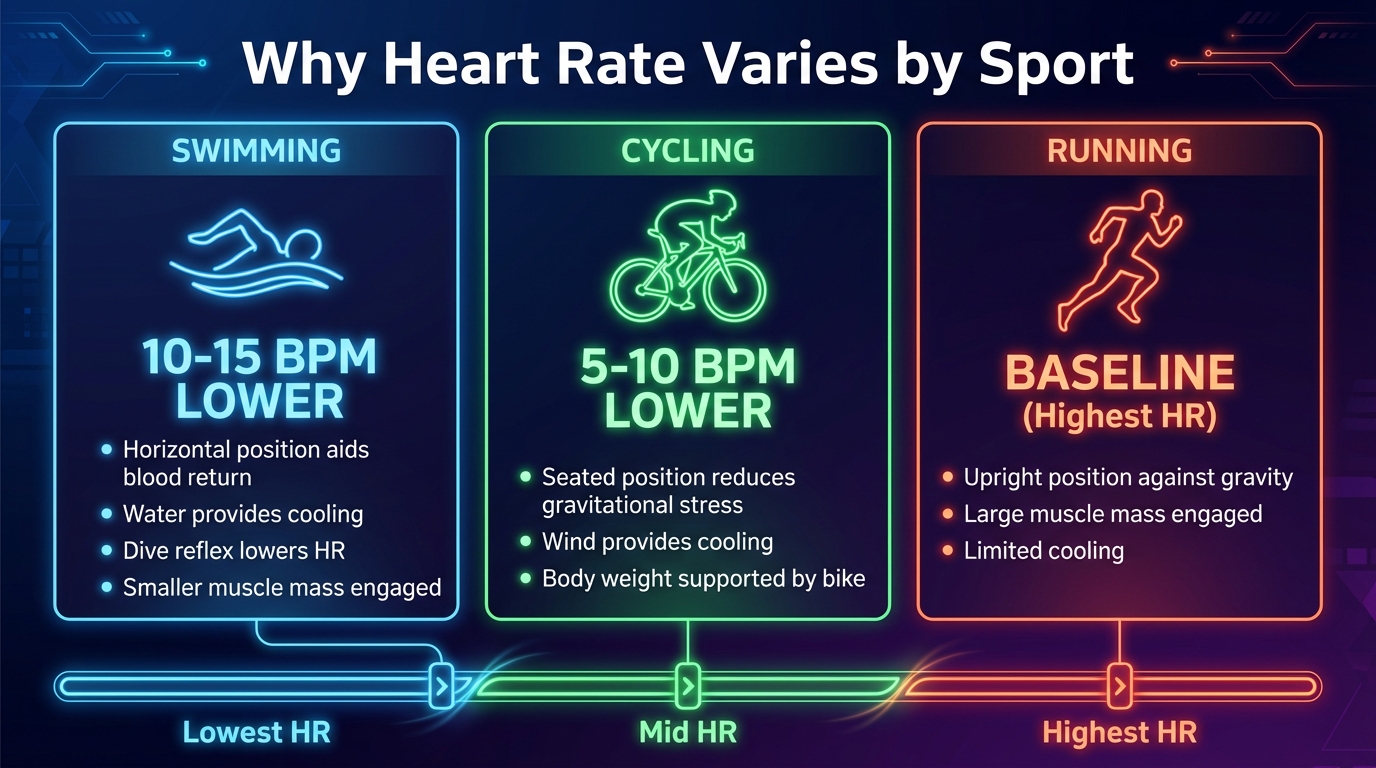
- Swimming (10-15 bpm lower): The horizontal body position improves blood return to the heart. Water provides cooling, reducing thermal stress. The dive reflex (face immersion) naturally lowers HR. Smaller muscle mass is engaged compared to running.
- Cycling (5-10 bpm lower): The seated position reduces gravitational stress on the cardiovascular system. Wind and forward movement provide cooling. Body weight is supported by the bike, reducing muscular demand.
- Running (Baseline): The upright position requires the heart to work harder against gravity. Large muscle mass (legs, core) is engaged. Limited cooling compared to cycling. Running typically produces the highest HR for a given effort level.
Training in Each Zone
Each heart rate zone targets specific physiological adaptations. Understanding when to use each zone is key to structured triathlon training:
Very easy effort for active recovery sessions, warm-ups, and cool-downs. Promotes blood flow without adding training stress. You should be able to hold a full conversation. Use after hard training days or races.
The foundation of endurance training. Builds aerobic capacity, improves fat oxidation, and develops mitochondrial density. Most long training sessions should be in Zone 2. Conversation is comfortable but slightly labored.
Moderately hard, "comfortably uncomfortable" effort. Improves aerobic power and muscular endurance. Good for race-pace training and tempo sessions. Speaking is limited to short sentences.
Hard effort at or near lactate threshold. This is the intensity sustainable for 30-60 minutes in racing. Improves lactate clearance and sustained power. Talking is difficult, limited to single words.
Maximum effort intervals. Develops VO2 max and anaerobic capacity. Typically done as 2-8 minute intervals with equal or longer recovery. Speaking is impossible. Use sparingly, 2-5% of total training volume.

Why Zone 2 Training Has Become Essential
Zone 2 has emerged as the most important training zone for endurance athletes and longevity enthusiasts alike. Popularized by experts like Peter Attia, Andrew Huberman, and Tour de France coaches, Zone 2 training builds the aerobic foundation that powers all other performance gains.
- Fat Burning Zone: At Zone 2 intensity (60-70% max HR), your body primarily oxidizes fat for fuel. This improves metabolic flexibility and helps with body composition.
- Mitochondrial Development: Zone 2 stimulates mitochondrial biogenesis—your cells build more "power plants" to produce energy aerobically.
- Lactate Clearance: Training at the upper end of Zone 2 improves your body's ability to clear lactate, raising your sustainable pace.
- Recovery-Friendly: Unlike high-intensity work, Zone 2 training doesn't accumulate fatigue. You can train more total hours without overtraining.
Elite endurance athletes typically spend 80% of training time in Zones 1-2, and only 20% in high-intensity Zones 4-5. This polarized approach—mostly easy, some very hard, little in between—produces the best long-term performance gains.
How to Find Your True Max HR
If you want more accurate zones than the age-based estimate provides, consider these testing methods:
- Lab Test (VO2max Test): The most accurate method. A graded exercise test on a treadmill or bike with gas analysis determines exact max HR and lactate thresholds.
- Field Test - Running: After 15-20 minutes easy warm-up, run 3 minutes hard, recover 2 minutes, then run 3 minutes all-out. Your peak HR in the final minute is close to max HR.
- Race Data: Your highest HR from a 5K or 10K race effort is typically 95-100% of max HR.
- Sport-Specific Testing: For swimming or cycling max HR, perform similar all-out tests in those sports. Remember these will naturally be lower than running max HR.
Frequently Asked Questions
What heart rate zone burns the most fat?
Zone 2 (60-70% of max HR) is the optimal fat-burning zone. At this intensity, your body primarily uses fat for fuel rather than carbohydrates. However, higher zones burn more total calories per minute. For weight loss, Zone 2 training is effective because you can sustain it longer, burning more total fat over extended sessions.
How accurate is the 220 minus age formula?
The 220-age formula is a rough estimate with a standard deviation of 10-15 bpm. This means your actual max HR could be 10-15 beats higher or lower than predicted. For more accurate zones, perform a field test (3-5 minute all-out effort) or use the Karvonen method which accounts for your resting heart rate and fitness level.
What is Zone 2 training and why is it important?
Zone 2 (60-70% max HR) is your aerobic endurance zone where you can hold a conversation while exercising. Training here builds mitochondrial density, improves fat oxidation, and develops your aerobic base. Experts like Peter Attia recommend 80% of training time in Zone 2 for longevity and endurance performance.
How long should I train in Zone 2?
Most endurance athletes should spend 3-6 hours per week in Zone 2. Individual sessions typically range from 45 minutes to 2+ hours. The key is consistency—Zone 2 adaptations come from accumulated time at this intensity. Start with 30-45 minute sessions and gradually increase duration as your aerobic base develops.
What is the difference between the percentage method and Karvonen formula?
The percentage method calculates zones as simple percentages of max HR (e.g., Zone 2 = 60-70% of max HR). The Karvonen formula uses heart rate reserve (Max HR - Resting HR) and adds resting HR back, providing more personalized zones. Athletes with lower resting heart rates benefit more from Karvonen as it accounts for fitness level.
Why are cycling heart rate zones different from running?
Cycling HR is typically 5-10 bpm lower than running at the same effort level. This is because the seated position reduces gravitational stress on your cardiovascular system, wind provides cooling, and your body weight is supported by the bike. A Zone 2 run effort would show as Zone 3 on a bike if using running-based zones.
Why is swimming heart rate lower than running?
Swimming HR runs 10-15 bpm lower than running due to several factors: the horizontal body position improves blood return to the heart, water provides cooling, the dive reflex naturally lowers HR when your face is submerged, and swimming uses smaller muscle groups than running.
Is training in Zone 3 bad?
Zone 3 is not bad, but spending too much time there can be counterproductive. Called the "gray zone" or "tempo zone," it is too hard for optimal aerobic development but not hard enough for threshold gains. Most coaches recommend polarized training: 80% in Zones 1-2, 20% in Zones 4-5, minimizing Zone 3 time.