Federal Gambling Loss Deduction Cap Takes Effect January 1: What Bettors Need to Know
The 90% gambling loss deduction cap creates phantom income taxation. All repeal bills stalled. Complete analysis with interactive calculator.
EDITOR’S NOTE — March 26, 2026
This article was originally published January 1, 2026, and has been substantially expanded with new analysis: the untraceable procedural origin of the provision, the permanent TCJA business expense reclassification, detailed bettor-profile impact modeling, prediction market tax treatment gaps, state tax stacking analysis, an interactive phantom income calculator, and legislative status updates. All four repeal bills remain stalled as of this update. Rep. Amodei’s “assured fix in January appropriations” has not materialized.
The “One Big Beautiful Bill Act” provision creates “phantom income” taxation, threatens professional poker careers, and may drive players to offshore crypto platforms — and nobody in Congress will claim they wrote it
KEY FACTS AT A GLANCE
- Effective Date: January 1, 2026
- Change: Gambling loss deductions capped at 90% of winnings (down from 100%)
- Law: Section 70114, One Big Beautiful Bill Act (P.L. 119-21)
- Revenue Impact: $1.1 billion over 10 years (JCT estimate)
- Repeal Status: All four repeal bills stalled as of March 2026
- Fix Deadline: April 2027 for 2026 tax returns
- Last Updated: March 26, 2026
A controversial provision buried deep within the Republican tax overhaul signed by President Donald Trump in July 2025 took effect on January 1, 2026, fundamentally altering how millions of American gamblers are taxed on their winnings and losses. Nearly three months later, every legislative attempt to reverse it has stalled — and the structural damage is worse than most coverage has acknowledged.
Section 70114 of the One Big Beautiful Bill Act (OBBBA) limits gambling loss deductions to 90 percent of winnings — down from the longstanding 100 percent that allowed bettors to fully offset their gains with corresponding losses. The change, inserted by the Senate Finance Committee during final reconciliation negotiations, is projected to generate $1.1 billion in additional federal revenue over the next decade, according to the Joint Committee on Taxation.
But the provision does far more than shave 10 percent off deductions. It creates phantom taxable income for break-even gamblers, permanently locks in a devastating reclassification of professional gambling expenses, and opens a tax treatment void for the booming prediction markets industry — all while nobody in Congress will publicly claim they wrote it.
The Provision Nobody Claimed
Here is the most underreported aspect of the 90 percent cap: no member of Congress has publicly claimed authorship. The provision did not appear in the original House version of the One Big Beautiful Bill Act. It was inserted during Senate reconciliation markup by Finance Committee staff — a procedural maneuver to satisfy the Byrd Rule, which requires every provision in a reconciliation bill to have a direct budgetary impact.
The Joint Committee on Taxation scored Section 70114 at $1.1 billion in revenue over ten years — making it a convenient offset to help the broader bill’s numbers work. But that revenue projection came at the expense of a constituency with no organized lobbying apparatus comparable to the industries typically shielded during reconciliation negotiations.
An analysis published by the Ave Maria Law Review flagged the procedural irregularity: the provision appeared in the Senate version during final negotiations, and many members who voted for the OBBBA apparently did not know it was included. A separate analysis by Jones Walker LLP noted that no senator has taken public ownership of the gambling loss provision — unusual for a measure projected to generate over a billion dollars in revenue.
Political analyst Matt Glassman, writing on the intersection of poker, tax politics, and the Byrd Rule, characterized the provision as a “revenue offset that nobody wanted to champion but everybody needed to make the math work.” The result: a billion-dollar tax on gamblers that exists because of procedural mechanics, not deliberate policy — and that nobody will defend on its merits.
The Phantom Income Problem
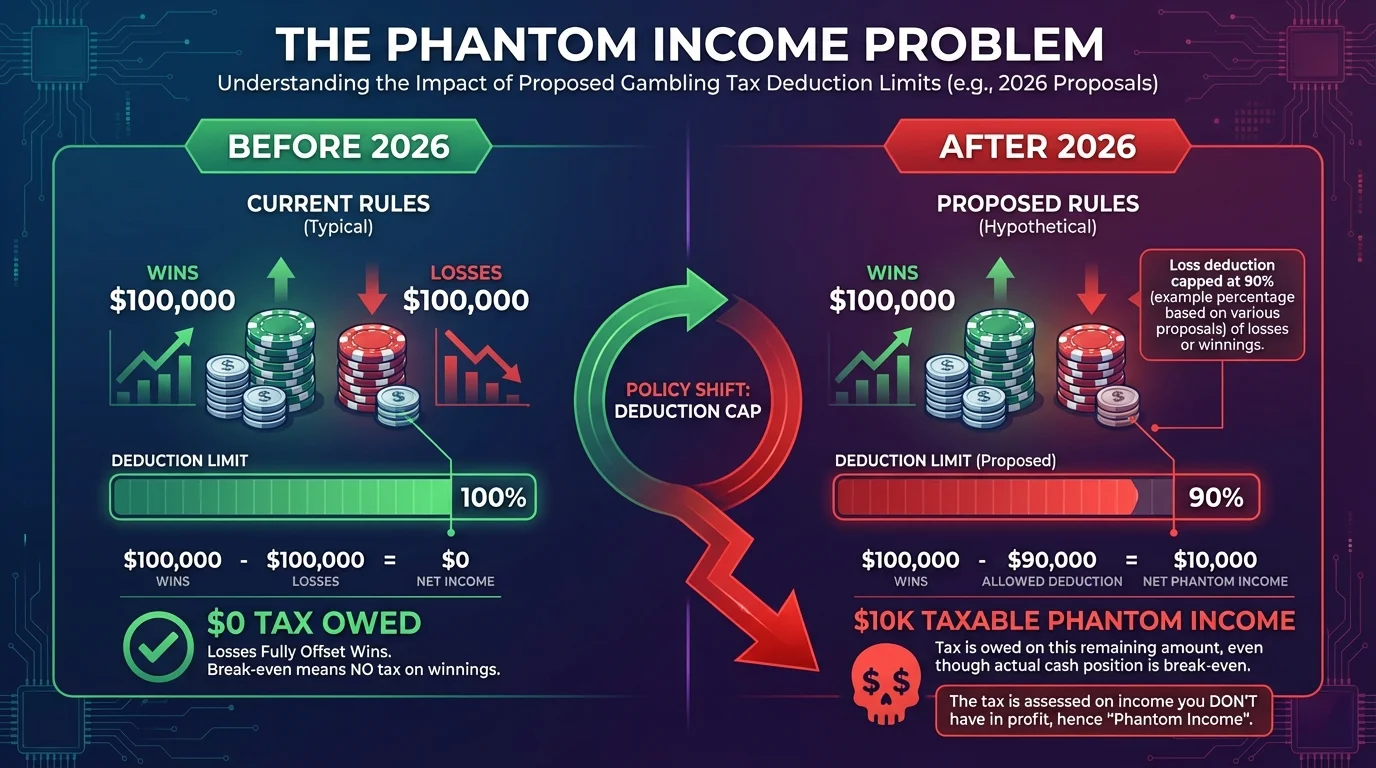
BEFORE VS. AFTER: HOW THE TAX CHANGE WORKS
Before (100% Deduction)
- Win $100,000, Lose $100,000
- Deduct full $100,000 in losses
- Taxable gambling income: $0
- Federal tax owed: $0
After (90% Deduction Cap)
- Win $100,000, Lose $100,000
- Deduct only $90,000 in losses
- Taxable “phantom income”: $10,000
- Federal tax owed: ~$2,400+
The mechanics are straightforward but punishing: A player who wins $100,000 and loses $100,000 during a tax year could previously deduct the full amount of losses, resulting in zero taxable gambling income. Under the new rules, that same player can only deduct $90,000, leaving $10,000 subject to federal income tax despite earning nothing.
“People shouldn’t pay taxes on phantom income. There’s a fundamental fairness issue here.”
— Bill Miller, CEO, American Gaming Association
The AGA has called the provision “uniquely penalizing” compared to other industries, where businesses can fully deduct losses against gains.
For high-volume bettors, the numbers become staggering. A professional poker player with $500,000 in winnings (use our bankroll calculator to plan) and $500,000 in losses would face taxes on $50,000 of phantom income — potentially a $12,000 tax bill on a year where they did not actually profit a single dollar.
The Permanent Expansion: Business Expenses as Wagering Losses
The 90 percent cap is only half the story. Section 70114 also made permanent a provision from the Tax Cuts and Jobs Act of 2017 that was originally set to expire at the end of 2025 — and this may be the more structurally damaging change.
The TCJA amended Section 165(d) of the Internal Revenue Code to expand the definition of “losses from wagering transactions” to include any deduction otherwise allowable that is incurred in carrying on a wagering activity. Before 2018, professional gamblers could deduct business expenses — travel, lodging, coaching, database subscriptions, staking fees — separately on Schedule C, outside the gambling loss limitation. The TCJA reclassified all of these as “wagering losses” subject to the cap, but only through December 31, 2025.
The OBBBA removed the sunset. This reclassification is now permanent.
WHAT THIS MEANS FOR PROFESSIONAL GAMBLERS
A professional poker player’s WSOP hotel room, PokerTracker database subscription, coaching fees, staking arrangements, and travel costs are now permanently classified as “wagering losses” — not business expenses. All of these are folded into the 90% deduction cap. This compounds the haircut because the denominator (total losses) is now larger than the actual gambling losses alone.
Consider a professional tournament player who cashes $500,000 in a year but has $450,000 in buy-ins and $50,000 in legitimate business expenses (travel, lodging, software, coaching). Before 2018, those $50,000 in business expenses were deducted separately. Under the permanent OBBBA rules, the full $500,000 in combined losses is subject to the 90 percent cap — meaning only $450,000 is deductible, creating $50,000 in phantom taxable income on a player who actually broke even.
Sharp Bettor Math: What the Cap Actually Costs
Related tools: Bankroll Calculator · Risk of Ruin Calculator · Kelly Criterion Calculator · Sports Betting Calculators
The industry coverage has focused on the headline scenario: a break-even gambler owing taxes on phantom income. But the real damage becomes visible only when you model specific bettor profiles — and the math is worse than the headlines suggest.
Take a sharp sports bettor with $1 million in annual handle and a genuine 2 percent edge. Their aggregate winning bet gains total $510,000 against $490,000 in losing bets — a real profit of $20,000. Under the old rules, they would deduct $490,000 in losses against $510,000 in winnings, paying tax on $20,000. Under the 90 percent cap, they can only deduct $459,000 (90 percent of $510,000), creating $51,000 in taxable income. At a 24 percent bracket, their tax bill jumps from $4,800 to $12,240 — turning a $20,000 profit year into just $7,760 after tax. Their effective edge drops from 2 percent to 0.78 percent, making the risk-adjusted return barely worth the variance.
For break-even bettors, the math is even more stark. Every dollar in gross winnings generates 10 cents of phantom taxable income, regardless of whether a single dollar of actual profit was earned.
| Profile | Gross Winnings | Gross Losses | Net P/L | Old Taxable | New Deduction (90% of W) | New Taxable | Phantom Income | Add’l Tax (24%) | Effective Edge After Tax |
|---|
The table above reveals a pattern that most coverage misses: the 90 percent cap is not just a nuisance for recreational players — it is an existential threat to any bettor operating on thin margins. A sharp sports bettor’s 2 percent edge, considered strong in the industry, becomes 0.78 percent after the cap. For anyone closer to break-even, the effective edge goes negative. You are paying the government for the privilege of breaking even.
Professional Poker in Crisis
Related tools: Hold’em Equity Calculator · Poker Odds Calculator · Texas Hold’em Guide
Perhaps no group faces more acute consequences than professional poker players, who operate in a high-variance environment (see our poker guide for fundamentals) where break-even years — or years with modest losses — are common even among elite competitors. The permanent reclassification of business expenses as wagering losses compounds the pain: every hotel room in Las Vegas, every database subscription, every coaching session now falls under the 90 percent cap.
Poker Hall of Famer Erik Seidel, who holds 10 World Series of Poker bracelets and over $40 million in career tournament earnings, told the Nevada Independent that the tax change is forcing him toward the exit.
“Next year, I am kind of forced into retirement. Everyone who I’ve spoken to plans on either cutting back or stopping.”
— Erik Seidel, Poker Hall of Famer (10 WSOP bracelets)
In a separate interview with PokerNews, Seidel elaborated on his plans: “I expect that I’ll be playing much smaller if I play. I might play some WPT $3ks or something, which I generally don’t play except for in Florida.”
“I love the game of poker. I don’t want to stop playing. And so it is a bit frustrating to be forced to not play these events. And there are some really cool events coming up that I just won’t be able to play.”
— Erik Seidel
Seidel also noted the disproportionate impact on younger professionals: “It’s even worse for the younger players. These are people who put in an incredible amount of effort and hours learning.”
Phil Hellmuth, another poker icon, has dubbed the provision the “Poker Players Death Tax” and publicly urged Senator Ted Cruz to work toward its repeal.
“A few high rollers I’ve spoken to said they won’t play much at all in 2026, and American players in high rollers could become scarce. Some American online grinders I know plan to completely shut down their play on American online sites, myself included.”
— Tony Dunst, Professional Poker Player
Casino Industry Already Feeling the Squeeze
The impact extends far beyond poker tables. Derek Stevens, CEO of Circa Casino Resorts in Las Vegas, told reporters that his properties are already experiencing reduced bookings for 2026.
“This could be fixed next year. The reality is that it needs to be done now. It’s already impacting wagering that goes into 2026.”
— Derek Stevens, CEO, Circa Casino Resorts
The timing could not be worse for Las Vegas, which relies heavily on the World Series of Poker and other major gambling events for summer tourism revenue. Industry insiders fear that professional players — who typically bring six-figure tournament buy-ins and significant side action — may dramatically reduce their participation.
Sportsbooks are also bracing for reduced activity, particularly around major events like the Super Bowl and March Madness. Our parlay betting guide explains these wager types, as high-volume bettors recalculate their risk exposure under the new tax regime.
The Prediction Markets Blind Spot
Related coverage: Prediction Markets’ Identity Crisis · Nevada’s Kalshi Shutdown
Absent from virtually all coverage of the 90 percent cap is its potential impact on prediction market traders — a rapidly growing category of financial activity that sits in a tax classification void. As of March 2026, the IRS has published no formal guidance on how prediction market contracts should be characterized for federal income tax purposes. No revenue ruling, no regulation, no form instruction exists.
This matters because prediction market positions can generate both “winning” and “losing” transactions from the IRS perspective even when the trader breaks even. A position bought at 50 cents and sold at 50 cents creates a reportable transaction. A high-frequency prediction market trader making thousands of trades per year — common on platforms like Kalshi, which processed $23.8 billion in volume in 2025 — can generate enormous gross winning and losing figures relative to their actual profit or loss.
Tax practitioners have identified three defensible approaches for reporting prediction market activity, each with dramatically different consequences under the 90 percent cap:
THREE TAX TREATMENT APPROACHES FOR PREDICTION MARKETS
Section 1256 (Most Tax-Efficient)
- 60% long-term / 40% short-term capital gains
- 90% loss cap does NOT apply
- Strongest case for CFTC-regulated platforms (Kalshi)
- Weakest case for offshore/DeFi platforms (Polymarket)
Gambling Income (Highest Risk)
- Ordinary income rates (up to 37%)
- 90% loss cap creates phantom income
- Break-even traders owe tax on 10% of gross wins
- High-frequency trading amplifies the phantom income
The gambling classification is the nightmare scenario for prediction market traders. Consider a trader who makes 10,000 trades in a year, generating $200,000 in aggregate winning positions and $200,000 in aggregate losing positions — breaking perfectly even. If classified as gambling income, they can only deduct $180,000 of their $200,000 in losses, creating $20,000 in phantom taxable income. At a 24 percent bracket, that is $4,800 in federal tax on zero actual profit.
For higher-volume traders, the numbers scale proportionally. A trader with $1 million in gross winning positions on a break-even year would owe $24,000 in federal tax on phantom income alone. The irony is that platforms like Kalshi are CFTC-regulated and have strong arguments for Section 1256 treatment — which would entirely avoid the 90 percent cap. But the IRS has not confirmed this, leaving every prediction market trader in an uncertain position until formal guidance arrives.
Bipartisan Legislative Push to Reverse the Change
The provision has generated rare bipartisan opposition, with lawmakers from both parties introducing four separate bills to undo the damage. But as of March 2026, every attempt has stalled — blocked by procedural maneuvers, committee inaction, and the same reconciliation math that created the provision in the first place.
| Bill | Chamber | Lead Sponsors | Status |
|---|---|---|---|
| FAIR BET Act (H.R.4304) | House | Rep. Dina Titus (D-NV), Rep. Guy Reschenthaler (R-PA) | BLOCKED |
| FULL HOUSE Act (S.2230) | Senate | Sen. Cortez Masto (D-NV), Sen. Ted Cruz (R-TX) | BLOCKED |
| FULL HOUSE Act (H.R.6985) | House | Rep. Max Miller (R-OH), Rep. Steven Horsford (D-NV) | IN COMMITTEE |
| WAGER Act (H.R.4630) | House | Rep. Andy Barr (R-KY) | IN COMMITTEE |
The FAIR BET Act, introduced by Rep. Dina Titus, was the first and most aggressive repeal attempt. Titus tried to attach it as an amendment to the 2026 National Defense Authorization Act — a legislative vehicle that would have significantly boosted its chances of passage. The House Rules Committee rejected the amendment in January 2026, blocking it from reaching a floor vote.
In the Senate, Sen. Cortez Masto sought unanimous consent to pass the FULL HOUSE Act quickly, but Sen. Todd Young (R-IN) objected, effectively killing the fast-track effort. A House companion to the FULL HOUSE Act (H.R. 6985) was introduced on January 8, 2026, by Reps. Max Miller (R-OH) and Steven Horsford (D-NV) — both members of the Ways and Means Committee, giving the bill a procedural advantage. It remains in committee with no floor vote scheduled.
House Ways and Means Committee Chairman Jason Smith (R-MO) has labeled the provision a “mistake” and pledged to reverse it, stating: “I believe there is a bipartisan path forward to restoring full deductibility of gambling losses.”
“We got a million responses to our tweet…more than I’ve ever gotten.”
— Rep. Dina Titus (D-NV)
Representative Mark Amodei (R-NV) said in late 2025 that a fix would be included in January appropriations packages: “We have been assured that when we wrap up this stuff in ’26 appropriations, that fix will be in there.” As of late March 2026, that fix has not materialized. The January appropriations package passed without any gambling loss deduction provision.
AGA’s Miller remains cautiously optimistic: “I believe that we’re going to get it done” early in 2026, though he acknowledged that Congressional gridlock poses risks to the timeline. With all four bills now stalled and no clear legislative vehicle in sight, that optimism faces diminishing returns.
The State Tax Nightmare
Federal phantom income is only the beginning of the calculation. Several states do not allow any gambling loss deduction at the state level — meaning a break-even gambler in those states was already paying state tax on gross winnings before the federal cap existed. Now they face federal phantom income tax on top of that, and the combined burden in some jurisdictions produces results that strain credulity.
In California, which has no gambling loss deduction and a top state income tax rate of 13.3 percent, a break-even gambler with $100,000 in gross winnings faces $13,300 in state tax on the full amount plus $2,400 in federal phantom income tax — a combined $15,700 tax bill on zero profit. That is a 157 percent effective tax rate on the $10,000 of federal phantom income. The total tax bill exceeds the phantom income by more than fifty percent.
Connecticut (6.99 percent, no deduction), Illinois (4.95 percent, no deduction), and Pennsylvania (3.07 percent, no deduction) all create similar stacking effects, though at lower rates. States that follow federal deduction rules — like New York and Massachusetts — still add meaningful state tax on the phantom income amount, pushing combined rates into the 33 to 35 percent range.
| State | Loss Ded? | State Rate | State Phantom Income | State Tax | Combined Tax | Combined Rate |
|---|
The practical consequence for professional gamblers in high-tax, no-deduction states is stark: the combined federal and state tax burden on a break-even year can exceed the phantom income itself. A poker player in California who breaks even on $500,000 in gross winnings faces roughly $78,500 in combined taxes — on zero profit. That is not a viable career.
The Crypto Gambling Wild Card

The standard narrative around the 90 percent cap and offshore migration frames the issue as a future risk: that the tax change “may drive” players to unregulated platforms. The reality is more nuanced and more immediate. The cap does not create offshore migration — it removes the last rational argument for staying onshore.
Professional bettors have estimated that sharp players already split their action roughly 60 percent offshore, 10 percent on prediction markets, and 30 percent on legal books. That 30 percent on legal books existed because of a rational calculation: the tax burden was tolerable in exchange for legal certainty, banking access, and dispute resolution through regulated channels. A break-even year meant zero tax liability. The 90 percent cap eliminated the “at least my deductions are fair” argument that justified accepting higher costs and lower anonymity on regulated platforms.
The platforms waiting to absorb this flow are not hypothetical. Stake.com, BC.Game, and other Curaçao-licensed operators already serve US players through VPNs — an open secret in the gambling industry. These platforms process billions in annual volume, accept cryptocurrency deposits, and operate outside US tax reporting requirements. The cap does not push players into an unknown; it pushes them toward platforms they have been using for years, with fewer reasons to maintain their onshore presence.
IMPORTANT: OFFSHORE GAMBLING RISKS
The IRS has explicitly warned against offshore and crypto-based gambling platforms, noting that such sites often avoid Know Your Customer protocols. All gambling winnings are taxable income regardless of where won, and failing to report cryptocurrency gambling activity can result in severe penalties. Starting in 2026, centralized exchanges must issue Form 1099-DA for crypto transactions, and the OECD’s Crypto-Asset Reporting Framework will facilitate international data sharing beginning in 2027.
Enforcement remains challenging. While the IRS has forced major exchanges like Coinbase and Kraken to share customer data, and has partnered with blockchain analytics firms like Chainalysis to trace transactions, the sheer volume of offshore crypto gambling activity — combined with the use of privacy coins and decentralized platforms — makes comprehensive tracking difficult. For those who do report their activity, our crypto tax calculator can help estimate obligations.
What’s Next
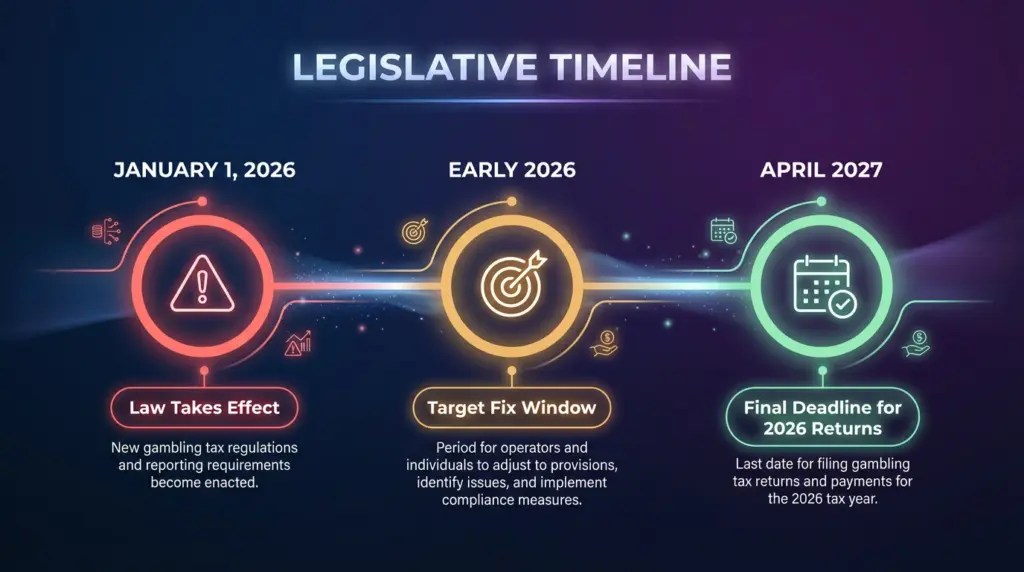
For gamblers, the immediate reality is grim. The law has been in effect since January 1, meaning all gambling activity in 2026 falls under the 90 percent deduction cap. Three months in, the legislative landscape offers little comfort.
JAN 1: LAW TOOK EFFECT
All gambling activity from January 1, 2026, forward is subject to the 90% deduction cap
MAR 2026: ALL BILLS STALLED
FAIR BET blocked, FULL HOUSE blocked in Senate, both House bills stuck in Ways and Means Committee
DEADLINE: APRIL 2027
Last chance to fix before 2026 tax returns are due. Any later fix would only apply to future years
Those hoping for a quick legislative fix face an increasingly uncertain timeline. Industry sources had targeted early 2026, but with the FAIR BET Act blocked from the NDAA, the Senate FULL HOUSE Act blocked by unanimous consent objection, and both House bills languishing in Ways and Means, no clear legislative vehicle exists for a fix. Any reversal needs to occur no later than April 2027 to affect 2026 tax returns.
“The Republicans’ tax on gamblers is ridiculous and will be bad for Nevada’s economy.”
— Spokesperson for Senator Cortez Masto
As Representative Titus put it: “We’ll believe it when it’s signed.”
Until then, America’s gamblers — from recreational scratch-off buyers to professional poker legends — face the prospect of paying taxes on money they never actually won.
Calculate Your Phantom Income
Use the calculator below to see exactly how the 90 percent deduction cap affects your specific situation. Enter your total annual gambling winnings, losses, and federal tax bracket to compare your tax liability under the old rules versus the new rules.
KEY TAKEAWAYS
- New 90% cap — Gamblers can only deduct 90% of losses against winnings starting January 1, 2026, creating “phantom income” taxation on break-even years
- Nobody claimed it — The provision was inserted by Senate Finance Committee staff for Byrd Rule compliance during reconciliation; no legislator has taken public ownership
- Business expenses trapped permanently — The TCJA’s reclassification of professional gambling business expenses as “wagering losses” was made permanent by the OBBBA, compounding the 90% haircut for pros
- Sharp bettor math — A sports bettor with a genuine 2% edge sees their effective return drop to 0.78% after the cap; break-even bettors pay tax on 10% of gross winnings
- Prediction markets in limbo — Zero IRS guidance on tax classification; if treated as gambling, the 90% cap creates extreme phantom income for high-frequency traders
- State tax stacking — States like California, Connecticut, and Illinois that disallow gambling loss deductions create combined phantom tax rates exceeding 100% of the federal phantom income
- All repeal bills stalled — Four bills (FAIR BET, FULL HOUSE Senate, FULL HOUSE House, WAGER) have been introduced; all remain blocked or stuck in committee as of March 2026
- Offshore migration accelerated — The cap removes the last rational argument for sharp players to stay on regulated platforms; Curaçao-licensed operators are the immediate beneficiaries
- April 2027 deadline — Last chance for a legislative fix to affect 2026 tax returns; without action, phantom income taxation is locked in for the year
Sources
- H.R.1 – One Big Beautiful Bill Act (Public Law 119-21) — U.S. Congress
- H.R.4304 – FAIR BET Act — U.S. Congress
- S.2230 – FULL HOUSE Act — U.S. Congress
- H.R.6985 – FULL HOUSE Act (House) — U.S. Congress
- H.R.4630 – WAGER Act of 2025 — U.S. Congress
- JCX-35-25: Revenue Estimates for Tax Provisions — Joint Committee on Taxation
- Topic No. 419: Gambling Income and Losses — Internal Revenue Service
- Why Congress Must Urgently Restore the Gambling Loss Deduction — Ave Maria School of Law
- Gambling Loss Deduction Changes Under H.R. 1 — Jones Walker LLP
- OBBBA Part III: Gambling / Code Section 165(d) — Foster LLP (Larry’s Tax Law)
- Nevada Casinos, Lawmakers Eager to Reverse Gambling Deduction Change — The Nevada Independent
- Erik Seidel Interview on Gambling Tax Changes — PokerNews
If you or someone you know has a gambling problem, call the National Council on Problem Gambling helpline at 1-800-522-4700.

Aevan Lark
Aevan Lark is a gambling industry veteran with over 7 years of experience working behind the scenes at leading crypto casinos — from VIP management to risk analysis and customer operations. His insider perspective spans online gambling, sports betting, provably fair gaming, and prediction markets. On Dyutam, Aevan creates in-depth guides, builds verification tools, and delivers honest, data-driven reviews to help players understand the odds, verify fairness, and gamble responsibly.
Related coverage
A $10 Parlay Skips FanDuel’s Illinois Fee. A $10 Straight Bet Doesn’t.
FanDuel’s 50¢ Illinois fee favors qualifying parlays over equal-sized singles, with a steep cost for small stakes.

What Does a DraftKings Gambling Warning Actually Change?
Safety Prompt, Then Promotion: Inside ProPublica’s DraftKings Test

Yasin Kol Arrested: Match-Fixing Allegations and a Disputed Money Trail
The Süper Lig referee denies wrongdoing as reported bank totals raise questions about the evidence behind the match-fixing allegations.