Drake and Adin Ross Hit with Third Federal Lawsuit Over Stake.us
Drake and Adin Ross sued for third time over Stake.us gambling promotion. RICO lawsuit alleges streaming manipulation scheme.
Rapper Drake and streamer Adin Ross are facing their third federal lawsuit in just three months over their partnership with controversial online gambling platform Stake.us.
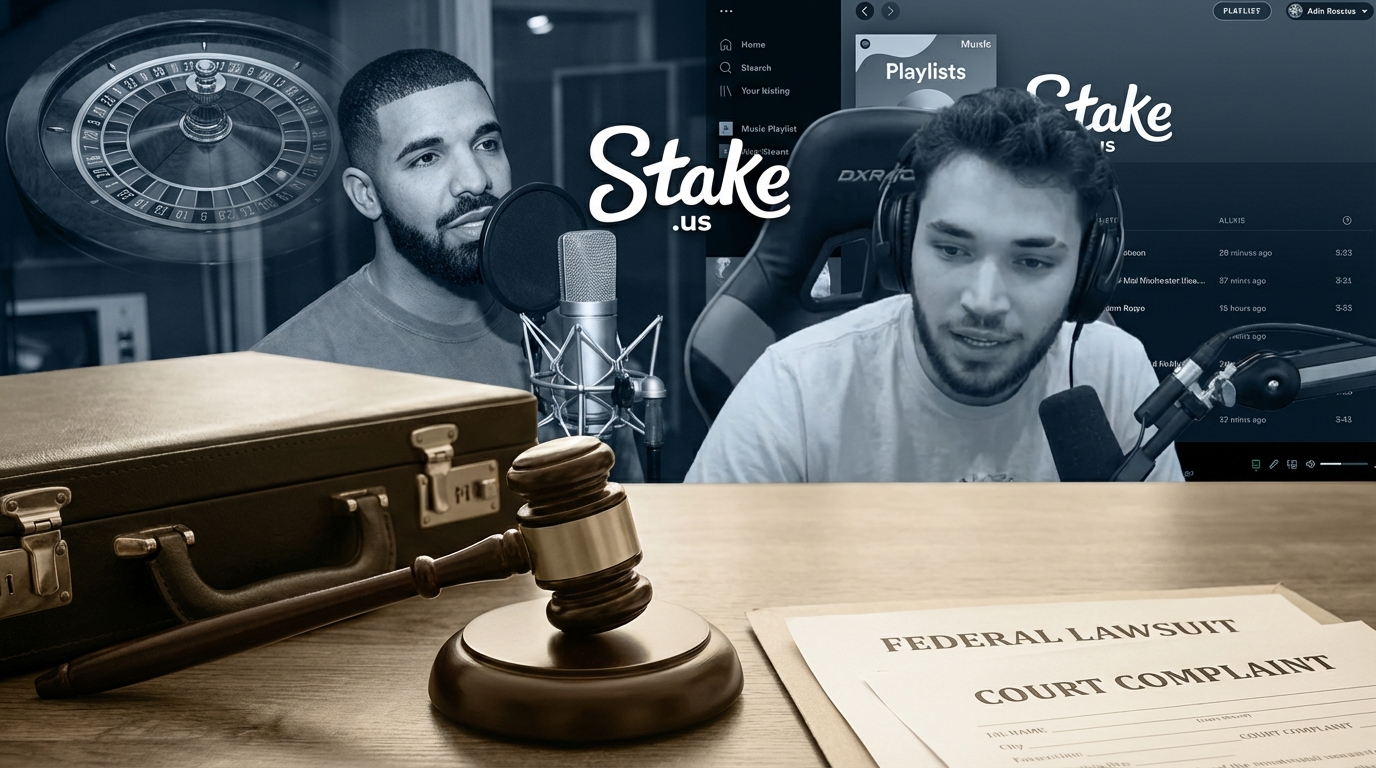
The latest complaint, filed on December 31, 2025, in Virginia federal court, includes explosive new allegations of using gambling proceeds to artificially inflate Drake’s music streaming numbers through bot farms.
KEY FACTS AT A GLANCE
- Court: U.S. District Court, Eastern District of Virginia (Alexandria)
- Filed: December 31, 2025
- Defendants: Drake, Adin Ross, Stake.us, and George Nguyen
- Key Charge: Civil RICO (Racketeering)
- Damages Sought: At least $5 million
- New Allegation: Using Stake funds to artificially boost Drake’s music streams
- Status: Third lawsuit in three months against the defendants
What the New Lawsuit Alleges
The class-action complaint was filed by plaintiffs LaShawnna Ridley and Tiffany Hines, seeking to represent Virginia residents who lost money on Stake.us within the past three years. The lawsuit names four defendants: 39-year-old rapper Drake, 25-year-old streamer Adin Ross, the Stake.us platform, and an Australian national named George Nguyen.
At the heart of the complaint is an allegation that goes beyond typical illegal gambling claims. The lawsuit accuses the defendants of operating “a racketeering conspiracy that preyed on consumers” through Stake.us, while simultaneously using the platform’s internal transfer features to fund a separate scheme to artificially inflate Drake’s music streaming numbers.
“At the heart of the scheme, Drake — acting directly and through willing and knowledgeable co-conspirators — has deployed automated bots and streaming farms to artificially inflate play counts of his music across major platforms, such as Spotify.”
— Virginia Federal Court Complaint
The Streaming Manipulation Scheme
The lawsuit introduces George Nguyen as a key figure in the alleged conspiracy. Nguyen is identified in court documents as the owner of an Instagram news-clipping account. According to the complaint, Nguyen served as a “broker and operational facilitator,” receiving cryptocurrency through Stake channels and then “interfacing with bot vendors, supervising coordinated amplification strategies, and integrating paid ‘clipping’ campaigns” on social media platforms including X (formerly Twitter).
The complaint alleges that Stake’s “tipping” feature was used as “an unlimited and wholly unregulated money transmitter” to transfer funds among the defendants. This system allegedly allowed for “concealment, covert routing, and disbursement of funds to bot operators, intermediaries, and amplifiers.”
The lawsuit points to specific instances of these transfers, including a $100,000 “tip” that Drake publicly sent to Adin Ross during a 2023 livestream. It also notes that Drake gave Ross a $220,000 car just days before this latest lawsuit was filed.
ALLEGED IMPACT ON MUSIC INDUSTRY
The complaint claims this scheme “has suppressed authentic artists and narrowed consumers’ access to legitimate content by undermining the integrity of curated experiences.” Plaintiffs allege the fraudulent streams and amplification campaigns sometimes targeted competitors with disparaging content, while manipulating chart performance and playlist placement.
How Stake.us Allegedly Operates
Central to all three lawsuits against Drake and Ross is the allegation that Stake.us operates as an illegal online casino while disguising itself as a legal “social casino” or sweepstakes platform. The platform, operated by Sweepstakes Limited and based in Curacao and Cyprus, has faced increasing legal scrutiny throughout 2025. Understanding how Stake.us has responded to legal pressure in other states provides context for these lawsuits.
THE DUAL-CURRENCY SYSTEM
Gold Coins
- Marketed as “non-redeemable”
- Users purchase these tokens
- Used for gameplay on the platform
- Bundled with Stake Cash at purchase
Stake Cash
- Can be redeemed for real money
- Allegedly 1:1 value with US dollar
- Cashable for cryptocurrency or gift cards
- Effectively makes it real-money gambling
According to the Virginia complaint, Stake.us has operated as “one of the largest and most profitable illegal online casinos” since at least 2022. The lawsuits allege this dual-currency model is designed to skirt state gambling laws while effectively allowing real-money wagering.
The “House Money” Allegations
A common thread across all three lawsuits is the allegation that when Drake and Ross livestream themselves gambling on Stake, they are not actually using their own money. This is important because their streams are promotional content that allegedly lures viewers into gambling.
“The two have engaged in live-streamed gambling, wagering large sums of money that was provided surreptitiously by Stake. In other words, though Drake and Ross purported to be gambling with their own Stake Cash, it was in fact provided to them by the house.”
— Missouri Lawsuit Complaint
The lawsuits allege this arrangement was not disclosed to viewers, meaning fans believed they were watching authentic gambling sessions when they were actually watching promotional content funded by the platform itself.
Timeline of Legal Actions
LAWSUIT #1: MISSOURI
October 27, 2025
Plaintiff Justin Killham filed in Jackson County, Missouri. Alleges deceptive practices under Missouri law. Later moved to federal court.
LAWSUIT #2: NEW MEXICO
October 30, 2025
Plaintiffs Nathaniel Torres and Rory Michie. Challenges sweepstakes model under New Mexico gaming laws where online gambling is illegal.
LAWSUIT #3: VIRGINIA (RICO)
December 31, 2025
Federal RICO charges. Adds streaming manipulation allegations and names George Nguyen. Seeks $5M+ in damages.
Legal Claims in the Virginia Lawsuit
The Virginia lawsuit is the most serious of the three, invoking federal racketeering statutes typically reserved for organized crime prosecutions. The complaint includes three main legal claims:
| Legal Claim | Description | Potential Consequences |
|---|---|---|
| Federal RICO Violation | Pattern of racketeering activity under the Racketeer Influenced and Corrupt Organizations Act | Treble damages, attorney fees |
| Racketeering Conspiracy | Conspiring to operate an illegal enterprise through gambling and money transmission | Joint and several liability |
| Virginia Consumer Protection Act | Deceptive practices that misled consumers about the nature of gambling on Stake.us | Statutory damages, injunctive relief |
Drake’s $100 Million Stake Partnership
Drake signed a reported $100 million endorsement deal with Stake.com in 2022, according to the Financial Times. The partnership included live-streamed gambling sessions, social media promotions, and exclusive giveaways for fans. Drake often hosted “Drake on Stake” events where he live-streamed himself placing massive bets, sometimes wagering millions of dollars in cryptocurrency.
One notable stream on May 26, 2022, saw Drake win $17.9 million playing online roulette, turning a $5 million starting stake into $28 million within 25 minutes. These high-profile gambling sessions drew massive audiences and allegedly drove significant user acquisition for Stake.
However, the partnership appears to have soured. In August 2025, Drake publicly accused Stake of blocking his withdrawal attempts and “disrespecting its key endorsers.” He subsequently deleted his Kick streaming account, and Ross confirmed to his audience that Drake would not be doing any more streams.
Regulatory Pressure Mounting on Stake
The lawsuits against Drake and Ross come amid increasing regulatory scrutiny of Stake and similar offshore gambling platforms. In August 2025, a bipartisan coalition of all 50 state attorneys general sent a letter to U.S. Attorney General Pam Bondi urging the Department of Justice to crack down on illegal offshore gambling sites.
REGULATORY ACTIONS AGAINST STAKE
State-Level Actions
- Arizona: Cease-and-desist order issued
- Louisiana: Cease-and-desist order issued
- Montana: Banned sweepstakes casinos entirely
- California: Lawsuit sent to arbitration
- 12 states filed anti-sweepstakes bills
Federal Pressure
- 50 AGs urged DOJ enforcement
- Bipartisan Senate letter to DOJ
- $400B+ estimated illegal gambling volume
- $4B+ in lost state tax revenue
- UIGEA enforcement requested
The attorneys general letter specifically called for the DOJ to pursue injunctive relief to block access to illegal websites, seize assets including servers and domains, and coordinate with financial institutions to block unlawful transactions.
Responses from the Defendants
The defendants have largely remained silent in response to the Virginia lawsuit. Drake’s representatives declined to comment to media outlets. Stake.us did not immediately respond to requests for comment.
Adin Ross has been the most vocal, dismissing the lawsuits during livestreams. In response to earlier lawsuits, he called the claims “complete bullsh*t” and encouraged his followers to read the complaints for themselves.
Stake has previously defended its business model through the Social and Promotional Games Association, which stated: “This ruling affirms what we’ve long said: Social sweepstakes sites are not gambling.”
What Happens Next
The Virginia case is still in its early stages. The defendants will need to respond to the complaint, and the court will determine whether to certify the class action. The Missouri case was recently moved from state court to federal court, potentially consolidating some of the legal proceedings.
If the RICO claims survive initial motions, the case could result in significant damages for the defendants. Under RICO, successful plaintiffs can receive treble (triple) damages plus attorney fees, meaning the $5 million minimum sought could multiply substantially.
The streaming manipulation allegations add a new dimension that could attract attention from music industry stakeholders and streaming platforms like Spotify, which have their own interests in combating artificial streaming.
KEY TAKEAWAYS
- Third lawsuit in three months — Drake and Adin Ross now face federal RICO charges in Virginia, in addition to state lawsuits in Missouri and New Mexico
- New streaming fraud allegations — The Virginia complaint adds claims that defendants used Stake funds to artificially boost Drake’s music streams through bot farms
- George Nguyen named — An Australian national is accused of serving as “broker and operational facilitator” for the alleged streaming manipulation scheme
- House money controversy — All lawsuits allege Drake and Ross used Stake-provided funds for gambling streams without disclosure to viewers
- Regulatory heat intensifying — 50 state AGs have urged DOJ action on offshore gambling sites like Stake
- $5M+ in damages sought — RICO violations could result in treble damages if plaintiffs prevail
Sources
- Drake, Ross & Stake Complaint (Virginia) — U.S. District Court, Eastern District of Virginia
- 50 State Attorneys General Letter to DOJ — National Association of Attorneys General

Aevan Lark
Aevan Lark is a gambling industry veteran with over 7 years of experience working behind the scenes at leading crypto casinos — from VIP management to risk analysis and customer operations. His insider perspective spans online gambling, sports betting, provably fair gaming, and prediction markets. On Dyutam, Aevan creates in-depth guides, builds verification tools, and delivers honest, data-driven reviews to help players understand the odds, verify fairness, and gamble responsibly.
Related coverage
A $10 Parlay Skips FanDuel’s Illinois Fee. A $10 Straight Bet Doesn’t.
FanDuel’s 50¢ Illinois fee favors qualifying parlays over equal-sized singles, with a steep cost for small stakes.
What Does a DraftKings Gambling Warning Actually Change?
Safety Prompt, Then Promotion: Inside ProPublica’s DraftKings Test
Yasin Kol Arrested: Match-Fixing Allegations and a Disputed Money Trail
The Süper Lig referee denies wrongdoing as reported bank totals raise questions about the evidence behind the match-fixing allegations.