Maine Becomes 8th US State to Legalize iGaming: Wabanaki Tribes Get Exclusive Online Casino Rights
Governor Mills allows tribal-exclusive iGaming bill to become law without signature, handing DraftKings and Caesars a duopoly while shutting out FanDuel entirely.
Maine has become the 8th US state to legalize iGaming after Governor Janet Mills allowed a tribal-exclusive online casino bill to become law without her signature—a stunning reversal from an administration that actively testified against the legislation and whose own Gambling Control Board unanimously requested a veto.
KEY FACTS AT A GLANCE
- State: Maine (becomes 8th US state with legal iGaming)
- Bill: LD 1164 “An Act to Create Economic Opportunity for the Wabanaki Nations”
- Status: Became law without Governor Mills’ signature on January 10, 2026
- Effective Date: ~July 2026 (90 days after April 17 legislative session ends)
- Tax Rate: 18% of Gross Gaming Revenue (GGR)
- Model: Tribal-exclusive rights (four Wabanaki tribes only)
- Projected Revenue: $3.5M+ by FY2027; potentially $200M/year at maturity
How the Bill Became Law: Mills’ Calculated Non-Action
Governor Janet Mills didn’t sign LD 1164. She didn’t veto it either. She simply let the clock run out, allowing the bill to become law through inaction—a move that let her avoid the political optics of actively endorsing iGaming expansion while still delivering a win for the Wabanaki tribes.
The official announcement from the Governor’s office frames this as supporting tribal economic development: “I believe that this new form of gambling should be regulated, and I am confident that Maine’s Gambling Control Unit will develop responsible rules.”
The political context makes this decision particularly notable. Mills’ administration testified against LD 1164 during legislative hearings. The Maine Center for Disease Control and Prevention raised addiction concerns. The Gambling Control Board voted unanimously to recommend a veto, warning the bill would create a “monopoly” and undermine existing casinos. Mills overrode all of them.
THE POLITICAL CALCULATION
The National Association Against iGaming notes that “the timing of this decision cannot be ignored”—Mills is running for US Senate and faces a competitive Democratic primary. Critics argue tribal support was essential to her campaign calculus. The decision came just days before the January 10 deadline, after months of holding the bill for “review.”
The Four Wabanaki Tribes with Exclusive iGaming Rights
LD 1164 grants exclusive iGaming rights to Maine’s four federally recognized Wabanaki tribes. No commercial operators, no retail casinos—just tribal nations. This tribal-exclusive model is unprecedented in US iGaming and could become a template for other states with strong tribal gaming presence.
| Tribe | Chief/Leader | Sports Betting Partner | Likely iGaming Partner |
|---|---|---|---|
| Passamaquoddy (Indian Township) | William Nicholas Sr. | DraftKings | DraftKings |
| Passamaquoddy (Sipayik) | Amkuwiposohehs “Pos” Bassett | DraftKings | DraftKings |
| Penobscot Nation | Kirk Francis | Caesars | Caesars |
| Houlton Band of Maliseet Indians | Clarissa Sabattis | Caesars | Caesars |
| Mi’kmaq Nation | Sheila McCormack | Caesars | Caesars |
Chief Clarissa Sabattis of the Houlton Band explicitly cited “black-market websites” as a problem that regulated tribal iGaming would address—positioning the legislation as consumer protection rather than gambling expansion. The tribes have hailed Mills as the “greatest” governor for signing this historic measure.
Winners and Losers: The DraftKings-Caesars Duopoly
The tribal-exclusive model creates clear winners and losers in Maine’s iGaming market. Since the Wabanaki tribes already have sports betting partnerships with DraftKings and Caesars, those operators are virtually guaranteed the iGaming contracts.
MARKET IMPACT ANALYSIS
Winners
- DraftKings: ~70% projected market share
- Caesars: ~30% projected market share
- Wabanaki Tribes: Exclusive rights, economic development
- Maine Players: Legal, regulated options vs offshore
Losers
- FanDuel: No path to Maine market
- BetMGM/Fanatics: Completely shut out
- Hollywood Bangor: Retail casino excluded
- Oxford Casino: Retail casino excluded
- Churchill Downs/PENN: No iGaming access
Deutsche Bank analyst Steven Pizzella projects a 70/30 market split favoring DraftKings over Caesars. The Passamaquoddy’s DraftKings partnership gives the sports betting giant access to two of the four tribal licenses, while Caesars holds relationships with the Penobscot Nation, Houlton Band, and Mi’kmaq Nation.
The Opposition: People’s Veto Campaign Launched
The law isn’t final yet. Maine allows citizens to challenge legislation through a “People’s Veto” referendum process, and the National Association Against iGaming (NAAiG) has announced plans to pursue exactly that.
| Opponent | Reason for Opposition |
|---|---|
| Maine Gambling Control Board | Unanimous veto request; called it a “monopoly,” warned of regulatory concerns |
| Maine CDC | Addiction concerns about “addictive nature of online games” |
| Churchill Downs | Retail casino owner excluded from iGaming market |
| PENN Entertainment | Retail casino owner excluded from iGaming market |
| FanDuel | No path to market (DraftKings/Caesars locked in via tribal deals) |
| NAAiG | Leading People’s Veto campaign to overturn the law |
NAAiG polling claims 64% of Maine voters oppose legalizing iGaming, with 49% “strongly opposed” and only 16% in favor. A separate poll found 51% of voters would be less likely to support lawmakers who voted for the bill. If accurate, a People’s Veto referendum could succeed—the last successful People’s Veto in Maine was in 2019.
The 1980 Settlement Act: Why Maine Is Different
Maine’s tribal nations operate under a unique legal framework that explains why separate iGaming legislation was necessary. The Maine Indian Claims Settlement Act of 1980—which resolved land claims by the Passamaquoddy, Penobscot, and Maliseet tribes—treated Maine tribes differently than tribes in other states.
Unlike tribal nations elsewhere, Maine tribes were made subject to state law in ways that limited their sovereignty. The 1980 settlement reinstated former state control over Indians that had been loosening under federal policy. This means Maine tribes couldn’t simply offer iGaming under the Indian Gaming Regulatory Act (IGRA) like tribes in other states—they needed specific state authorization through LD 1164.
The Mi’kmaq Nation wasn’t even part of the original 1980 settlement. They received federal recognition separately in 1991 through the Aroostook Band of Micmacs Settlement Act. This fragmented history explains why Maine’s tribal gaming landscape is more complicated than in states like Connecticut or Michigan.
US iGaming Landscape: Maine Joins Elite Club
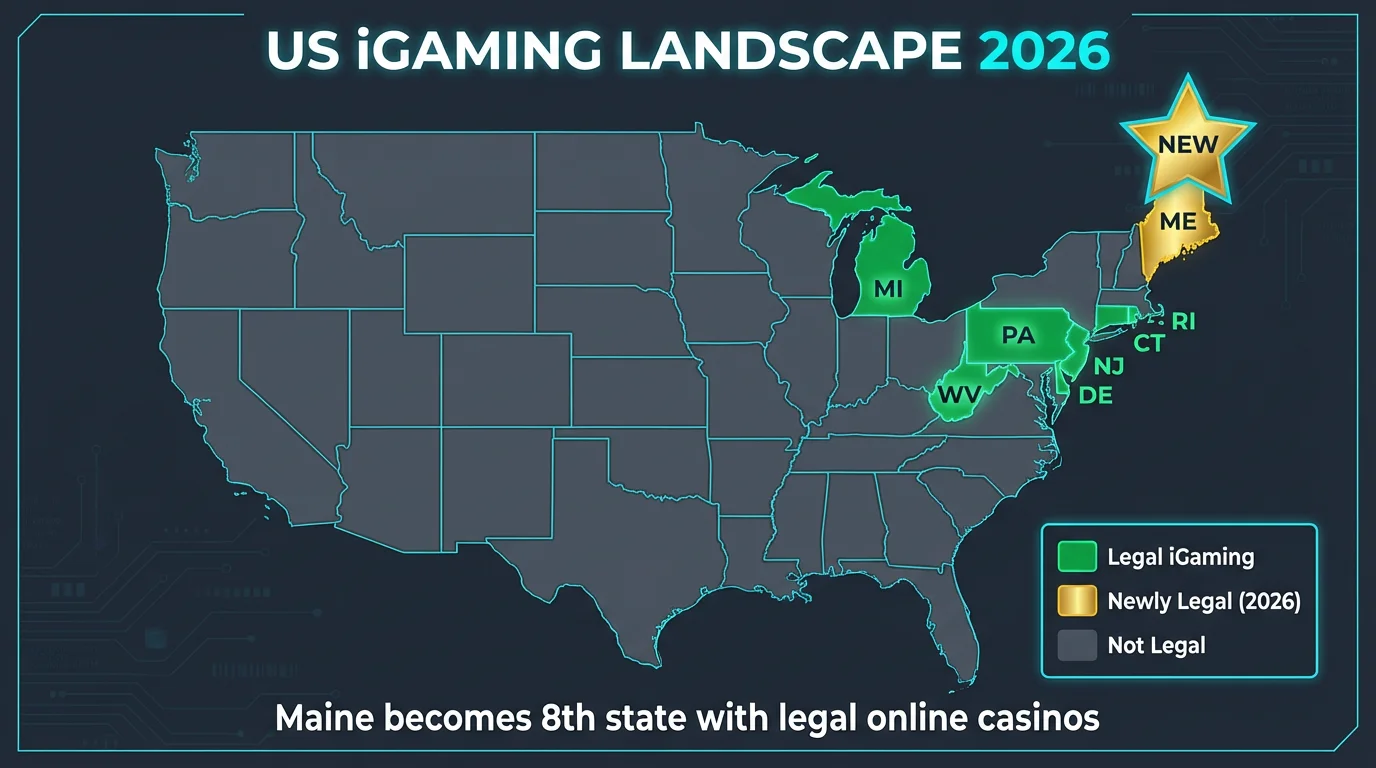
Maine becomes only the 8th US state to legalize online casino gambling. The iGaming club remains extremely exclusive—far more states have legalized sports betting than online casinos.
| State | Year Legalized | Model | 2023 Revenue |
|---|---|---|---|
| Delaware | 2012 | State lottery | $15M |
| New Jersey | 2013 | Open market | $1.92B |
| Pennsylvania | 2017 | Open market | $2.0B+ |
| West Virginia | 2019 | Casino-linked | $250M |
| Michigan | 2021 | Open market | $1.92B |
| Connecticut | 2021 | Tribal duopoly | $300M+ |
| Rhode Island | 2024 | Limited | New |
| Maine | 2026 | Tribal-exclusive | Est. $200M/yr |
Maine’s tribal-exclusive model is closest to Connecticut’s tribal duopoly with Mohegan Sun and Foxwoods, but even more restrictive. Analyst projections suggest Maine could eventually become a $200 million annual iGaming market at maturity, though the initial years will likely see more modest revenue as the market develops.
Timeline to Launch
JANUARY 10, 2026
LD 1164 becomes law without signature
APRIL 17, 2026
Legislative session ends; 90-day countdown begins
JULY 2026
Law takes effect (~90 days after session)
LATE 2026 / 2027
Realistic launch window after regulatory framework established
The law takes effect 90 days after the legislative session adjourns on April 17, putting the effective date around mid-July 2026. However, the Gambling Control Unit must still develop regulations, and tribal operators need to finalize platform partnerships. Industry analysts expect a realistic launch in late 2026 or early 2027.
PEOPLE’S VETO RISK
A People’s Veto petition must be filed within 90 days of legislative adjournment. If successful in gathering signatures, the law would be suspended until voters decide in a referendum. Given the polling showing 64% opposition, this remains a significant risk to Maine iGaming actually launching.
Regulated vs. Offshore: The Consumer Protection Angle
Supporters of LD 1164 frame tribal iGaming as consumer protection rather than gambling expansion. Chief Sabattis’ explicit reference to “black-market websites” echoes the argument that Maine residents are already gambling online—just through unregulated offshore platforms with no consumer protections, responsible gaming tools, or tax contributions.
This mirrors the sweepstakes casino crackdowns happening across states like Tennessee and Indiana, where regulators argue that quasi-legal gambling operations harm consumers and legitimate operators alike. Maine’s approach brings online casino gambling into a regulated framework with the 18% GGR tax contributing to state coffers.
For players, regulated iGaming means verified blackjack, roulette, and slots with RNG certification, dispute resolution mechanisms, self-exclusion options, and deposit limits—none of which offshore sites reliably provide.
KEY TAKEAWAYS
- Historic expansion: Maine becomes 8th US state with legal iGaming, first since Rhode Island in 2024
- Tribal-exclusive model: Only the four Wabanaki tribes can offer online casinos—no commercial operators allowed
- DraftKings-Caesars duopoly: Existing tribal sports betting partnerships make them the only viable iGaming operators; FanDuel, BetMGM completely shut out
- Political controversy: Mills let bill become law despite her administration testifying against it and Gambling Control Board’s unanimous veto request
- People’s Veto threat: NAAiG launching referendum campaign; polling shows 64% of Maine voters oppose iGaming
- Timeline: Law effective ~July 2026; realistic launch late 2026 or 2027 pending regulations and potential referendum
- National precedent: Tribal-exclusive iGaming model could become template for other states with strong tribal gaming presence

Aevan Lark
Aevan Lark is a gambling industry veteran with over 7 years of experience working behind the scenes at leading crypto casinos — from VIP management to risk analysis and customer operations. His insider perspective spans online gambling, sports betting, provably fair gaming, and prediction markets. On Dyutam, Aevan creates in-depth guides, builds verification tools, and delivers honest, data-driven reviews to help players understand the odds, verify fairness, and gamble responsibly.
Related coverage

Dabble Fined A$1.07 Million for Leaving Self-Excluded Bettors’ Accounts Open
Dabble paid A$1,069,200 for delayed account closure. The notices, wider marketing failures and scoped no-betting finding explained.
NYT: DraftKings AI Targeted Bettors Likely to Lose More
A Times investigation raises questions about promotional scoring and player protection. DraftKings disputes loss-based targeting.
Lithuania Blocks Polymarket: Access and Payment Orders
Lithuania’s Polymarket enforcement involved separate access and payment instructions, with an August court ruling preceding September announcements.