Kalshi’s April Legal Tidal Wave: Arizona Charges Survive, Washington Showdown, and the Gambling Trademark
April 2026 brought a legal tidal wave for Kalshi with criminal charges, new lawsuits, and a gambling trademark controversy.
In a single week in April 2026, Kalshi lost a bid to stop criminal prosecution in Arizona, watched Robinhood file a federal lawsuit on its behalf in Washington, and saw the CFTC sue three states to defend prediction markets — all while its own trademark filing calling itself a “gambling company” quietly made the rounds. April has become the most legally intense month in prediction market history. Here is what happened, why it matters, and what comes next.
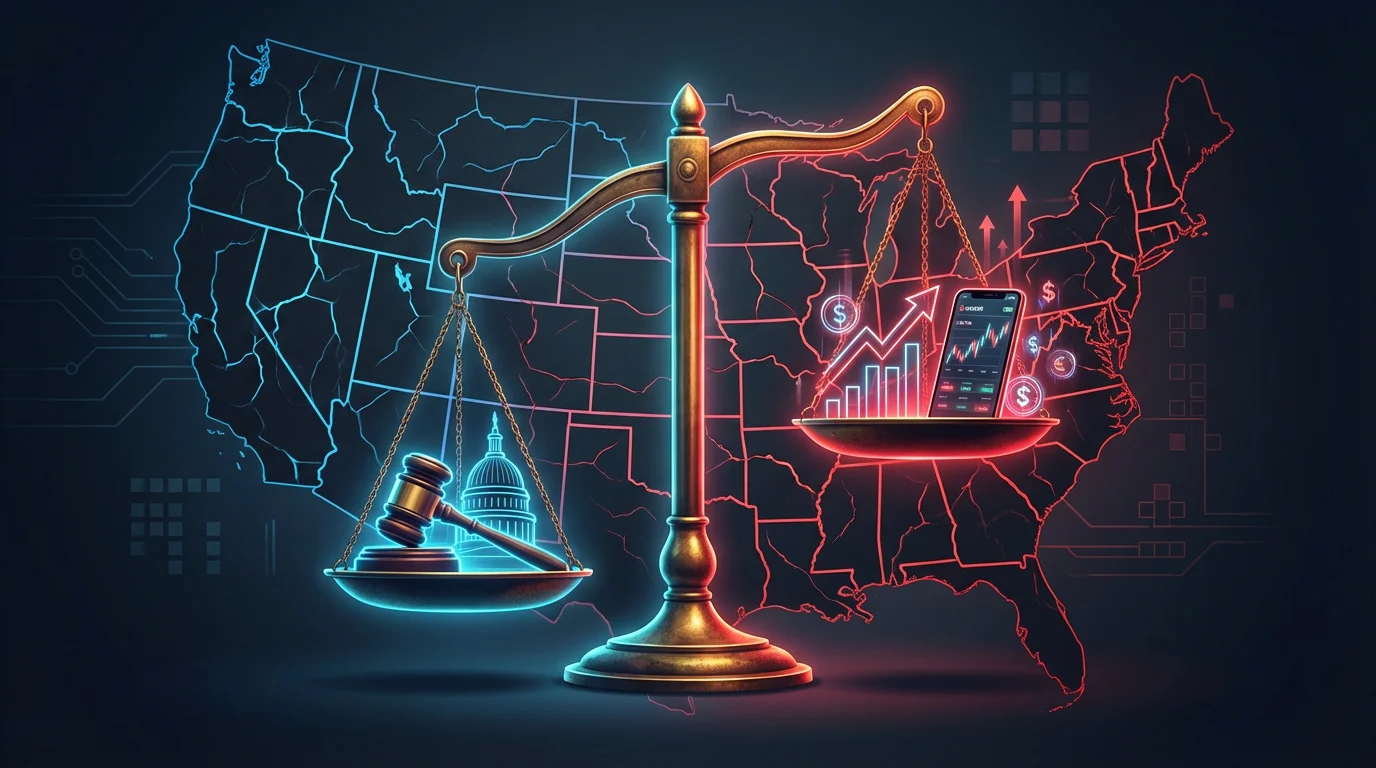
KEY FACTS AT A GLANCE
- Arizona became the first state to file criminal charges against Kalshi — 20 counts including election wagering
- A federal judge denied Kalshi’s bid to block the Arizona prosecution — citing the Anti-Injunction Act
- Washington AG Nick Brown sued Kalshi; Robinhood counter-sued Washington three days later
- Kalshi’s own trademark filing classified its services under “bookmaking” and “gambling tournaments”
- The Third Circuit ruled 2-1 that New Jersey cannot regulate Kalshi’s prediction market
- The CFTC sued Arizona, Connecticut, and Illinois — the federal agency’s most aggressive defense of prediction markets yet
APRIL 2026 LEGAL TIMELINE
Washington Draws the Line: AG Brown vs. Kalshi and Robinhood
On March 27, Washington Attorney General Nick Brown filed a civil lawsuit against KalshiEx LLC in King County Superior Court, alleging the platform violates both the Washington State Gambling Act and the Consumer Protection Act. The complaint paints a vivid picture of how prediction markets have penetrated states that ban sports betting.
“Found a way to bet on the NFL even though we live in Washington.”
— Text exchange featured in a Kalshi advertisement, cited in the Washington AG’s complaint
The numbers support the allegation. According to the AG’s office, more than 1,200 Kalshi accounts were opened by Washington residents, processing over $7 million in wagers since mid-2022. The state is seeking to shut down Kalshi’s operations in Washington, recover money lost by residents, and impose civil penalties.
Three days later, Robinhood fired back. The brokerage — which offers event contracts through both Kalshi and ForecastEx — filed a federal lawsuit against Washington officials on March 30, arguing the state’s actions against Kalshi created an immediate enforcement threat. Robinhood’s core argument mirrors what Kalshi has maintained in courtrooms across the country: the Commodity Exchange Act grants the CFTC exclusive authority over these markets, and state gambling laws simply cannot override federal regulation.
The competing lawsuits reached a federal court hearing on April 3. No rulings have been issued yet, with legal observers expecting preliminary injunction decisions within 60 to 90 days.
The Trademark That Proved the States’ Point
While Kalshi fights to avoid being classified as a gambling operation in courtrooms across the country, its own filing with the federal government tells a different story. In November 2025, Kalshi submitted a trademark application to the U.S. Patent and Trademark Office for the term “prediction market.” The classification it chose: “bookmaking services, namely, providing of information related to sports betting; organizing, arranging, conducting sports betting and gambling tournaments.”
“[Our platform] has nothing to do with sports betting.”
— Tarek Mansour, CEO of Kalshi (public statement)
When the filing surfaced publicly in early 2026, Kalshi spokesperson Elisabeth Diana said the trademark strategy was “intentionally broad and designed to cast a wide net, not to define our business.” The company argued it filed broadly to prevent competitors in adjacent categories from claiming the term.
The USPTO ultimately denied the application, finding that “prediction market” was merely a feature description rather than a protectable trademark. Kalshi requested a three-month extension to re-file on March 3, which was approved. But the legal damage may already be done. State attorneys general now have a federal filing in which Kalshi itself placed its services under gambling classifications — powerful ammunition in courtrooms where the central question is whether prediction markets are financial instruments or gambling operations.
Arizona’s Criminal Case Survives: Injunction Denied
Arizona has been the most aggressive state in the prediction market fight, and April proved why. On March 17, Attorney General Kris Mayes filed a 20-count criminal information against KalshiEx LLC and Kalshi Trading LLC — the first criminal charges any state has brought against the company. Sixteen counts allege illegal betting and wagering, while four counts specifically target election wagering: the 2028 presidential race, the 2026 Arizona governor’s race, the 2026 Republican gubernatorial primary, and the 2026 Secretary of State race.
“Arizona will not be bullied into letting any company place itself above state law.”
— Kris Mayes, Arizona Attorney General
Other alleged illegal wagers included bets on professional and college sports, individual player performance propositions, and whether the SAVE Act would become law. Kalshi had tried to get ahead of the state, filing a preemptive federal lawsuit on March 12 — five days before the criminal charges dropped — seeking to block Arizona enforcement. That strategy failed decisively on April 9.
U.S. District Judge Michael T. Liburdi denied Kalshi’s request for a preliminary injunction, finding that the federal Anti-Injunction Act bars federal courts from halting ongoing state criminal proceedings. The ruling effectively means that once a state files criminal charges, Kalshi cannot use federal court to stop the prosecution — a significant procedural finding.
“Technology often sprints faster than the law can keep pace.”
— Judge Michael T. Liburdi, U.S. District Court for the District of Arizona
In a dramatic same-day development, the CFTC filed its own motion for a temporary restraining order against Arizona’s prosecution, arguing the state was “unconstitutionally intruding on the CFTC’s exclusive regulatory jurisdiction” and warning against a “patchwork of 50 state regulations.” Legal analyst Daniel Wallach noted a potentially significant strategic implication: by filing criminal charges first, Arizona may have discovered a procedural shield — “a procedural advantage states may exploit” — that prevents Kalshi from obtaining federal court relief.
KALSHI LEGAL SCORECARD — APRIL 2026
WINS
- NJ Third Circuit — 2-1 ruling: federal law preempts state gambling regulation
- CFTC backing — Federal agency suing 3 states on Kalshi’s behalf
- CFTC rulemaking — Advanced Notice of Proposed Rulemaking issued
LOSSES
- AZ injunction denied — Anti-Injunction Act blocks federal relief
- AZ criminal charges — 20 counts, first criminal prosecution
- NV injunction — Sports and election contracts blocked
- MA state court — Sports contracts subject to state gaming law
PENDING
- WA (both suits) — Ruling expected in 60-90 days
- NV 9th Circuit — Hearing set for April 16
- MD 4th Circuit — Hearing scheduled for May
- CFTC rulemaking — Public comments due April 30
The Bigger Picture: Federal Cavalry Arrives
The three developments above did not happen in a vacuum. April 2026 saw the federal government make its most aggressive move yet to defend prediction markets. On April 2, the CFTC filed lawsuits against Arizona, Connecticut, and Illinois — challenging all three states’ regulatory actions against CFTC-registered prediction market operators.
“Congress rejected such a fragmented patchwork of state regulations because it resulted in poorer consumer protection and increased risk of fraud and manipulation.”
— CFTC Chairman Michael Selig
Four days later, Kalshi scored perhaps its biggest legal victory yet. The Third Circuit Court of Appeals ruled 2-1 that New Jersey’s gaming regulators cannot prevent Kalshi from offering sports-related event contracts. It was the first U.S. circuit court to rule on whether federal commodities law preempts state gambling regulation for prediction markets. But the win comes with an asterisk: a circuit split is forming. While the Third Circuit sided with Kalshi, the Ninth Circuit has permitted state enforcement, and a Fourth Circuit appeal from Maryland remains pending. Legal observers say this trajectory is pointing directly toward Supreme Court review.
Congress is also entering the fray. On March 23, Senators John Curtis (R-UT) and Adam Schiff (D-CA) introduced the bipartisan Prediction Markets Are Gambling Act, which would explicitly ban CFTC-registered entities from listing any contract that resembles a sports bet or casino-style game. The sponsors note that Super Bowl trading volume on prediction markets surpassed $1 billion in 2026, while a single March Madness winner contract exceeded $100 million in volume — all accessible in states where sports betting is illegal.
The financial stakes for states are enormous. The American Gaming Association estimates states have lost over $600 million in tax revenue from wagers placed on prediction markets. Eleven states have introduced prediction market legislation in 2026, and eleven have issued cease-and-desist orders against operators. With Kalshi reporting $1.9 billion in college basketball wagers in February 2026 alone — and roughly 90% of its contracts being sports-related during NFL season — the revenue at stake keeps growing.
What Comes Next
UPCOMING LEGAL CALENDAR
- April 16: 9th Circuit hears Nevada appeal — a ruling against Kalshi would deepen the circuit split
- April 30: CFTC public comment period closes on prediction market rulemaking
- May 2026: 4th Circuit hears Maryland appeal
- 60-90 days: Washington preliminary injunction decisions expected in both the Kalshi and Robinhood cases
The core question remains the same one that has driven every lawsuit on this list: are prediction markets financial instruments subject to exclusive federal regulation, or gambling operations subject to state law? With Kalshi controlling 89% of the U.S. prediction market and processing billions in monthly volume, the answer will reshape a multi-billion-dollar industry. The circuit split between the Third Circuit (favoring Kalshi) and the Ninth Circuit (favoring states) makes Supreme Court involvement increasingly likely — and the Prediction Markets Are Gambling Act could resolve the fight legislatively before the Court even weighs in.
STATES TAKING ACTION AGAINST PREDICTION MARKETS
Dashed blue borders indicate states also facing CFTC counter-suits
KEY TAKEAWAYS
- Criminal charges create a federal court shield — the Anti-Injunction Act prevents Kalshi from blocking state prosecutions through federal court, giving states a new strategic playbook
- Washington’s dual lawsuits — AG Brown vs. Kalshi and Robinhood vs. Washington will test federal preemption in a new jurisdiction with rulings expected this summer
- The gambling trademark undercuts Kalshi’s core defense — its own federal filing classified prediction markets under “bookmaking” and “sports betting,” handing states powerful courtroom ammunition
- The CFTC is all-in on defending prediction markets — suing three states and filing an emergency TRO in Arizona on the same day the injunction was denied
- A Supreme Court path is forming — the circuit split between the Third Circuit (pro-Kalshi) and Ninth Circuit (pro-state) makes high court review increasingly likely
- Congress may resolve it first — the bipartisan Prediction Markets Are Gambling Act would ban sports contracts on CFTC-regulated platforms outright
Sources
- Attorney General Mayes Charges Kalshi With Illegal Gambling Operation, Election Wagering in Arizona — Arizona Attorney General’s Office
- CFTC Sues Trio of States to Reaffirm its Exclusive Jurisdiction Over Prediction Markets — Commodity Futures Trading Commission
- Curtis, Schiff Introduce Bipartisan Legislation to Ban Sports Prediction Market Contracts — U.S. Senator John Curtis
- Kalshi Loses Bid to Halt Arizona Criminal Suit As CFTC Acts — Bloomberg Law
- New Jersey cannot regulate Kalshi’s prediction market, U.S. appeals court rules — CNBC

Aevan Lark
Aevan Lark is a gambling industry veteran with over 7 years of experience working behind the scenes at leading crypto casinos — from VIP management to risk analysis and customer operations. His insider perspective spans online gambling, sports betting, provably fair gaming, and prediction markets. On Dyutam, Aevan creates in-depth guides, builds verification tools, and delivers honest, data-driven reviews to help players understand the odds, verify fairness, and gamble responsibly.
Related coverage
Duel.com Controversy: Fake-Volume Claims and the Sneako Clip
Conflicting wager records and an unconfirmed AI label: what the evidence establishes about Duel.com’s volume dispute and the Sneako clip.
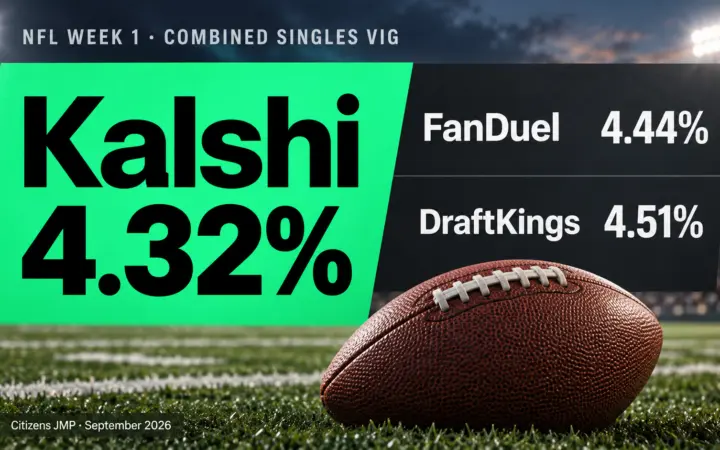
Kalshi NFL Week 1 Vig: Totals Drive Its Pricing Lead
Citizens' NFL pricing snapshot gives Kalshi a narrow overall lead, while FanDuel wins moneylines and sportsbooks lead sampled combos.

Mark Locke: Prediction Markets Can Outlast Today’s Rules
Mark Locke expects enduring wagering demand, while taxes, court disputes and settlement questions test the structure of sports prediction markets.