College football is the sharp bettor’s playground. With 130+ FBS teams playing 800+ games per season, sportsbooks simply can’t price every matchup as tightly as they do for the NFL’s 32 teams. That information gap — combined with massive point spreads, wildly different talent levels, and a transfer portal that reshuffles rosters every offseason — creates more exploitable edges than any other major American sport. This guide covers everything you need to bet college football profitably, from reading CFB odds to conference-specific strategies and College Football Playoff futures.

KEY FACTS AT A GLANCE
- Scale: 130+ FBS teams playing 800+ games per season — far more betting opportunities than the NFL’s 272 regular season games
- Spreads: Point spreads regularly exceed 20+ points, with 30+ point favorites common in Power 4 vs FCS matchups
- Playoff: The 12-team College Football Playoff creates lucrative futures markets from preseason through Selection Sunday
- Home Field: Home field advantage is worth 3-4 points in college football — nearly double the modern NFL’s ~2 points
- Information Edge: Conference strength gaps and roster turnover create exploitable lines that sharp bettors target
- Roster Flux: The transfer portal and NIL deals have transformed roster analysis — last year’s stats often don’t apply
Why College Football Betting Is Different from NFL
If you’re coming from NFL betting, college football requires a different analytical framework. The two sports share rules, but the betting dynamics are fundamentally different.
COLLEGE FOOTBALL VS NFL BETTING
College Football
- 130+ FBS teams — impossible to follow all
- Spreads regularly 20-40+ points
- Home field worth 3-4 points
- Massive talent gaps between tiers
- Roster turnover every year (portal + draft)
- Softer lines — books can’t model every team
- Conference strength varies wildly
NFL
- 32 teams — easier for books to model
- Spreads rarely exceed 14-17 points
- Home field worth ~2 points
- Parity built into the system (draft, cap)
- Rosters are relatively stable season to season
- Tighter lines — heavily bet, efficient market
- Talent is more evenly distributed
The key takeaway: NFL lines are efficient because the market is deep and the data is comprehensive. College football lines are less efficient because sportsbooks can’t devote equal resources to pricing Sun Belt Conference games as they do SEC matchups. That inefficiency is where sharp bettors profit.
Types of College Football Bets
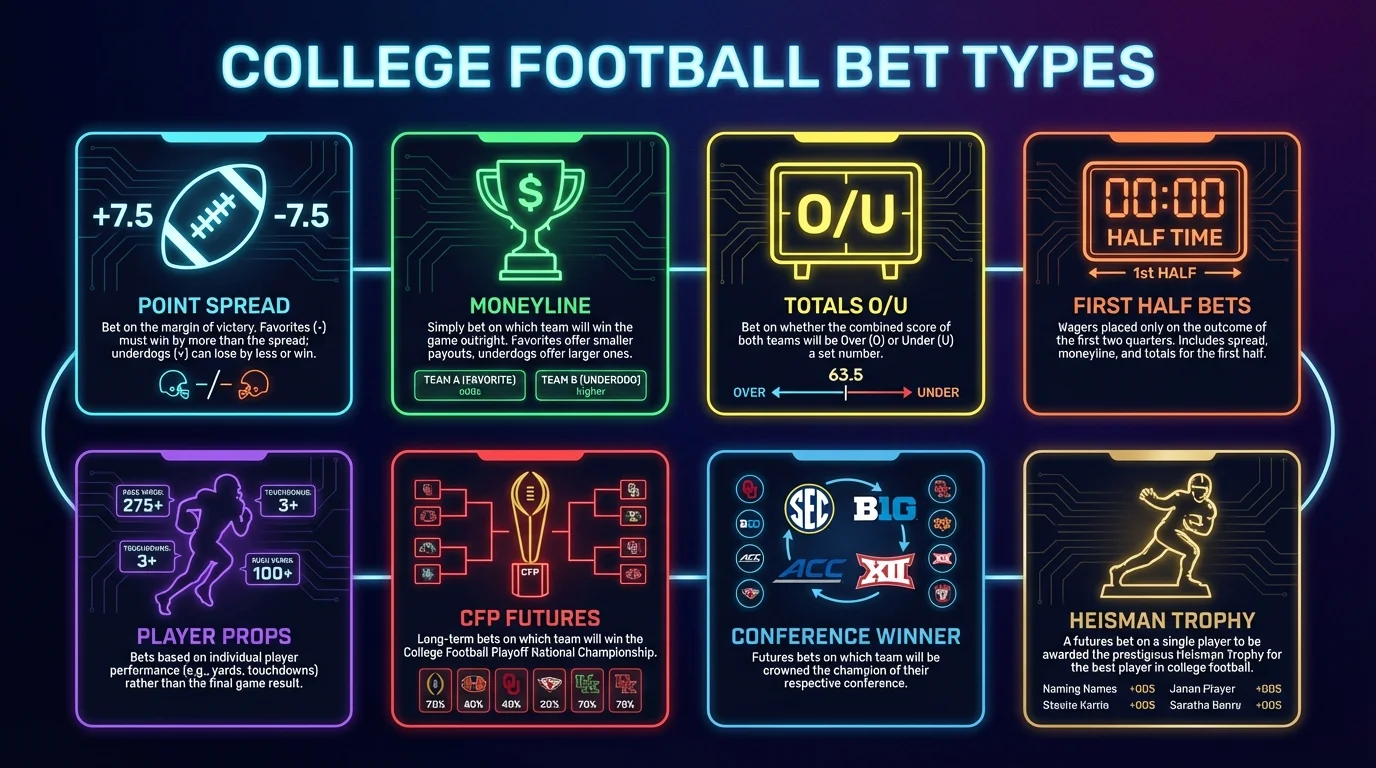
College football offers the same bet types as the NFL, plus several unique markets tied to the season-long structure and playoff format.
Point Spread
The point spread is the most popular way to bet college football. It works identically to NFL spreads — the favorite must win by more than the spread, the underdog can lose by less than the spread (or win outright).
The critical difference in CFB: spreads are much larger. Seeing Ohio State -28.5 against a mid-major isn’t unusual. In the NFL, a 28-point spread would be unthinkable. This creates different dynamics — garbage time becomes a bigger factor, and backdoor covers happen more frequently when starters are pulled in blowouts.
KEY NUMBERS IN COLLEGE FOOTBALL SPREADS
In the NFL, 3 and 7 are the magic numbers. In college football, the key numbers shift: 7, 10, 14, 17, and 21 matter most because scoring margins tend to be larger and touchdowns (7 points) are the dominant scoring unit. When you see a spread at 13.5 vs 14.5, that half-point matters significantly because 14 (two touchdowns) is a common final margin in CFB blowouts. If a push lands on one of these numbers, you want to be on the right side of it.
Moneyline
Moneyline bets in college football have a unique problem: when a team is -28.5 on the spread, the moneyline might be -5000 or worse. Risking $5,000 to win $100 is terrible value — one upset wipes out 50 wins worth of profit.
CFB moneylines are most useful in these scenarios:
| Scenario | Spread | Moneyline | When to Use ML |
|---|---|---|---|
| Close rivalry game | -3 to -7 | -150 to -300 | Good value — reasonable juice for win probability |
| Underdog with upset potential | +7 to +14 | +200 to +500 | When you think they can win, not just cover |
| Massive blowout favorite | -28 or more | -3000+ | Almost never — juice is prohibitive |
| Parlay leg | Any | Any | Use spread-to-moneyline converter to compare value |
Totals (Over/Under)
Totals betting in college football is influenced heavily by pace and style. Two up-tempo spread offenses can push a total to 70+, while a Big Ten ground-and-pound matchup might sit at 42. Conference tendencies are the best predictor of totals — a Big 12 game between two Air Raid offenses is almost always an over play structurally.
Weather matters more for CFB totals than NFL because more college stadiums are outdoor venues in cold-weather regions. A November game in Madison or Minneapolis with 20-degree temperatures and wind suppresses scoring significantly.
First Half & Second Half Bets
Half bets are particularly valuable in college football because of how coaches manage large leads. A favorite might be -28.5 for the game but only -17.5 for the first half — because starters typically play the entire first half before backups enter in the third quarter.
First-half spreads and totals often provide better value than full-game lines in blowout matchups because they remove the garbage-time variable entirely.
Team & Player Props
Prop bets on college football are growing but remain less developed than NFL props. You’ll find quarterback passing yards, rushing yards for star backs, and team-specific props like total touchdowns. The key edge: prop lines in CFB are softer because sportsbooks have less data on college players than NFL veterans.
College Football Playoff Futures
The 12-team CFP has expanded futures betting dramatically. You can bet on which teams make the playoff, which conference gets the most bids, and who wins the national championship. The expanded field means more teams have realistic paths, creating value at longer odds.
The best time to bet CFP futures is early — preseason odds reflect public perception and brand names rather than current roster quality. A team that lost its quarterback to the draft but added a five-star transfer might be undervalued in preseason markets.
Conference Championship Futures
Conference title futures offer concentrated value. Instead of betting a team to win the national championship at +3000, you might find them at +400 to win their conference — a more achievable outcome. SEC and Big Ten championship markets are the most heavily bet, while Big 12 and ACC often have softer lines.
Heisman Trophy Futures
The Heisman is driven by narrative as much as performance. A quarterback on an undefeated team with a highlight-reel play gets more Heisman attention than a statistically superior player on a two-loss team. Betting Heisman futures requires predicting which teams will be in the national spotlight — and which players will get the media coverage that drives voting.
Season Win Totals
Win totals are set before the season and you bet over or under the projected number of wins. A team might be set at 8.5 wins — bet the over if you think they’ll win 9+ games, under if you think 8 or fewer.
Win totals are a great market for preseason research because they force you to analyze the entire schedule rather than individual games. Look at strength of schedule, home/away splits, and bye week placement.
Understanding College Football Odds
College football odds follow the same formats as all sports betting — American (+150/-150), decimal, and fractional. If you need to convert between them, use an odds converter. What’s unique about CFB odds is the scale.
EXAMPLE: READING A COLLEGE FOOTBALL ODDS BOARD
Georgia -24.5 (-110) vs. Vanderbilt +24.5 (-110)
Moneyline: Georgia -5000 / Vanderbilt +2000
Total: Over 51.5 (-110) / Under 51.5 (-110)
The spread tells you Georgia is expected to win by roughly 25 points. The moneyline is practically useless — risking $5,000 to win $100 on Georgia is terrible value. In games with spreads this large, focus on the spread and totals markets instead.
Alternate spreads are particularly useful in college football. If you love Georgia but think -24.5 is too many points, you can buy the spread down to -17.5 at steeper juice (maybe -150 instead of -110). Conversely, if you think Georgia will destroy Vanderbilt, you can sell the spread to -31.5 at plus odds (+120). The tradeoff is always juice versus points.
Conference Breakdown for Bettors
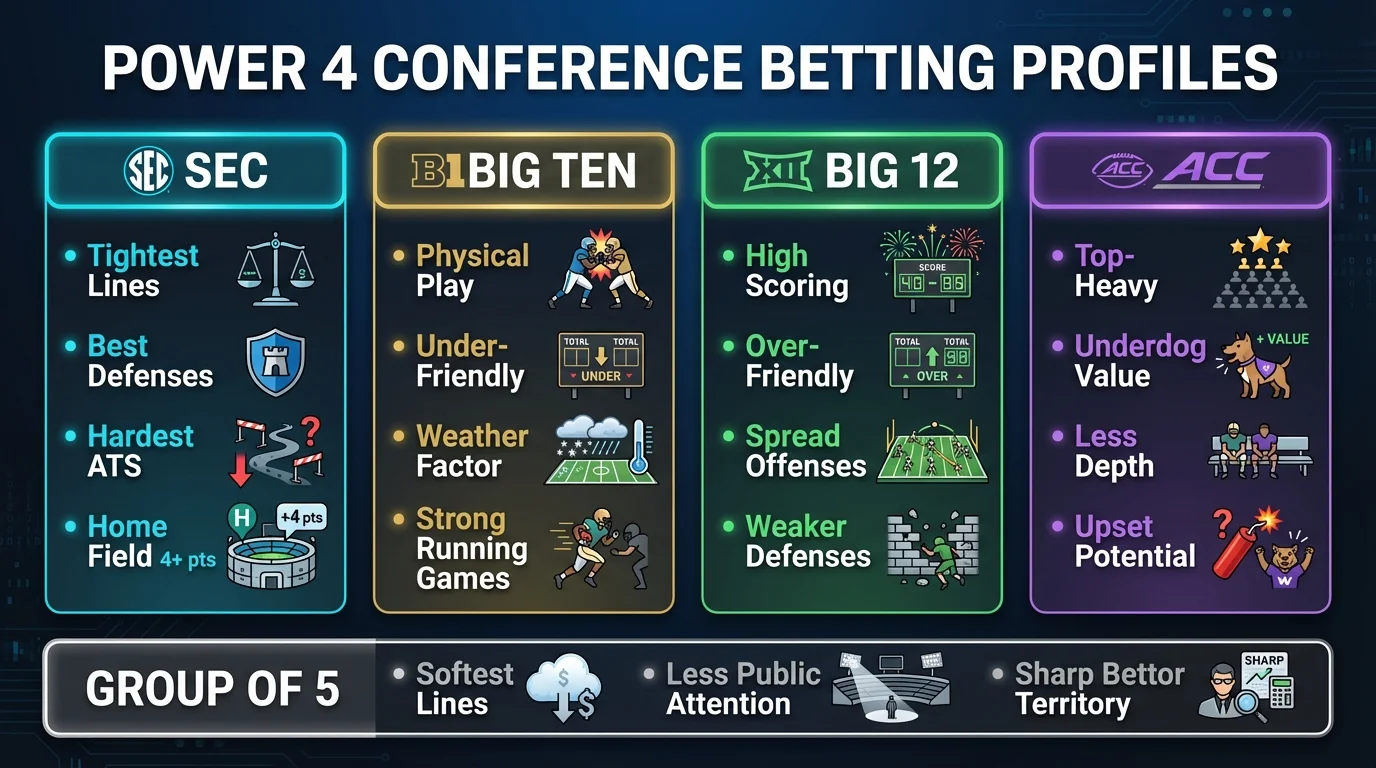
Each conference has distinct characteristics that affect betting lines and outcomes. Understanding these tendencies is one of the most reliable edges in college football betting.
SEC
The SEC is the deepest conference with the best top-to-bottom talent. This means sportsbooks price SEC games most carefully — lines are tighter and harder to beat ATS. SEC home field advantage is among the strongest in college football (think Death Valley, The Swamp, Neyland Stadium). Defensive strength makes unders historically profitable in SEC cross-divisional games where teams are unfamiliar with each other.
Big Ten
The Big Ten is defined by physical, run-heavy football — particularly in November when cold weather hits stadiums in Wisconsin, Minnesota, Michigan, and Penn State. This physical identity pushes games toward unders, especially late in the season. Big Ten road underdogs have historically been undervalued because the public overrates home favorites in this conference.
Big 12
The Big 12 is historically the most over-friendly conference thanks to spread offenses and weaker defensive traditions. Games regularly push into the 50s and 60s. However, the public knows this, which means overs are often overpriced. The sharper play in Big 12 games is often the under when two defensively improved teams meet and the total is inflated by conference reputation.
ACC
The ACC is top-heavy — a few elite programs (historically Clemson, Florida State, Miami) with significant drop-offs below them. This creates underdog value: when a mid-tier ACC team hosts a ranked opponent, the spread is often inflated by the name recognition gap. ACC road favorites covering at rates lower than expected is a consistent trend.
Group of 5 (AAC, Mountain West, Sun Belt, MAC, C-USA)
THE SHARP BETTOR’S SECRET: GROUP OF 5 CONFERENCES
Group of 5 games are where sharp bettors find their biggest edges. Sportsbooks devote fewer resources to pricing these games, casual bettors barely follow them, and information asymmetry is highest. If you’re willing to watch Mountain West and Sun Belt film, you’ll find more consistently exploitable lines than in any Power 4 conference. The tradeoff: betting limits are lower, and lines move faster when sharps attack them.
College Football Betting Strategy
Research Beyond the Box Score
Traditional stats are less useful in college football than any other major sport because of roster turnover. A team that went 11-1 last year might have lost its quarterback, three offensive linemen, and top two receivers to the NFL Draft — plus two defensive starters to the transfer portal.
The metrics that matter most for CFB betting:
| Metric | Why It Matters | Where to Find |
|---|---|---|
| Returning production % | Teams returning 70%+ of production outperform preseason expectations | ESPN, 247Sports |
| Transfer portal additions | Impact transfers can transform a program overnight | On3, 247Sports portal tracker |
| SP+ / FPI ratings | Advanced power ratings account for strength of schedule and efficiency | ESPN (FPI), Bill Connelly (SP+) |
| Recruiting rankings | Talent correlates with winning — top recruiting classes produce more NFL-caliber players | 247Sports composite |
| Coaching changes | New coaches in Year 1 often underperform; Year 2+ with their recruits improves results | Team news, 247Sports |
Early-Season Angles
The first 3-4 weeks of the college football season offer the softest lines of the year. Sportsbooks are working with preseason projections and limited game data, while bettors who’ve done offseason research already know which teams improved or declined.
Week 1 non-conference games are prime targets — particularly FCS vs. FBS matchups where the public overvalues the bigger school. A strong FCS program visiting a weak FBS team might get a spread of +20 when the true line should be +14.
Conference Play vs Non-Conference
Conference games and non-conference games are fundamentally different betting propositions. In conference play, teams have more film on each other, familiarity breeds competitive games, and home field advantage intensifies. Non-conference games, especially early-season “cupcake” matchups, have less predictable margins because the talent gap is uncertain until teams actually play.
The sharpest angle: bet conference road underdogs getting more than a touchdown. Teams that know each other well tend to play closer games than the spread implies, and motivated road underdogs in rivalry or revenge spots cover at elevated rates.
Rivalry Games and Motivation Spots
College football is driven by emotion more than any professional sport. Rivalry games, homecoming, senior nights, and revenge matchups all produce statistically significant ATS deviations.
Look-ahead spots: A ranked team plays an unranked opponent with a huge rivalry game the following week. The public hammers the ranked team, but the players are mentally focused on next week. These look-ahead games are prime underdog spots.
Let-down spots: A team coming off a massive emotional win (beating a top-10 rival, for example) often plays flat the following week. Fade the public’s recency bias in these situations.
Bowl Game Betting
Bowl season is a unique animal. The month-long gap between regular season and bowl games changes everything:
PLAYER OPT-OUTS
NFL Draft prospects skip bowl games to avoid injury. Check for opt-outs — losing a star QB or top receiver can shift a spread by 3-7 points.
MOTIVATION MISMATCH
A 6-6 team happy to be in any bowl vs. an 8-4 team that feels “they should be in a better bowl” creates unequal motivation. The hungry team often covers.
COACHING CHANGES
A team whose coach left for another job often plays with less preparation and motivation. Interim coaches in bowl games are a red flag for the favorite.
Weather and Travel
Weather impacts CFB more than NFL because of the schedule and venue distribution. Late-season games in the upper Midwest (Wisconsin, Michigan State, Minnesota, Iowa) regularly face sub-freezing temperatures, wind, and even snow. These conditions suppress scoring, hurt passing games, and favor physical rushing attacks.
Travel matters too. A West Coast team playing a noon Eastern kickoff has effectively woken up at 4 AM body-clock time. Cross-country travel in college football — particularly early kickoffs — has measurable performance impacts. Look for West Coast teams traveling east for noon games as fade candidates.
Line Shopping
College football lines vary more across sportsbooks than NFL lines do. While an NFL game might be -3 everywhere, a CFB game could be -14.5 at one book and -16 at another. That 1.5-point difference matters significantly at key numbers.
Always compare lines across multiple sportsbooks before placing a CFB bet. The expected value difference between getting +15 versus +13.5 on a college football underdog is substantial over a season of betting.
Bankroll Management
With 50+ games on a single Saturday, the temptation to overbet is real. Use a bankroll calculator to set proper unit sizes before the season starts. The Kelly Criterion can help optimize bet sizing based on your perceived edge in each game.
A practical approach: 1-2% of bankroll per regular game, 2-3% on high-conviction plays where your research strongly contradicts the market, and never exceed 5% on any single bet — even in rivalry games where you’re “sure” about the outcome.
College Football Playoff Betting
The 12-team College Football Playoff has transformed the futures landscape. With automatic bids for the top conference champions and at-large selections, more teams have viable paths to the playoff than ever before.
How the 12-Team CFP Works
The top 4 seeds (highest-ranked conference champions) receive first-round byes. Seeds 5-12 play in the first round, hosted at the higher seed’s campus. Quarterfinals and semifinals are played at traditional bowl sites (Rose Bowl, Sugar Bowl, Fiesta Bowl, Peach Bowl, Cotton Bowl, Orange Bowl), and the national championship is at a predetermined neutral site.
CFP Futures Value Windows
PRESEASON (BEST VALUE)
Odds reflect public perception and brand names. Teams with new transfers, coaching upgrades, or favorable schedules are often undervalued. This is the widest value window.
EARLY SEASON (WEEKS 1-4)
Overreactions to early results create opportunities. A team that barely beats a bad opponent sees their odds tank — but one game doesn’t define a season.
MID-SEASON (WEEKS 5-8)
Lines stabilize but one-loss teams get discounted too heavily. A one-loss team that lost a close road game in a tough conference can still make the 12-team field.
Hedging Your CFP Futures
If you bet a team at +3000 preseason and they make the playoff, your futures bet has significant value. You can use a hedging calculator to determine how much to bet on their opponent in each round to guarantee profit regardless of outcome. The deeper your team goes, the more valuable your hedge becomes — but you’re also giving up potential upside with each hedge bet.
The optimal strategy: partial hedges as the team advances through each round, locking in progressively larger guaranteed profits while maintaining some exposure to the full payout. Build a parlay or combine with our expected value calculator to determine whether hedging or riding is +EV at each stage.
Common Mistakes in College Football Betting
MISTAKE 1: BETTING HEAVY FAVORITES ON THE MONEYLINE
Alabama at -4000 means you risk $4,000 to win $100. One upset — and upsets happen every single week in college football — wipes out 40 wins worth of profit. The juice on massive CFB favorites makes moneyline bets mathematically terrible. Stick to spreads, or use teasers if you want to back favorites with more margin.
MISTAKE 2: IGNORING ROSTER TURNOVER
Last year’s 10-2 record means nothing if the team lost 8 starters to the draft and 3 more to the transfer portal. Preseason rankings and public perception lag behind reality. Always check returning production percentages and incoming transfer quality before assuming a team is “good” based on last season.
MISTAKE 3: OVERVALUING PRESEASON RANKINGS
Preseason AP and Coaches polls are popularity contests, not accurate power ratings. Teams ranked in the preseason top 10 receive outsized public betting action, inflating their spreads. Historically, fading preseason top-10 teams against the spread in the first month of the season has been profitable because the market overvalues the ranking.
MISTAKE 4: CHASING GARBAGE-TIME COVERS
A team trailing 42-14 scores two meaningless touchdowns against backups to make the final 42-28 — “covering” the -21.5 spread. This distorts ATS records and creates false narratives. When analyzing ATS records, check whether covers came in meaningful game time or garbage time. A team’s ATS record against the closing spread with first-string lineups is far more predictive.
Building Your Saturday Card
A typical college football Saturday offers 50+ games. Trying to bet them all is a recipe for disaster. Disciplined bettors limit their card to 3-5 games where they have genuine edges, rather than scattering action across every kickoff.
Build your card by conference and time slot. Research your targeted conferences during the week, identify 1-2 plays per time slot, and use a parlay calculator if you want to combine confident picks. But remember: parlays compound the sportsbook’s edge across every leg, so single bets are almost always better expected value than multi-leg parlays.
KEY TAKEAWAYS
- CFB is the sharp bettor’s sport — 130+ teams and soft lines create more exploitable edges than the NFL
- Spreads are massive — key numbers shift to 7, 10, 14, 17, 21 instead of the NFL’s 3 and 7
- Home field matters more — 3-4 points in college vs ~2 in the NFL, especially in hostile SEC and Big Ten venues
- Roster turnover is the biggest variable — check returning production, transfer portal adds, and draft departures before every bet
- Conference tendencies are predictable — SEC unders, Big 12 overs, Big Ten road underdogs are consistent angles
- Early season has the softest lines — preseason projections create the widest value windows of the year
- Bowl games are a unique market — opt-outs, motivation mismatches, and coaching changes create edges
- 12-team CFP expands futures value — more paths to the playoff means more undervalued teams in futures markets
- Never bet massive moneyline favorites — the juice on -3000+ favorites destroys long-term profitability
- Limit your Saturday card — 3-5 well-researched plays beat 15 random bets every time
FAQs
In some ways, no — college football has more inefficient lines because sportsbooks can’t model 130+ teams as accurately as 32 NFL teams. This creates more edges for bettors who research deeply. However, CFB has higher variance (larger spreads, more blowouts, garbage time) and roster turnover makes historical data less reliable. The opportunity is greater, but so is the noise.
The most important numbers in college football are 7, 10, 14, 17, and 21 — all multiples or combinations of touchdowns (7 points). Unlike the NFL where 3 (field goal) is the most critical number, college football scoring margins tend to be larger with touchdowns dominating. Getting a half-point through these key numbers significantly affects your win rate over a full season.
The transfer portal has fundamentally changed roster analysis. Teams can gain or lose multiple impact players in a single offseason, making last year’s performance a poor predictor of this year’s results. Before betting, always check a team’s transfer portal activity — incoming five-star transfers can elevate a program immediately, while losing key starters to the portal can cause unexpected regression.
Preseason offers the best futures value because odds are based on public perception and last year’s results rather than current roster quality. Teams with significant roster improvements through the transfer portal or favorable schedule changes are often undervalued. Early-season overreactions (weeks 1-4) also create buying opportunities when one-loss teams see their odds crater.
Almost never. When a team is favored by 25+ points, the moneyline is typically -3000 or worse — meaning you risk $3,000 to win $100. One upset wipes out 30 wins of profit. College football upsets happen every week, and the juice on massive favorites destroys long-term profitability. Use point spreads, first-half lines, or teasers instead when backing heavy favorites.
Home field advantage in college football is worth approximately 3-4 points — nearly double the NFL’s ~2 points. College crowds are larger, louder, and more passionate, which affects opponent communication and morale. Some venues are particularly hostile: LSU’s Tiger Stadium (Death Valley), Penn State’s Beaver Stadium, and Texas A&M’s Kyle Field create measurable performance gaps between home and visiting teams.
Bowl game betting requires checking three things: player opt-outs (star players skipping the game for NFL Draft preparation), coaching changes (teams with interim coaches often underprepare), and motivation mismatches (a 6-6 team thrilled to be bowling vs. an 8-4 team that feels slighted). The month-long gap between regular season and bowls also resets momentum, making regular-season form less predictive.
You can bet on the CFP through futures (which team wins the national championship, which teams make the playoff), individual game spreads and totals for each playoff round, and props for playoff games. The 12-team format with first-round byes for the top 4 seeds and campus-site first-round games creates unique betting dynamics. Futures are best bought preseason or after early-season overreactions.
