How the world’s fourth-most populous nation is waging total war against online gambling—blocking millions of sites, freezing billions in assets, arresting its own government officials, and driving a 68% drop in active gamblers.

The Scale of the Crisis
Indonesia is facing what officials have called a “national emergency.” As of February 2026, the government reports that Indonesians have lost a total of $68.7 billion (IDR 1,100 trillion) to online gambling—a figure that has sent shockwaves through the government and prompted one of the most aggressive anti-gambling campaigns the world has ever seen.
President Prabowo Subianto, speaking at the 2025 APEC Summit in South Korea, put it bluntly: “Indonesia loses around $8 billion every year solely due to outflows from online gambling.” He described the phenomenon as a threat not just to the economy, but to the nation’s “social and moral stability.”
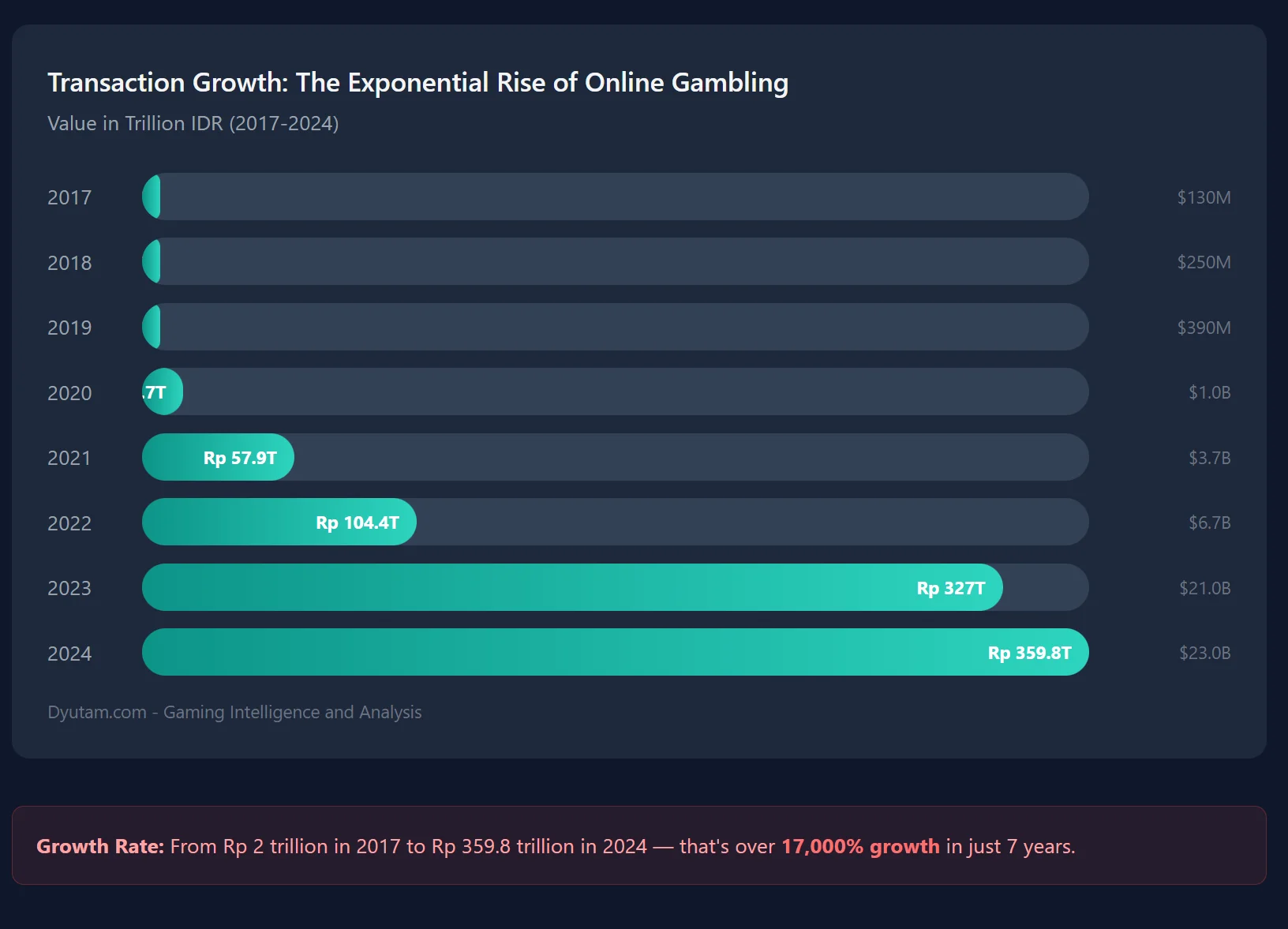
The numbers tell a story of explosive, almost viral growth. In 2017, Indonesia’s Financial Transaction Reports and Analysis Center (PPATK) detected just 250,700 gambling transactions worth Rp 2 trillion. By 2024, that had exploded to 209.57 million transactions worth Rp 359.81 trillion—a growth rate of over 17,000% in just seven years.
16 Million Players: Who’s Gambling?
The PPATK estimates that by 2024, approximately 16.38 million Indonesians were involved in online gambling—roughly 6% of the country’s total population. But the demographics reveal a troubling pattern: this isn’t a problem of the wealthy seeking thrills. It’s overwhelmingly a crisis hitting the nation’s poorest citizens.
The Poor Man’s Vice
- 71% of gamblers earn less than Rp 5 million ($315) per month
- 80% of players come from the lower-middle economic class
- Transaction amounts range from as little as Rp 10,000 ($0.60) to Rp 100,000 for lower-income gamblers
This “micro-transaction” model has been deliberately designed by operators. By accepting bets as small as pocket change—what Indonesians call “recehan” (small change)—gambling platforms have made betting accessible to virtually anyone with a smartphone, including children and the extreme poor.
Age Demographics: From Toddlers to Retirees
80,000 children under the age of 10 have been detected gambling online. The head of PPATK, Ivan Yustiavandana, noted grimly: “The age of online gambling players reaches as low as under 10 years old. The demographic population of players is expanding.”
| Age Group | Percentage | Estimated Players |
|---|---|---|
| Under 10 years | 2.02% | ~80,000 |
| 10-20 years | 10.97% | ~440,000 |
| 21-30 years | 12.82% | ~520,000 |
| 30-50 years | 40.18% | ~1.64 million |
| Over 50 years | 33.98% | ~1.35 million |
Throughout 2024, nearly 200,000 children aged 11-19 made gambling deposits totaling Rp 293 billion across 2.2 million transactions. The majority (191,380) were aged 17-19, but over 1,160 children under 11 were also identified.
80,000 children under 10 and 440,000 teenagers have been detected gambling online. Throughout 2024, nearly 200,000 minors aged 11-19 made gambling deposits totaling Rp 293 billion across 2.2 million transactions.
Underage Gambling by Age Group (2024)
| Age Group | Players | Transactions | Value |
|---|---|---|---|
| Under 11 | 1,160 | 22,000 | Rp 3 billion |
| 11-16 years | 4,514 | 45,000 | Rp 7.9 billion |
| 17-19 years | 191,380 | 2.1 million | Rp 282 billion |
Cities with the Highest Underage Gamblers (2017-2023)
| Rank | City/Regency | Underage Gamblers |
|---|---|---|
| 1 | East Jakarta | 4,563 |
| 2 | Bogor Regency | 4,432 |
| 3 | West Jakarta | 4,377 |
| 4 | South Jakarta | 3,971 |
| 5 | Bandung City | 3,478 |
| 6 | Bekasi City | 3,273 |
| 7 | Bekasi Regency | 2,939 |
| 8 | Tangerang Regency | 2,838 |
| 9 | Tangerang City | 2,758 |
| 10 | Depok City | 2,670 |
The Human Cost: Divorces, Murders, and Suicides
The statistics only hint at the human devastation. Online gambling has torn through Indonesian families with unprecedented force, leaving a trail of broken marriages, violent crimes, and tragic deaths.
Divorce Rates Skyrocket
Gambling-related divorces in Indonesia increased by 83.77% in a single year, jumping from 1,572 cases in 2023 to 2,889 cases in 2024. Since 2019, gambling has consistently ranked among the top reasons for divorce in Islamic courts across the country.
| Year | Divorce Cases | Change |
|---|---|---|
| 2019 | 1,947 | — |
| 2020 | 648 | -66.7% |
| 2021 | ~900 | +38.9% |
| 2022 | ~1,200 | +33.3% |
| 2023 | 1,572 | +31.0% |
| 2024 | 2,889 | +83.77% |
Provinces with Highest Gambling-Related Divorces (2024)
| Province | Cases |
|---|---|
| East Java | 819 |
| West Java | 472 |
| Central Java | 281 |
| Banten | 166 |
| Lampung | 131 |
Crimes That Shocked the Nation
The gambling epidemic has spawned a wave of violent crimes that have dominated Indonesian headlines:
- The Burning Husband Case (Mojokerto, East Java): A policewoman set her husband on fire after discovering he had spent their “13th salary” bonus entirely on online gambling.
- The Matricide in Central Sulawesi: A 48-year-old man robbed and murdered his own mother to fund his gambling habit.
- Military Officer Suicide (Papua): A military officer took his own life after accumulating gambling debts of Rp 819.3 million ($50,000+).
- Journalist Murder (Pangkalpinang): A local journalist was killed in a crime motivated by gambling debts and financial desperation.
- Multiple Family Murders: Reports of nephews killing aunts, children killing parents, all connected to gambling addiction and debt.
Anwar Abbas, Chairman of Muhammadiyah (one of Indonesia’s largest religious organizations), summarized the crisis: “The adverse effects include murder, theft, robbery, divorce, domestic violence, poverty, and others.”
The Addiction Spiral
PPATK data reveals how deeply addiction has taken hold. In 2017, the average gambler spent about 10% of their income on betting. By 2024, that figure had risen to 70-80% of income—meaning addicts are gambling away nearly everything they earn.
“Instead of large amounts being transferred into one account, transactions are now being broken into smaller amounts across many accounts, which has made the flow of money much more massive,” explained PPATK head Ivan Yustiavandana.
Gambling With Government Aid: The Welfare Scandal
Perhaps no statistic better illustrates the depth of Indonesia’s gambling crisis than this: over 600,000 recipients of government social assistance have been identified as online gamblers.
In a nation where the poverty rate hovers around 9% and millions depend on welfare programs like PKH (Family Hope Program) and food assistance, the discovery that hundreds of thousands were using aid money to gamble sparked public outrage and a swift government response.
The Numbers
- 603,999 families flagged for suspected gambling activity
- 571,410 welfare recipients made 7.5 million gambling transactions totaling Rp 957 billion in 2024 (from a single bank’s data alone)
- 132,557 aid recipients linked to gambling transactions worth Rp 542.5 billion in just the first half of 2025
- 300,000+ beneficiaries have had their social assistance suspended
Regional Breakdown of Gambling-Linked Aid Recipients
| Region | Recipients | Transaction Value |
|---|---|---|
| West Java | 49,431 | Rp 199 billion |
| Central Java | 18,363 | Rp 83 billion |
| East Java | 9,771 | Rp 53 billion |
| Jakarta | 7,717 | Rp 36 billion |
| Bogor Regency | 5,497 | Rp 22 billion |
| Nationwide Total (H1 2025) | 132,557 | Rp 542.5 billion |
Minister of Social Affairs Saifullah Yusuf confirmed the harsh new policy: “More than 300,000 beneficiaries can no longer receive assistance. If it is proven they were engaged in online gambling, their benefits will be terminated immediately.”
The government has since reinstated aid for 7,200 former gamblers who demonstrated genuine need, calling it a “final opportunity.” But for the rest, the message is clear: gamble, and you lose your lifeline.
The Crackdown: Indonesia’s Total War on Gambling
Indonesia’s response to the gambling epidemic has been nothing short of a full-scale war. Under both former President Joko Widodo and current President Prabowo Subianto, the government has mobilized every available resource—police, military, financial regulators, tech ministries, and even religious leaders—in what officials call a mission to “eradicate” online gambling.
Key Milestones
- June 2024: President Jokowi signs Presidential Decree No. 21/2024, establishing the Online Gambling Eradication Task Force (Satgas Pemberantasan Judi Online)
- Mid-2024: Government blocks Network Access Points (NAP) to Cambodia and Davao, Philippines—known hubs for offshore gambling operations targeting Indonesians
- October 2024: President Prabowo takes office and immediately declares gambling eradication among his top three priorities (alongside drugs and smuggling)
- November 2024: Ministry staff investigated; 11 employees suspended for allegedly protecting gambling sites
- 2025: Crackdown intensifies with AI-powered detection, e-wallet freezes, and welfare sanctions
Sites Blocked: The Digital Cleanup
The scale of content removal is staggering:
| Period | Sites/Content Blocked |
|---|---|
| 2017-2023 (cumulative) | ~2.5 million |
| July – December 2023 | 805,923 |
| Full Year 2024 | ~3.5 million |
| October 2024 – November 2025 | 2.4 million+ |
| Total (2017-2025) | 7.2 million+ |
The Ministry of Communication and Digital Affairs (Komdigi) has blocked content across virtually every platform:
- 1.93 million items from websites
- 97,779 from file-sharing platforms
- 94,000+ from Meta platforms (Facebook, Instagram)
- 35,000+ from Google services
- 17,400+ from X (Twitter)
- Plus thousands more from Telegram, TikTok, Line, and app stores
Following the Money: Bank Accounts and E-Wallets
The crackdown has increasingly targeted the financial infrastructure of gambling operations:
- 31,382 bank accounts flagged from September 2023 to December 2025, with over 100 additional accounts blocked in January 2026 operations alone
- 13,481 accounts frozen by PPATK for facilitating gambling
- 573 e-wallet accounts (GoPay, OVO, Dana) blocked
- Rp 280 trillion ($17.77 billion) frozen in Q3 2024 alone
- Rp 154.3 billion seized in a single August 2025 police operation
The government has even imposed a daily cap on online credit transfers of approximately Rp 1 million ($62) to make it harder for gamblers to move large sums.
Arrests and Asset Seizures
The police have been relentless:
| Period | Cases | Suspects | Assets Seized |
|---|---|---|---|
| 2020-2024 | 6,386 | 9,096 | Rp 861.8 billion |
| November 2024 (single operation) | 619 | 734 | Rp 77 billion+ |
| May-August 2025 | 235 | 259 | Ongoing |
High-profile arrests have included:
- TikTok influencer Gunawan “Sadbor”: Named as a suspect for promoting gambling to his large rural audience
- Vienna Varella (19): Instagram influencer sentenced to 18 months for gambling promotion
- Multiple female influencers in Bali and Java prosecuted for posting gambling links
- Chinese national arrested managing overseas gambling servers serving 85,000 Indonesian users
- TAHU69 operators arrested in Tangerang after police tracked their coordinates
The Cloudflare Controversy: Taking the Fight to Silicon Valley
In November 2025, Indonesia made international headlines by directly confronting Cloudflare, the U.S.-based internet infrastructure giant. The Ministry of Communication and Digital Affairs revealed that over 76% of gambling sites they sampled were using Cloudflare’s services to mask their true server locations.
Director-General Alexander Sabar announced that Cloudflare had been summoned and given a 14-working-day deadline to:
- Register as a Private Electronic System Provider (PSE) in Indonesia
- Ensure its services aren’t used for unlawful activity
- Cooperate with blocking requests
The threat was explicit: comply or face a nationwide ban. “If Cloudflare does not register and cooperate, its services could be blocked for non-compliance,” officials stated.
This move signals Indonesia’s willingness to target not just gambling operators, but the entire technical infrastructure that enables them—even if it means confronting major Silicon Valley companies.
2026 Developments: The Crackdown Intensifies
As Indonesia enters 2026, the crackdown has expanded in scope and severity — targeting not just gambling operators and users, but the government’s own ranks.
International Network Busts (January 2026)
In early January 2026, Indonesia’s National Police Criminal Investigation Department (Bareskrim) dismantled an international online gambling network operating across multiple regions. Raids in Jakarta, Tangerang, Pamekasan (Madura), and Cianjur (West Java) led to the arrest of site operators, financial administrators, account renters, and money laundering facilitators connected to T6.com, WE88, PWC (Play With Confidence), and 1xBet network sites.
The networks maintained connections across Asia and Europe. Suspects face charges under Article 303 of Indonesia’s Criminal Code, the Information and Electronic Transactions Law, and anti-money laundering legislation — carrying potential sentences of up to 20 years in prison and fines of up to IDR 10 billion (~$650,000).
The Rot Within: Ministry Corruption Scandal
In one of the most damaging revelations, 11 employees of the Ministry of Communication and Digital Affairs were suspended following arrests for allegedly abusing their authority to shield online gambling websites from government blocks. The key suspect, Adhi Kismanto, an IT specialist within the ministry, allegedly helped gambling syndicates bypass the very blocking systems he was supposed to maintain. Ministry officials were found working as intermediaries between gambling networks and corrupt civil servants — meaning the people tasked with shutting down gambling sites were actively protecting them.
Civil Servant Phone Checks (February 2026)
The crackdown reached into government offices in February 2026 when the Medan City Government began conducting unannounced mobile phone checks of government employees using “special tools” to detect gambling apps. In North Sumatra alone, authorities discovered over 1,000 government employees involved in online gambling, tracing IDR 2.18 billion (~$126,000) in gambling transactions by civil servants.
Participant Collapse: 68% Drop in Active Gamblers
The most significant metric of 2025-2026: the number of active online gamblers in Indonesia dropped from approximately 9.7 million in 2024 to ~3.1 million in 2025 — a 68% reduction. Q1 2025 alone saw only about 1.07 million participants. Full-year 2025 transactions totaled IDR 286.84 trillion (~$9.3 billion), down from IDR 359.81 trillion in 2024.
2026 Criminal Code: Closing the Legal Loophole
Indonesia’s updated Criminal Code, taking effect in January 2026, removes the “public place” requirement from gambling laws. Previously, some operators argued that online gambling conducted privately didn’t meet the legal definition. Under the new code, private online gambling carries the same penalties as public gambling — closing a loophole that defense attorneys had exploited.
Additional 2026 Enforcement Measures
- VPN regulations in development: Indonesia is preparing dedicated regulations targeting VPN services used to circumvent gambling site blocks — the primary workaround for blocked users
- Military task force: The TNI (Indonesian Military) formed its own task force targeting online gambling, drugs, smuggling, and corruption within military ranks — extending the crackdown beyond civilian law enforcement
- President Prabowo’s directive: PPATK officials publicly praised President Prabowo’s “strictness in reducing online gambling” in January 2026, confirming the crackdown will intensify further
- Influencer sentencing: Beyond Vienna Varella’s 18-month sentence, a second influencer — Nia, 21, from Buleleng Regency — received 10 months in prison and an IDR 6 million ($362) fine for promoting gambling links (August 2025 conviction)
- Content removal scale-up: Over 2.8 million gambling-related content pieces were removed between October 2024 and September 2025, plus 43,000+ gambling advertisements blocked in early 2025
Is the Crackdown Working?
The data increasingly suggests the aggressive measures are having a substantial effect:
Transaction Decline (2024 vs 2025)
Quarterly Transaction Decline (2024)
| Quarter | Transaction Value | Change |
|---|---|---|
| Q1 2024 | Rp 21 trillion | — |
| Q2 2024 | Rp 16 trillion | -23.8% |
| Q3 2024 | Rp 4 trillion | -75.0% |
Challenges Remain
Despite the progress, officials acknowledge the battle is far from won:
- New sites emerge constantly: “We have blocked millions of pieces of content, but new ones appear just as fast. This is a global challenge that requires collective action,” said Komdigi’s Director of Digital Space Regulation.
- Cross-border operations: Most gambling operators are based in Cambodia and the Philippines, beyond Indonesian jurisdiction.
- VPN workarounds: While the government has banned certain free VPNs and is now preparing dedicated VPN regulations, tech-savvy users continue finding ways around blocks.
- Identity theft concerns: Some welfare recipients may have had their identities stolen by gambling syndicates, raising questions about the fairness of aid suspensions.
Key Statistics Summary
| Metric | Figure |
|---|---|
| Total gambling losses (cumulative) | IDR 1,100 trillion ($68.7 billion) |
| Annual economic loss | $8 billion |
| Active gamblers (2025) | ~3.1 million (down 68% from 9.7M in 2024) |
| Children under 10 gambling | 80,000 |
| Gambling-related divorces (2024) | 2,889 (+83.77%) |
| Welfare recipients caught gambling | 600,000+ |
| Sites blocked (total) | 7.2 million+ |
| Bank accounts flagged (Sep 2023–Dec 2025) | 31,382 |
| Suspects arrested (2020-2024) | 9,096 |
| Assets seized (2020-2024) | Rp 861.8 billion |
The Road Ahead
Indonesia has made its position clear: it will pursue online gambling with every tool at its disposal, for as long as it takes.
At the APEC Summit, President Prabowo called for stronger international cooperation, describing online gambling as a cross-border organized crime that requires collective action. The government is:
- Expanding AI capabilities to detect gambling-related transactions and content
- Strengthening partnerships with Meta, Google, TikTok, and other platforms
- Pursuing diplomatic channels to pressure countries hosting gambling operations
- Launching education campaigns targeting rural areas and youth
- Mobilizing religious leaders to preach against gambling
“Blocking and law enforcement must be accompanied by education,” emphasized one lawmaker. “The government needs to continuously remind the public of the dangers of online gambling, especially the younger generation, who are the main targets of digital promotions.”
Conclusion
Indonesia’s war on online gambling represents one of the most comprehensive anti-gambling campaigns in modern history. The numbers are staggering: $68.7 billion in cumulative losses, millions of players (though dropping sharply), 7 million+ blocked sites, 31,000+ flagged bank accounts, and hundreds of billions seized. The 68% drop in active gamblers between 2024 and 2025 suggests the crackdown is having measurable impact — but the discovery of ministry officials protecting gambling sites reveals how deeply entrenched the problem remains.
But behind every statistic lies a human story—families torn apart, children exposed to addiction before they can read, welfare recipients gambling away their survival money, and violent crimes born of desperation and debt.
What the data reveals is a troubling pattern: with 71% of gamblers earning less than $315 per month and 80% coming from lower-middle economic backgrounds, this appears to be a classic case of vulnerable populations turning to gambling as a perceived escape from poverty—only to find themselves in deeper financial ruin. The promise of quick winnings became a trap, and what was meant to be a path out of hardship instead accelerated the descent into it. This is irresponsible gambling at a societal scale.
Whether Indonesia can truly “eradicate” online gambling remains to be seen. The operators are adaptive, the technology evolves constantly, and the demand—fueled by economic hardship, accessibility, and the illusion of easy money—shows no signs of disappearing.
What’s certain is that Indonesia has drawn a line. From the poorest welfare recipient to Silicon Valley tech giants, the message is the same: in Indonesia, the house will not win.
Last updated: 5th, February 2026
Sources & References
- PPATK (Financial Transaction Reports and Analysis Center): ppatk.go.id
- Indonesian Ministry of Communication and Digital Affairs (Komdigi): komdigi.go.id
- Indonesian National Police: polri.go.id
- Financial Services Authority (OJK): ojk.go.id
- Indonesian Central Statistics Agency (BPS): bps.go.id
- ANTARA News: en.antaranews.com
- Tempo English: en.tempo.co
- Jakarta Globe: jakartaglobe.id
- Databoks Katadata: databoks.katadata.co.id
