A new federal RICO lawsuit alleges Drake funneled his $100 million annual Stake promotional earnings through the platform’s tipping feature to fund a massive bot network that artificially inflated his Spotify streams by 37 billion plays. If proven, it would represent one of the largest streaming fraud schemes in music history—and expose a previously unknown connection between crypto casino money and music industry manipulation.

KEY FACTS AT A GLANCE
- Filed: December 31, 2025 (Virginia federal court)
- Defendants: Drake, Adin Ross, George Nguyen, Stake/Sweepsteaks Ltd.
- Charge: RICO (Racketeer Influenced and Corrupt Organizations Act)
- Alleged Fake Streams: 37 billion (January 2022 – September 2025)
- Drake’s Stake Deal: $100 million per year (per Financial Times)
- Plaintiffs Seeking: At least $5 million + refunds + disgorgement of profits
- Stake’s Response: Called it “a nonsense claim”
The Allegation: From Casino Tips to Fake Streams
The lawsuit, filed by law firm Impresa Legal Group on behalf of Stake users LaShawnna Ridley and Tiffany Hines, outlines an alleged scheme connecting Drake’s gambling promotion income directly to music streaming fraud. The mechanism? Stake’s internal “Tipping” feature.
According to the complaint, Drake, alongside streamer Adin Ross and a third individual named George Nguyen, used Stake’s tipping system to transfer cryptocurrency to bot operators. Nguyen, identified as the owner of an Instagram news-clipping account, allegedly served as the operational hub—receiving crypto through Stake, interfacing with bot vendors, and coordinating amplification strategies across platforms.
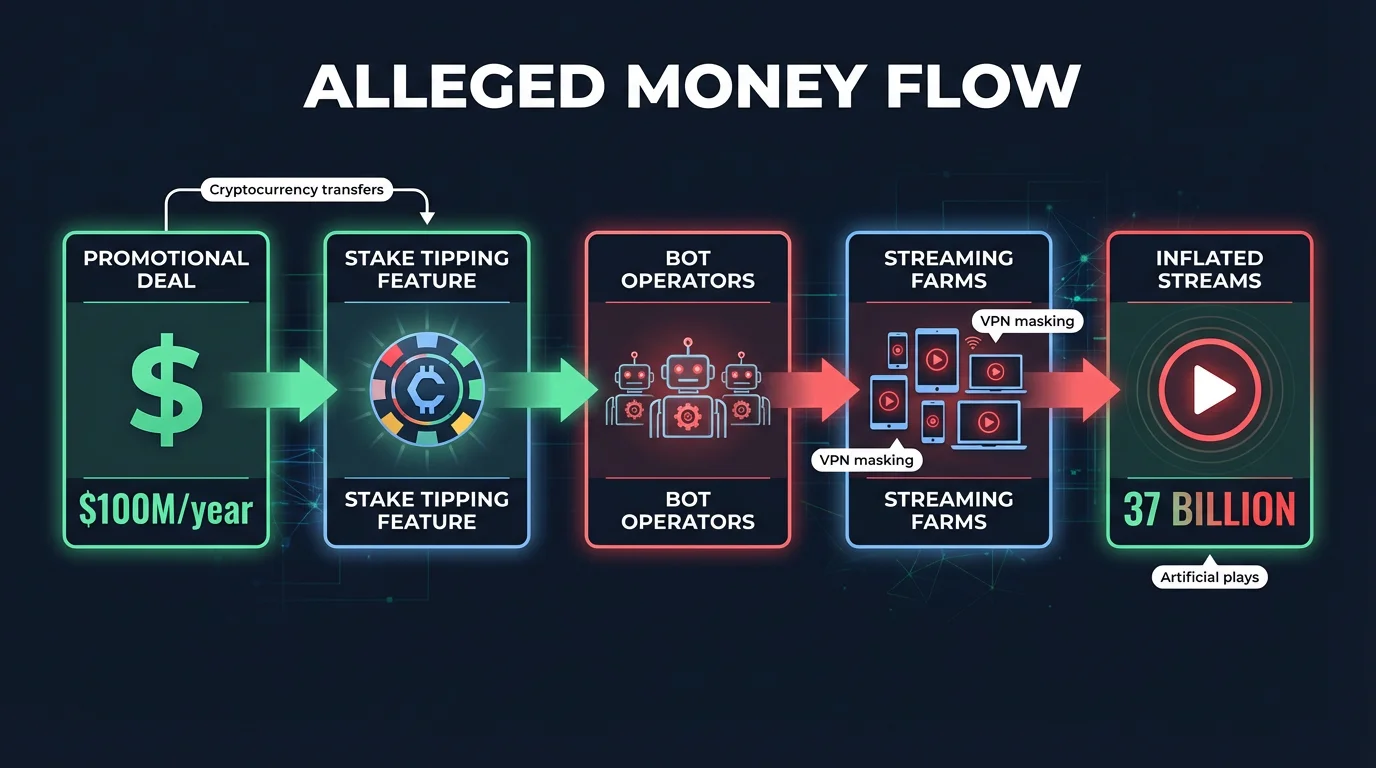
The plaintiffs are invoking RICO—the Racketeer Influenced and Corrupt Organizations Act—a federal statute typically reserved for prosecuting organized crime. It’s a significant legal escalation that, if successful, could expose defendants to treble damages and establish precedent for treating coordinated streaming fraud as racketeering.
The Evidence: 37 Billion Suspicious Streams
The lawsuit cites analysis suggesting approximately 37 billion streams attributed to Drake between January 2022 and September 2025 “were inauthentic and appeared to be the work of a sprawling network of bot accounts.” If accurate, this would represent roughly 8% of Spotify’s estimated total annual fake streams applied to a single artist.
EVIDENCE CITED IN THE LAWSUIT
VPN Manipulation
- Over 250,000 streams of “No Face” in a 4-day period originated in Turkey
- Streams were “falsely geomapped through VPNs to the United Kingdom”
- “Abnormal VPN usage” detected across Drake’s catalog
Listener Concentration
- Less than 2% of listeners accounted for ~15% of total plays
- Highly unusual ratio compared to other popular artists
- Pattern consistent with bot account behavior
The VPN evidence is particularly damning if verified. Legitimate listeners don’t typically mask their geographic location, but bot farms routinely use VPNs to distribute fake streams across multiple regions—a tactic designed to evade Spotify’s fraud detection algorithms.
How Streaming Fraud Actually Works
To understand the allegations, it helps to understand how streaming fraud operates at scale. Spotify estimates over 8% of all streams in 2025 came from artificial accounts or bots. The music industry loses an estimated $300+ million annually to fake streams—and that figure is likely conservative.
| Bot Behavior | Real Listener Behavior | Detection Flag |
|---|---|---|
| Just press play, no interaction | Save tracks, add to playlists, follow artist | High streams, zero engagement |
| Play on mute | Adjust volume, skip tracks | Silent playback detected |
| Sudden spike, then drop | Gradual organic growth | Unnatural traffic pattern |
| Geographic concentration via VPN | Distributed global audience | Suspicious IP patterns |
Sophisticated fraudsters now use AI to manage bot networks, spoofing digital identities, rotating through proxies, and mimicking human listening patterns. Spotify removed over 100,000 songs in 2023 alone for artificial streaming violations—but catching well-funded operations remains challenging.
The Stake Connection: Tipping as Money Transfer
The lawsuit’s most novel claim is that Stake’s tipping feature served as a money laundering mechanism. Tipping on crypto gambling platforms typically allows users to send cryptocurrency to other users—ostensibly for entertainment or social purposes.
“Drake, Ross, and Nguyen have been zealous promoters of Stake, with Drake having been paid, by his own admission, $100,000,000 per year for his promotional services.”
— Court complaint, December 2025
Stake has pushed back hard. A company representative stated that Stake.us “does not have a tipping function that could be used in this way” and called the entire lawsuit “nonsense.” The company said it is “not concerned” about the legal challenge. For a deeper look at the ongoing legal battles facing Stake.us, see our comprehensive Stake.us controversy coverage.
Why This Matters for Crypto Gambling
This lawsuit represents the most significant legal challenge to crypto casino celebrity marketing ever filed. The implications extend far beyond Drake:
INFLUENCER DEALS
If courts find promotional money was used for fraud, expect massive restructuring of how casinos pay celebrities. Compliance requirements could become prohibitive.
PLATFORM LIABILITY
The RICO angle suggests platforms could be held responsible for how users move money through their systems—even for purposes unrelated to gambling.
TIPPING FEATURES
Crypto casino tipping could face increased scrutiny. Anti-money laundering (AML) requirements may tighten significantly.
For players using platforms like Stake, BC.Game, or Shuffle, the lawsuit raises questions about platform stability and regulatory risk. Increased legal pressure typically leads to stricter compliance—which can mean slower withdrawals, enhanced KYC requirements, and reduced anonymity.
The Sweepstakes Casino Backdrop
This lawsuit doesn’t exist in isolation. Stake.us is already defending against class actions in multiple states challenging its dual-currency sweepstakes model. The platform offers “Gold Coins” (no cash value) bundled with “Stake Cash” that can allegedly be redeemed for real money—a structure critics call a legal loophole to operate as an unlicensed casino.
ONGOING LEGAL CHALLENGES
- Missouri (October 2025): Class action alleging illegal gambling promotion
- Virginia (December 2025): RICO lawsuit with streaming fraud claims
- California: Los Angeles City Attorney civil enforcement action
- Illinois: Class action challenging dual-currency model
- 52 total lawsuits pending against sweepstakes casinos industry-wide
Montana, New Jersey, and New York have already passed measures effectively prohibiting sweepstakes casinos. Several states have issued cease-and-desist letters. The American Gaming Association continues pushing for stricter enforcement against social casino models. Understanding how house edge works is important for players evaluating these platforms.
What Happens Next
The Missouri case has a trial date set for March 20, 2026. The Virginia RICO case will proceed on its own timeline. Several outcomes are possible:
POSSIBLE OUTCOMES
If Defendants Prevail
- Celebrity crypto casino deals continue unchanged
- Tipping features remain unrestricted
- Sweepstakes model gains legal validation
- Plaintiffs could face counter-claims
If Plaintiffs Prevail
- RICO precedent for streaming fraud cases
- Major restructuring of influencer deals
- Treble damages could exceed $15 million
- Industry-wide compliance overhaul
Drake’s representatives have declined to comment. Spotify stated it “in no way benefits from the industry-wide challenge of artificial streaming” and pointed to its anti-fraud measures. The platform removes tracks and penalizes users caught using bots—but proving the connection between gambling money and bot purchases would be a first.
The Bigger Picture: Celebrity Gambling Promotion
Drake isn’t the only celebrity facing scrutiny over gambling promotion. The intersection of celebrity marketing, crypto platforms, and regulatory grey zones has created an environment ripe for legal challenges. Major crypto casinos have signed deals with athletes, streamers, and musicians worth tens of millions annually.
For players, the lesson is vigilance. Platforms under legal pressure may change terms quickly, restrict features, or face operational disruptions. Always verify game results are provably fair and maintain proper bankroll management—especially on platforms navigating legal uncertainty.
KEY TAKEAWAYS
- Novel legal theory — First major lawsuit connecting crypto casino promotional money to streaming fraud
- RICO charges — Treating streaming manipulation as organized crime could set significant precedent
- 37 billion streams — If proven, one of the largest streaming fraud schemes in music history
- Platform risk — Stake.us faces multiple lawsuits; players should monitor for operational changes
- Industry impact — Outcome could reshape celebrity crypto casino marketing permanently
- Trial date — Missouri case set for March 20, 2026
Related coverage: Stake.us Controversy & Lawsuits · Drake vs Stake · Third Federal Lawsuit
