Mississippi legislators have filed a sweepstakes casino ban for the second consecutive year—and this time, it comes with teeth. Senate Bill 2104 would make operating sweepstakes casinos in Mississippi a felony punishable by up to 10 years in prison, $100,000 in fines, and complete asset forfeiture. For players using platforms like Chumba Casino or High 5 Casino, the political drama behind this bill matters as much as its penalties.
KEY FACTS AT A GLANCE
- Bill: SB2104, filed January 9, 2026
- Sponsors: Sen. Joey Fillingane (R) + Sen. David Blount (D) — bipartisan
- Penalties: Up to 10 years prison + $100,000 fine + asset forfeiture
- Effective Date: July 1, 2026 (if passed)
- Committee: Senate Judiciary, Division B (chaired by Fillingane)
- 2025 Attempt: Passed Senate 44-1, died after House added sports betting amendment
The 2025 Drama: Sports Betting Poison Pill
The real story behind Mississippi’s sweepstakes ban isn’t about sweepstakes—it’s a proxy war over sports betting legalization.
In 2025, the identical sweepstakes ban sailed through the Senate with a near-unanimous 44-1 vote. Then it hit the House, where Representative Casey Eure attached a sports betting legalization amendment. The Senate rejected the amended bill, killing both measures.
The dynamics remain unchanged for 2026. Senator David Blount—one of SB2104’s sponsors—chairs the Senate Gaming Committee and has previously killed sports betting legislation. The House has shown consistent interest in legalizing sports betting. The two chambers are at an impasse, and sweepstakes legislation keeps getting caught in the crossfire.
WATCH FOR REPEAT DRAMA
If SB2104 passes the Senate again (likely, given the 44-1 precedent), the House may once again attempt to attach sports betting provisions. The bill’s fate depends on whether the chambers can separate these two issues—or whether the sweepstakes ban becomes collateral damage in the broader gambling debate.
Already Enforced: VGW Exited Mississippi in 2025
Here’s the twist: regulatory enforcement is already working without SB2104.
In June 2025, the Mississippi Gaming Commission issued a cease-and-desist order to VGW Holdings—the parent company of Chumba Casino, LuckyLand Slots, and Global Poker. VGW complied and exited Mississippi entirely by September 2025. The state’s largest sweepstakes operator is already gone.
This raises an obvious question: if enforcement already worked, why pass SB2104?
The answer lies in the bill’s provisions. SB2104 would provide criminal prosecution tools—not just cease-and-desist authority—including asset forfeiture for any property used in sweepstakes operations. It also creates a statutory framework that doesn’t depend on regulatory interpretation. For future operators attempting to enter Mississippi, the deterrent effect of potential prison time is significantly stronger than administrative orders.
This mirrors the pattern we’ve seen elsewhere. Tennessee’s Attorney General achieved 100% compliance from 38 sweepstakes platforms using cease-and-desist orders alone. But states are increasingly codifying bans to prevent future legal challenges and provide prosecutors with clearer authority.
Part of a National Wave
Mississippi isn’t acting in isolation. 2026 is shaping up to be the year sweepstakes bans go mainstream.
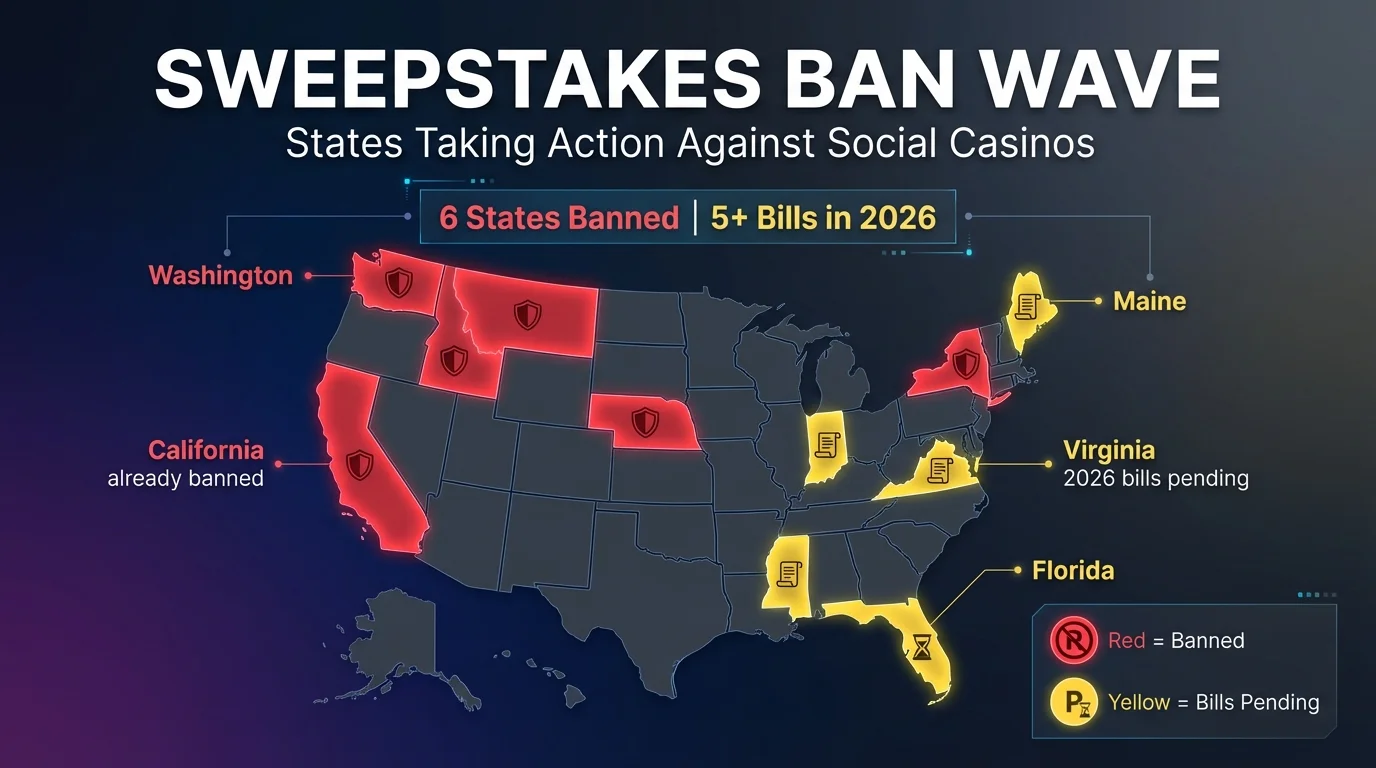
| State | Bill/Status | Key Details |
|---|---|---|
| California | AB 831 — Effective Jan 1, 2026 | Stake.us, others already exited |
| New York | Banned | No sweepstakes casinos operate |
| Washington | Banned | Strict gambling laws |
| Montana | Banned | State-run gambling only |
| Idaho | Banned | Constitutional prohibition |
| Nebraska | Banned | Restrictive gambling constitution |
| Mississippi | SB2104 — Filed Jan 9, 2026 | 10-year felony, asset forfeiture |
| Indiana | HB 1052 — Hearing held Jan 6 | $100K civil penalty per violation |
| Maine | LD 2007 — Hearing Jan 14 | Ban proposal pending |
| Florida | Two bills pre-filed | HB 591 + companion bill |
| Virginia | HB 161 — Pre-filed | Ban proposal pending |
The Indiana Gaming Commission recently acknowledged that sweepstakes casinos operate in a legal gray zone—not explicitly illegal under current state law, but not authorized either. That ambiguity is exactly what these bills aim to eliminate.
Who’s Pushing This: The Casino Lobby Angle
SB2104 explicitly carves out protections for Mississippi’s licensed riverboat and land-based casinos. This isn’t coincidental—it’s the point.
Mississippi has 26 licensed casinos generating approximately $2.7 billion in annual gaming revenue. Sweepstakes casinos compete for the same customers without paying state gaming taxes, licensing fees, or employment mandates. From the brick-and-mortar industry’s perspective, sweepstakes platforms are unregulated competitors siphoning revenue.
THE INCUMBENT PROTECTION FRAMEWORK
What Licensed Casinos Pay
- State gaming taxes (8-12% of revenue)
- Licensing fees ($5M+ initial)
- Local employment mandates
- Regulatory compliance costs
- Property taxes on facilities
What Sweepstakes Pay
- No state gaming taxes
- No licensing requirements
- No employment mandates
- Minimal regulatory oversight
- No local physical presence
Frame this as you will—consumer protection or incumbent protection—but the economic reality is clear. Established casinos have significant incentive to support sweepstakes bans, and the bipartisan sponsorship of SB2104 suggests the industry’s influence crosses party lines.
This pattern extends nationally. California’s AB 831 was championed by tribal gaming interests. Indiana’s HB 1052 emerged as the state’s casino industry pushed back against sweepstakes competition. The brick-and-mortar lobby is a consistent driver of these bills nationwide.
The Stake.us Connection
Mississippi’s action fits a broader pattern of states targeting sweepstakes platforms like Stake.us that have faced regulatory scrutiny and legal challenges.
The platform—which has faced multiple federal lawsuits over its influencer marketing and business model—has already exited California and faces potential bans in multiple states. VGW’s exit from Mississippi following the Gaming Commission’s cease-and-desist suggests operators are increasingly choosing compliance over legal battles when states take enforcement action.
What Mississippi Players Should Know
If you’re currently using sweepstakes casino sites in Mississippi, here’s the practical reality:
| Operator | Current Status in Mississippi | Risk Level |
|---|---|---|
| Chumba Casino | Exited (Sept 2025) | N/A – No longer operates |
| LuckyLand Slots | Exited (Sept 2025) | N/A – No longer operates |
| Global Poker | Exited (Sept 2025) | N/A – No longer operates |
| High 5 Casino | Still operating | Moderate – May exit if bill passes |
| Pulsz Casino | Still operating | Moderate – May exit if bill passes |
| Modo.us | Still operating | Moderate – May exit if bill passes |
PLAYER LIABILITY UNDER SB2104
The bill’s language targets operators, promoters, and those who “aid” in sweepstakes gambling operations. While individual players aren’t the primary target, the broad language could theoretically apply to users in certain circumstances. In practice, no state has prosecuted individual players under sweepstakes bans—enforcement focuses on operators and payment processors. If you’re playing on sweepstakes sites still operating in Mississippi, monitor the bill’s progress—if it passes and takes effect July 1, 2026, continuing to use these platforms carries legal ambiguity at minimum.
Timeline and What to Watch
JANUARY 2026
SB2104 filed (Jan 9). Committee assignment to Senate Judiciary, Division B (Fillingane chairs)
FEBRUARY-MARCH 2026
Expected committee hearing and Senate floor vote (watch for 44-1 repeat)
HOUSE CONSIDERATION
Critical juncture: will House add sports betting amendment again?
JULY 1, 2026
Effective date if passed. Criminal penalties begin
The bill’s fate likely hinges on whether Mississippi’s chambers can separate the sweepstakes ban from the sports betting debate. Given the 2025 precedent, expect political drama—and potentially another collapse if the House attempts to expand the bill’s scope.
KEY TAKEAWAYS
- Second attempt after 2025 failure — Bill passed Senate 44-1 last year but died when House added sports betting amendment
- Severe penalties — Up to 10 years prison, $100K fine, and complete asset forfeiture for operators
- Already partially enforced — VGW (Chumba, LuckyLand, Global Poker) already exited Mississippi after June 2025 cease-and-desist
- Part of national wave — 6+ states have banned sweepstakes casinos, 5+ more bills filed in 2026
- Casino lobby support — Bill explicitly protects licensed casinos while targeting unregulated competitors
- Watch the House — Sports betting amendment could derail the bill again
Sources
- Mississippi SB2104 Bill Status — Mississippi Legislature
- Mississippi Gaming Commission — Official regulatory body
