What is Over/Under Betting in Sports? (Totals Explained & Strategies)
Complete guide to over/under sports betting with totals strategy, key numbers, and expert tips.
In sports betting, sometimes you don’t care who wins or loses. You just want action. That’s where Over/Under betting (also known as “Totals”) comes in—one of the simplest yet most exciting ways to wager, focusing purely on the combined scoring output of both teams.
KEY FACTS AT A GLANCE
- What You Bet On: Combined score of both teams (higher or lower than the line)
- Standard Odds: -110 (bet $110 to win $100)
- The Hook (.5): Half-points eliminate ties — one side must win
- Push: Exact landing on whole numbers refunds your bet
- Overtime: Counts toward the total in all major US sports
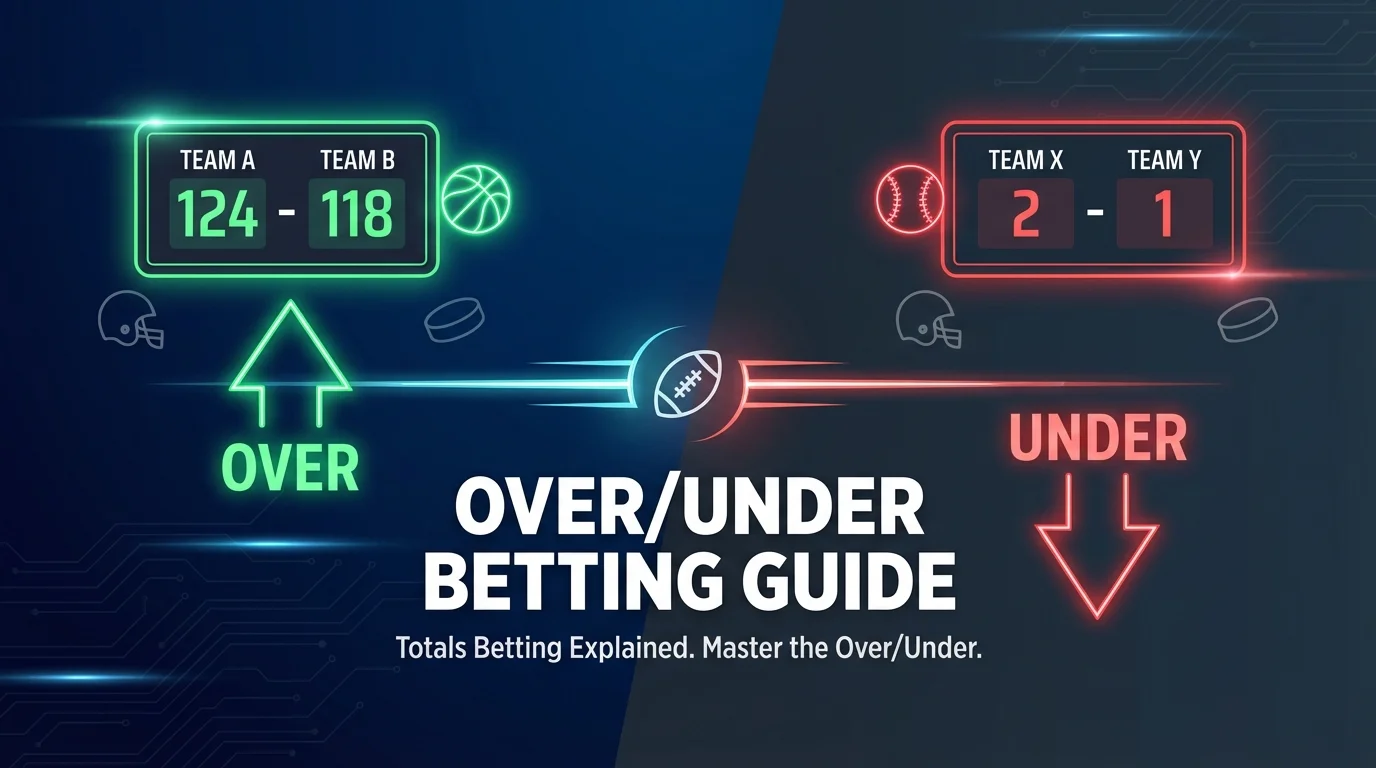
Instead of picking a side, you ask one question: Will this be a high-scoring shootout or a defensive battle?
What is Over/Under Betting?
An Over/Under bet is a wager on the combined score of both teams in a game. The sportsbook sets a predicted total (the “line”), and you bet on whether the actual final score will be Over (higher) or Under (lower) that number. You can use our Odds Converter to switch between American, Decimal, and Fractional formats when comparing lines.
How It Works: A Real-World Example
NBA EXAMPLE: Lakers vs. Celtics
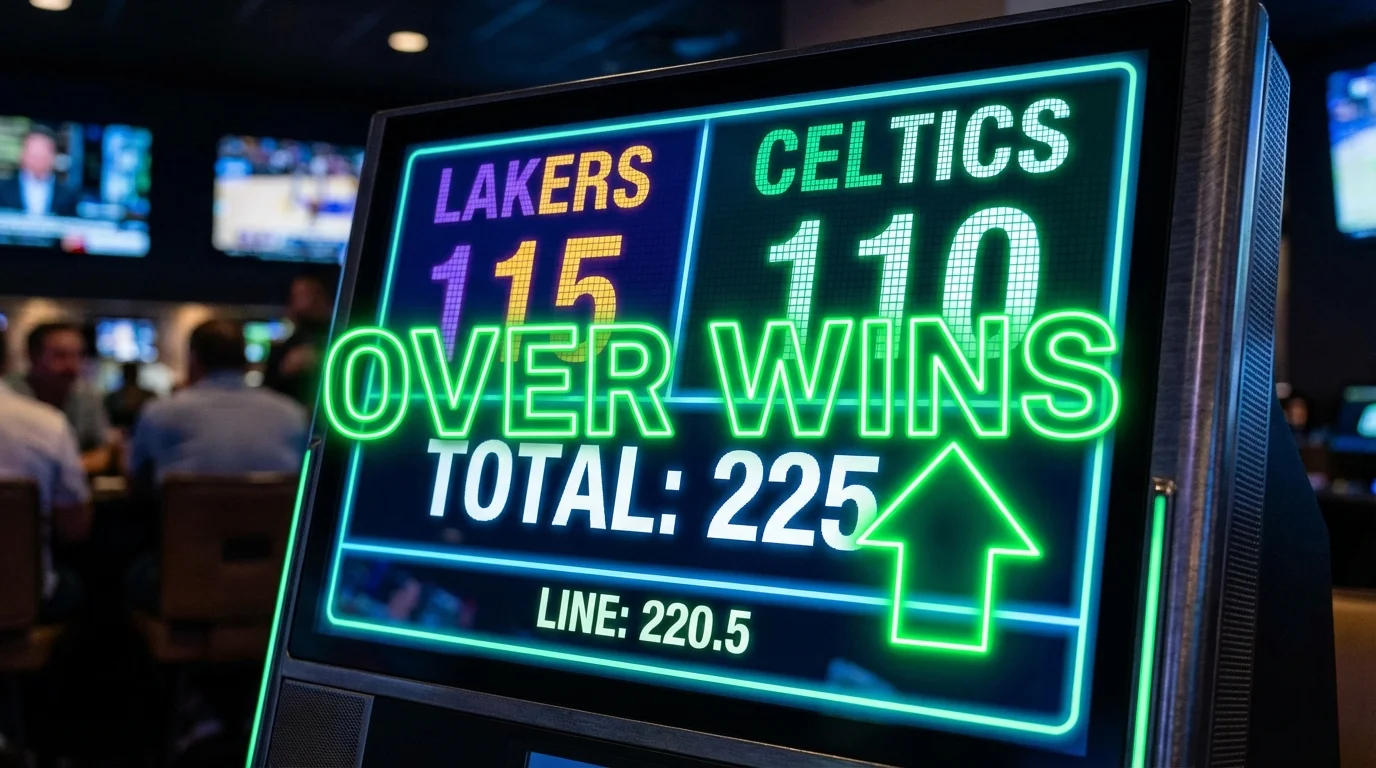
The Total Line: 220.5 Points
Betting the OVER
- You’re rooting for points
- To Win: Combined score 221+
- Example: Lakers 115, Celtics 110
- Total: 225 → You Win!
Betting the UNDER
- You’re rooting for defense
- To Win: Combined score 220 or less
- Example: Lakers 105, Celtics 100
- Total: 205 → You Win!
Reading the Odds (-110)
Like spread betting, Over/Under bets come with a “price” or “vig”:
Over 220.5 (-110)
Under 220.5 (-110)
This means you bet $110 to win $100. The extra $10 is the sportsbook’s commission. Use our Vig Calculator to understand exactly how much the house edge costs you over time.
Key Concepts: The Hook and The Push
THE HOOK (.5)
Oddsmakers add a half-point (e.g., 48.5) to ensure no tie. One side must win. No refunds, no pushes.
THE PUSH (TIE)
If the total is a whole number (e.g., 48) and the combined score lands exactly on 48, your bet is refunded.
Key Numbers for Totals Betting
Just like spreads have key numbers (3 and 7 in the NFL), totals have commonly occurring final scores. Understanding these helps you decide when buying a half-point is worth the extra juice.
NFL Totals Key Numbers
Based on NFL regular season games (2018-2024), here’s how often final totals land on specific numbers:
| Total | Frequency | Implication |
|---|---|---|
| 37 | 4.1% | Key number – worth buying through |
| 40 | 3.8% | Moderate frequency |
| 41 | 4.5% | Key number – worth buying through |
| 43 | 4.8% | High frequency – valuable hook |
| 44 | 5.2% | Most common total – always consider |
| 45 | 2.9% | Low frequency – less value buying |
| 47 | 4.6% | Key number – worth buying through |
| 51 | 4.3% | Key number – worth buying through |
WHY 44 MATTERS
Games landing on 44 occur nearly twice as often as games landing on 45—making that half-point around 44 especially valuable. If you can buy from 44.5 to 44, consider it.
NBA Totals Key Numbers
Basketball’s continuous scoring means no true key numbers exist. Every point from 200-240 is roughly equally likely. Even numbers appear slightly more often due to 2-point baskets being the most frequent scoring play, but unlike NFL, you won’t find meaningful clustering. In NBA totals, focus on game analysis rather than specific numbers.
Historical Over/Under Win Rates by Sport
Understanding baseline win rates helps calibrate your expectations:
| Sport | Over Win % | Under Win % | Push % | Notes |
|---|---|---|---|---|
| NFL | 48.7% | 49.1% | 2.2% | Slightly Under-biased (weather) |
| NBA | 49.8% | 49.6% | 0.6% | Most balanced market |
| MLB | 50.3% | 48.4% | 1.3% | Slight Over edge |
| NHL | 49.2% | 48.9% | 1.9% | Empty net goals push Overs |
| NCAAF | 51.2% | 47.6% | 1.2% | Over bias from tempo teams |
| NCAAB | 48.1% | 50.8% | 1.1% | Under bias (tournament defense) |
Totals Betting Across Different Sports
Each sport has unique characteristics that affect how totals behave.
NFL Game Totals
Football totals typically range from 36 to 56 points, with most games in the 42-50 range.
NFL TOTALS FACTORS
- Weather Impact: Wind over 15 MPH crushes passing. Rain and cold reduce scoring. Always check the forecast.
- Dome Games: Indoor games go Over 52.4% vs. 47.8% for outdoor cold-weather games.
- Primetime Unders: Sunday Night Football Unders hit at 53.1% since 2018—more prep = better defense.
- Divisional Games: Familiarity breeds defense. Divisional matchups go Under at 51.8%.
NBA Game Totals
Basketball totals typically range from 210 to 240 points, with significant variation based on pace.
NBA TOTALS FACTORS
- Pace is Everything: Two bad teams that play fast can outscore two good teams that play slow.
- Back-to-Backs: When both teams are on a back-to-back, Overs hit at 54.2%—tired legs = lazy defense.
- Garbage Time: Blowouts see reserves pad stats late, often pushing games Over unexpectedly.
- Playoff Adjustments: Playoff games average 8.3 fewer points. Playoff Unders hit at 53.6%.
MLB Game Totals
Baseball totals are measured in runs, typically ranging from 7 to 10.5.
- Starting Pitcher is King: The most important factor. An ace (low ERA, high strikeout rate) points to the Under.
- Ballpark Factors: Coors Field Overs hit at 56.3%. Oracle Park Unders hit at 54.1%.
- Wind Direction: Wind blowing out at Wrigley adds runs. Wind blowing in kills home runs.
- Day Games After Night Games: Hitters struggle with fatigue. Lean Under.
NHL Game Totals
Hockey totals are typically set at 5.5 or 6.5 goals and rarely deviate far from this range.
- Goaltender Matchups: Elite goalies significantly reduce expected goals. Check who’s starting.
- Empty Net Goals: Late-game empty net goals push games Over 5.5 approximately 18% of the time in the final 2 minutes.
- Playoff Hockey: Stanley Cup Playoff Unders hit at 55.2% due to dramatically increased defensive intensity.
Soccer Totals (Goals Markets)
Soccer totals work differently. The most common line is Over/Under 2.5 goals.
| League | Avg Goals/Game | Over 2.5 Hit Rate | Lean |
|---|---|---|---|
| Bundesliga | 3.2 | ~58% | Over-friendly |
| Premier League | 2.85 | ~54% | Balanced |
| Serie A / Ligue 1 | <2.7 | ~48% | Under-friendly |
| Champions League (Group) | 3.1 | ~56% | Over-friendly |
| Champions League (Knockout) | 2.4 | ~42% | Under-friendly |
Factors That Move Totals
Understanding what causes totals to shift helps you find value before the market adjusts.
Weather Conditions
| Condition | Effect on Scoring | Betting Implication |
|---|---|---|
| Wind (15+ MPH) | Reduces passing/kicking | Lean Under in NFL, MLB |
| Rain | Ball control issues | Slightly Under |
| Extreme Cold | Lower scoring | Under (especially NFL) |
| Dome/Indoor | Consistent conditions | Slightly Over historically |
Injuries and Absences
HOW INJURIES MOVE TOTALS
- Quarterback Out (NFL): Typically drops total 2-4 points depending on backup quality
- Top Scorer Out (NBA): Can drop total 3-6 points if a 25+ PPG player sits
- Starting Pitcher Scratch (MLB): Total can move 1-2 runs if an ace is replaced
- Starting Goalie Out (NHL): Backup goalies increase expected goals by 0.3-0.5
Advanced Totals Concepts: Reading the Market
Recreational bettors bet on games. Sharp bettors bet on markets. These concepts separate profitable totals bettors from the rest.
Closing Line Value (CLV)
THE BEST PREDICTOR OF LONG-TERM SUCCESS
CLV measures whether you beat the closing line (the final number before kickoff). It’s the single best predictor of long-term betting success.
Example: You bet Over 44.5 on Monday. By Sunday kickoff, the line has moved to Over 46.5. You got 2 points of CLV. Even if this specific bet loses, consistently getting CLV means you’re finding value the market eventually recognizes.
Bettors who consistently beat the closing line by even 1-2% are long-term winners. Track your CLV, not just wins and losses. Use our Expected Value Calculator to quantify the value of your positions.
Steam Moves
A steam move is sudden, sharp line movement caused by significant money from professional bettors hitting multiple sportsbooks simultaneously.
RECOGNIZING STEAM
Example: An NFL total opens at 45.5 across all major books. Within 30 minutes, every book moves to 47. This is sharp money pounding the Over—the information spread instantly across the market. Steam moves on totals often relate to weather forecasts, injury updates, or lineup news not yet public.
Reverse Line Movement (RLM)
When the line moves opposite to where public betting percentages suggest it should.
Example: 75% of bets are on the Over 48.5. Logically, the line should move UP to 49. Instead, it drops to 47.5. This indicates sharp money on the Under outweighs the recreational Over tickets.
- RLM suggests “smart money” disagrees with public sentiment
- Historically hits at 53-55% against the public side
- Combine RLM with your own analysis—don’t blindly follow
10 Pro Strategies for Totals Betting
- Check the Weather (NFL/MLB): Wind kills points. Bad conditions? Look at the Under.
- Pace Over Talent (NBA): Two bad fast teams can outscore two good slow teams.
- Shop for the Best Line: Totals vary between books. One point can flip outcomes.
- Fade Public Overs: Casual bettors love points. High-profile matchups often have Under value.
- Track Referee Tendencies (NBA): Some crews call more fouls = more free throws = higher scores.
- Respect Closing Line Value: Track CLV over 100+ bets, not just wins and losses.
- Consider Game Script: Blowouts = garbage time scoring. Close games = clock management.
- Watch for Reverse Line Movement: Use it as a data point, not a blind follow.
- Playoff Adjustments: Scoring drops across all sports. Defenses tighten, pace slows.
- Specialize in One Sport: Go deep, not wide. Become an expert in one market.
Bankroll Management for Totals Betting
Finding good bets is only half the battle. Proper bankroll management ensures you survive variance.
UNIT SIZING GUIDE
1 Unit = 1-2% of Bankroll
$1,000 bankroll = $10-20 per unit
Standard Bet: 1 Unit
Most plays should be flat bet
Max Bet: 2-3 Units
Only on highest-conviction plays (~5%)
Never: >5% on One Game
Protects against bad beats
When NOT to Bet Totals
PASS ON THESE SITUATIONS
- No Edge Identified: If you’re betting for action, you’re gambling, not betting.
- Uncertain Lineups: Key players are game-time decisions and line hasn’t adjusted.
- Sharp Movement Against You: Line dropped 2+ points since you liked the Over.
- Preseason/Exhibition: Starters play limited minutes, lines are poorly calibrated.
- Chasing Losses: Never increase bet size after a losing streak.
Pre-Bet Totals Checklist
Before placing any totals bet, run through this checklist:
PRE-BET CHECKLIST
1. Weather check (outdoor sports)?
2. Injury report reviewed?
3. Line movement analyzed?
4. Pace/tempo checked?
5. Rest/schedule spots?
6. 2+ point edge vs. line?
7. Shopped 3+ sportsbooks?
Bet Decision Table
Translate your analysis into action:
| Your Projected Total | Sportsbook Line | Action |
|---|---|---|
| 228 | 224.5 | BET OVER – 3.5 point edge |
| 226 | 224.5 | LEAN OVER – Small edge |
| 225 | 224.5 | PASS – No meaningful edge |
| 223 | 224.5 | LEAN UNDER – Small edge |
| 220 | 224.5 | BET UNDER – 4.5 point edge |
A 2+ point difference from the line = potential edge. 3+ points = stronger conviction.
FAQs
Does overtime count for Over/Under bets?
Yes, in almost all major US sports (NFL, NBA, MLB, NCAA), overtime scores count toward the total. This is often a ‘bad beat’ for Under bettors who were winning in regulation.
What happens if the total lands exactly on the number?
If the line is a whole number (e.g., 200) and the final combined score is exactly 200, it is a Push. Your original bet is refunded. This is why books often use half-points (.5) to avoid pushes.
Can I bet on team totals instead of the game total?
Yes! Sportsbooks offer ‘Team Totals’ where you bet on just one team’s score (e.g., Lakers Over 110.5) regardless of the opponent’s score. This is useful when you have strong conviction about one team’s offense but not the other’s.
What are first half totals?
First half totals let you bet on just the scoring in the first half of a game. Typically set slightly below half of the full-game total. In NFL, first halves tend to be higher-scoring than second halves due to more aggressive play calling.
How does weather affect totals?
Weather significantly impacts scoring, especially in NFL and MLB. Wind over 15 MPH reduces passing and home runs. Rain causes fumbles and slippery conditions. Extreme cold stiffens muscles and reduces offense. Indoor/dome games historically go Over more often.
Are there key numbers for totals like there are for spreads?
In NFL, yes. Common final totals cluster around 41, 43, 44, 47, and 51 due to football’s scoring structure (3s and 7s). In NBA and other sports, totals are more evenly distributed with no significant key numbers.
Can I bet totals live during a game?
Yes, live totals betting is available at most sportsbooks. The line adjusts in real-time based on the current score, time remaining, and pace of play. Live totals often carry slightly higher juice (-115 to -120).
What is CLV (Closing Line Value) and why does it matter?
CLV measures whether you got a better number than the closing line. If you bet Over 44.5 and the line closes at 46.5, you got 2 points of CLV. Consistently beating the closing line is the best predictor of long-term profitability, even more than short-term win rate.
Are totals markets easier to beat than spreads?
Many sharp bettors believe totals are slightly softer (less efficient) than spread markets because casual bettors focus on picking winners, leaving totals less thoroughly analyzed. Weather, pace, and game flow create more variables that books may not perfectly price.
How do soccer totals work?
Soccer uses goal totals, typically Over/Under 2.5 goals. Over 2.5 means 3+ goals wins. Different leagues have different scoring averages: Bundesliga is high-scoring (Over-friendly), Serie A is lower-scoring (Under-friendly). Some books offer Asian totals with split stakes on whole numbers.
KEY TAKEAWAYS
- Over/Under = combined score — You’re betting whether total points will be higher or lower than the line
- Standard odds: -110 — Bet $110 to win $100 (4.5% vig)
- The Hook (.5) — Half-points eliminate ties, ensuring one side wins
- NFL key number: 44 — Most common final total; worth buying through
- Weather matters — Wind, rain, cold push scoring down (lean Under)
- CLV > Win Rate — Beating the closing line is the best success predictor
- Specialize — Go deep on one sport rather than wide on many
- 1-2% per bet — Never risk more than 5% of bankroll on one game
For more betting guides, check out our spread betting guide and parlay betting guide.

Aevan Lark
Aevan Lark is a gambling industry veteran with over 7 years of experience working behind the scenes at leading crypto casinos — from VIP management to risk analysis and customer operations. His insider perspective spans online gambling, sports betting, provably fair gaming, and prediction markets. On Dyutam, Aevan creates in-depth guides, builds verification tools, and delivers honest, data-driven reviews to help players understand the odds, verify fairness, and gamble responsibly.
Related coverage

Fresno State Betting Scandal: First Nevada Felony Arrest
Nevada made its first arrest in the Fresno State betting scandal, filing fraud and money-laundering charges with more suspects to come.

CFTC Sports Prediction Market Rules: 38 States vs Kalshi
The CFTC's proposed sports prediction market rules would let Kalshi keep most bets — but 38 states are fighting back.

World Cup 2026: The Biggest Betting Event in History, by the Numbers
Analysts project $60 billion in global wagers on the 2026 World Cup — the biggest betting event ever staged.