
What Is Moneyline Betting? How It Works, Examples & Strategy
Learn moneyline betting odds, payouts, and strategy. Convert odds to probability with our calculators.
Moneyline betting is the simplest way to bet on sports—you pick who wins, full stop. No point spreads, no over/unders, no complicated math. If your team wins, you win. But “simple” doesn’t mean there’s nothing to learn. Those plus and minus signs next to the odds? They’re telling you exactly how much risk you’re taking and how much you stand to gain.
Key Highlights
- Moneyline = picking the winner — No point spreads involved, just predict which team or player wins the game outright
- Negative odds (-) = favorites — The minus sign shows how much you need to bet to win $100 (e.g., -150 means bet $150 to win $100)
- Positive odds (+) = underdogs — The plus sign shows how much you’d win on a $100 bet (e.g., +200 means win $200 on a $100 bet)
- Implied probability — Convert odds to percentages to understand the bookmaker’s view of each team’s chances
- The vig/juice — Sportsbooks build in a margin (usually 4-5%) which is why both sides don’t add up to 100%
- Best for heavy favorites or underdogs — Moneyline shines when you’re confident in a winner regardless of margin
What Is Moneyline Betting?
A moneyline bet is a wager on which team or player will win a game. That’s it. Unlike point spread betting where you need to win by a certain margin, moneyline betting only cares about the final outcome. Win by 1 point or win by 50—if you picked the winner, you cash.
This makes moneyline the go-to bet type for beginners, but it’s also heavily used by sharp bettors who see value in specific matchups. The tradeoff? Betting on heavy favorites requires risking a lot to win a little, while underdogs offer big payouts but win less often.
How Moneyline Odds Work
American moneyline odds use a baseline of $100. The number tells you either how much you need to risk or how much you’ll win, depending on whether it’s positive or negative.
Negative Odds (Favorites)
When you see a minus sign, you’re looking at the favorite. The number represents how much you need to bet to win $100.
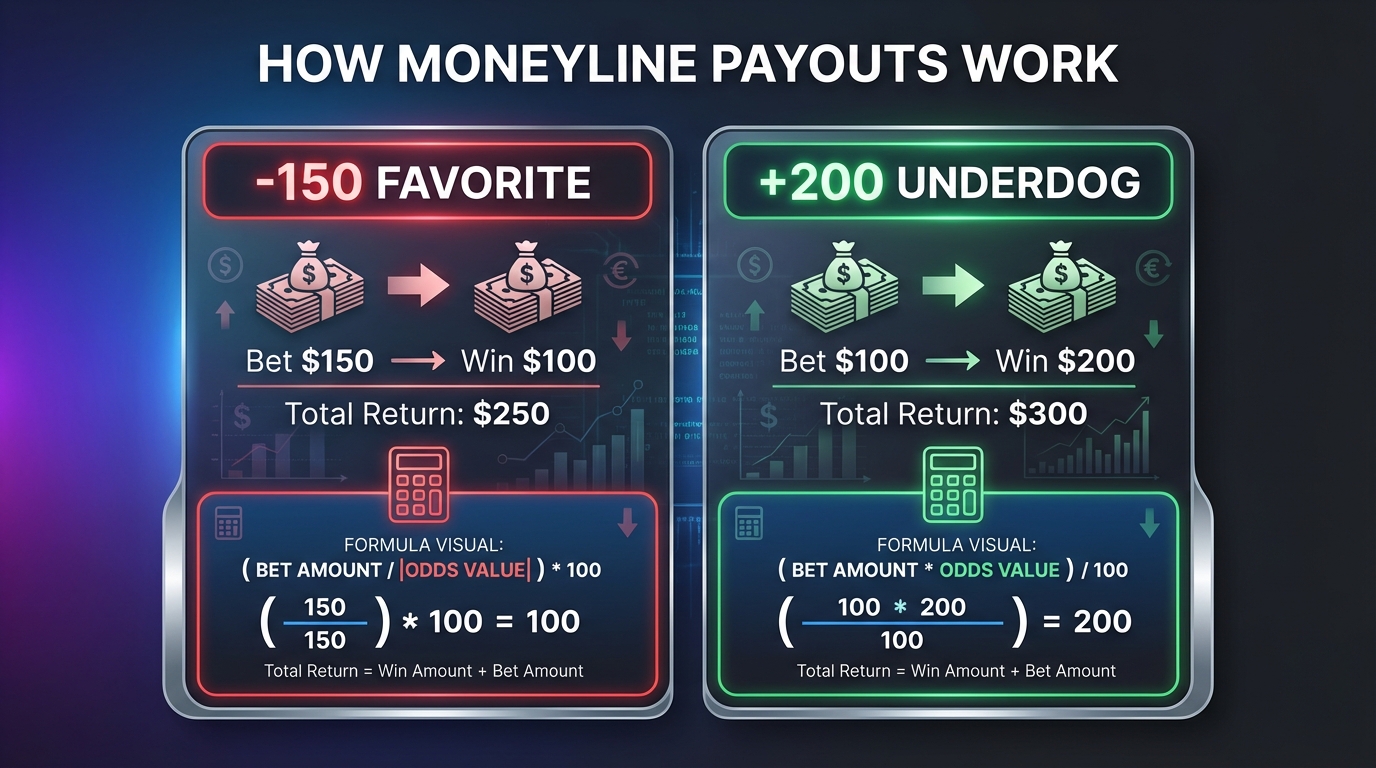
EXAMPLE: -150 FAVORITE
Bet: $150
Potential Win: $100
Total Return: $250 (your $150 stake + $100 profit)
The bigger the negative number, the heavier the favorite. A -300 favorite requires $300 to win $100, meaning the sportsbook expects them to win handily.
Positive Odds (Underdogs)
A plus sign means you’re looking at the underdog. The number shows how much you’d win on a $100 bet.
EXAMPLE: +200 UNDERDOG
Bet: $100
Potential Win: $200
Total Return: $300 (your $100 stake + $200 profit)
The bigger the positive number, the longer the odds. A +500 underdog would pay $500 on a $100 bet—great payout, but the sportsbook thinks they’re unlikely to win.
Convert Your Odds Instantly
Don’t want to do the math in your head? Use our Moneyline Converter to instantly calculate payouts, implied probability, and convert between American, decimal, and fractional odds formats.
Try Our Betting Calculators
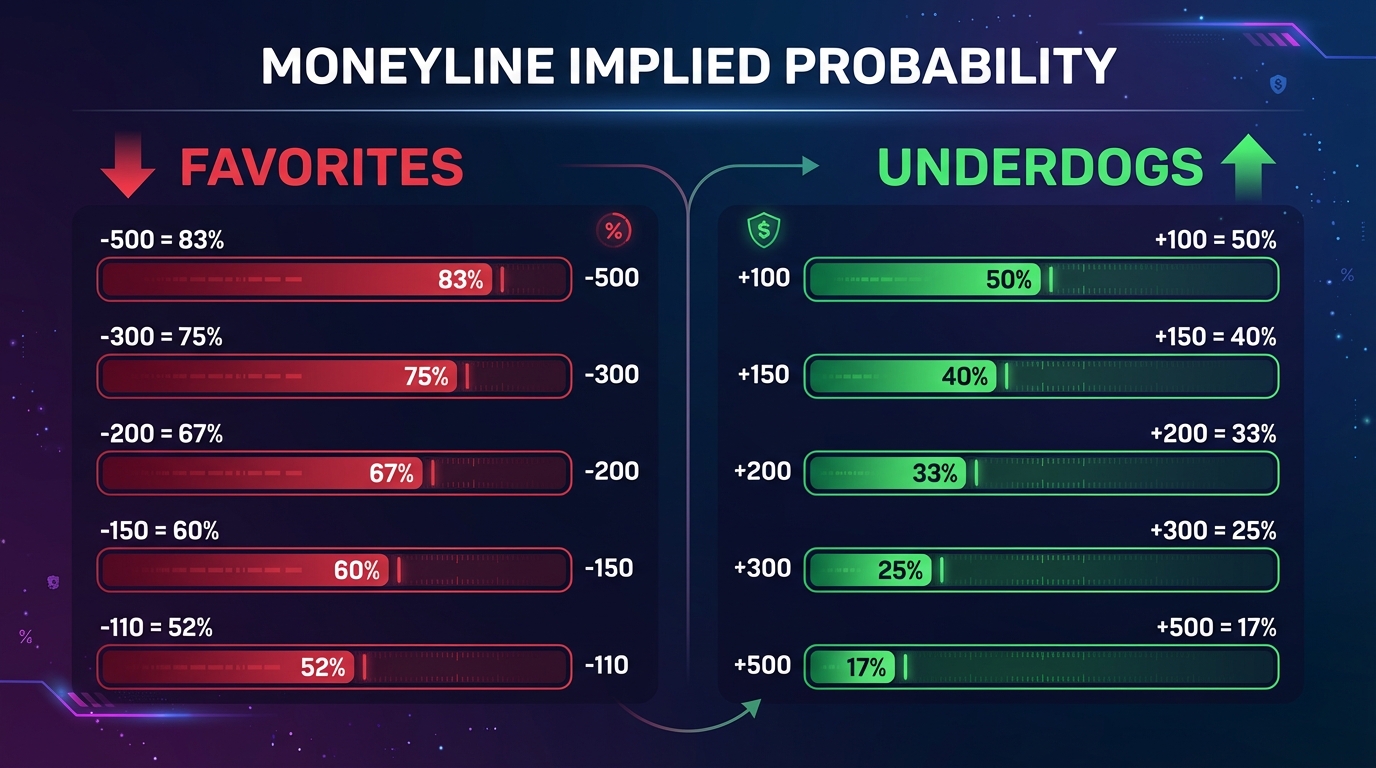
Understanding Implied Probability
Every moneyline odds number has an implied probability baked in—the sportsbook’s estimate of how likely each outcome is. Converting odds to probability helps you spot value bets where your assessment differs from the book’s.
The Formulas
CONVERTING ODDS TO PROBABILITY
For Negative Odds
Probability = |Odds| ÷ (|Odds| + 100)
Example: -150 → 150 ÷ 250 = 60%
For Positive Odds
Probability = 100 ÷ (Odds + 100)
Example: +200 → 100 ÷ 300 = 33.3%
Implied Probability Reference Table
| American Odds | Implied Probability | $100 Bet Payout | Type |
|---|---|---|---|
| -500 | 83.3% | $120 | Heavy Favorite |
| -300 | 75.0% | $133 | Strong Favorite |
| -200 | 66.7% | $150 | Moderate Favorite |
| -150 | 60.0% | $167 | Slight Favorite |
| -110 | 52.4% | $191 | Near Even |
| +100 | 50.0% | $200 | Even Money |
| +150 | 40.0% | $250 | Slight Underdog |
| +200 | 33.3% | $300 | Moderate Underdog |
| +300 | 25.0% | $400 | Strong Underdog |
| +500 | 16.7% | $600 | Heavy Underdog |
Implied Probability Calculator
Moneyline vs Point Spread
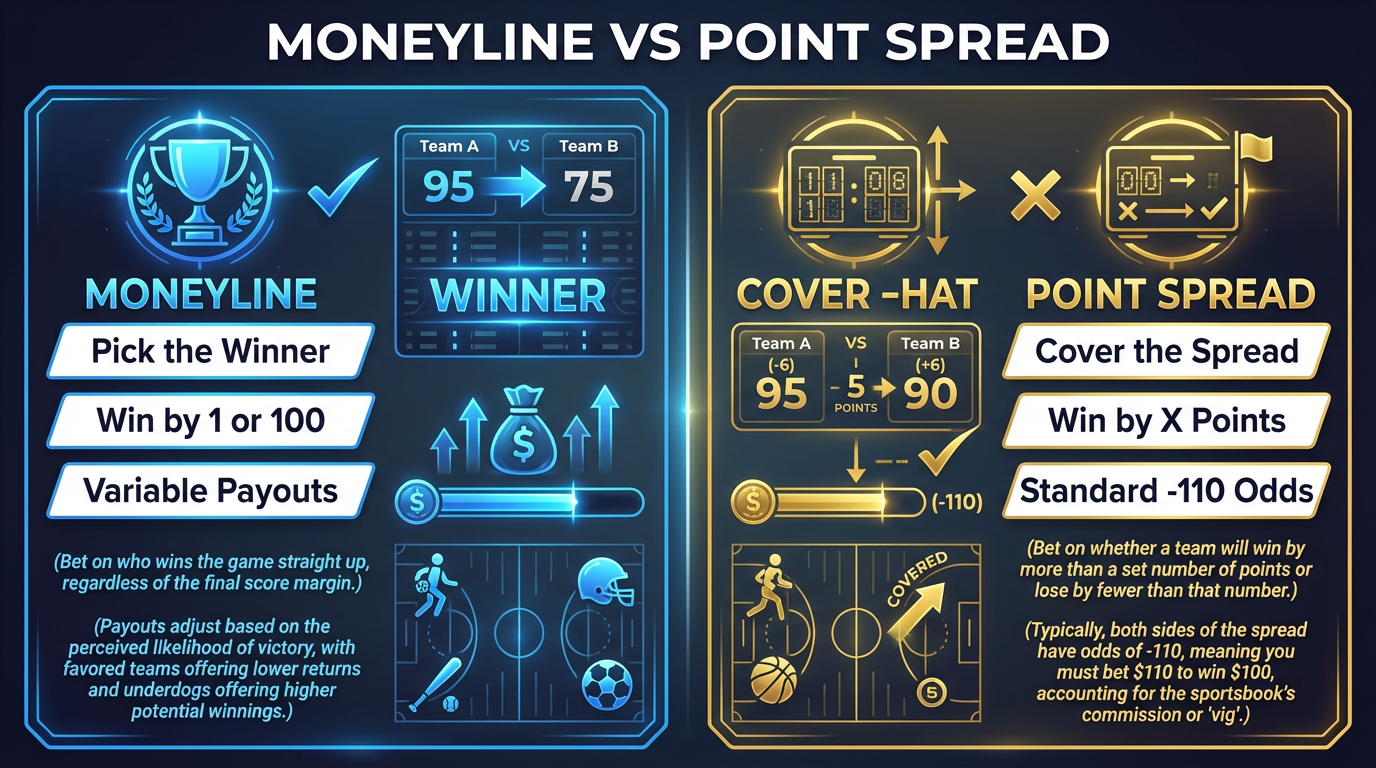
Point spread betting and moneyline betting answer different questions. Point spreads ask "will Team A win by more than X points?" while moneyline asks simply "will Team A win?"
MONEYLINE VS POINT SPREAD
Moneyline
- Pick the outright winner
- No margin of victory matters
- Variable payouts based on odds
- Better for lopsided matchups
- Simpler to understand
Point Spread
- Pick winner against the spread
- Must win/lose by specific margin
- Typically -110 on both sides
- Evens out mismatched games
- More strategic complexity
Here's a real-world example to illustrate the difference:
EXAMPLE: CHIEFS VS BRONCOS
Point Spread: Chiefs -7.5 (-110) vs Broncos +7.5 (-110)
Moneyline: Chiefs -320 vs Broncos +250
If the Chiefs win 24-20, a Chiefs spread bet loses (they didn't cover 7.5), but a Chiefs moneyline bet wins. If you're confident the Chiefs win but unsure about the margin, moneyline is your play—though you'll need to risk $320 to win $100.
Need to convert between spread and moneyline odds? Try our Spread-Moneyline Converter.
The Vig (Juice) Explained
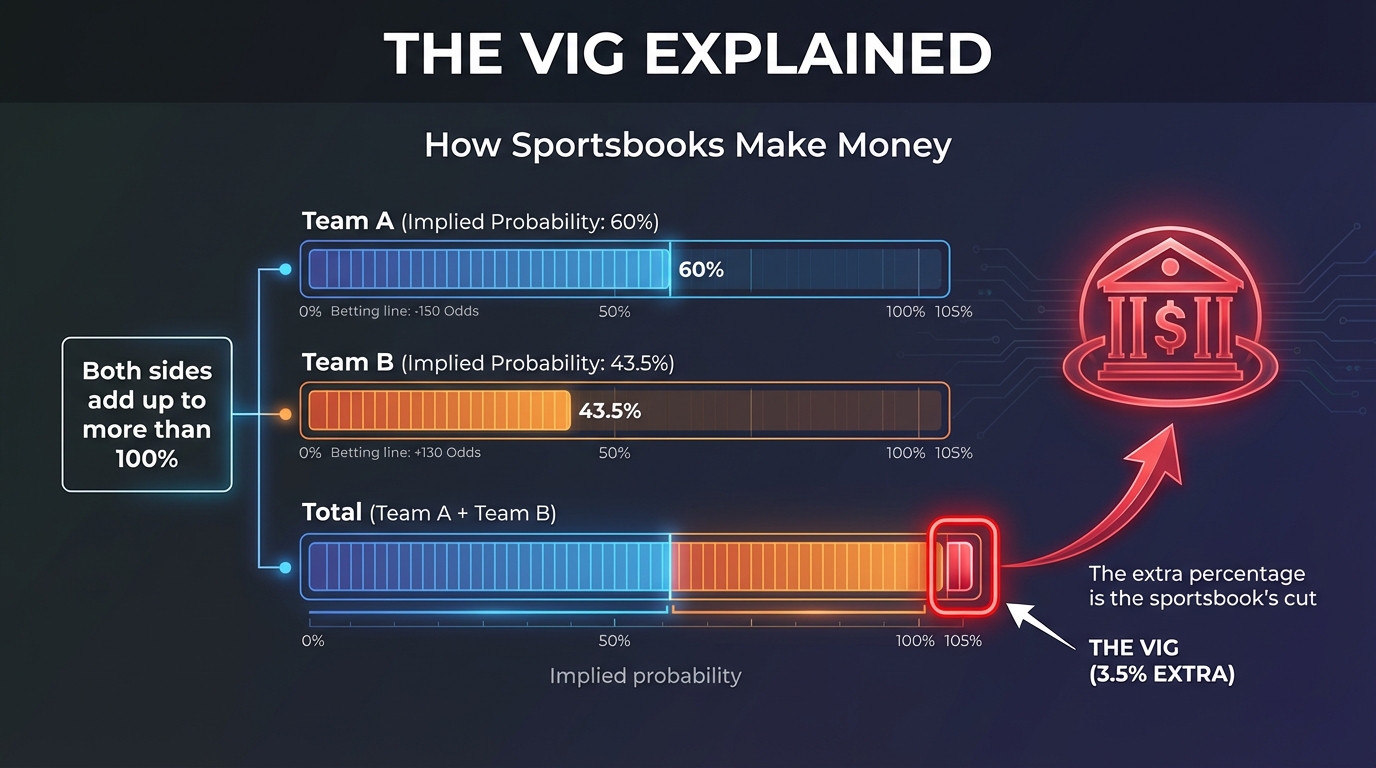
If you add up the implied probabilities of both sides in a moneyline bet, you'll notice they exceed 100%. That extra percentage is the vigorish—the sportsbook's built-in commission.
HOW THE VIG WORKS
Game: Lakers (-150) vs Celtics (+130)
Lakers implied probability: 60.0%
Celtics implied probability: 43.5%
Total: 103.5%
That extra 3.5% is the vig. In a perfectly efficient market, the odds would be Lakers -150 vs Celtics +150 (totaling 100%). The sportsbook shaves a bit off each side to guarantee profit regardless of outcome.
Standard vig runs 4-5% on most moneylines. Our Vig Calculator shows you exactly how much the house is taking, and the No-Vig Calculator reveals the "true odds" with the juice removed.
Calculating Your Payout
Let's walk through the math for calculating exact payouts on any moneyline bet.
For Favorites (Negative Odds)
Profit = (Bet Amount × 100) ÷ |Odds|
Example: $50 bet on -175 favorite
Profit = ($50 × 100) ÷ 175 = $28.57
Total Return = $50 + $28.57 = $78.57
For Underdogs (Positive Odds)
Profit = (Bet Amount × Odds) ÷ 100
Example: $50 bet on +175 underdog
Profit = ($50 × 175) ÷ 100 = $87.50
Total Return = $50 + $87.50 = $137.50
Moneyline Payout Calculator
When to Use Moneyline Bets
Moneyline betting makes the most sense in specific situations. Here's when it shines—and when you might want to look elsewhere.
BEST USE CASES FOR MONEYLINE
When Moneyline Works
- You're confident in the winner but not the margin
- Betting on slight underdogs (+100 to +200)
- Low-scoring sports like hockey, soccer, baseball
- Playoff games where margin is unpredictable
- Building parlays with multiple favorites
When to Avoid Moneyline
- Heavy favorites beyond -300 (poor risk/reward)
- You have strong feelings about the margin
- High-scoring sports with predictable margins
- The spread offers better value
- You need to limit variance
Moneyline Betting Strategy
Successful moneyline betting isn't about picking winners—it's about finding value. Here are strategies that separate profitable bettors from the pack.
1. Shop for the Best Lines
Different sportsbooks offer different odds on the same game. A team might be -145 at one book and -160 at another. Over hundreds of bets, this difference compounds significantly. Always compare lines before placing a bet.
2. Focus on the +100 to +200 Range
Slight underdogs offer the best risk/reward ratio on moneylines. You're getting plus money on teams that still have a reasonable shot at winning. Heavy underdogs (+400 and beyond) rarely hit often enough to be profitable long-term.
3. Understand Break-Even Points
For any moneyline bet to be profitable long-term, your win rate must exceed the implied probability. At -150 odds (60% implied), you need to win more than 60% of those bets to profit. Use our Expected Value Calculator to determine if a bet has positive expected value.
4. Consider Moneyline Parlays Carefully
Parlaying favorites is tempting—combine three -200 favorites and the combined odds look attractive. But remember: each leg multiplies your risk. Three -200 favorites at 66.7% each have only a 29.6% combined chance of hitting. Use our Parlay Calculator to see exact combined odds and payouts.
5. Apply Kelly Criterion for Sizing
When you find a value bet, proper sizing matters. Bet too small and you're leaving money on the table. Bet too large and a losing streak wrecks your bankroll. The Kelly Criterion Calculator tells you the optimal percentage of your bankroll to wager based on your edge.
Common Moneyline Mistakes
MISTAKES TO AVOID
- Chasing heavy favorites blindly — A -400 favorite needs to win 80% of the time just to break even. One upset wipes out four wins.
- Ignoring the vig — If you're not accounting for the sportsbook's margin, you're overestimating your edge.
- Betting based on name recognition — The Yankees might be famous, but the odds reflect that. Value often hides with lesser-known teams.
- Not line shopping — Taking -150 when you could get -140 elsewhere is leaving money on the table.
- Forgetting about ties — In sports where draws are possible (soccer), moneyline bets on either team lose if the game ties. Check for three-way moneylines.
Moneyline in Different Sports
The moneyline format is consistent across sports, but how it plays out varies significantly.
| Sport | Typical Range | Moneyline Behavior | Key Note |
|---|---|---|---|
| NFL | -200 to +200 | Moderate swings | Spread more popular |
| NBA | -300 to +300 | Wide spreads | Home court matters |
| MLB | -150 to +150 | Tighter lines | Pitcher-dependent |
| NHL | -180 to +180 | Competitive | Puck line often used |
| Soccer | -200 to +400 | 3-way lines | Draw option included |
| UFC/Boxing | -500 to +500 | Extreme variance | High upset potential |
Conclusion
Moneyline betting is the foundation of sports wagering—pick the winner, get paid. While the concept is simple, profitable moneyline betting requires understanding implied probability, recognizing value, managing bankroll, and knowing when moneyline is the right bet type versus point spreads or totals.
The key insight? Those plus and minus signs aren't just numbers—they're the sportsbook's assessment of probability wrapped in a profit margin. When your assessment differs from theirs, and you're right more often than the math requires, that's where the edge lives. Use our calculators to crunch the numbers, shop for the best lines, and never chase heavy favorites without a compelling reason.
FAQs
What does -110 mean in moneyline betting?
A -110 moneyline means you need to bet $110 to win $100. This is close to even odds, with a slight edge to that side. The implied probability is 52.4%, and -110 is the standard vig line used for point spread bets.
How do you calculate moneyline payout?
For negative odds, divide your bet by the odds and multiply by 100. For positive odds, multiply your bet by the odds and divide by 100. Example: $50 on +200 = ($50 × 200) ÷ 100 = $100 profit, plus your $50 stake back.
Is moneyline or spread betting better?
Neither is universally better—it depends on the situation. Moneyline is better when you're confident in the winner but not the margin, or in low-scoring sports. Point spreads offer better value on heavy favorites and normalize payouts between mismatched teams.
What happens if a moneyline bet ties?
In most sports (NFL, NBA, NHL), overtime determines the winner, so ties are rare. In soccer with standard moneyline (not 3-way), a draw typically loses. Some sportsbooks offer 'draw no bet' options where ties return your stake.
What is the vig or juice on moneyline bets?
The vig (vigorish) or juice is the sportsbook's commission built into the odds. If you add both sides' implied probabilities and get more than 100%, the excess is the vig—typically 4-5% on moneylines. This is how sportsbooks profit regardless of outcome.
Can you parlay moneyline bets?
Yes, moneyline parlays are common. You combine multiple moneyline selections into one bet with multiplied odds. All selections must win for the parlay to pay. Parlaying favorites improves the payout but multiplies risk—use a parlay calculator to see combined odds.
What does +100 mean on a moneyline?
+100 represents even money—bet $100 to win $100. This indicates the sportsbook sees both outcomes as equally likely (50% implied probability each, before vig). Even money bets are relatively rare and usually indicate a very competitive matchup.
Why do moneyline odds change before a game?
Odds move based on betting action, injury news, weather, and other factors. If heavy money comes in on one side, sportsbooks adjust odds to balance their liability. Sharp bettors often cause early line movements, while public betting affects odds closer to game time.

Aevan Lark
Aevan Lark is a gambling industry veteran with over 7 years of experience working behind the scenes at leading crypto casinos — from VIP management to risk analysis and customer operations. His insider perspective spans online gambling, sports betting, provably fair gaming, and prediction markets. On Dyutam, Aevan creates in-depth guides, builds verification tools, and delivers honest, data-driven reviews to help players understand the odds, verify fairness, and gamble responsibly.
Related coverage

Shuffle’s $235M Revenue and SHFL’s Price Rally: How Much Value Reaches the Token, and What Is It Worth?
Shuffle’s revenue is substantial. We examine how lottery staking, burns and supply releases translate into SHFL token value.

Indian State Tamil Nadu’s 2023 Gambling Bill: Passed Twice, Governor Dispute Details
Why the Indian state of Tamil Nadu passed its gambling bill twice in 2023, and how the Governor dispute unfolded.

Crypto Casino Bonuses vs Traditional: The 25x Rule
Crypto vs traditional casino bonuses: the 25x break-even rule, rakeback's $10,000 gate, and the volatility that moves a bonus's value.