Trump Backs CFTC as the Feds-vs-States Prediction-Market Battle Escalates
Trump backed the CFTC's authority over prediction markets as Minnesota criminalized them and Rhode Island became the agency's seventh state.
When President Donald Trump took to Truth Social on May 26 to brand four state officials “SCUM” for trying to police prediction markets, a wonky regulatory turf war officially became a White House priority — and the fight between Washington and the states over Kalshi, Polymarket and the booming world of event-contract trading entered a dangerous new phase.
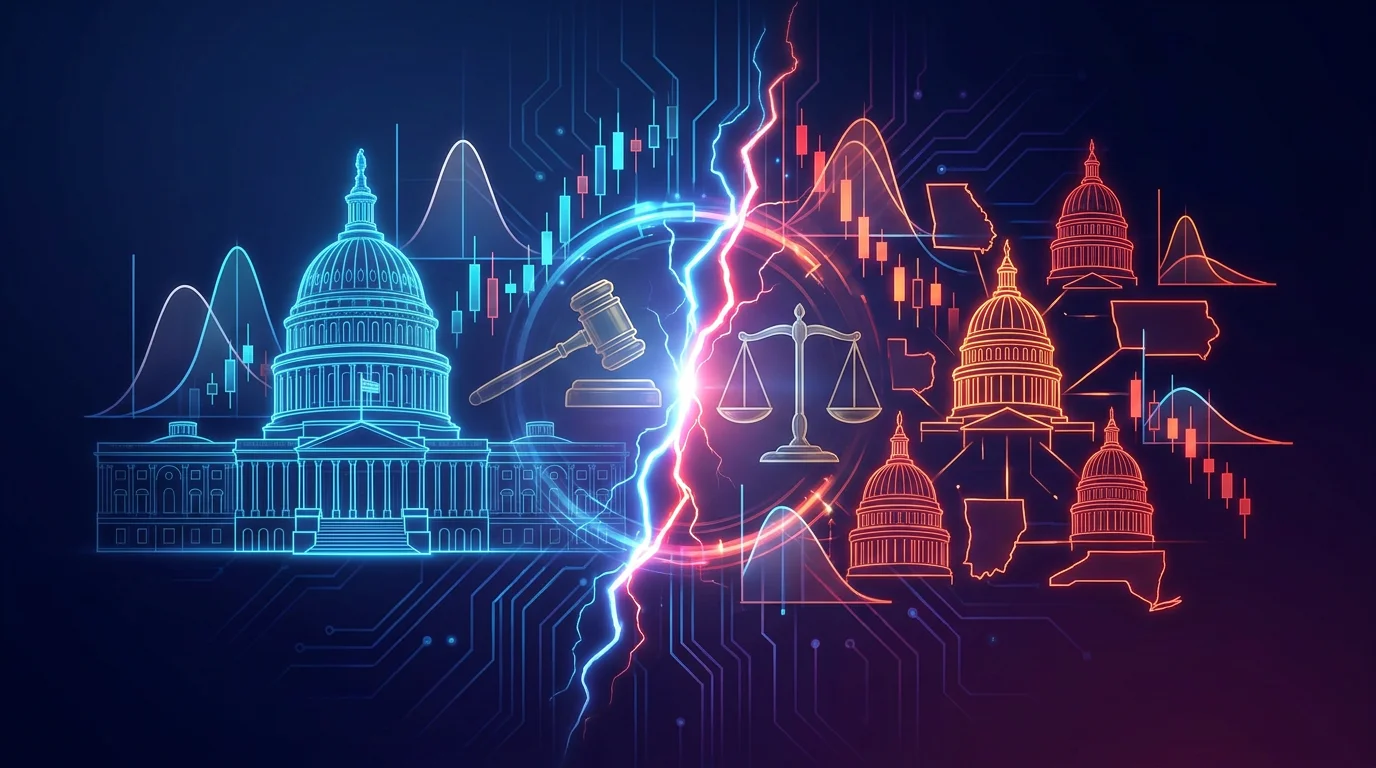
KEY FACTS AT A GLANCE
- The trigger: Trump publicly endorsed the CFTC’s “exclusive authority” over prediction markets on May 26, 2026, escalating the dispute to the presidential level.
- Federal theory: the administration argues event contracts are CFTC-regulated derivatives (“swaps”), not state-regulated gambling.
- Minnesota: first state to criminalize prediction markets — operating or advertising them becomes a felony on Aug. 1, 2026.
- Rhode Island: the CFTC’s seventh state, after the agency moved to intervene in the state’s lawsuit against Kalshi and Polymarket on May 28.
- Where it’s headed: conflicting court rulings have created a circuit split widely expected to reach the US Supreme Court.
What Trump Said — and Why It Matters
In a Truth Social post late on May 26, Trump declared it “critically important” that the Commodity Futures Trading Commission retain “exclusive authority” over prediction markets, framing federal oversight as the “Gold Standard for the States.” He then named former New Jersey Governor Chris Christie, New York Attorney General Letitia James, Minnesota Governor Tim Walz and Illinois Governor J.B. Pritzker as “SCUM” who should not be “setting the rules.” He cast the stakes in competitive terms, warning that “other Countries are after this new form of Financial Market, and we want to remain at the top.”
“Under my leadership, we are setting ‘rules of the road’ that are the Gold Standard for the States. We cannot have SCUM like Chris Christie, Letitia James, Tim Walz, and JB Pritzker setting the rules!”
— President Donald Trump, Truth Social, May 26, 2026
The endorsement is more than rhetoric. It landed in the same window that the CFTC sent a proposed “Prediction Markets” rule to the White House for review — the first step toward a national framework that would define which platforms may operate and which election, gaming and sports contracts could be barred as contrary to the public interest. With the president now personally invested, what had been an agency-level jurisdiction dispute has become an administration-wide push to override state gambling regulators.
Why the urgency? Because the market the states are trying to police has exploded. Combined monthly trading volume on Kalshi and Polymarket leapt from under $5 billion in September 2025 to roughly $24 billion by April 2026 — surpassing the average monthly handle at every legal US sportsbook combined. For state regulators who license and tax those sportsbooks, that is an existential threat.
The Bigger Picture: The CFTC's Legal War on the States
Trump's post is the loudest moment in a campaign that has been building for more than a year. It began in March 2025, when Nevada gaming regulators fired off the first cease-and-desist letters to Kalshi, soon joined by New Jersey and Maryland. The platforms argued that because they are licensed by the CFTC under the Commodity Exchange Act, their event contracts are federally regulated derivatives that states have no power to touch — and early federal injunctions agreed.
The posture flipped under Trump's CFTC chairman, Michael Selig, who was sworn in at the end of 2025. In February 2026, Selig withdrew the Biden-era proposal that would have banned political and sports event contracts, calling it a "frolic into merit regulation," and declared the agency would sue any state that interfered with licensed operators. The CFTC made good on the threat in April, filing its first own-name lawsuits against Arizona, Connecticut and Illinois, then Wisconsin, Minnesota and — most recently — Rhode Island. The escalation built on the wave of state actions we covered when the CFTC first took the states to court.
New Front #1: Minnesota's Felony Ban
Minnesota did not bother with cease-and-desist letters. Instead, it became the first state in the nation to flatly criminalize prediction markets. Tucked into an omnibus public-safety bill (SF 4760) signed by Governor Tim Walz on about May 18, the provision makes it a felony to create, operate, manage, facilitate or even advertise a prediction market for business purposes. The ban takes effect August 1, 2026, and sweeps broadly — covering contracts tied to sports, elections, government actions, weather and more.
The federal response was nearly instantaneous. The CFTC sued Minnesota the very next day, with Selig warning that the statute would turn lawful traders into criminals overnight and arguing it tramples the agency's exclusive jurisdiction. Kalshi filed its own federal challenge roughly a week later, naming the state's attorney general, governor and gambling-enforcement director as defendants and raising both a preemption claim and a First Amendment objection to the advertising ban.
"This Minnesota law turns lawful operators and participants in prediction markets into felons overnight."
— Michael S. Selig, CFTC Chairman
New Front #2: Rhode Island's Lawsuit
Rhode Island opened the newest front in late May, again through litigation rather than letters. Attorney General Peter Neronha sued Kalshi and Polymarket in state court, alleging they are running unlawful sports gambling dressed up as "event contracts" and seeking a ban plus disgorgement of profits. The state's grievance is concrete: it points to an 8% decline in its lottery sports-betting handle from 2024 to 2025 — money that funds public programs — and a sports-wagering operation that has generated about $2.8 billion since Rhode Island legalized it in 2019.
On May 28, the CFTC moved to intervene in the case, making Rhode Island the seventh state in its litigation campaign. The agency's filing reprised its now-familiar argument that an "onslaught of lawsuits" is trying to undermine its sole jurisdiction over prediction markets.
"There is no substantive difference between sports betting and 'events contracts' in this context; Kalshi and Polymarket know that, and we know that."
— Peter Neronha, Rhode Island Attorney General
The State-by-State Scoreboard
Roughly 18 states are now tangled up in prediction-market litigation, and the map is a patchwork of bans, lawsuits, injunctions and licensing experiments. Here is where the most significant battlegrounds stand as of late May 2026.
| State | What the state did | Where it stands now |
|---|---|---|
| Minnesota | First felony ban (effective Aug. 1) | CFTC and Kalshi both suing |
| Rhode Island | AG sued Kalshi and Polymarket | CFTC intervened (7th state) |
| New Jersey | Cease-and-desist to Kalshi | Third Circuit ruled for Kalshi |
| Nevada | First C&D; gaming enforcement | Injunction dissolved; state ahead |
| Arizona | Filed criminal charges | Kalshi won permanent injunction |
| Massachusetts | AG sued Kalshi | State won an injunction |
| Ohio | Regulators pushed back | Kalshi injunction denied |
| Tennessee | Sports council C&D | Kalshi won an injunction |
| Illinois | Pushed to restrict markets | Sued by the CFTC (April) |
| Connecticut | Issued cease-and-desists | Sued by the CFTC (April) |
| Wisconsin | DOJ sued operators | Sued by the CFTC (April) |
| New York | Gaming commission C&D | Federal and state suits active |
| Maryland | C&D; led a 38-state amicus | Litigation ongoing |
The Courts Are Split — and the Supreme Court Is Coming
The reason both sides keep escalating is that the law is genuinely unsettled. The core question — are sports event contracts federally regulated "swaps" or simply gambling under another name? — has produced directly contradictory rulings. In April, a divided Third Circuit panel sided 2-1 with Kalshi against New Jersey, holding the Commodity Exchange Act preempts state gambling law. But trial courts in Nevada, Massachusetts and Ohio went the other way, finding the contracts are not swaps at all. That is exactly the kind of circuit split that tends to draw the Supreme Court in.
COURT SCORECARD
WINS FOR THE OPERATORS
- New Jersey — Third Circuit affirmed Kalshi's injunction (Apr. 6)
- Arizona — federal judge issued a permanent injunction (May 5)
- Tennessee — Kalshi won a preliminary injunction (Feb. 20)
WINS FOR THE STATES
- Nevada — judge dissolved Kalshi's injunction (Nov. 25)
- Massachusetts — state secured an injunction (Jan. 20)
- Ohio — court denied Kalshi's injunction (Mar. 10)
Kalshi, now valued at roughly $22 billion with about 85% of its business tied to sports, has the resources to keep fighting on every front — a stamina on display throughout its sprawling legal war and its recent capital raise amid Arizona's criminal charges. With the White House now backing the CFTC and states like Minnesota raising the stakes to felony prosecution, a Supreme Court showdown looks less like a possibility than a matter of timing.
What's at Stake
Beyond the legal doctrine, the fight is about money and control. The American Gaming Association claims states and tribes have already lost more than $1 billion in tax revenue to prediction markets — a figure Kalshi has dismissed as "fake math," but one that captures why state regulators are alarmed. Tribal nations, whose gaming compacts depend on exclusivity, have filed their own suits arguing the platforms violate federal Indian gaming law.
States also frame the issue as consumer protection, warning that 24/7 contracts on sports and elections reach problem gamblers and young people without the guardrails that apply to licensed sportsbooks, like those examined in our coverage of the Massachusetts ruling. The platforms counter that they are transparent, federally supervised exchanges — and that a single national rulebook beats a 50-state patchwork. With contracts that began as the kind of cease-and-desist targets now drawing presidential defense, both sides are dug in for a long fight.
KEY TAKEAWAYS
- The White House is now all-in — Trump's May 26 endorsement turned an agency turf war into a presidential priority, with a CFTC national rule under White House review.
- Two new state fronts opened in May — Minnesota became the first state to make prediction markets a felony, and Rhode Island became the CFTC's seventh litigation target.
- The legal question is unsettled — courts have split on whether event contracts are federally regulated "swaps" or illegal gambling, with operators and states each notching wins.
- The stakes are huge and growing — monthly volume hit ~$24 billion, surpassing regulated sportsbooks, while states cite $1 billion+ in lost tax revenue.
- The Supreme Court looms — a circuit split makes a definitive federal-vs-state ruling increasingly likely.
Sources
- CFTC Acts to Defend Its Jurisdiction in Rhode Island — Commodity Futures Trading Commission
- CFTC Sues Minnesota to Block State Prediction-Market Law — Commodity Futures Trading Commission
- CFTC Sues Arizona, Connecticut and Illinois — Commodity Futures Trading Commission
- CFTC Withdraws Prior Event-Contracts Proposal and Advisory — Commodity Futures Trading Commission
- SF 4760 — Omnibus Public Safety Bill — Minnesota Legislature
- AG Neronha Sues Kalshi and Polymarket — Rhode Island Office of the Attorney General
- Trading Volume on Prediction Markets Has Soared — Pew Research Center

Aevan Lark
Aevan Lark is a gambling industry veteran with over 7 years of experience working behind the scenes at leading crypto casinos — from VIP management to risk analysis and customer operations. His insider perspective spans online gambling, sports betting, provably fair gaming, and prediction markets. On Dyutam, Aevan creates in-depth guides, builds verification tools, and delivers honest, data-driven reviews to help players understand the odds, verify fairness, and gamble responsibly.
Related coverage
The 2022 FanDuel Withdrawal Lawsuit: Must You Bet Your Deposit First?
A recirculated 2022 lawsuit raises questions about unused FanDuel deposits, current New Jersey rules and an unverified case outcome.

New York’s AI Proposal Would Make Sportsbooks Prove Why Your Bonus Is Different
New York’s AI proposal would put data-linked betting offers under scrutiny, with public criteria, regulatory records and narrow exceptions.

Kick Florida Lawsuit: The August Ban Request and the Seizure Claim
Florida’s August complaint targets Kick with operating-ban and forfeiture requests, but does not expressly seek seizure of its domain.